
Yes, electrical steel rusts. It is more than 95% iron, and its insulation coating slows rust down but does not make the steel rust-proof. The cut edges of slit strip and punched laminations are bare steel. Rust on electrical steel usually starts with condensation: water forms on the steel when it is colder than the air around it. Light surface rust on the outer wraps of a coil is usually a handling problem. Rust that eats into the coating, pits the surface or sits between laminations in a finished core is a performance problem.
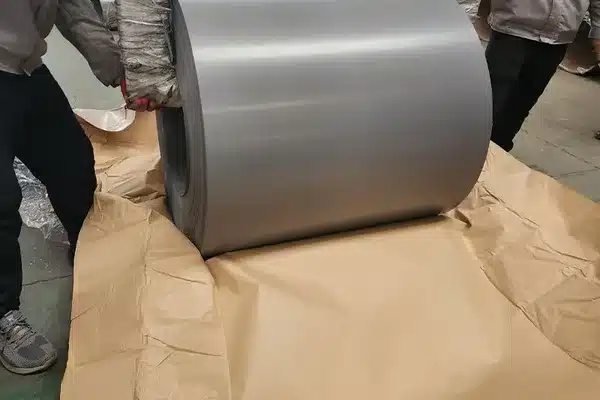
The question comes up from two sides on engineering forums. One hub motor owner found rust on a stator, sanded it off and took the insulation off with it. They then had to recoat the stack, which we covered in our guide to lamination stacking methods. Another user noted that the E-laminations in an old welder had stayed rust-free for years. Both are right. This guide explains why, and what a buyer can do about it.
Key Takeaways
- Electrical steel rusts like other low-carbon steel once its surface stays wet. The coating protects the flat faces; slit and punched edges are bare.
- The usual trigger is condensation, not rain. It forms when cold steel meets warm, humid air, in a container, a truck or a warm workshop.
- Steel corrodes slowly below about 60% relative humidity and much faster above it. Keeping coils dry, covered and off the floor prevents most rust.
- None of the seven mill certificates we checked from past orders reports rust or surface condition, so the evidence for a claim is photos taken when the shipment arrives.
- Light rust on outer wraps can often be removed with the wrap. Do not sand through the coating on laminations; if you must, recoat thinly.
- With transformer lead times of up to four years in 2026, material can sit in storage longer, so storage conditions matter more.
Why Does Electrical Steel Rust if It Has a Coating?
Because the coating is an electrical insulator first and a rust barrier second. It is very thin, and its main job is to stop eddy currents from flowing between laminations. Mills do say their coatings resist rust. Nippon Steel describes its grain-oriented coating as having “excellent resistance to rust”. But resistance is not immunity, and the protection depends on the coating type.
Coating types differ here. On thyssenkrupp’s non-oriented range, corrosion protection is listed as a feature of only one of its coatings, stabolit 60, a pigmented organic-inorganic type. If storage conditions are poor, ask which coating you are getting. Our guide to C-2, C-3 and C-5 electrical steel coatings explains the main classes.
The bigger gap is at the edges. Slitting cuts through the coating, so every slit coil has two edges of bare steel. Punching and laser cutting do the same along every slot and tooth of a lamination. That is why rust on stamped parts often starts at the edges first.
Salt is the other trigger. A Nippon Steel patent on electrical steel coatings notes that coated sheet often shows no corrosion in a standard humidity-cabinet test. In real life, salt sticks to the sheet “during storage and transportation”, and later “deliquesces under a high humidity environment”: it pulls water from the air and leaves a salty film on the steel. Sea air is the usual source.
Why Does Storage Matter More in 2026?
Because steel and cores are waiting longer before they are used. In May 2026, pv magazine reported PwC analysts saying lead times for high-capacity transformers had stretched to as long as four years. The same report named the limited supply of grain-oriented electrical steel as a major cause. Some buyers now book factory slots before a project site is even chosen.
A long project timeline means a coil or a finished core can sit in a warehouse for months between delivery and assembly. Every month adds more chances for condensation. Our article on the global GOES shortage explains why supply is tight.
When Does Electrical Steel Start to Rust?
When the surface stays wet. That happens in two ways: high humidity, or condensation when the steel is colder than the dew point of the air around it.
| Condition | What happens | Rust risk |
|---|---|---|
| Relative humidity below 40% | Steel is “much less likely to corrode” | Very low |
| 40–60% RH | Corrosion can occur “but at a very low rate” | Low |
| Above 60% RH | Rate of corrosion “increases dramatically” | High |
| Cold coil moved into a warm, humid room | Water condenses on the steel | High, and fast |
| Temperature swings inside a sealed container | “Cargo sweat” forms inside the packaging | High on long sea routes |
| Salt on the surface (sea air) | Salt pulls water from humid air onto the steel | High |
The humidity bands come from a corrosion study by California State University, Northridge and Cortec, which cites Prof. H. H. Uhlig of the MIT Corrosion Laboratory. TIS, the cargo guide run by the German insurers’ association, recommends keeping steel sheet in coils at less than 40–50% relative humidity.
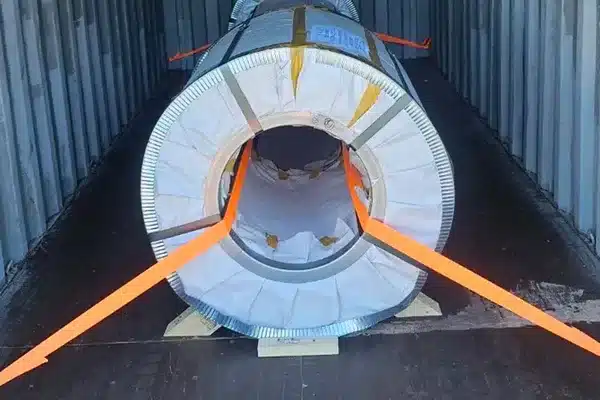
The most common mistake happens on arrival. A coil that crossed a cold sea is unloaded into a warm workshop and unwrapped straight away. Water condenses on the cold steel. TIS advises leaving packages wrapped until the steel has reached room temperature. Our container loading and packaging guide covers how coils are wrapped and secured for sea transport.
Hot, humid routes need more than a standard wrap. See our case on packing coils for Southeast Asia’s humidity.
Does Rust Affect Magnetic Performance?
Light rust on the surface of a coil does not change the steel’s grade. Rust that gets between laminations can raise losses in the finished core.
We have not found published test data that puts a number on how much room-temperature rust raises core loss, so treat the points below as how rust can cause harm, not as measured figures:
- Stacking factor. Rust is thicker and rougher than the coating. A rusty sheet takes up more space in the stack, so there is less steel in the same core height. This is the stacking factor printed on your mill certificate.
- Shorts between laminations. Rust at the edges can bridge the coating between neighbouring sheets. Shorted laminations behave like thicker sheet and carry larger eddy currents. We explain the mechanism in why transformer cores are laminated.
- Lost coating. The real damage often comes from cleaning, not from the rust itself. Sanding or grinding removes the insulation along with the rust.
Don’t confuse rust with oxidation during heat treatment. Nippon Steel warns that oxidation during stress-relief annealing “seriously impairs the magnetic properties, particularly at high inductions”. That is high-temperature oxidation, which is why annealing furnaces use a dry, non-oxidizing gas. Rust in a warehouse is a slower, surface-level process.
If you are unsure whether a batch has been affected, test it. An Epstein test on samples from the affected area tells you whether core loss is still within the grade limit. We explain how in core loss testing on an Epstein frame.
How Should You Store Electrical Steel Coils and Laminations?
Dry, covered, off the floor, and in the original wrapping until you need the steel.
- Store indoors. TIS says steel sheet in coils should always be stored, handled and transported in the dry. Avoid loading or unloading in rain.
- Keep humidity below about 60%, and lower if you can. In a closed store, a dehumidifier does this.
- Let cold coils warm up before unwrapping. Leave the packaging on until the steel reaches room temperature.
- Keep coils off the floor on timber or rubber supports, away from doors, walls and roof leaks.
- Rewrap opened coils. A cold-rolled coil maker’s manual says that after a coil “is slit or cut sheet, it should be covered again to prevent rust”. The same applies to electrical steel.
- Use the oldest stock first. The same manual tells buyers to use even oiled coils “as soon as possible”, because humidity can still cause rust. Plan deliveries so material does not sit for months longer than it has to.
- Bag stamped laminations. Finished laminations have far more bare edge than a coil. Keep them in sealed bags or boxes, and handle them with gloves.
What Should You Check When a Shipment Arrives?
Look at the packaging before you unwrap anything, and photograph what you find.
- Outside the wrap. Look for torn film, wet cartons, water marks and dented edges.
- Inside the wrap. Look for water droplets, damp paper and rust on the coil face or edges.
- Write it down. TIS advises recording the degree of rust in the shipping documents before you accept the consignment.
- Seawater or condensation? If rust is found, a silver nitrate test shows whether chloride (seawater) or fresh water caused it. Under 30x magnification, salt crystals point to seawater contact. This helps decide whether a transport insurance claim applies.
Your mill certificate will not help with rust. We checked seven original mill certificates from our past orders, from Baosteel, WISCO and Shagang. Each one reports core loss, magnetic polarization, stacking factor, hardness or bend count, and mechanical properties. None has a field for rust or surface condition. A certificate shows what the mill tested at the mill, not what arrived. Our guide to EN 10204 3.1 and 3.2 mill certificates explains what those documents do cover.
Heavy or uneven oil on a coil can also hide rust underneath. If the material is supposed to be prime but looks worn, our guide to prime vs secondary CRGO steel lists the signs.
Can You Use Rusted Electrical Steel?
Often yes, if the rust is light and only on the surface. It depends on where the rust sits and how you remove it.
| What you see | Usually means | What to do |
|---|---|---|
| Light brown film on the outer wraps of a coil | Condensation on the outside | Remove the affected outer wraps; check the inner wraps |
| Rust along slit edges | Bare edges exposed to damp air | Check how far it reaches into the width; trim if needed |
| Pitting, or wraps stuck together by rust | Water got inside the wrap | Stop and test samples before use |
| Rust on finished laminations or a stator | Storage or service in damp air | Clean gently, recoat bare spots thinly, test the core |
For laminations and cores, avoid abrasives that cut through the coating. If you must clean down to bare steel, recoat it thinly. A commenter warned the hub motor owner that a thick recoat can upset the balance between rotor and stator.
The Electrical Apparatus Service Association (EASA) sees the same problem in motor repair. In a 2007 paper, Chuck Yung called three core repair methods myths: using water to grow an oxide layer, sodium silicate, and acids. They are “ineffective and can cause further damage”. The paper recommends cleaning the laminations, coating them with a proper coreplate and restacking them. After any repair, a core loss test shows whether the core is still sound.
The welder whose E-laminations never rusted fits the same pattern. Small transformer cores are often dipped in varnish after assembly, and they warm up in use. A core like that stays dry and has little chance to rust. Electrical steel rusts when it sits cold and damp, not because it is less protected than other steel. If you want to compare, our article on whether stainless steel rusts covers a metal designed to resist it.
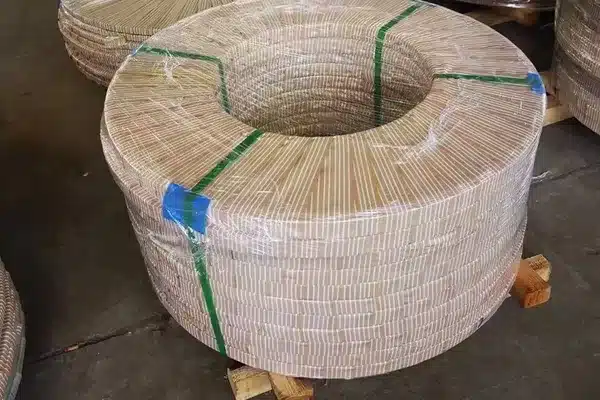
We supply CRGO steel coil and CRNGO coil, slit strip and cut sheet. Our export coils are typically wrapped in paper and film, fitted with edge protectors and lashed in the container, as in the photos above. Coil orders typically start at about 5 tonnes, and smaller lots can be cut from coil. Sheet orders typically start at about 500 kg; if you need less, tell us and we’ll do our best to meet the request. Samples typically cost USD 200 including freight, refunded when you place a production order.
FAQ
Does electrical steel rust?
Yes. Electrical steel is more than 95% iron and rusts once its surface stays wet. The insulation coating slows rust on the flat faces, but slit and punched edges are bare steel. Most rust starts with condensation, when cold steel meets warm, humid air.
Does the insulation coating on silicon steel stop rust?
It slows rust but does not stop it. The coating is very thin and is designed to insulate laminations from each other. Some coatings are rated for corrosion protection and others are not, so ask your supplier which type you are getting if the steel will be stored in damp conditions.
How should electrical steel coils be stored?
Indoors, dry and off the floor, in the original wrapping. Keep relative humidity below about 60%, and let cold coils reach room temperature before unwrapping. Rewrap opened coils, keep stamped laminations in sealed bags, and use the oldest stock first.
Does rust increase core loss?
It can. Rust adds thickness, which lowers the stacking factor. Rust at the edges can bridge the coating and short neighbouring laminations, which increases eddy currents. Sanding off rust removes insulation too. If in doubt, run an Epstein test on samples from the affected area.
Can I sand rust off motor laminations?
Avoid it if you can. Sanding removes the insulation coating along with the rust. If you have to clean down to bare steel, recoat the laminations thinly so the stack height barely changes, and test the core afterwards.
Storing steel for a long project, or worried about a humid route? Contact us with your grade, form, quantity and destination, and we’ll quote the packing that suits it.
References
- Nippon Steel — Grain-oriented electrical steel sheets catalogue (D004je) and Non-oriented electrical steel sheets catalogue (D005je)
- thyssenkrupp Steel — Insulation types for non grain-oriented electrical steel
- Nippon Steel, US Patent 11,332,831 B2 — Insulating coating for electrical steel sheet
- B. Bavarian et al., California State University, Northridge and Cortec Corporation — Comparison of the corrosion protection effectiveness of vapor corrosion inhibitors and dry air system
- TIS Transport Information Service (GDV) — Steel sheet in coils
- pv magazine USA, 11 May 2026 — U.S. transformer market faces severe supply constraints as lead times extend to four years
- EASA, Chuck Yung, 2007 — Stator core repair and testing
- China Steel / Nippon Steel Vietnam — Cold rolled steel coils product manual


