
Transformers hum because their core steel changes shape as it is magnetized. The effect is called magnetostriction. Each sheet of electrical steel in the core stretches and shrinks slightly twice in every cycle of the alternating current. On a 50 Hz grid that makes a 100 Hz tone, and on a 60 Hz grid a 120 Hz tone. A steady hum is normal. A hum that gets louder, rattles or buzzes usually means something in the core has worked loose. How loud a transformer is depends on its design, how well it is built, and the steel in its core.
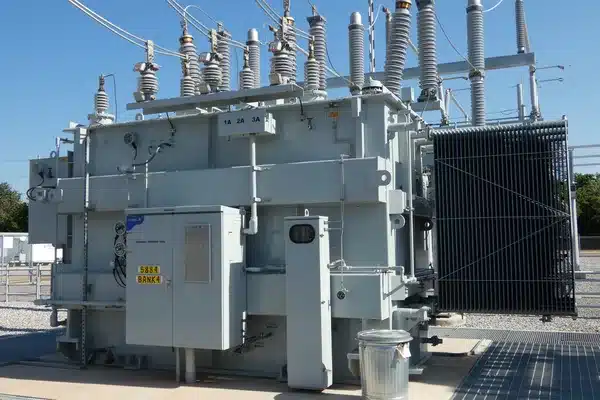
The question comes up all the time on engineering forums. Homeowners ask about the buzz from a doorbell transformer or a new substation behind the garden. Audio repairers ask why an old amplifier started humming and whether epoxy will stop it. This guide answers both, using manufacturers’ data and published tests. It ends with what transformer buyers can do on the steel side. If you are new to core design, start with why transformer cores are laminated.
Key Takeaways
- Transformer hum comes mainly from magnetostriction: the core steel changes length twice per cycle, so the tone is 100 Hz on 50 Hz grids and 120 Hz on 60 Hz grids, plus harmonics.
- Core noise is there whenever the transformer is energized, even with no load. Load noise from the windings and fan noise add to it as load rises.
- A transformer that gets louder with age usually has laminations or windings that have worked loose as the varnish or adhesive dries out.
- Thin varnish forced into the core under vacuum works better than a thick layer of epoxy on the outside. Replacement is often cheaper than repair on small units.
- DC on the supply makes transformers louder. A 2026 field study in New Zealand measured higher sound and vibration levels on two 216 MVA grid transformers when DC was injected.
- Lower flux density, tight clamping, step-lap joints and grain-oriented steel with low magnetostriction all lower core noise. That matters more as new substations are built close to homes.
Is Transformer Hum Normal?
Yes. Every transformer with a steel core hums to some degree. Acme Electric, a dry-type transformer maker owned by Hubbell, puts it plainly: “Transformer noise cannot be eliminated.” It can only be reduced by design and assembly, or masked by a careful choice of location.
What matters is how loud it is compared with its surroundings. Acme gives an example. An average office runs at about 50 decibels. A 300 kVA transformer with a maximum sound level of 55 dB placed in that office “would produce complaints”. Five decibels sounds small, but the ear notices it.
Big transformers are louder than small ones. ABB engineers wrote that power transformers of around 65 to 93 MVA would typically have a no-load noise level, from the core and fans, in the 70 dB(A) range. Our article on distribution vs power transformer steel explains how the two classes differ.
| What you hear | Usually means | What to do |
|---|---|---|
| Steady low hum, same every day | Normal core noise | Nothing, or move the unit away from people |
| Hum that grows louder over months or years | Laminations or windings working loose | Check clamping; consider re-varnishing or replacing |
| Rattle or buzz that changes when you press the case | A loose lamination, screw or cover | Tighten what you can reach |
| Hum louder at night | Usually the same hum against a quieter background | Compare it with the background noise before worrying |
| Crackling or sizzling near high-voltage lines | Corona or a damaged insulator, not core hum | Report it to the utility |
| New noise with heat, smell or smoke | A fault | Switch off and call an electrician |
Where Does Transformer Hum Come From?
From three places: the core, the windings and the cooling equipment. ABB lists the same three sources for power transformers.
Core noise. The core is a stack of thin silicon steel sheets. When the steel is magnetized it gets very slightly longer or shorter. HyperPhysics at Georgia State University gives the size of the change: a fractional length change of the order of 10⁻⁵ as the steel goes from zero to full magnetization. The length change does not care which way the field points, so it peaks twice per cycle. That is why the fundamental tone is twice the supply frequency. ABB adds that core noise has components at multiples of 100 or 120 Hz. Their relative size depends on the core material, the core geometry, the operating flux density and how close the core and tank resonances are to those frequencies.
This explains a common mistake. A resident in Ireland on one forum described a “low 50/60hz level hum” from a substation that had just been replaced with a larger unit. On a 50 Hz grid, the main tone from the core is 100 Hz, not 50 Hz.
Loose parts. On top of magnetostriction, magnetic forces pull neighbouring sheets together and apart at the joints. If a sheet, a screw or a cover is loose, it rattles. Forum answers to “why is my transformer buzzing” usually point here first.
Load noise and fans. Current in the windings creates forces between turns and on the tank. ABB notes that load noise rises with load, and that halving the current cuts load noise by about 12 dB. Fans add a broadband rush with no clear tone. If the hum stays the same whether the load is light or heavy, it is mostly coming from the core.
Why Are More People Hearing Transformer Hum in 2026?
Because more large transformers are being built close to where people live, and new research shows how DC on the grid makes them louder.
Substations near homes. In August 2026 the Fairfax County Times reported on residents opposing a Dominion Energy substation planned to serve data centres near their homes in Virginia. One of their main concerns was a constant humming noise. The paper noted that Fairfax County requires substations to be built at least 100 feet from residential property lines, and that the county’s zoning ordinance requires a noise study. Old units are also being replaced with larger ones, as in the forum story above. Our report on the grain-oriented electrical steel shortage explains why new units are hard to get.
DC on the grid. A transformer is designed for pure alternating current. A DC component pushes the core towards saturation on one half of each cycle. In March 2026 the journal Space Weather published a field test from New Zealand. Researchers led by the University of Canterbury, with grid operator Transpower, injected DC into the ground at Haywards substation in Wellington to imitate the currents that solar storms induce. They monitored two 216 MVA, 220/110 kV autotransformers. Saturation started at about 20 A of DC, and up to about 35 A flowed through one transformer. The team found “corresponding increases in acoustic sound and vibration levels”, with especially large increases at 350, 500 and 700 Hz. They warned this could matter for transformers close to urban areas.
The same effect shows up at home on a small scale. One forum user found that their AV receiver hummed on the mains but went quiet when run from a UPS battery. A small DC offset on household mains, often caused by appliances that draw current unevenly, is one likely explanation. Makers of audio “DC blockers” sell filters for exactly this, mostly for toroidal transformers. Those claims come from sellers, not independent tests.
Why Do Transformers Get Louder With Age?
Because the parts that hold the core tight slowly let go.
Small transformers are often dipped in varnish after assembly. The varnish fills the gaps between laminations and between wire turns, and it holds everything still. The TestGuy electrical testing wiki describes what happens next: over time the core adhesive breaks down and the laminated layers separate slightly. Once that starts, the sound gets louder. A commenter on r/explainlikeimfive put it in one line: the varnish usually keeps a transformer quiet, but “over time it gets cracked and buzzing starts”.
Heat speeds this up. The owner of a three-year-old AV receiver noticed that the hum only started after about an hour of use, once the unit had warmed up. One reply said the usual cause is that “the transformer starts to delaminate from the base”.
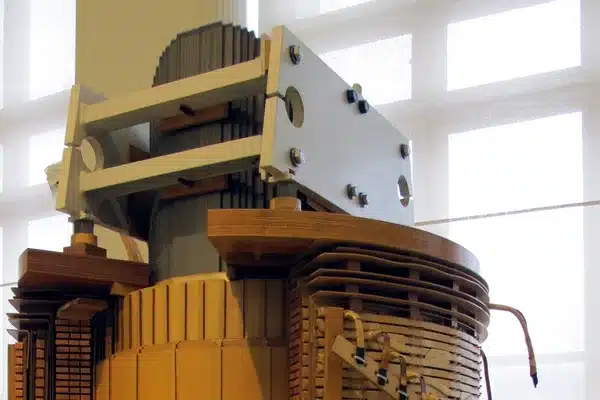
E-I transformers suffer most. Silicon Chip magazine noted in 1995 that in E-I designs “laminations tend to loosen over time and produce increasing noise”. Large power transformer cores are held by bolted clamping structures instead of glue. ABB stresses that the clamping must give uniform pressure on the laminations without local deformation. Our guide to lamination stacking methods compares interlocking, welding, bonding and the clamping used on transformer cores.
Which Transformer Hum Fixes Actually Work?
The best-supported fix is to get thin varnish into the gaps under vacuum. Painting the outside or pouring on thick epoxy does much less.
The clearest discussion is an r/AskElectronics thread with 125 upvotes and 73 comments. The poster had a 9 V AC power supply for a synthesizer with a loud 60 Hz buzz and wanted to seal the transformer in epoxy. The top replies agreed on a different approach.
| Fix | What the evidence says | Verdict |
|---|---|---|
| Tighten clamping screws and covers | Fixes rattles from loose parts; forum repairers try it first | Try first |
| Vacuum varnish impregnation | Pulls air out and forces thin varnish between laminations and turns; repairers report quiet results | Works best |
| Dip in thin varnish or lacquer | Soaks in better than thick resin; less thorough than vacuum | Often helps |
| Pour or paint thick epoxy on the outside | “Dumping thick epoxy may not even reduce the humming,” one reply said; it does not reach the gaps | Rarely helps |
| Rubber feet or isolation pads | Stops the hum spreading into shelves, floors and walls | Helps with how loud it sounds |
| Replace with a toroidal or switch-mode supply | Removes the old core entirely | Often the cheapest fix for small units |
For large units, placement matters as much as repair. Acme’s advice is to mount transformers on a base that weighs at least ten times as much as the unit, avoid corners that reflect sound into a room, and never mount them on thin walls that act like a speaker.
The poster in the epoxy thread ended up buying a toroidal transformer for about 40 euros. For a small consumer device, that is often the sensible answer.
Are Toroidal Transformers Quieter Than E-I Transformers?
Usually, yes. A toroid’s core is one long strip of steel wound into a ring, so it has no joints, and the winding covers the whole core. Silicon Chip magazine wrote that “the nature of the toroidal transformer’s construction helps to dampen acoustic noise”, while E-I laminations tend to loosen and get louder.
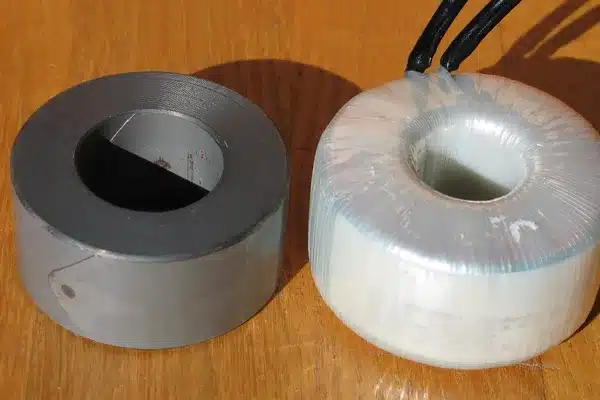
There are two catches. First, quality matters more than shape: a poorly wound toroid can still hum. Second, sellers of audio DC blockers market them mainly for toroid-powered equipment, saying a DC offset of a few hundred millivolts can push a toroidal core towards saturation. If a toroid hums on one supply and not another, check the mains before blaming the transformer.
How Does Core Steel Affect Transformer Noise?
The steel sets the starting point. Design and assembly decide how much of that noise reaches your ears.
A team from TU Graz and industry studied this directly. Their 2018 paper in IEEE Transactions on Industry Applications states that “the main source of a PT’s no-load noise is the magnetostrictive vibration” of the core. They measured magnetostriction on production coils of grain-oriented steel weighing up to 6,000 kg, found differences between coils, and compared them with the noise of model and full-size transformers.
Better steel can make a measurable difference. In a 2000 study, Kawasaki Steel (now part of JFE) built model three-phase cores with step-lap joints from two 0.23 mm high-permeability grades. At 1.7 T and 50 Hz, the core built from the better grade had lower core loss (0.86 vs 0.97 W/kg) and was 2 dB quieter (52 vs 54 dB). Our comparison of Hi-B vs standard CRGO explains what separates those classes.
These are the steel factors that matter most for noise:
- Flux density. “Higher flux levels generate more noise,” as a US patent on quiet transformer cores from Espey Mfg. puts it. A December 2025 article in Transformer Technology adds that core noise correlates with core mass and flux density. The trade-off of a lower flux density is a bigger, heavier core.
- Grain orientation. ABB’s engineers list seeking low magnetostriction, using “steel with higher grades of magnetic orientation” and reducing the flux density as the starting points for lowering core noise. thyssenkrupp credits the “reduced noise emissions” of its grain-oriented range to an optimized magnetic domain structure and improved insulation.
- Tension coating. JFE Steel explains in a patent that the insulating tension coating puts the steel under tensile stress, which improves magnetostriction and reduces transformer noise. Too thin a coating, under 3 g/m² in that patent, gave poor noise results.
- Domain refinement done right. Laser scribing and grooving lower core loss, but JFE notes that grooves deformed by handling were “a cause of increasing transformer noise”. Ask how the domain-refined grade performs for noise, not just loss.
- Flat, burr-free laminations. Magnetostriction is very sensitive to strain. The Espey patent says laminations “must be accurately cut to dimension, be free of burrs, and be perfectly flat” to get the benefit of a quiet core design.
Joint design matters too. A 1998 study by Z. Valković in Croatia tested single-phase model cores built from 0.27 mm grain-oriented steel, the class of our 27Q120 electrical steel. Multi-step-lap joints cut noise by up to 7.5 dB compared with a single step-lap at 1.4–1.5 T, with almost no gain at 1.7 T. Three or four steps captured most of the benefit.
What Should You Specify When You Need a Quiet Transformer?
Put the noise limit in the transformer specification, then make sure the core steel can support it. Transformer sound levels are measured to IEC 60076-10, and buyers in noise-sensitive areas set strict limits. Con Edison in New York required power transformers 15 to 20 dB quieter than typical units of the same size. Its limits added up to about 54 dB(A) at full voltage and current. ABB’s later units met them without a sound enclosure or tank panels.
On the steel side, a low-noise order usually means:
- A grade with low loss and high B8. In the Kawasaki model cores, the grade with lower loss and higher B8 was also the quieter one. Hi-B and domain-refined grades sit at that end of the range.
- A realistic design flux density. Asking for a quiet unit and a very small, high-induction core at the same time works against itself.
- A full tension coating in good condition. Specify the coating class and avoid sheet with damaged coating. Our guide to C-2, C-3 and C-5 coatings explains the options.
- Clean slitting and cutting. Low burr, good flatness and careful handling keep extra stress out of the core.
- Test data you can trace. Mill certificates report core loss and B8, not noise. If noise is critical, ask the transformer maker how they test it and to which standard.
We supply grain-oriented coil and slit strip, including Hi-B CRGO grades in 0.23 mm, 0.27 mm and 0.30 mm. Coil orders typically start at about 5 tonnes, and smaller lots can be cut from coil. Sheet orders typically start at about 500 kg; if you need less, tell us and we’ll do our best to meet the request. Samples typically cost USD 200 including freight, refunded when you place a production order.
FAQ
Why do transformers hum?
Because of magnetostriction. The steel sheets in the core get slightly longer and shorter as the alternating magnetic field rises and falls. This happens twice per cycle, so the hum is 100 Hz on a 50 Hz grid and 120 Hz on a 60 Hz grid. Loose laminations, windings and covers can add a rattle on top.
Is it normal for a transformer to hum?
Yes. Every iron-core transformer hums when it is energized, even with no load. A steady hum is normal. A hum that gets louder over time, rattles, or comes with heat, smell or smoke is not, and should be checked by an electrician.
Why is my transformer humming louder than before?
Usually because the varnish or adhesive holding the core has dried out and the laminations have worked loose. Heat makes it worse, so the noise may only start after the unit warms up. A DC offset on the mains, a higher supply voltage or a heavier load can also make it louder.
Can you stop a transformer from humming?
You can reduce it, not eliminate it. Tighten clamping screws first. Vacuum impregnation with thin varnish works better than coating the outside with epoxy. Rubber pads and a heavy, solid mounting surface stop the sound spreading. For small units, a toroidal transformer is often the simplest fix.
Does the core steel affect transformer noise?
Yes. Magnetostriction is the main source of no-load noise, and it depends on the steel grade, its coating and how it is cut and stacked. Grain-oriented steel with high B8 and an intact tension coating, run at a moderate flux density in step-lap joints, gives the quietest cores.
Planning a low-noise transformer or core? Contact us with the grade, thickness, width and quantity you need, and we’ll come back with options and a quote.
References
- Hubbell / Acme Electric — Transformer FAQ: hum and noise
- R. Girgis, M. Bernesjö, ABB Review special report — The quiet life: ABB’s ultralow-noise power transformers
- ABB Review 2/2008 — The sound of silence
- HyperPhysics, Georgia State University — Magnetostriction
- M. Pirnat, Transformer Technology, December 2025 — Quiet by design: understanding and reducing transformer noise
- Fairfax County Times, 7 August 2026 — Residents rally against data center substation
- S. Subritzky et al., Space Weather, 2026, doi:10.1029/2025SW004681 — High voltage DC active current injection to simulate geomagnetically induced currents in New Zealand (open-access PDF)
- TestGuy Wiki — Transformer humming noise explained
- M. Larkin, Silicon Chip, December 1995 — The pros and cons of toroidal power transformers
- T. Tanzer et al., IEEE Transactions on Industry Applications 54(5), 2018 — Magnetostriction of electrical steel and its relation to the no-load noise of power transformers
- M. Ishida, S. Okabe, T. Imamura, M. Komatsubara, Journal of Materials Science and Technology 16(2), 2000 — Model transformer evaluation of high-permeability grain-oriented electrical steels
- Z. Valković, J. Phys. IV France 8, 1998 — Effects of transformer core design on noise level
- JFE Steel, US Patent Application 2013/0143004 A1 — Grain oriented electrical steel sheet
- Espey Mfg. & Electronics, US Patent 5,777,537 — Quiet magnetic structures such as power transformers and reactors
- thyssenkrupp Steel — powercore® grain-oriented electrical steel
- Reddit forum threads, r/AskElectronics, r/hometheater, r/AskEngineers, r/explainlikeimfive (user questions and replies quoted as forum opinion)
Image credits
- Substation power transformer: Yoshieslunchbox, Wikimedia Commons, CC BY-SA 4.0
- Transformer core limb model (Technisches Museum Wien, inventory 50971): photographer not named, Wikimedia Commons, public domain
- Toroidal core and transformer: emeko, Wikimedia Commons, public domain


