
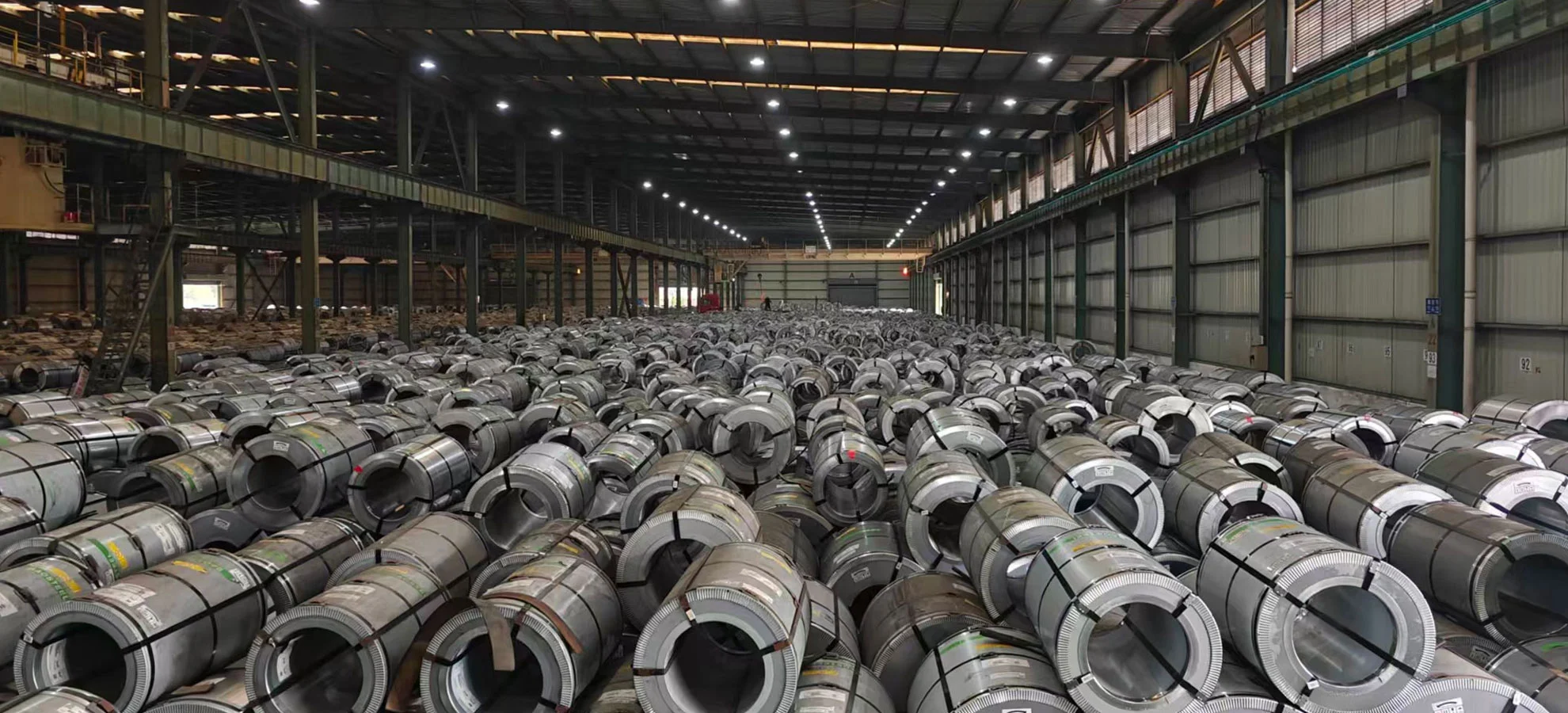
Products · Non-oriented · Ultra-thin
Ultra-Thin CRNGO0.05–0.20 mm high-frequency non-oriented silicon steel
Non-oriented silicon steel down to 0.05 mm, for motors that run at high electrical frequency — EV traction, drone and servo motors, high-speed spindles and 400 Hz aerospace machines. Thinner laminations cut eddy-current loss where standard 0.35–0.65 mm gauges run hot.
Why go thinner
Eddy-current loss falls with thickness
In a rotating machine, eddy currents circulate within each lamination and dissipate as heat. That eddy-current component scales roughly with the square of the lamination’s thickness, so at high electrical frequency — a high-speed or high-pole-count motor can run at 1–5 kHz — a 0.20 mm gauge already outperforms standard 0.50 mm steel, and 0.05–0.10 mm cuts loss further still. We also raise the alloy’s silicon content on the thinnest gauges to increase electrical resistivity, trading a little saturation induction for a further drop in eddy-current loss.
| Property | Standard CRNGO | Ultra-thin CRNGO |
|---|---|---|
| Thickness | 0.35–0.65 mm | 0.05–0.20 mm |
| Typical test frequency | 50 Hz | 400 Hz – 1 kHz |
| Eddy-current loss | Higher at frequency | Substantially lower |
| Silicon content | Standard | Elevated on thinnest gauges |
| Best for | 50/60 Hz motors, generators | High-speed & high-frequency motors |
Running at line frequency instead? Standard CRNGO at 0.35–0.65 mm is the more economical choice — see Standard CRNGO →
In hand
Ultra-thin CRNGO strip
Slit strip at 0.10 mm — thin enough to flex like foil, held flat and burr-free through precision slitting.
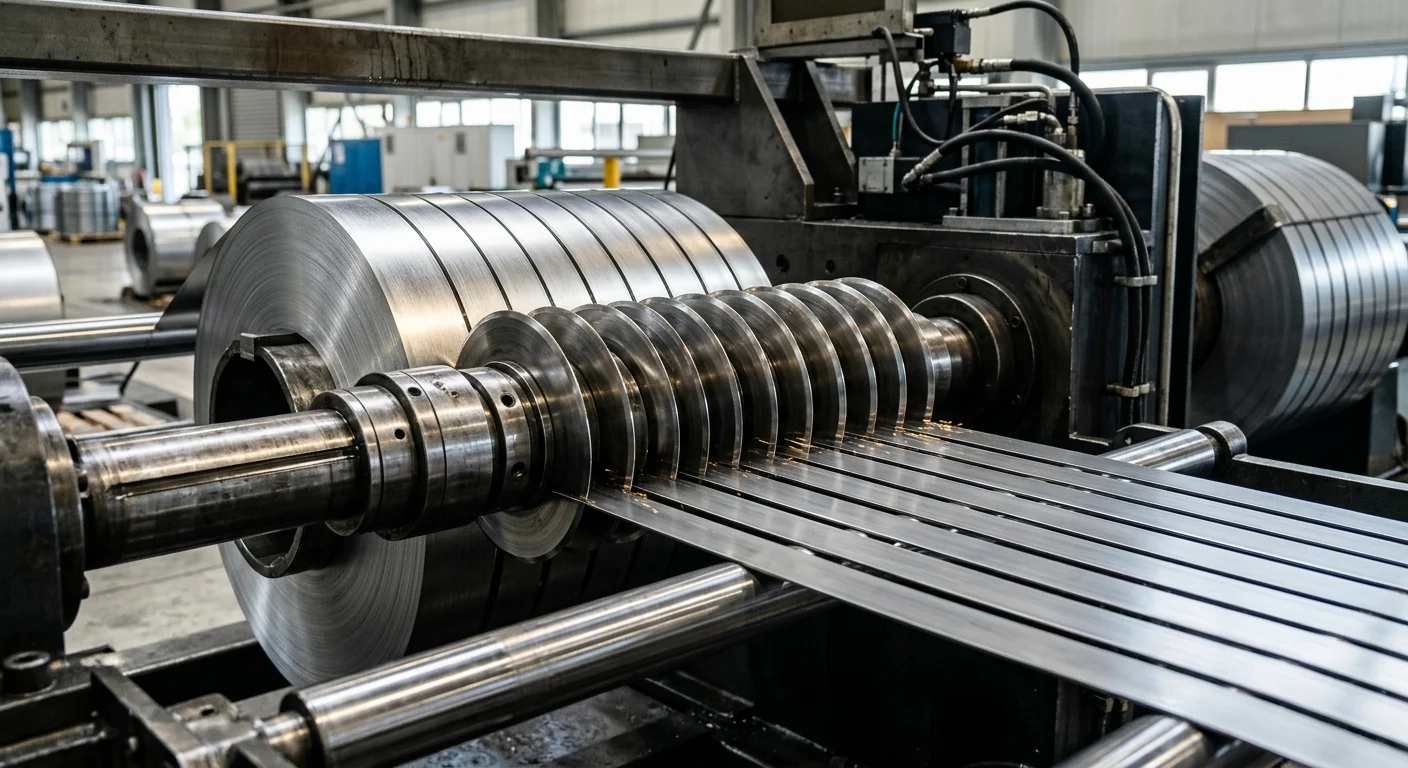 0.10 mm · slit strip
Ultra-thin CRNGO slit strip, 0.10 mm gauge
From coil to lamination
How we hold gauge down to 0.05 mm
Rolling and annealing thin non-oriented strip without edge waviness or grain-size drift takes tighter process control at every stage.
Precision cold rolling
Multi-pass rolling down to final gauge, tolerance held tight across the coil width.
Decarburization anneal
Controlled-atmosphere annealing sets grain size for low hysteresis loss.
Insulation coating
Thin, high-resistance coating limits interlaminar eddy current paths.
Precision slitting
Slit to width with edge-camber control critical at ultra-thin gauge.
Test & certify
Core loss and induction tested per coil before a mill certificate ships.
Ultra-thin CRNGO grades
Grades we supply
Core loss for thin, high-frequency non-oriented steel is more meaningful measured above line frequency, so we quote P1.0/1000 (1.0 T at 1 kHz) alongside the standard P1.5/50 figure. Send your operating frequency and induction and we’ll confirm the right gauge and grade.
| Grade | Thickness | Core loss P1.0/1000 | Core loss P1.5/50 |
|---|---|---|---|
| 20W-HF | 0.20 mm | ≤ 28 W/kg | ≤ 2.30 W/kg |
| 15W-HF | 0.15 mm | ≤ 20 W/kg | ≤ 1.95 W/kg |
| 10W-HF | 0.10 mm | ≤ 14 W/kg | ≤ 1.55 W/kg |
| 08W-HF | 0.08 mm | ≤ 11 W/kg | ≤ 1.35 W/kg |
| 05W-HF | 0.05 mm | ≤ 8 W/kg | ≤ 1.10 W/kg |
Values are typical grade targets; a mill test certificate with measured core loss and induction ships with every order. Working from an EN or JIS thin-gauge spec? Check the grade equivalents chart →
By application
Where ultra-thin non-oriented earns its cost
The thinner and more expensive the gauge, the more it matters that your motor actually spends most of its life above line frequency.
EV traction motors
High-pole-count and high-speed drive motors running at kHz-range electrical frequency.
Explore →Drone & servo motors
Compact high-RPM motors where lamination loss dominates efficiency.
Explore →High-frequency reactors
Rotating and static cores sharing the same high-frequency loss problem.
Explore →400 Hz aerospace
Generators and motors on 400 Hz aircraft power systems.
Explore →Explore the range
Other product lines
Ultra-thin CRNGO is one branch of our non-oriented range. If your project also needs standard gauges, high-strength EV-grade steel, or grain-oriented material for transformer cores, start here.
Standard CRNGO
Grades 35W300–65W800, 0.35–0.65 mm, for line-frequency motors and generators.
Explore →Non-Oriented hub
Full non-oriented range overview — thicknesses, grades and applications.
Explore →Grain-Oriented (CRGO)
Anisotropic steel for transformer and reactor cores, 0.23–0.35 mm.
Explore →All products
Full range overview — CRGO, CRNGO and ultra-thin silicon steel.
Explore →FAQ
Ultra-thin CRNGO, explained
Why use ultra-thin gauge instead of standard non-oriented steel?
Eddy-current loss inside each lamination scales roughly with the square of its thickness. Motors that run at high electrical frequency — high-speed or high-pole-count EV, drone and servo motors — lose disproportionately more in standard 0.35–0.65 mm gauge. Cutting thickness to 0.05–0.20 mm reduces that loss and keeps the rotor cooler.
At what frequency does ultra-thin gauge start to matter?
There’s no single cutoff — it depends on your loss budget and thermal limits — but as a rule of thumb, once your electrical frequency runs into the several-hundred-Hz to low-kHz range, thinner gauge starts paying for itself. Send us your operating frequency and induction and we’ll help you compare gauges.
Why do the thinnest grades use higher silicon content?
Higher silicon raises the steel’s electrical resistivity, which further limits eddy-current flow within each lamination. The trade-off is a slightly lower saturation induction and more brittle strip, which is why rolling and slitting ultra-thin, high-silicon gauge takes tighter process control.
How is core loss specified for ultra-thin non-oriented steel?
We quote both the standard P1.5/50 figure and a high-frequency figure, P1.0/1000 (1.0 T at 1 kHz), since 50 Hz loss alone doesn’t represent how the material performs in a high-frequency motor. Tell us your actual operating point and we can quote loss at that frequency.
What thicknesses and grades can you supply?
0.05, 0.08, 0.10, 0.15 and 0.20 mm as standard, in grades 05W-HF through 20W-HF. Custom thicknesses within that range are possible — ask for your target gauge.
Can you cross-reference this to my EN or JIS thin-gauge spec?
Yes — send your grade or datasheet and we’ll confirm the closest match. See the grade equivalents chart for common cross-references.
What’s the minimum order quantity for ultra-thin gauge?
MOQ is typically higher than standard gauges given the processing involved. Tell us your target volume and gauge and we’ll confirm what’s workable, including trial quantities for new projects.
Do you provide samples before ordering?
Yes — free samples are usually ready within about a week, so you can test core loss and stamping behaviour before committing to a production order.
Why buyers choose Zhongxin
Thin-gauge capability, export-ready service
Wuxi Zhongxin Special Steel Co., Ltd. supplies ultra-thin non-oriented silicon steel to high-speed and high-frequency motor makers across Europe, the Americas and Asia, with slitting and testing handled in-house.
Send your frequency & gauge — quote in 24 hours
Share operating frequency, induction and target thickness, or upload a drawing. Free samples available.


