
Applications · High-frequency
Silicon Steel for High-Frequency TransformersUltra-thin 0.05–0.20 mm grades for HF transformers & reactors
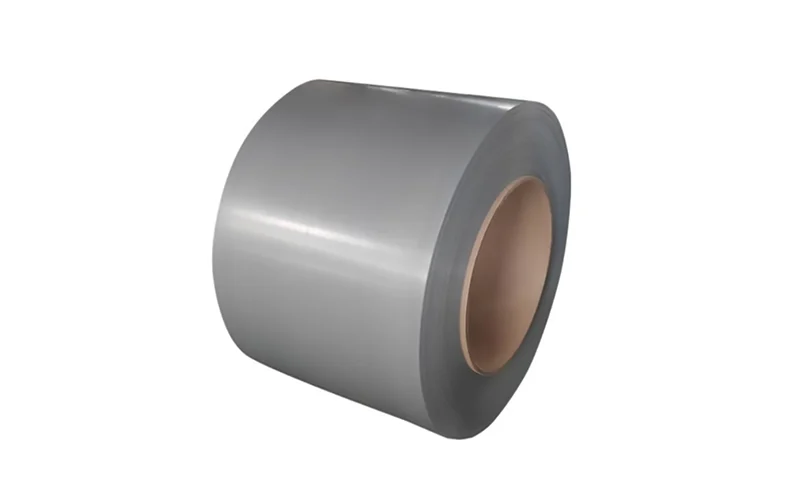
Above mains frequency, eddy-current loss stops being a rounding error and starts dominating your core budget. We supply grain-oriented silicon steel down to 0.05 mm, purpose-thinned for 400 Hz aircraft power supplies, medium-frequency reactors and kHz-range switch-mode transformer cores — cut, slit and tested to the gauge your frequency actually requires.
The core-loss problem
Eddy-current loss rises with the square of frequency and thickness
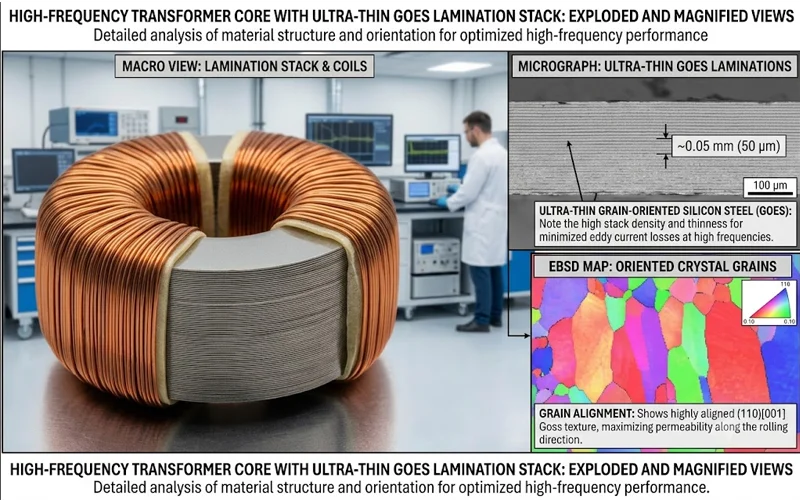
Total core loss splits into two mechanisms that behave very differently as frequency climbs. Hysteresis loss scales roughly linearly with frequency and is set mainly by the grain structure and coating of the steel. Eddy-current loss is the one that gets out of hand: it scales with the square of both frequency and lamination thickness. Run a standard 0.30 mm CRGO core at 1 kHz instead of 50 Hz and the eddy-current component alone can multiply several hundred times over — the transformer overheats long before it saturates.
Cutting the lamination thickness breaks the eddy-current paths into narrower loops, and because the loss term scales with thickness squared, even a modest gauge reduction buys a disproportionate loss reduction. That’s the entire logic behind ultra-thin electrical steel: it doesn’t change the alloy, it changes the geometry the eddy currents have to circulate in. Silicon content and coating resistance still matter — higher silicon raises resistivity and helps at the margin — but for anything running above a few hundred hertz, gauge is the lever that actually moves the needle.
Match gauge to frequency
What gauge does your frequency actually need?
General guidance to size your enquiry — final gauge selection depends on your target core loss, flux density and duty cycle, so treat this as a starting point and confirm with our engineers before finalising a design.
| Frequency band | Typical use | Recommended gauge | Why this gauge |
|---|---|---|---|
| 50 / 60 Hz | Power & distribution transformer cores | 0.23–0.35 mm standard CRGO | Loss is hysteresis-dominated; thicker gauge is the economical choice |
| 400 Hz | Aircraft & shipboard power, ground power units | 0.20 mm ultra-thin CRGO | Eddy-current term becomes significant; thinner gauge controls core loss and weight |
| 1–3 kHz | Medium-frequency reactors, welding transformers, medium-frequency inverter stages | 0.10 mm ultra-thin CRGO | Eddy loss scales with t² — gauge must drop faster than frequency climbs |
| 3–20 kHz | HF switch-mode transformers, output chokes, induction heating cores | 0.05–0.08 mm ultra-thin CRGO | Approaching the practical limit for silicon steel; verify loss budget against ferrite or amorphous alternatives |
Not sure which row applies? Send your operating frequency, flux density and target core loss and we’ll recommend a gauge — request a quote →
By application
Where high-frequency silicon steel gets used
01
400 Hz aircraft & marine power
Static frequency converters, ground power units and shipboard inverters running the 400 Hz standard.
02
SMPS & switch-mode transformers
Isolation and flyback transformers in AC-DC power supplies, telecom rectifiers and chargers.
03
HF reactors & chokes
Output filter inductors and DC-link reactors in VFDs, UPS systems and welding equipment.
04
Induction heating cores
Coupling transformer cores for induction heating and induction furnace power stages.
Grade & gauge
GT-050 and GT-100 ultra-thin CRGO
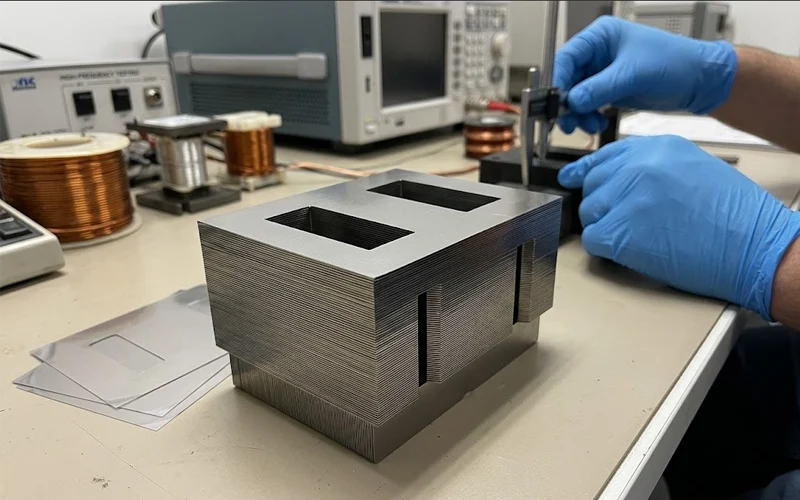
Our high-frequency line covers five gauges from GT-050 to GT-200. The two core grades are GT-050 at 0.05 mm for the top of the frequency range and GT-100 at 0.10 mm for mid-range reactors and chargers, with GT-080, GT-150 and GT-200 available on the same lead time. All are supplied as slit coil to your stack width, with domain-refined options available for the lowest-loss builds.
Where this fits in the range
How we work
From enquiry to your dock
The same simple path we use for every grade, adapted for tighter high-frequency tolerances.
Send your spec
Frequency, flux density, target loss and stack width — or a drawing.
Quote in 24h
Gauge recommendation and pricing within one business day.
Free samples
Test HF core loss and stampability before committing, usually within a week.
Production & QC
Slit to width and tested to grade, with a mill certificate per coil.
Export delivery
Moisture-proof packing and ocean or air freight to your port.
FAQ
Sourcing silicon steel for HF applications
Why does core loss increase so much above 50/60 Hz?
Eddy-current loss scales with the square of frequency, so a small jump in operating frequency produces a much larger jump in loss. At mains frequency, hysteresis loss dominates and standard-gauge CRGO is efficient; above a few hundred hertz the eddy-current term takes over and thinner laminations become necessary to keep the core from overheating.
What gauge should I use for a 20 kHz SMPS transformer?
At the top of that range we’d generally start the conversation at 0.05 mm and also check whether ferrite or amorphous alloy suits your design better — silicon steel is approaching its practical limit by 20 kHz. Send your flux density and loss target and we’ll confirm the right material.
Can you supply cut cores or only strip and coil?
We supply coil, slit strip and stamped laminations to your drawing. Cut toroidal or wound cores aren’t something we produce in-house, but we can slit to the exact width your core-winding line needs.
Do you test core loss at high frequency, or only at 50/60 Hz?
Standard mill certificates report loss at power frequency. For HF-specific loss data at your actual operating point, send us the frequency and flux density and we’ll arrange testing or point you to the relevant datasheet curve.
What about 400 Hz aerospace or marine qualification requirements?
We can supply to the thickness and grade your 400 Hz design calls for and provide mill test certificates for your qualification file. Tell us the governing spec and we’ll confirm what documentation we can provide alongside the material.
What’s the minimum order quantity for ultra-thin gauges?
MOQ is generally higher for ultra-thin gauges than standard CRGO due to slitting setup. Tell us your target volume and gauge and we’ll confirm what’s workable, including trial quantities for new designs.
How fast can you quote and ship?
Quotes come within 24 hours. Ultra-thin gauges are typically made-to-order and take longer than standard-stock CRGO — we’ll give you a firm lead time with the quote.
Related products
Explore the rest of the range
Ultra-thin CRGO
0.05–0.20 mm grain-oriented steel — the material on this page.
Explore →Ultra-thin CRNGO
Non-oriented ultra-thin steel for high-speed and high-frequency motors.
Explore →Ultra-thin overview
Compare both ultra-thin lines and pick by application.
Explore →All products
The full CRGO, CRNGO and ultra-thin range.
Explore →Why buyers choose Zhongxin
Mill-grade material, export-ready service
Wuxi Zhongxin Special Steel Co., Ltd. is a Chinese manufacturer and exporter of grain-oriented, non-oriented and ultra-thin silicon steel, serving transformer and motor makers across Europe, the Americas, Asia and beyond.
Send your frequency and flux density — get a gauge recommendation in 24 hours
Tell us the operating frequency, target core loss and stack width. Free samples available.


