
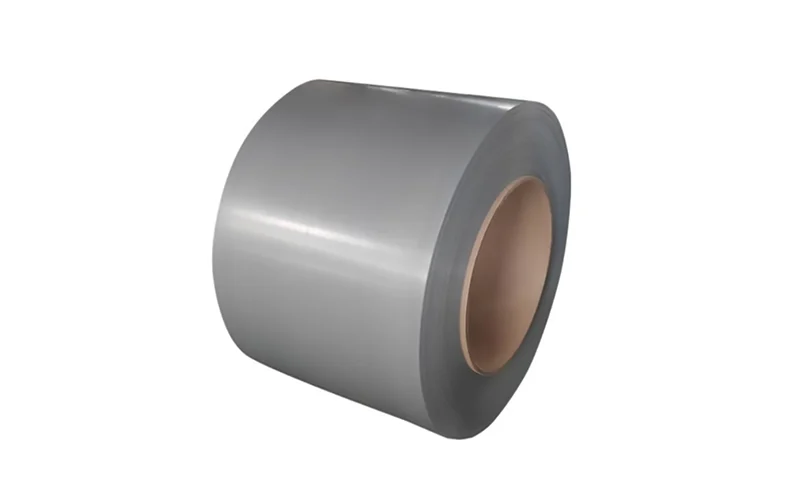
Anwendungen · Hochfrequenz
Siliziumstahl für HochfrequenztransformatorenUltradünn 0,05–0,20 mm Güten für HF-Transformatoren & Drosseln
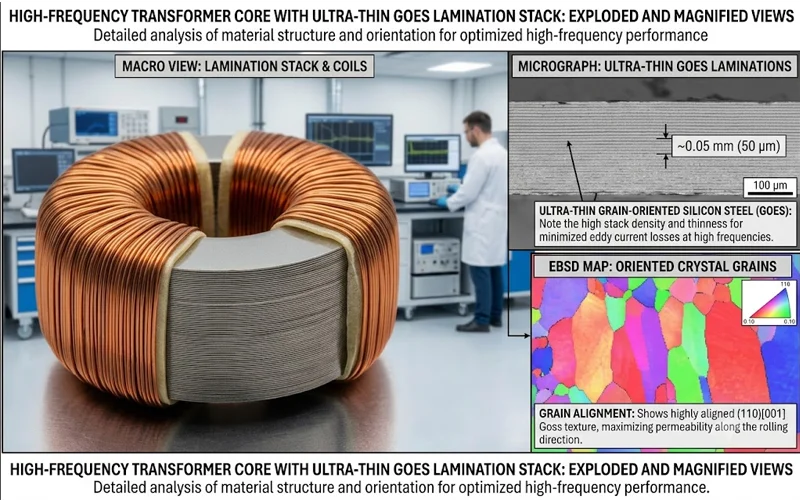
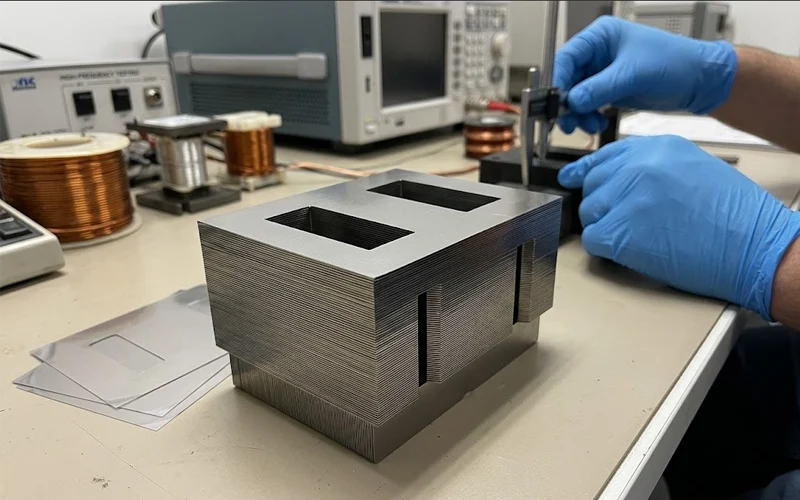
Oberhalb der Netzfrequenz wird der Wirbelstromverlust von einem Rundungsfehler zur bestimmenden Größe in Ihrem Kernbudget. Wir liefern kornorientiertes Siliziumblech bis 0,05 mm, speziell dünn gewalzt für 400 Hz-Bordstromversorgungen, Mittelfrequenzdrosseln und Schaltregler-Transformatorkerne im kHz-Bereich – geschnitten, aufgeschlitzt und auf die Blechdicke geprüft, die Ihre Frequenz tatsächlich erfordert.
Das Ummagnetisierungsverlust-Problem
Der Wirbelstromverlust steigt mit dem Quadrat der Frequenz und Dicke
Der gesamte Ummagnetisierungsverlust setzt sich aus zwei Mechanismen zusammen, die sich bei steigender Frequenz sehr unterschiedlich verhalten. Der Hystereseverlust skaliert ungefähr linear mit der Frequenz und wird hauptsächlich durch die Kornstruktur und Beschichtung des Stahls bestimmt. Der Wirbelstromverlust ist derjenige, der außer Kontrolle gerät: Er skaliert mit dem Quadrat sowohl der Frequenz als auch der Blechdicke. Betrieben ein Standard-CRGO-Kern mit 0,30 mm bei 1 kHz statt 50 Hz, kann sich die Wirbelstromkomponente allein um mehrere hundert Male vervielfachen — der Transformator überhitzt sich lange, bevor er in die Sättigung geht.
Das Reduzieren der Blechdicke unterteilt die Wirbelstrompfade in engere Schleifen, und da der Verlust quadratisch mit der Dicke skaliert, führt auch eine bescheidene Dickenreduktion zu einem überproportionalen Verlustabbau. Das ist die gesamte Logik hinter ultradünnem Elektroband: Es ändert nicht die Legierung, sondern die Geometrie, in der die Wirbelströme zirkulieren müssen. Siliziumgehalt und Beschichtungswiderstand spielen weiterhin eine Rolle – höherer Siliziumgehalt erhöht den spezifischen Widerstand und hilft marginal – aber für alles, das oberhalb weniger hundert Hertz arbeitet, ist die Blechdicke der Hebel, der wirklich Einfluss hat.
Blechstärke der Frequenz anpassen
Welche Blechstärke benötigt Ihre Frequenz tatsächlich?
Allgemeine Orientierungshilfe für Ihre Anfrage – die endgültige Blechstärkenauswahl hängt von Ihrem Ziel-Ummagnetisierungsverlust, der magnetischen Flussdichte und dem Betriebszyklus ab. Behandeln Sie dies als Ausgangspunkt und bestätigen Sie die Auslegung mit unseren Ingenieuren, bevor Sie das Design abschließen.
| Frequenzband | Typische Anwendung | Empfohlene Blechstärke | Begründung |
|---|---|---|---|
| 50 / 60 Hz | Ummagnetisierungsverluste in Verteiltransformator- und Transformatorkernen | 0,23–0,35 mm Standard-CRGO | Verlust wird von Hysterese dominiert; größere Blechstärke ist wirtschaftlich sinnvoll |
| 400 Hz | Luftfahrt- und Bordnetzstromversorgung, Bodenstromanlagen | 0,20 mm ultradünn CRGO | Wirbelstromverluste werden bedeutsam; geringere Blechstärke senkt Ummagnetisierungsverluste und Gewicht |
| 1–3 kHz | Drosseln im Mittelfrequenzbereich, Schweißtransformatoren, Umrichterschaltungsstufen im Mittelfrequenzbereich | 0,10 mm ultradünn CRGO | Wirbelstromverlust skaliert mit t² — die Blechstärke muss schneller sinken als die Frequenz steigt |
| 3–20 kHz | HF-Schaltregler-Transformatoren, Ausgangsdrosseln, Induktionsheizungskerne | 0,05–0,08 mm ultradünn CRGO | Nähert sich der praktischen Grenze für Siliziumstahl; Verlustbudget gegen Ferrit- oder amorphe Alternativen abgleichen |
Sie sind sich unsicher, welche Reihe zutrifft? Teilen Sie uns Ihre Betriebsfrequenz, Flussdichte und angestrebten Ummagnetisierungsverlust mit – wir empfehlen Ihnen die richtige Blechstärke – Angebot anfordern →
Nach Anwendung
Einsatzbereiche von Hochfrequenz-Siliziumstahl
01
400-Hz-Stromversorgung in Flugzeugen und Schiffen
Statische Frequenzumrichter, Flugplatz-Stromversorgungsgeräte und bordeigene Wechselrichter nach dem 400-Hz-Standard.
02
SMPS und schaltregeeltransformatoren
Isolations- und Speichertransformatoren in AC-DC-Stromversorgungen, Telekommunikations-Gleichrichtern und Ladegeräten.
03
Hochfrequenz-Drosseln und Ringkerne
Ausgangsfilterdrosseln und DC-Link-Drosseln in Frequenzumrichtern, USV-Systemen und Schweißgeräten.
04
Induktivheiz-Kerne
Kopplungstransformatorkerne für Induktivheizung und Induktionsofen-Leistungsstufen.
Güte und Dicke
GT-050 und GT-100 ultradünn CRGO
Unsere Hochfrequenzlinie umfasst fünf Dicken von GT-050 bis GT-200. Die beiden Kernqualitäten sind GT-050 mit 0,05 mm für den oberen Frequenzbereich und GT-100 mit 0,10 mm für Drosseln und Lader im mittleren Frequenzbereich, mit GT-080, GT-150 und GT-200 verfügbar mit gleicher Lieferzeit. Alle werden als geschlitzte Spule in Ihrer Stapelbreite geliefert, mit Domain-verfeinerten Optionen für die Ausführungen mit minimalem Verlust.
<>>Einordnung in das Sortiment
Wie wir arbeiten
Von der Anfrage bis zu Ihrer Rampe
Der gleiche einfache Ablauf, den wir für jede Sorte verwenden, angepasst an engere Hochfrequenz-Toleranzen.
Senden Sie Ihre Spezifikation
Frequenz, Flussdichte, Zielummagnetisierungsverlust und Schichthöhe — oder eine Zeichnung.
Angebot in 24h
Schichtdickenempfehlung und Preisgestaltung innerhalb eines Geschäftstags.
Kostenlose Muster
Prüfen Sie Hochfrequenz-Ummagnetisierungsverlust und Stanzbarkeit, bevor Sie sich verpflichten, normalerweise innerhalb einer Woche.
Produktion & Qualitätskontrolle
Auf Breite geschnitten und auf Sorte geprüft, mit Hüttenzeugnis pro Spule.
Exportversand
Feuchtigkeitsdichte Verpackung und See- oder Luftfracht zu Ihrem Hafen.
FAQ
Siliziumstahl für HF-Anwendungen beschaffen
Warum steigt der Ummagnetisierungsverlust oberhalb von 50/60 Hz so stark an?
Der Wirbelstromverlust skaliert mit dem Quadrat der Frequenz, daher führt ein kleiner Anstieg der Betriebsfrequenz zu einem wesentlich größeren Anstieg des Verlusts. Bei Netzfrequenz dominiert der Hystereseverlust und Standard-CRGO ist effizient; oberhalb einiger hundert Hertz überwiegt der Wirbelstromterm und dünnere Bleche werden notwendig, um zu verhindern, dass sich der Kern überhitzt.
Welches Blechdickenmaß sollte ich für einen 20-kHz-Schaltnetzteil-Transformator verwenden?
Bei diesem oberen Frequenzbereich beginnen wir das Gespräch normalerweise bei 0,05 mm und prüfen auch, ob Ferrit oder amorphe Legierung besser zu Ihrem Design passt – Siliziumstahl nähert sich bei 20 kHz seiner praktischen Grenze. Senden Sie Ihre Flussdichte und Verlustzielvorgaben, und wir werden das richtige Material bestätigen.
Können Sie geschnittene Kerne oder nur Spaltband und Rollen liefern?
Wir liefern Rollen, Spaltband und gestanzte Bleche nach Ihrer Zeichnung. Geschnittene toroidale oder wickelfertige Kerne stellen wir intern nicht her, aber wir können auf die exakte Breite spalten, die Ihre Kernwickellinie benötigt.
Prüfen Sie Ummagnetisierungsverlust bei hoher Frequenz oder nur bei 50/60 Hz?
Standardwerk-Zertifikate melden Verluste bei Netzfrequenz. Für hochfrequenzspezifische Verlustdaten bei Ihrem tatsächlichen Betriebspunkt senden Sie uns die Frequenz und Flussdichte, und wir organisieren Prüfungen oder verweisen Sie auf die relevante Datenblattkurve.
Was ist mit den Anforderungen der 400-Hz-Luftfahrt- oder Schifffahrtsqualifikation?
Wir können die Dicke und Güte liefern, die Ihr 400-Hz-Design erfordert, und stellen Werksprüfzeugnisse für Ihre Qualifikationsdatei bereit. Teilen Sie uns die geltende Norm mit und wir bestätigen Ihnen, welche Dokumentation wir zusammen mit dem Material bereitstellen können.
Wie hoch ist die Mindestbestellmenge für ultradünne Dicken?
Die Mindestbestellmenge ist für ultradünne Dicken aufgrund des Längsteilaufwands in der Regel höher als für Standard-CRGO. Teilen Sie uns Ihr Zielvolumen und die gewünschte Dicke mit und wir bestätigen Ihnen, was machbar ist, einschließlich Probemengen für neue Designs.
Wie schnell können Sie ein Angebot erstellen und versenden?
Angebote erhalten Sie innerhalb von 24 Stunden. Ultradünne Dicken werden typischerweise nach Bestellung gefertigt und benötigen längere Lieferzeiten als Standard-Lagerwaren-CRGO — wir teilen Ihnen mit dem Angebot eine verbindliche Lieferzeit mit.
Verwandte Produkte
Erkunden Sie den Rest des Sortiments
Ultradünn CRGO
0,05–0,20 mm kornorientierter Stahl — das Material auf dieser Seite.
Erkunden →Ultradünn CRNGO
Nicht-orientierter ultradünner Stahl für Hochgeschwindigkeits- und Hochfrequenzmotoren.
Erkunden →Ultradünn-Übersicht
Vergleichen Sie beide ultradünnen Linien und wählen Sie nach Anwendung.
Erkunden →Alle Produkte
Das vollständige CRGO-, CRNGO- und ultradünne Sortiment.
Erkunden →Warum sich Käufer für Zhongxin entscheiden
Werksgütestahl mit exportfertiger Servicequalität
Wuxi Zhongxin Special Steel Co., Ltd. ist ein chinesischer Hersteller und Exporteur von kornorientiertem, nichtkornorientiertem und ultradünnem Siliziumstahl und beliefert Transformatoren- und Elektromotorenhersteller in Europa, Amerika, Asien und darüber hinaus.
Teilen Sie uns die Betriebsfrequenz und Flussdichte mit — erhalten Sie eine Blechstärke-Empfehlung in 24 Stunden
Geben Sie uns die Betriebsfrequenz, den angestrebten Ummagnetisierungsverlust und die Paketbreite an. Kostenlose Muster sind verfügbar.


