
Grade, thickness, core loss ceiling, down to the decimal point. Coating designation: left blank, “whatever’s standard.” That was one customer’s RFQ last quarter, and we had to circle back before quoting, because “standard” varies enough between applications that guessing wrong wastes both our time. The coating on a stack of laminations does real work — it’s what stops adjacent sheets from conducting into each other and creating an entirely separate eddy current path across the whole core, not just within individual sheets. Grade gets all the attention on RFQs — see our electrical steel grades guide for that side of the spec — but coating deserves more than a blank field too.
Core Key Points
- Electrical steel coating exists for interlaminar insulation. It stops adjacent laminations in a stacked core from conducting into each other — without it, eddy currents flow across the whole stack instead of staying confined to individual sheets.
- C-5 coatings hold roughly 40% market share as of 2025, per industry market research, driven by strong insulation performance and punchability — especially in motor and transformer applications.
- C-5 is an organic- and inorganic-filled varnish. Higher insulation resistance. Better resistance against annealing than lighter coating classes. That combination is why it won so much market share.
- Coating choice interacts directly with your process: if assembly involves post-processing heat treatment, like a stress-relief anneal, the coating needs a rating for that temperature — or its insulating properties degrade during your own process, quietly, until someone notices the core loss numbers don’t match the spec anymore.
- A generic “standard coating” line on an RFQ leaves this decision to the supplier by default. Worth specifying once you actually know what your process and application need.
Why Interlaminar Insulation Exists
A stacked electrical steel core is built from many thin laminations, not one solid block — specifically to limit eddy current loss within each sheet. Stack bare, uncoated laminations together, though, and you’ve created a new problem. The sheets conduct into each other at contact points. That effectively builds a much larger eddy current path across the entire stack, undoing a real chunk of the benefit laminating was supposed to deliver in the first place.
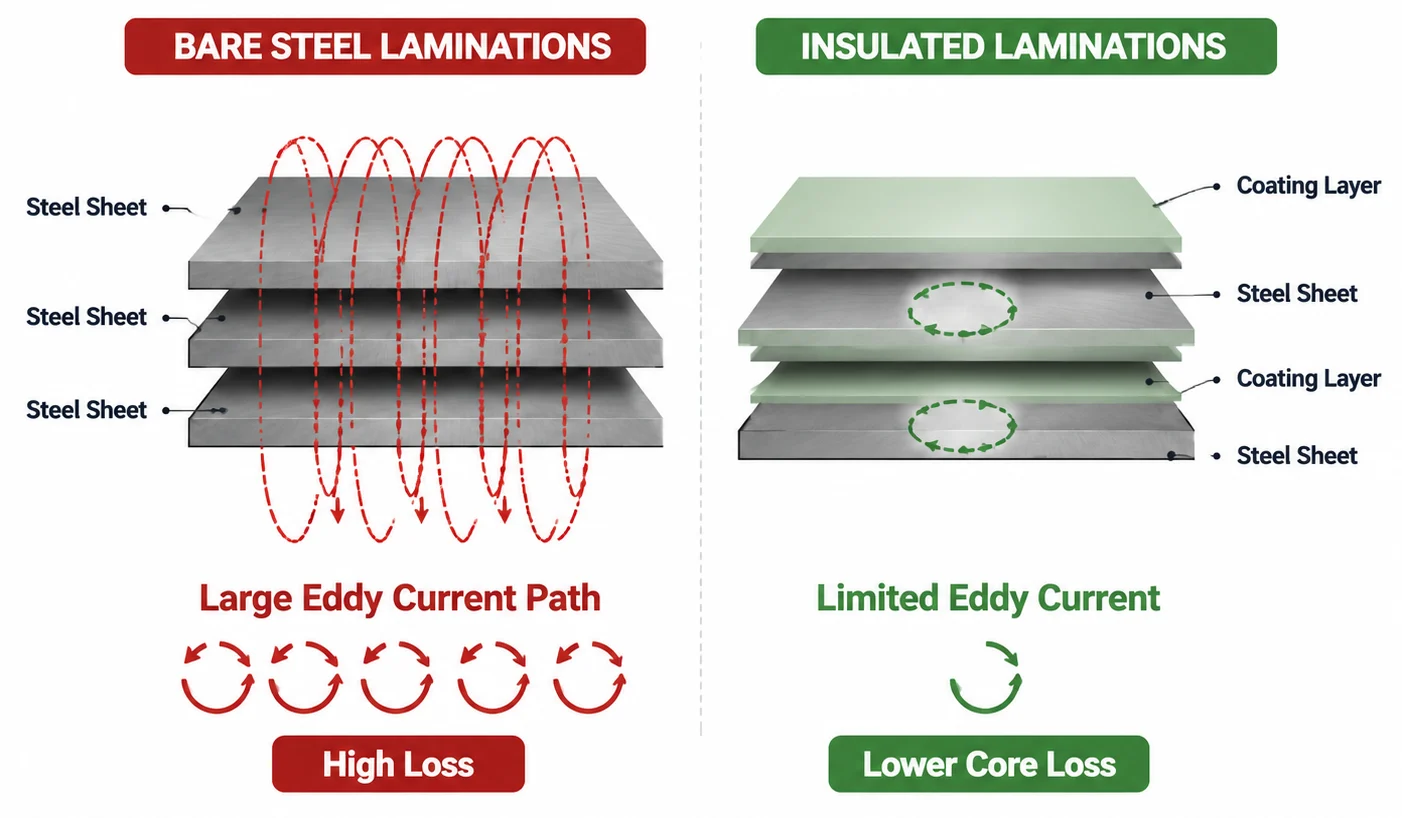
Coating solves this with electrical insulation between adjacent sheets, confining eddy currents to individual laminations the way the lamination design intended. Thin layer. Real structural work for the core’s efficiency, not just surface protection — coating specs are usually listed right alongside the grade on our grain-oriented silicon steel product pages.
C-2 vs C-5: The Two You’ll See Most
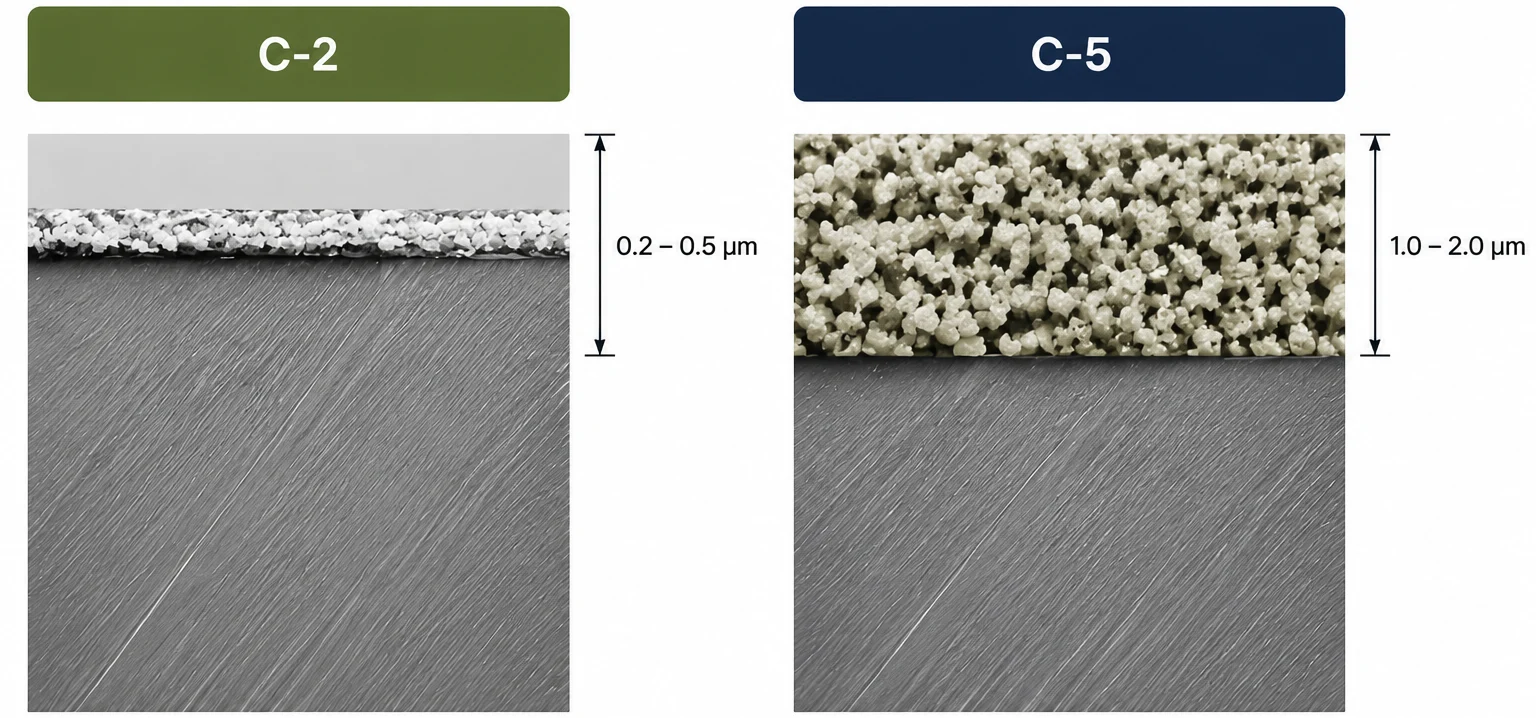
Classifications vary somewhat by standard, but C-2 and C-5 are the two designations that come up most in practice:
| Coating | Typical Composition | Key Characteristics |
|---|---|---|
| C-2 (and similar light inorganic coatings) | Thin inorganic layer | Lower insulation resistance, adequate for less demanding applications, generally lower cost |
| C-5 | Filled organic- and inorganic-based varnish | Higher insulation resistance, better resistance to annealing temperatures, improved punchability |
C-5 became the dominant choice across a wide share of motor and transformer applications — roughly 40% market share as of 2026 — largely because it holds up through the kind of post-processing many core assemblies go through, without sacrificing the punchability stamping operations actually need. Coating designation is one of the fields our transformer core buyer’s guide recommends nailing down before the RFQ goes out.
Coating Grades on Non-Oriented (CRNGO) Steel
The C-2/C-5 comparison above covers coating in general, but if you’re specifying non-oriented (CRNGO) steel for a motor or generator core, the two designations that actually show up on our mill test certificates are C-3 and C-5, per GB/T 2521:
| Coating | Type | Where it’s used on CRNGO |
|---|---|---|
| C-3 | Semi-organic (organic enamel) | Standard coating on most CRNGO grades — good punchability for stamped motor laminations |
| C-5 | Inorganic | On request where higher annealing resistance is needed |
Interlaminar resistance runs roughly 5–50 Ω·mm² per lamination, tested by the Franklin method (ASTM A717) — the same insulation-resistance test used across both our grain-oriented and non-oriented lines. If your spec calls out a minimum resistance value, send it along with your grade and we’ll confirm the matching coating before quoting.
How Coating Choice Interacts With Your Process
This is exactly the part that gets missed when coating is treated as a checkbox instead of a real spec decision:
- Post-processing heat treatment. Stress-relief anneal after stamping? Confirm your coating’s temperature rating first. Some coatings are built to survive annealing. Others degrade, losing insulation resistance right where you need it most.
- Stamping/punching operations. Coating affects die wear and punchability. A poor match to your stamping process shows up as faster tool wear or inconsistent edge quality on the punched laminations.
- Varnish or impregnation compatibility. Core assembly with a varnish dip or impregnation step? Confirm chemical compatibility. An incompatible pairing can hurt adhesion or insulation performance in ways that don’t show up until later.
- Transit and storage exposure. Coating also factors into corrosion resistance during export — see our container loading and packaging guide for how coating and packaging work together to prevent rust on arrival.
What to Actually Specify
Instead of leaving coating blank or writing “standard,” a spec that actually protects you includes:
- Coating designation (C-2, C-5, or whatever classification is relevant to your standard)
- Post-processing temperature requirements, if your assembly involves heat treatment after the steel arrives
- Minimum surface insulation resistance value, tested per the relevant standard
- Compatibility confirmation with any varnish, impregnation, or bonding process in your core assembly
FAQ
What does electrical steel coating actually do?
It provides interlaminar insulation, preventing adjacent laminations in a stacked core from conducting into each other. Without it, eddy currents flow across the entire stack rather than staying confined to individual sheets, undermining the point of laminating the core in the first place.
What’s the difference between C-2 and C-5 coating?
C-2 and similar light inorganic coatings offer lower insulation resistance at generally lower cost, fine for less demanding applications. C-5 is a filled organic/inorganic varnish with higher insulation resistance, better anneal resistance, and improved punchability — which is why it holds such a large share of motor and transformer applications.
Does coating choice matter if I’m doing post-processing heat treatment?
Yes, a lot more than people expect. Some coatings are explicitly rated to survive annealing temperatures without degrading. Others aren’t. Confirm the temperature rating against your specific post-processing step before locking in a spec.
Can I just request “standard coating” on my RFQ?
You can, but it hands the decision to your supplier by default instead of matching coating to your actual application and process. Once you know your post-processing requirements and insulation resistance needs, spell it out.
What coating does non-oriented (CRNGO) steel use?
C-3 semi-organic or C-5 inorganic, per GB/T 2521 — C-3 is standard on most grades, with C-5 available where the core sees higher annealing temperatures. Interlaminar resistance runs about 5–50 Ω·mm² per lamination (Franklin method, ASTM A717). See our non-oriented silicon steel page for full coil and coating specs.
Tell us whether your core assembly involves post-stamping heat treatment and what insulation resistance your application actually needs. We’ll recommend the coating that fits, not just whatever “standard” happens to mean that week.

