
Yes, stainless steel can rust. It resists rust because a thin chromium oxide film seals its surface. Chlorides, trapped dirt, iron contamination, welding heat or the wrong grade can break that film, and then the steel underneath corrodes like any other iron alloy.
By the ZHX Steel technical team. Published 9 October 2026. Last updated 9 October 2026.
The useful question is not whether it can rust but where the limits sit. Grade 304 handles water with up to about 200 ppm chloride. Grade 316 handles about 1,000 ppm. Seawater carries roughly 19,000 ppm, far beyond both. Most cases of “rusty stainless” come down to a gap like that, or to plain steel dust left on the surface.
We’re Wuxi Zhongxin Special Steel (ZHX Steel). We don’t make stainless. We supply non-oriented silicon steel and grain-oriented electrical steel for motors and transformers, a material with no chromium film at all. That contrast is useful, and we come back to it below.
Key Takeaways
- Stainless steel is rust-resistant, not rust-proof. It needs at least 10.5% chromium to form its protective film.
- The film is only nanometres thick. It repairs itself in air, but not under deposits, in tight crevices or in strong chloride solutions.
- Published chloride guidelines at room temperature: about 200 ppm for 304, 1,000 ppm for 316 and 3,600 ppm for 2205 duplex.
- Above 60°C, 304 and 316 in chloride service risk sudden stress corrosion cracking.
- Brown staining on new stainless is very often iron contamination from tools or grinding dust, not a failure of the stainless itself.
- Within about 5 km of the surf, use 316 as a minimum and specify a smooth finish of 0.5 µm Ra or better.
How Stainless Steel Resists Rust, in Three Steps
Stainless steel resists rust because chromium in the alloy forms a sealed oxide film that ordinary steel cannot form. The process has three steps.
- Chromium meets oxygen. A steel counts as stainless once it contains at least 10.5% chromium. At that level, chromium at the surface reacts with oxygen in air or water faster than the iron does.
- A film forms. The reaction leaves a layer of chromium oxide a few nanometres thick. It is invisible and far thinner than the wavelength of light. It blocks oxygen and water from reaching the iron below.
- The film repairs itself. Scratch the surface and fresh chromium is exposed. It reacts with oxygen again and the film closes, almost at once.
Step three is the weak point. Self-repair needs oxygen. Under a gasket, a bolt head or a layer of dirt, oxygen runs short and the film has trouble reforming. Carbon steel behaves differently from the start. Its rust is porous and flakes off, so new metal keeps being exposed and the attack continues.
So the right mental picture is not a metal that can’t corrode. It is a metal with a very good coating that it makes for itself, as long as conditions allow.
Six Ways Stainless Steel Rusts
Stainless steel rusts in six recognisable ways, and each one points to a different cause. Identify the pattern first, because the fix depends on it.
| What you see | Type | Usual cause |
|---|---|---|
| Small dark pinholes, often with a rust halo | Pitting | Chlorides breaking the film at weak points |
| Rust line under a washer, gasket or lap joint | Crevice corrosion | Oxygen-starved gap that traps chlorides |
| Brown film over a wide area, worse near the coast | Tea staining | Salt deposits on a rough or unwashed surface |
| Orange specks or streaks on new work | Iron contamination | Carbon steel dust, tools or lifting gear |
| Attack in a band beside a weld | Sensitisation (weld decay) | Chromium carbides formed by welding heat |
| Fine branching cracks, little visible rust | Stress corrosion cracking | Chlorides plus tensile stress above about 60°C |
Pitting is the classic chloride failure. A pit is small at the surface but can run deep, so a part can perforate while most of it still looks bright.
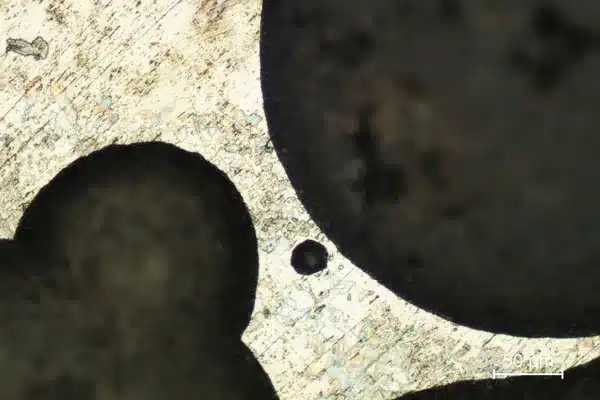
Crevice corrosion starts at lower chloride levels than pitting does, because the gap concentrates the attack. This is why published chloride limits are set with crevices in mind.
Tea staining is the brown discolouration seen on coastal handrails and cladding. The Australian Stainless Steel Development Association (ASSDA) describes it as a cosmetic issue that does not affect structural integrity or service life. It occurs most often within about 5 km of the surf, and in windy or polluted locations it can appear 20 km or more inland.
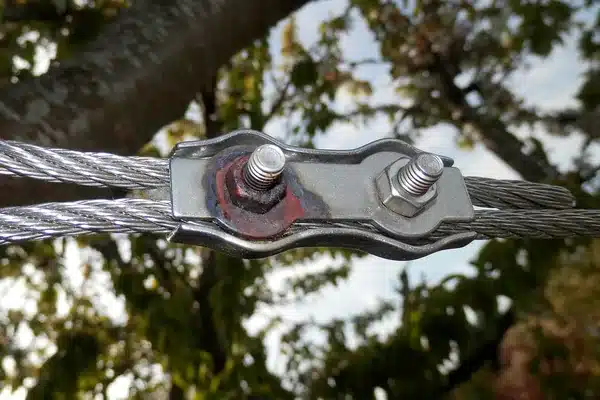
Iron contamination is the one that surprises buyers. The stainless is fine. The rust belongs to particles of ordinary steel sitting on it. The British Stainless Steel Association (BSSA) lists the usual sources: non-stainless work tables, lifting chains, and cutting or grinding debris from carbon steel that settles on the stainless. As soon as that debris gets wet, it rusts and stains. The cover photo shows the same thing at a larger scale: one nut, almost certainly plain steel, rusting on an otherwise clean stainless clamp.
Sensitisation happens when an austenitic grade such as 304 is held between roughly 500 and 850°C, as it is beside a weld. Chromium combines with carbon at the grain boundaries, and the metal next to them is left short of chromium. Low-carbon “L” grades, capped at 0.03% carbon, largely avoid the problem.
Stress corrosion cracking is the dangerous one, because it gives little warning. It needs three things together: chlorides, tensile stress and heat.
The Numbers That Decide It: Chromium, PREN, Chloride and Temperature
Four numbers decide whether a given stainless steel will rust in a given place. If you remember only one section of this guide, make it this one.
1. Chromium content. The floor is 10.5%. Common grades carry 16 to 18% or more, which makes the film more stable.
2. PREN. The pitting resistance equivalent number ranks grades by composition:
PREN = %Cr + 3.3 × %Mo + 16 × %N
Molybdenum counts 3.3 times as much as chromium, which is why the 2 to 3% molybdenum in 316 matters so much. BSSA’s published ranges put 304 at 17.5 to 20.8 and 316 at 23.1 to 28.5. One caution from BSSA itself: PREN ranks grades against each other, but it cannot predict whether a grade will suit a particular application.
3. Chloride level. Nickel Institute guidelines, as summarised by ASSDA, allow the following for continuous exposure at neutral pH and ambient temperature:
| Grade | Chloride guideline | Chlorine (disinfectant) guideline |
|---|---|---|
| 304 | 200 ppm | 2 ppm |
| 316 | 1,000 ppm | about 5 ppm |
| 2205 duplex | 3,600 ppm | not stated |
These figures allow for crevices but assume a passivated surface. Higher temperatures lower them.
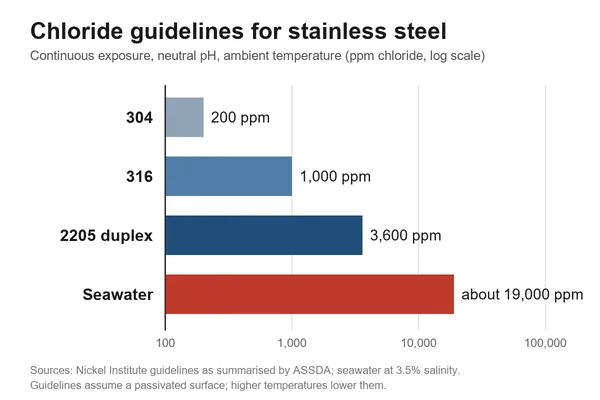
For scale, drinking water is usually far below 200 ppm chloride. Seawater averages 3.5% salt, which works out to roughly 19,000 ppm chloride. That is about 19 times the guideline for 316. Calling 316 “marine grade” is fair for sea air and splash, and misleading for permanent immersion.
Note the difference between chloride and chlorine. Chloride is the salt ion. Chlorine is the disinfectant in bleach and pool water, and it is far more aggressive: the guideline for 304 is just 2 ppm.
4. Temperature. ASSDA does not recommend 304 or 316 above 60°C in chloride service, because of the risk of sudden failure by stress corrosion cracking. Hot water systems and heated pool buildings are where this bites.
Surface finish is a fifth factor worth a number. Abraded surfaces smoother than about 0.5 µm Ra are much less prone to staining than rougher ones, because deep grooves hold salt.
Which Grades Rust First
Stainless steel is a family of alloys, and the grade decides how soon rust appears. The table runs from least to most resistant.
| Grade | Family | Typical chromium | Other key elements | PREN (BSSA range) | Rust behaviour |
|---|---|---|---|---|---|
| 410 | Martensitic | about 12% | none | not listed | Stains readily outdoors; used for cutlery blades and tools |
| 430 | Ferritic | 16–18% | no nickel | 16.0–18.0 | Fine indoors and dry; likely to stain in marine air |
| 201 | Austenitic | 16–18% | manganese replaces part of the nickel | not listed | Often sold as a cheaper stand-in for 304; less resistant |
| 304 | Austenitic | about 18% | about 8% nickel | 17.5–20.8 | The general-purpose grade; fails in chlorides above its limit |
| 316 | Austenitic | 16–18% | 2–3% molybdenum | 23.1–28.5 | Coastal air, de-icing salt, many chemicals |
| 2205 | Duplex | about 22% | about 3% molybdenum, nitrogen | 30.8–38.1 | Hot chloride service, severe marine atmospheres |
| 904L | Austenitic | about 20% | 4–5% molybdenum | 32.2–39.9 | Acid and aggressive chloride duty |
| Super duplex | Duplex | about 25% | molybdenum, nitrogen | above 40 | Seawater systems |
Two practical points follow from the table.
First, a lot of consumer “stainless” that rusts early is 201 or 430 sold without a grade stamp. A magnet doesn’t settle the question, since 430 is magnetic and cold-worked 304 can be too. Our guide on whether stainless steel is magnetic explains why the magnet test misleads.
Second, the jump from 304 to 316 is the most common upgrade and the one buyers most often get wrong in both directions. We compare the two in detail, including the 2026 price gap, in 304 vs 316 stainless steel.
Where It Rusts and Where It Doesn’t
The same grade can last decades in one place and stain within months in another. Use this table as a starting point for the minimum grade.
| Environment | Minimum grade to consider | Why |
|---|---|---|
| Indoors, dry | 430 or 304 | Almost no chloride or moisture |
| Kitchens, food contact, fresh water | 304 | Chloride normally well under 200 ppm |
| Urban or rural outdoors | 304 | Rain washes the surface; low salt |
| Water at 200–1,000 ppm chloride | 316 | Above the 304 guideline |
| Within about 5 km of the surf | 316, smooth finish | Salt deposits cause tea staining on 304 and 430 |
| Road de-icing salt | 316 | Chloride splash and crevices |
| Chloride service above 60°C | 2205 duplex | 304 and 316 risk stress corrosion cracking |
| Seawater immersion | Super duplex, PREN above 40 | About 19,000 ppm chloride |
| Pool water, continuous | 316, with the chlorine level watched | Guideline is about 5 ppm chlorine |
Three situations cause most of the surprises.
Sheltered coastal surfaces. A handrail under a balcony never gets rained on, so salt builds up. The exposed rail beside it stays cleaner. ASSDA’s advice is blunt: if the window next to it needs washing, wash the stainless too.
Dishwashers and sinks. Salt, acidic food and bleach-based cleaners left to dry on the surface can pit 304. Rinse and dry instead of soaking.
Fasteners. A stainless bolt in a carbon steel bracket collects rust from the bracket. A carbon steel bolt in stainless does what the cover photo shows.
Stainless vs Other Ways to Stop Rust
Stainless steel is one of four common ways to keep iron from rusting, and it is not always the right one. The others add protection from outside the metal.
| Approach | How it protects | Self-repairing? | Weak point |
|---|---|---|---|
| Stainless steel | Chromium oxide film from the alloy itself | Yes, if oxygen reaches the surface | Chlorides, crevices, contamination |
| Galvanised steel | Zinc layer corrodes in place of the steel | Partly, at small scratches | Zinc is used up over time |
| Painted or coated steel | Barrier film | No | Any break in the coating |
| Aluminium | Aluminium oxide film | Yes | Chlorides, contact with other metals |
Stainless costs more up front and asks for the least maintenance afterward. A coated carbon steel part is cheaper on day one, but it depends completely on the coating staying whole. Aluminium also protects itself with an oxide film, and it has its own failure modes, which we cover in Does Aluminum Rust?.
How to Remove Rust and Keep It Away
Rust on stainless steel can usually be removed, and the method depends on how deep it goes. Start with the mildest option that works. This ladder follows BSSA guidance.
| Severity | What to use |
|---|---|
| Light staining | Domestic cream cleaner (calcium carbonate based) or a citric acid cleaner |
| Fresh iron dust | Saturated oxalic acid solution |
| Moderate staining | Phosphoric acid cleaner or dilute nitric acid |
| Severe staining, weld tint | Nitric/hydrofluoric pickling paste, applied by a trained operator |
After any acid treatment, rinse thoroughly with clean water. Then let the surface dry in air so the film can reform.
Three things to avoid:
- Carbon steel wool or wire brushes. They leave iron behind and start the problem again. Use stainless or nylon.
- Bleach and hydrochloric acid. Both attack the film directly. Remember the 2 ppm chlorine guideline for 304.
- Rubbing across the grain. It roughens the finish, and rough surfaces hold salt.
To keep rust away, work through this list at the specification stage:
- Pick the grade from the chloride level and temperature, not from habit.
- Specify the finish. For coastal work, ask for 0.5 µm Ra or smoother.
- Design out crevices. Seal lap joints, avoid ledges and let surfaces drain.
- Keep carbon steel away during fabrication. Dedicated tools, non-metallic contact materials and covered storage.
- Passivate after fabrication. ASTM A967 covers nitric and citric acid passivation treatments, and ASTM A380 describes the ferroxyl test, where a blue stain within about 15 seconds shows free iron.
- Use L grades for welded parts in corrosive service.
- Wash it. In marine air, a wash every three to four months with low-chloride water and detergent is a typical cycle.
How to check what you were sold. Ask for the mill test certificate and read the chromium, nickel and molybdenum figures against the grade you ordered. A 316 certificate with no molybdenum figure isn’t a 316 certificate. Our guide to EN 10204 3.1 and 3.2 certificates explains what each certificate level proves. Where the stakes are high, a handheld XRF analyser confirms the molybdenum on the part itself.
What Electrical Steel Does Instead
Electrical steel has no chromium film, so it rusts like ordinary steel and has to be protected from outside. This is the material we supply, and the comparison with stainless explains a lot of what buyers see on arrival.
Silicon steel is alloyed for magnetic performance, with around 3% silicon in grain-oriented grades. Silicon lowers core loss. It does nothing for rust resistance. Electrical steel grades are specified on core loss and magnetic induction, and none of the standard grades carries the 10.5% chromium a passive film needs.
Protection therefore comes from two places.
The insulation coating. Every lamination carries a thin coating whose main job is electrical: it keeps eddy currents from flowing between sheets. It also helps with corrosion in transit, but that is a side benefit, and the cut edges of a slit coil are bare. Our guide to electrical steel coating types covers what each class does.
The packing. A sea voyage means two to four weeks of humidity. Our export packing uses a moisture-proof wrap, corrosion-inhibiting interleaving paper matched to the coating and the transit time, edge protectors at the inner and outer diameter, and a weatherproof outer wrap or crate.
What does that mean at your receiving dock? Check the wrap for tears and water marks before you sign for the coils. Store them indoors and off the floor, and let cold coils reach room temperature before unwrapping so condensation doesn’t form on the steel. If you find rust on the coated face or the edges, photograph it with the coil label before unwrapping further and send it to your supplier the same day.
If you’re ordering grain-oriented silicon steel or non-oriented coil for a long sea route or a humid destination, tell us the route and the expected storage time when you ask for a quote. We’ll match the packing to it and state it in the quotation.
When Stainless Is the Wrong Answer
Stainless steel is the wrong choice in a few situations where buyers often assume it is the safe one. Knowing them saves money in both directions.
- Permanent seawater immersion with 304 or 316. Both sit far below the roughly 19,000 ppm chloride of seawater. Use a super duplex grade or a different material system.
- Hot chloride service above 60°C with 304 or 316. The risk is cracking, not staining, and it can be sudden.
- Where appearance doesn’t matter and loads are modest. Galvanised or painted carbon steel often does the job for less.
- Magnetic cores. Stainless grades make poor core material for motors and transformers. Cores need electrical steel, protected by coating, packing and the finished equipment’s enclosure.
- Low-oxygen deposits. Under permanent sludge or marine growth the film can’t repair itself, whatever the grade.
On the other side, specifying 316 for a dry indoor part pays for molybdenum that will never be needed. Grade 304 or even 430 does the same job there.
Bottom Line
Stainless steel does rust, but only when something defeats its chromium oxide film. Decide in this order.
- What is the chloride level? Under 200 ppm, 304 is enough. Up to 1,000 ppm, use 316. Above that, look at duplex grades.
- Is it above 60°C with chlorides present? If yes, skip 304 and 316.
- Is it near the coast? Use 316 at minimum, with a smooth finish and a washing routine.
- Is the rust on new work? Suspect iron contamination before blaming the grade. Clean it, passivate it and check the certificate.
And if the part is a motor or transformer core, the answer isn’t stainless at all. It is electrical steel, kept dry. For grades, coatings and export packing on silicon steel coil or slit strip, request a quote with your grade, size and destination, and we’ll reply with the specification and packing detail.
Cover photo: Lpele, Wikimedia Commons, CC BY-SA 4.0.
FAQ
Does stainless steel rust in water?
In clean fresh water, no. Grade 304 is rated for continuous contact with water up to about 200 ppm chloride, and most drinking water is well below that. Rust starts when chloride is higher, when water sits stagnant in crevices, or when the surface carries iron contamination.
Does stainless steel rust in salt water?
Yes, common grades do. Seawater holds roughly 19,000 ppm chloride, against guidelines of 200 ppm for 304 and 1,000 ppm for 316. Grade 316 copes with sea air and splash if it is rinsed. Permanent immersion needs a super duplex grade with a PREN above 40.
Does 304 stainless steel rust?
It can. Grade 304 is reliable indoors, in fresh water and in most outdoor air. It pits or tea-stains in coastal air, with de-icing salt, with bleach-based cleaners and in water above about 200 ppm chloride.
Does 316 stainless steel rust?
Less readily than 304, because of its 2 to 3% molybdenum, but yes. It can tea-stain near the sea if the surface is rough or unwashed. It can pit in stagnant seawater, and it can crack in hot chloride service above 60°C.
Why is my new stainless steel rusting?
The most common cause on new work is iron contamination. Carbon steel dust from grinding, tools or handling gear sits on the surface and rusts when it gets wet. Clean it off with a citric or phosphoric acid cleaner, rinse well, and the stainless underneath is normally undamaged.
How do you remove rust from stainless steel?
Start mild. Use a cream cleaner or citric acid cleaner for light stains, oxalic acid for fresh iron dust, and phosphoric acid cleaner for heavier staining. Rinse thoroughly and let the surface dry in air. Don’t use carbon steel wool, bleach or hydrochloric acid.
Is rust on stainless steel a structural problem?
It depends on the type. Tea staining is cosmetic and does not affect structural integrity. Pitting and crevice corrosion can penetrate deep under a small surface mark, and stress corrosion cracking can cause sudden failure, so those need investigation.
Have a question about rust protection on electrical steel coil in transit? Contact our team with your route and grade.
References
- Cedinox (Spanish Stainless Steel Development Association) — Stainless steel protects itself
- Scientific American — Why doesn’t stainless steel rust?
- British Stainless Steel Association — Calculation of pitting resistance equivalent numbers (PREN)
- Australian Stainless Steel Development Association — Chlorine and chloride: same element, very different effect
- Nickel Institute — Resistance of stainless steel to corrosion in naturally occurring waters
- Australian Stainless Steel Development Association — Preventing coastal corrosion (tea staining)
- Australian Stainless Steel Development Association — Seven ways to prevent tea staining of stainless steel
- British Stainless Steel Association — Iron contamination and rust staining on stainless steel
- Austral Wright Metals — Sensitisation of austenitic stainless steels
- ASTM International — ASTM A967/A967M: Chemical passivation treatments for stainless steel parts
- Wikipedia — Seawater
- ASTM International — A240/A240M: Chromium and chromium-nickel stainless steel plate, sheet and strip


