
No, aluminum does not rust. Rust is iron oxide, and aluminum contains no iron, so the reddish-brown flaking you see on old steel cannot form on it. What aluminum does instead is oxidize instantly into a thin, hard layer of aluminum oxide that seals the metal underneath. That layer is why an aluminum ladder looks the same after ten years in a garage.
But “doesn’t rust” is not the same as “doesn’t corrode.” Aluminum corrodes quickly under three conditions: when the surrounding water is too acidic or too alkaline, when chlorides such as sea salt break through the oxide film, and when it touches a more noble metal like steel or copper in the presence of moisture.
We supply grain-oriented and non-oriented electrical steel to transformer and motor builders, and this question reaches us in a specific form: if the windings are aluminum, what in this transformer is actually going to corrode? The honest answer is usually the steel, including the core we sell. This article explains why, and what each material needs.
Key takeaways
- Aluminum cannot rust; rust is specific to iron and steel.
- Aluminum’s oxide film is stable roughly between pH 4 and pH 8.3. Outside that range, the film dissolves and the metal corrodes.
- Chlorides (coastal air, road salt, seawater) cause pitting, which shows up as white powder rather than red flakes.
- Aluminum touching steel or copper in wet conditions becomes the sacrificial metal. Insulating the joint is the standard fix.
- In a liquid-filled distribution transformer, aluminum windings sit sealed in oil. The silicon steel core is the component that can rust, mostly before assembly, during shipping and storage.
Rust vs. corrosion: why aluminum is chemically unable to rust
Rust is the common name for hydrated iron(III) oxide, the reddish product that forms when iron or steel reacts with oxygen and water. Corrosion is the broader term for any metal degrading through chemical or electrochemical reaction with its environment. Every rust is corrosion; most corrosion is not rust.
Shapes by Hydro, the extrusion arm of one of the world’s largest aluminum producers, puts it bluntly in a piece written by one of its corrosion researchers: aluminum cannot rust, and that is a chemical fact, not a marketing claim. The metal has no iron to turn into iron oxide.
Aluminum is actually a very reactive metal. Left bare in air, it grabs oxygen almost immediately and forms aluminum oxide (Al₂O₃). The important difference from steel is what happens next:
| Steel (rust) | Aluminum (oxide) | |
|---|---|---|
| Oxide formed | Iron oxide / hydroxide | Aluminum oxide |
| Film thickness | Grows continuously | A few nanometres, self-limiting |
| Adhesion | Porous, flakes off | Dense, tightly bonded |
| Effect on metal below | Exposes fresh metal, corrosion continues | Seals the surface, corrosion stops |
| If scratched | Rust spreads from the scratch | Film re-forms on its own almost immediately |
| Colour | Red-brown | Invisible to dull grey; white powder when attacked |
Rust flakes away and keeps exposing new steel, so the attack never stops on its own. Aluminum oxide stays put, and because it is so thin it doesn’t even change the look of the metal. That is the whole reason aluminum became the default for window frames, boat hulls and, as we’ll get to, transformer windings.
Three conditions that break aluminum’s oxide film
The oxide film is excellent, but it has limits, and nearly every case of aluminum “going bad” comes down to one of three things.
1. The water is too acidic or too alkaline
Aluminum is amphoteric, which means both acids and alkalis dissolve it, and they dissolve its oxide film too. A Pourbaix diagram (a map of which chemical form of a metal is stable at a given pH and electrical potential) shows the safe window clearly. Course material from George Mason University’s electrochemistry teaching gives the boundaries this way:
- Below pH 4: dissolved Al³⁺ ions are the stable form, so the metal corrodes.
- Between pH 4 and pH 8.3: Al₂O₃ is stable and protects the metal.
- Above pH 8.3: the aluminate ion is stable, so the film dissolves again.
The same source notes that these boundaries are not fixed lines; they shift with what else is dissolved in the water. In practice that makes the window “roughly 4 to 8.5,” and you’ll see slightly different numbers quoted in different references.
Common real-world ways to leave that window:
- Alkaline cleaners and degreasers. Many heavy-duty alkaline cleaners sit well above pH 8.3, and aluminum washed with them comes out dull and etched.
- Wet concrete and mortar. Fresh cement is strongly alkaline, which is why aluminum embedded in or splashed with wet concrete corrodes.
- Acidic process environments. Pickling areas, some chemical plants, and places where acidic condensate collects.
2. Chlorides punch through the film (pitting)
Chloride ions are small and aggressive, and they attack the oxide film at weak spots. Instead of an even layer of corrosion, you get pitting: small, deep holes that fill with white corrosion product. Hydro’s corrosion team singles out chloride-containing environments as the main trigger for this kind of localized attack.
This is why a piece of aluminum trim can look perfect inland and pockmarked after a few seasons near the coast. The white, chalky crust people sometimes call “aluminum rust” is aluminum hydroxide and oxide, and in a coastal setting it usually means chlorides are involved.
3. It touches a more noble metal while wet (galvanic corrosion)
When two different metals are electrically connected and wetted by an electrolyte, they form a battery. The more active metal (the anode) corrodes faster, and the more noble one (the cathode) is protected. Aluminum sits toward the active end of the galvanic series, so when it is paired with carbon steel, stainless steel or copper, aluminum is the one that gives way.
The Australian Stainless Steel Development Association (ASSDA), referencing the ASTM G82 galvanic series, lists three conditions that all must be present:
- An electrolyte: the joint has to be wet with a conductive liquid.
- Metal-to-metal contact: the two metals must be electrically connected.
- A sufficient potential difference between the two metals.
Take away any one, and galvanic corrosion stops. That is why the fixes are so simple in principle: keep the joint dry, put an insulator between the metals, or pick metals that sit close together on the series.
Two details from those sources matter a lot in the field:
- Water quality changes everything. ASSDA notes that low-conductivity rainwater causes only slight galvanic effects, while salt or industrial pollution raises the water’s conductivity and makes the attack much worse.
- Area ratio matters. A small piece of aluminum bolted to a large steel structure corrodes fast, because all of the steel’s cathodic current concentrates on that small anode. ASSDA’s rule of thumb: if the wetted area of the corroding metal is about 10 times that of the noble metal, galvanic effects are not serious. It also warns that as a joint dries after rain, a comfortable 1:50 ratio can collapse to 1:1 in the last wet film.
The American Galvanizers Association gives a sense of scale for aluminum’s position. In seawater it lists aluminum at about −0.86 V and zinc at about −1.10 V. That gap of roughly 0.24 V is small, which is why aluminum next to galvanized (zinc-coated) steel is usually low risk. Steel, copper and stainless steel all sit on the noble side of aluminum, so pairing aluminum with any of them bare is where trouble starts.
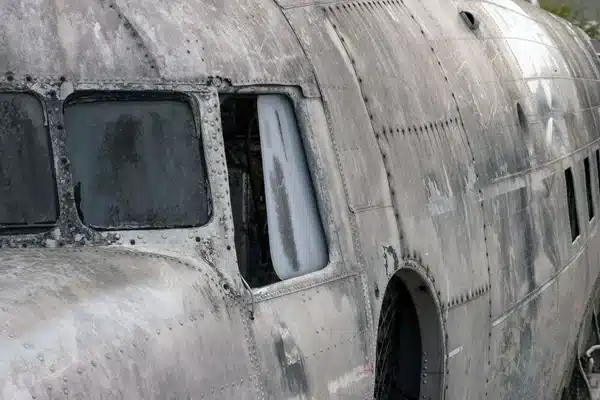
Decades outdoors leave aircraft aluminum dull and grey. The oxide film does its job: no red rust, no flaking.
Does aluminum rust in water?
It doesn’t rust, but what happens depends heavily on the water.
| Water type | What happens to plain aluminum | Why |
|---|---|---|
| Clean freshwater, near-neutral pH | Very little; film stays intact | pH sits inside the 4–8.3 window, low chloride |
| Rainwater | Minimal; slow dulling | Low conductivity, near-neutral |
| Seawater / salt spray | Pitting over time, white deposits | Chlorides attack the film |
| Alkaline water (cleaners, concrete runoff) | Etching, general thinning | pH above the stable window |
| Water bridging aluminum and steel | Aluminum corrodes at the joint | Galvanic cell |
Alloy matters too. Marine and outdoor aluminum is usually specified in the 5xxx (aluminum–magnesium) or 6xxx series; the copper- and zinc-bearing high-strength 2xxx and 7xxx alloys are generally less forgiving in wet, salty service.
Inside a transformer: aluminum windings, steel core
Here is where the question gets practical for our customers.
Aluminum windings are the norm, not a compromise
In North American distribution transformers, aluminum has been the dominant winding material for about thirty years, according to transformer supplier Maddox. Their engineering write-up (authored by Matt Estelle, Ben Gulick and Mac Spiller, first published in 2022 and updated in March 2026) lays out the trade:
- Aluminum’s conductivity is about 60% that of copper, so manufacturers enlarge the conductor to match copper’s losses.
- Copper-wound units come out roughly 20% heavier and can cost 2 to 3 times more than aluminum-wound ones.
- Efficiency is not the variable. Under current DOE rules, a 500 kVA three-phase liquid-filled padmount must meet 99.35% efficiency regardless of winding material.
On corrosion specifically, Maddox makes a point that answers most of the worry: in liquid-filled transformers, the winding connections are sealed in dielectric fluid. There is no oxygen-and-moisture environment inside a healthy, sealed tank, so the aluminum windings have none of the three conditions above. Aluminum joints are typically welded rather than bolted, which also removes the loose-connection oxidation problem people remember from aluminum house wiring.
The core is the part that can rust
The core is a different story. Grain-oriented electrical steel (CRGO) and non-oriented electrical steel (CRNGO) are iron with roughly 3% silicon added. The silicon is there for magnetic reasons: lower core loss and higher resistivity. It does not make the steel stainless. Electrical steel rusts like other low-alloy steel when bare metal meets moisture and oxygen.
In a finished, sealed, oil-filled transformer, the core sits in oil and rust is rarely the issue. The risk sits in the weeks before that: coils in transit, slit strip waiting in a warehouse, and laminations stacked on the shop floor before assembly.
The core does have one layer of defence. Its insulation coating, whose main job is to insulate laminations from each other and keep eddy-current losses down, also covers the bare surface. The coating types differ (we compare them in our guide to C-2 vs C-5 electrical steel coatings). But slit edges and punched edges are bare metal no matter what coating the coil carries, and edges are where we see the first rust spots when packaging fails.
| Component | Typical material | Can it rust? | Main corrosion risk | Standard protection |
|---|---|---|---|---|
| Windings (distribution units) | Aluminum (or copper) | No | Galvanic attack at external Al–Cu joints if exposed | Sealed in oil; welded joints inside; bimetallic connectors outside |
| Core | Grain-oriented or non-oriented electrical steel (Fe–Si) | Yes | Rust on bare edges and damaged coating during transit and storage | Insulation coating; moisture-barrier packing; dry storage |
| Tank | Usually painted mild steel | Yes, if paint fails | Coastal and industrial atmospheres | Paint systems; stainless tanks in harsh coastal sites |
| External hardware | Mixed metals | Depends | Galvanic pairs at fasteners | Isolation washers and compatible fasteners |
What coastal and humid routes teach us about the steel side
Most of our rust conversations are about the time between our mill and a customer’s core line, not about finished transformers.
One recent example is the Gulf region. We shipped 38 tons of standard 0.27 mm CRGO, slit to five widths from 142 mm to 210 mm, to a distribution transformer core maker supplying utility and industrial projects there. We wrote that order up in detail in 38 tons of custom-slit CRGO coils for the Middle East. The biggest risk on that route was not the voyage. It was the long dwell in hot, humid port conditions before inland transport, which is harder on moisture-barrier wrap than a short regional route. So we specified the packing for the destination port’s humidity and dwell time rather than using a generic export default.
On a typical ocean route, bare or lightly protected steel faces two to four weeks of humidity exposure at sea. The protection is mundane but effective: moisture-proof wrap, corrosion-inhibiting interleaving paper matched to the coating and the transit time, and edge protectors so the wrap isn’t torn at the coil faces. We walk through the container side in our steel coil packing and container loading guide.
Condensation during temperature swings in the container, sometimes called container rain, is the classic cause of rust spots on arrival. A cold coil unpacked in a warm, humid receiving bay can also sweat and start to spot.
What we suggest buyers check when coils arrive, especially at coastal plants:
- Look at the wrap before cutting it. Tears, crushed edges or water staining on the outer layer tell you where to inspect first.
- Let cold coils reach room temperature before unwrapping in a humid bay, so moisture doesn’t condense on the steel.
- Inspect slit edges first. That is where bare metal meets air, and it is where rust shows up before it appears anywhere on the coated surface.
- Store indoors and off the floor, away from doors that open to salt air, and don’t leave partly used coils unwrapped over a weekend.
- Photograph anything suspicious on arrival so it is documented against the shipment.
None of this applies to the aluminum windings going into the same transformer. That is the core of the answer: in an electrical equipment plant, the aluminum is rarely the metal you need to worry about rusting.
Aluminum vs. stainless vs. galvanized vs. electrical steel
Buyers often lump these together, so here is how they compare on rust:
| Metal | Rusts? | Why | What attacks it |
|---|---|---|---|
| Aluminum | No | No iron; self-healing oxide | Strong acids/alkalis, chlorides (pitting), galvanic contact |
| Stainless steel | Rarely | Chromium oxide passive film | Chlorides, crevices, contamination with carbon steel |
| Galvanized steel | Slowly, after the zinc is consumed | Zinc corrodes sacrificially first | Acidic or salty environments speed up zinc loss |
| Electrical steel (CRGO/CRNGO) | Yes | Iron–silicon; coating is for insulation, not rust-proofing | Moisture on bare edges, condensation, damaged coating |
| Carbon steel | Yes | Iron with no protective film | Moisture and oxygen |
If magnets are part of the same buying question, we covered that in is stainless steel magnetic?, including why a magnet test tells you less about grade than people expect.
Joints to watch in electrical equipment
A few joints deserve attention during design and installation:
- Aluminum-to-copper terminal connections exposed to air. Use connectors rated for the pair and keep the joint dry and clean. This is the main place the galvanic conditions above can all line up.
- Aluminum brackets or covers bolted to steel frames. Insulating washers or sleeves break the metal-to-metal path. Avoid the small-aluminum-part-on-large-steel-structure arrangement in wet areas.
- Coastal substations. Salt spray supplies chlorides and a conductive electrolyte at once. That is why tank and hardware specifications for these sites are stricter.
For the transformer as a whole, material choice follows duty. Our CRGO steel for distribution transformers page covers how core grade trades off against loss and cost for pole-mounted, pad-mounted and dry-type units. Corrosion protection of the finished unit is a separate layer on top of that choice.
FAQ
Will aluminum rust if it sits in water?
No. Aluminum cannot rust in water or anywhere else, because rust is iron oxide. In clean, near-neutral freshwater, aluminum’s oxide film keeps it stable. In seawater, chlorides cause pitting and white deposits over time, and water that is strongly acidic or alkaline dissolves the protective film.
What eats away aluminum?
Strong alkalis (many heavy-duty cleaners, wet concrete), strong acids, and chloride salts are the main culprits. Contact with steel, stainless steel or copper in wet conditions also makes aluminum corrode faster, through galvanic action.
Can aluminum windings corrode inside an oil-filled transformer?
Not under normal conditions. The windings and their connections are sealed in dielectric fluid, so they lack the oxygen, moisture and electrolyte that corrosion needs. Aluminum winding joints are usually welded, which avoids loose-connection oxidation.
Is the white powder on aluminum a problem?
It is aluminum oxide or hydroxide, the aluminum equivalent of corrosion product. A light haze is cosmetic. Heavy white crusting, especially near the sea or at joints with other metals, means the film is being broken down and the part should be inspected for pitting or galvanic attack.
Does electrical steel rust?
Yes. Grain-oriented and non-oriented electrical steels are iron–silicon alloys, and they rust when bare metal meets moisture. The insulation coating covers the surface, but slit and punched edges are bare. That is why packaging, dry storage and careful unpacking matter more than anything that happens inside a sealed transformer.
Which metals can never rust?
Strictly speaking, any metal without iron cannot rust, including aluminum, copper, zinc, titanium and gold. Whether a metal resists corrosion is a separate question: gold and platinum barely corrode at all, while aluminum, copper and zinc corrode under specific conditions.
References
- Shapes by Hydro. Does aluminum rust? Understanding aluminum corrosion. https://www.shapesbyhydro.com/en/knowledge/does-aluminum-rust-or-corrode-the-key-difference-explained/
- Shapes by Hydro. Galvanic corrosion in aluminum: how to prevent and protect against it. https://www.shapesbyhydro.com/en/knowledge/avoiding-galvanic-corrosion/
- George Mason University, ECE 590 course notes. Pourbaix Diagrams: Phase diagrams for corrosion scientists (Pourbaix diagram for aluminium). http://complex.gmu.edu/people/peixoto/subpages/ece590s08/Pourbaix.pdf
- Australian Stainless Steel Development Association. FAQ 1: Galvanic/Dissimilar Metal Corrosion. https://www.assda.asn.au/publications/technical-faqs/galvanicdissimilar-metal-corrosion
- American Galvanizers Association. Galvanized Steel with Aluminum Parts. https://galvanizeit.org/knowledgebase/article/galvanized-steel-with-aluminum-parts
- Maddox Transformer. Aluminum vs. Copper Windings in Distribution Transformers (M. Estelle, B. Gulick, M. Spiller; updated March 2026). https://www.maddox.com/resources/articles/aluminum-vs-copper-in-distribution-transformers

