
Is aluminum magnetic? Not in the way most people mean. A fridge magnet won’t stick to an aluminum can, window frame, or sheet, and no amount of bending, machining, or cold work changes that. Technically, aluminum is paramagnetic: a very strong magnetic field pulls on it slightly, but the effect is so small you need lab equipment to measure it.
The catch is that aluminum is an excellent electrical conductor. Move a strong magnet near it and aluminum pushes back through induced eddy currents. That behavior explains the classic “magnet falls slowly down an aluminum tube” demo. It’s also how recycling plants sort cans out of scrap, and why aluminum appears all over electric motors and transformers even though it isn’t magnetic at all.
We’re Wuxi Zhongxin Special Steel (ZHX Steel). Most of what we ship is grain-oriented and non-oriented silicon steel, the material that makes a transformer core or motor stator as magnetic as possible. Aluminum usually sits right beside our steel in the finished machine, doing the opposite job. Seeing how the two differ is the quickest way to understand both.

Key Takeaways
- Aluminum is paramagnetic, not ferromagnetic. Its volume magnetic susceptibility is about +2.2 × 10⁻⁵, so its relative permeability is roughly 1.00002, barely distinguishable from air.
- A permanent magnet will not stick to pure aluminum or to standard aluminum alloys (1xxx through 7xxx series), in any temper.
- Unlike 304 stainless, aluminum does not become magnetic after cold working. It has no crystal phase that can transform into a ferromagnetic one.
- A magnet that does stick to “aluminum” is almost always pointing at something else: a steel fastener, a steel core under an aluminum skin, iron contamination, or a part that simply isn’t aluminum.
- Aluminum reacts strongly to a changing magnetic field because it conducts electricity well (about 61% IACS). Eddy current separators, induction braking, and the slow-falling-magnet demo all rely on that property, not on magnetism.
- In electrical equipment, aluminum carries current (transformer windings, die-cast motor rotor bars) while silicon steel carries magnetic flux. Neither material can do the other’s job.
The Short Physics: Why Aluminum Doesn’t Hold a Magnet
For a metal to be strongly magnetic (ferromagnetic), two things have to be true. Its atoms need unpaired electron spins that act like tiny magnets. The crystal also has to line those spins up with their neighbors in the same direction, in regions called magnetic domains. Iron, nickel, and cobalt meet both conditions at room temperature, which is why they’re the basis of nearly every magnetic alloy, including the silicon steel we produce.
Aluminum fails the second condition. Its three valence electrons don’t stay bound to individual atoms. They join a shared “sea” of conduction electrons across the whole metal. When you apply a magnetic field, a tiny extra fraction of those free electrons lines up with it, an effect physicists call Pauli paramagnetism. Remove the field and the alignment disappears at once. Nothing gets locked in, no domains form, and there’s nothing for a magnet to grab.
The numbers show how small the effect is. The CRC Handbook lists aluminum’s magnetic susceptibility at about +2.2 × 10⁻⁵ at 20°C, which gives a relative permeability of about 1.00002. For comparison, grain-oriented electrical steel reaches relative permeabilities in the tens of thousands along the rolling direction. That’s why a transformer core carries flux so easily, and why no engineer would build one from aluminum.
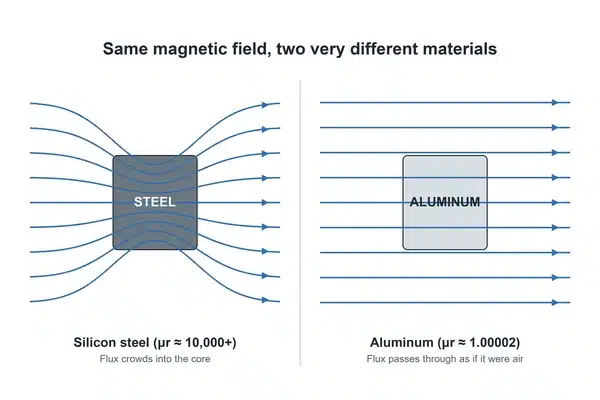
Paramagnetic, Diamagnetic, Ferromagnetic: Where Aluminum Sits
Every material responds to a magnetic field somehow. The response just varies by many orders of magnitude. Here’s how aluminum compares with the other metals buyers usually ask about:
| Material | Magnetic class | Approx. susceptibility (χ, SI volume) | Will a fridge magnet stick? |
|---|---|---|---|
| Aluminum | Paramagnetic | +2.2 × 10⁻⁵ | No |
| Copper | Diamagnetic | −9.6 × 10⁻⁶ | No |
| 304 stainless (annealed) | Paramagnetic (austenitic) | ~10⁻³ to 10⁻² | No, or faintly at cold-worked spots |
| 430 stainless | Ferromagnetic | Very large | Yes |
| Carbon steel | Ferromagnetic | Very large | Yes |
| Silicon (electrical) steel | Soft ferromagnetic | Very large; permeability designed to be as high as possible | Yes, strongly |
Two points stand out from that table.
First, aluminum and copper are nearly mirror images: aluminum is pulled very slightly into a field and copper is pushed very slightly out of it. At everyday scales both effects are close to zero. That’s why the two metals are interchangeable in a magnet test and in most sorting processes.
Second, the gap between “paramagnetic” and “ferromagnetic” is enormous. It isn’t a difference of degree you can close with a stronger magnet. A neodymium magnet held against aluminum still won’t stick, because the force it produces is thousands of times too weak to support even the magnet’s own weight.
If you read our guide on whether stainless steel is magnetic, you’ll notice aluminum is far simpler. Austenitic stainless can turn partly magnetic when strain-induced martensite forms during cold work. Aluminum has no equivalent phase change. Its face-centered cubic structure stays put whether the metal is annealed, rolled hard, drawn into wire, or machined. A magnet test on aluminum gives the same answer every time, as long as the part really is aluminum.
The Falling Magnet Trick: Eddy Currents, Not Magnetism
Drop a strong neodymium magnet down a vertical aluminum tube and it drifts down slowly, as if falling through honey. Drop a same-sized piece of plain steel down the same tube and it falls straight through. At first glance that looks like proof that aluminum is magnetic. It isn’t.
Here’s what actually happens. As the magnet falls, the magnetic field at each section of the tube keeps changing. By Faraday’s law, a changing field induces circulating electric currents, called eddy currents, in any conductor it passes through. By Lenz’s law, those currents create their own magnetic field that opposes the change that caused them. The result is a braking force that grows with the magnet’s speed, so it quickly reaches a slow, steady falling speed.
The things that matter here are conductivity and motion, not magnetism:
- Aluminum conducts electricity well: around 61% of copper’s conductivity by the IACS scale, at about a third of the density. The induced currents are strong, so the braking is strong.
- A stationary magnet sitting against aluminum induces no current at all, so there’s no force. That’s why it just slides off.
- A non-conductive tube (plastic, glass) gives no braking, however strong the magnet.
The same effect runs magnetic brakes on roller coasters, eddy-current dampers in precision balances, and the non-ferrous metal separators discussed below.
“But My Magnet Stuck to It”: Five Common Explanations
Buyers and workshop staff sometimes report that a magnet stuck to what they were told was aluminum. Since aluminum can’t become ferromagnetic, the cause is always something other than the aluminum itself. The usual suspects:
- Steel fasteners, inserts, or reinforcement. Aluminum window frames, truck bodies, and enclosures often contain steel screws, threaded inserts, or hidden steel stiffeners. Move the magnet a few centimeters and the “magnetism” disappears.
- A steel substrate with an aluminum finish. Aluminized steel (hot-dip aluminum-coated sheet, common in exhaust systems and ovens) looks like aluminum but is magnetic carbon steel underneath. The same goes for aluminum-foil-faced composite panels with a steel backing.
- Iron contamination on the surface. Grinding dust, steel shot, or swarf from nearby machining can embed in soft aluminum and give a faint, patchy pull. Wipe or pickle the surface and test again.
- The part isn’t aluminum at all. Magnesium alloys and zinc die-castings are non-magnetic too, so a magnet won’t help you tell them apart from aluminum. But a light-gray painted steel part can pass for aluminum until you pick it up or test it. Weight is a quick clue: aluminum is roughly one-third the density of steel.
- Iron as an alloying element or impurity. Most commercial aluminum alloys contain some iron, often 0.1 to 1%, and secondary (recycled) aluminum can carry more. That iron is bound up in intermetallic particles that aren’t ferromagnetic in bulk, so it doesn’t make the alloy stick to a magnet. It can matter for sensitive magnetic instruments, though, and badly contaminated scrap can show a weak response.
If a magnet grips the flat face of a sheet firmly and evenly, you’re almost certainly looking at steel. Confirm with the mill certificate or a quick XRF check, the same verification approach we describe for mill test certificates on steel orders.
Aluminum and Silicon Steel Inside Motors and Transformers
This is where the question stops being trivia for our customers. Open almost any induction motor or distribution transformer and you’ll find aluminum and electrical steel side by side, each chosen for the property the other lacks.
Induction motor rotors. The standard squirrel-cage rotor is a stack of non-oriented silicon steel laminations with die-cast aluminum poured through slots to form the conductor bars and end rings. The steel carries the rotating magnetic flux. The aluminum carries the currents that flux induces, and those currents produce the torque. Because aluminum is non-magnetic, it doesn’t short-circuit the flux path. Because it conducts well, the rotor losses stay manageable. (Premium-efficiency designs sometimes switch to die-cast copper bars for lower resistance, but aluminum is still the volume choice.)
Transformer windings. Many distribution transformers use aluminum foil or strip windings instead of copper, largely on cost and weight. Aluminum’s conductivity is about 61% IACS against copper’s 100%, so the winding needs more cross-section. Copper price swings over the past few years have pushed more buyers to take that trade-off. What doesn’t change is the core: whatever the winding material, flux still runs through grain-oriented silicon steel or amorphous alloy. Aluminum windings can make the core window slightly larger, which affects core dimensions and the tonnage of steel per unit.
Shielding and stray flux. Large transformers and reactors sometimes line tank walls with aluminum or copper plates to control stray leakage flux. The metal isn’t absorbing the flux magnetically. Eddy currents in the plate push the field back and keep it away from the steel tank, where it would otherwise cause local heating. The same logic explains why aluminum works as a shield against high-frequency electromagnetic interference but does very little against static or low-frequency magnetic fields. For those you need a high-permeability material that pulls the flux into itself.
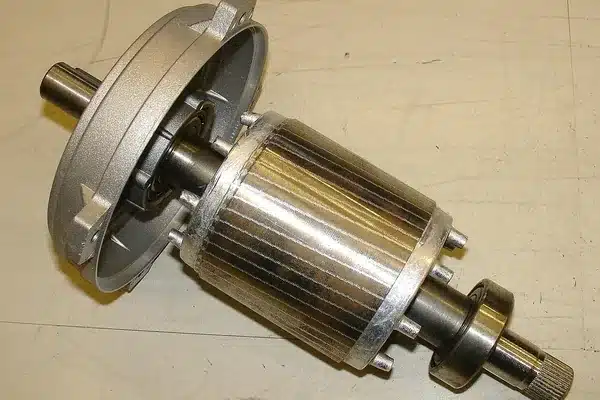
A practical note for motor and transformer builders: since aluminum is non-magnetic, magnetic lifting and handling equipment that works on our steel coils and lamination stacks won’t hold aluminum parts. That sounds obvious, but it matters when a line handles both, for example die-cast rotors after casting. We regularly see aluminum-related questions come up in EV traction motor and industrial motor projects, where the lamination grade and the rotor conductor are chosen together.
How Recyclers Use This to Sort Aluminum
Scrap processing is the clearest large-scale proof that aluminum isn’t magnetic. Recyclers exploit it in two steps:
- Overhead or drum magnets pull out the ferrous fraction (steel, iron, and ferritic stainless). Aluminum passes straight under them.
- An eddy current separator then kicks the aluminum out of the remaining stream. A rotor of alternating permanent magnets spins at high speed inside a conveyor head pulley. The rapidly changing field induces eddy currents in aluminum, copper, and brass pieces, and the resulting repulsion throws them off the end of the belt, clear of the non-conductive glass, plastic, and wood.
Aluminum responds particularly well because it has a high ratio of conductivity to density: plenty of eddy current force per gram of material. Equipment suppliers report recovery rates in the 90-98% range for mixed non-ferrous scrap streams. The whole process would be impossible if aluminum were magnetic. It would simply end up in the ferrous pile.
Bottom Line
Aluminum is not magnetic in any practical sense. It’s paramagnetic, with a susceptibility of about 2 × 10⁻⁵, so a magnet won’t stick to it, and unlike stainless steel it won’t become magnetic through cold work or processing. If a magnet sticks, look for steel hiding somewhere: a fastener, a coating substrate, contamination, or a mislabeled part.
What aluminum does do is conduct electricity well, and that’s why it reacts so strongly to a moving magnet. That same conductivity is why it sits next to silicon steel in nearly every motor and transformer. Aluminum carries the current, and the steel carries the magnetic flux. If your project needs the magnetic half of that pairing, our CRGO and CRNGO product pages list the grades, thicknesses, and coatings we supply.
FAQ
Does a magnet stick to aluminum?
No. Pure aluminum and standard aluminum alloys are paramagnetic, with a magnetic susceptibility around +2.2 × 10⁻⁵. The attraction is far too weak to hold even a small neodymium magnet in place. If a magnet does stick, it’s usually attracted to steel fasteners, a steel substrate under an aluminum coating, or iron contamination, not the aluminum itself.
Is aluminum paramagnetic or diamagnetic?
Paramagnetic. Aluminum has a small positive magnetic susceptibility caused by Pauli paramagnetism of its conduction electrons, so it’s weakly pulled into a magnetic field. Copper, by contrast, is diamagnetic and is weakly pushed out. At everyday scales both effects are negligible, and neither metal will hold a magnet.
Why does a magnet fall slowly through an aluminum tube?
Eddy currents, not magnetism. The falling magnet creates a changing magnetic field in the tube wall, which induces circulating electric currents. By Lenz’s law those currents make a magnetic field that opposes the magnet’s motion, which slows its fall. The effect needs motion and a good electrical conductor, which is why a stationary magnet simply slides off aluminum.
Can aluminum become magnetic?
Not through normal processing. Aluminum has no crystal phase that can turn ferromagnetic, so cold rolling, bending, machining, or heat treatment won’t make it magnetic. This differs from austenitic stainless steels like 304, which can develop localized magnetism after cold work. A magnetic “aluminum” part points to contamination, a steel component, or a different material.
Is aluminum foil magnetic?
No. Aluminum foil is typically 1xxx- or 8xxx-series alloy and behaves exactly like bulk aluminum: paramagnetic and non-magnetic in practice. A magnet won’t stick to it, though a strong magnet moved quickly over thin foil can nudge it slightly through induced eddy currents.
Which metals are not magnetic?
Common non-magnetic metals include aluminum, copper, brass, bronze, zinc, lead, tin, titanium, magnesium, gold, silver, and austenitic stainless steels (304, 316) in the annealed state. Strongly magnetic metals are iron and most steels, nickel, cobalt, and their alloys, including ferritic and martensitic stainless steels and silicon electrical steel.
Why use aluminum in motors if it isn’t magnetic?
Because the motor needs both a magnetic material and a conductor. In an induction motor rotor, silicon steel laminations guide the magnetic flux, while die-cast aluminum bars carry the induced currents that produce torque. Aluminum’s non-magnetic nature keeps it from disturbing the flux path, and its conductivity, low density, and castability make it a cost-effective conductor.
References
- Wikipedia — Aluminium
- CRC Handbook of Chemistry and Physics — Magnetic Susceptibility of the Elements and Inorganic Compounds (4-130)
- MRIquestions.com — What is magnetic susceptibility?
- Bunting — Eddy Current Separators for Metal Recovery
- BAS Industrial — Eddy Current vs Magnetic Separation: When to Use Each
- Eaton — Copper vs. Aluminum Conductor (Product Aid PA202008EN)
- Maddox — Aluminum vs. Copper Windings in Distribution Transformers

