
Low-noise transformer core steel is grain-oriented steel bought against a noise target, not just a core-loss grade. A mill certificate tells you the loss and the B8 of a lot. It does not tell you how much that lot will vibrate. For a quiet transformer, the buyer has to add four things to the order: a sound limit with a named measurement standard, magnetostriction or noise data for the grade, a domain-refinement type that suits the core design, and slit-edge and handling limits that keep stress out of the steel. This guide shows what to write and why.
If you want the physics first, our guide to why transformers hum explains magnetostriction, loose laminations and what is normal. This article picks up where that one stops: what a transformer maker or core shop should ask for when it buys the steel.
Key Takeaways
- A low-noise order starts in the transformer specification: a dB limit, whether it is sound pressure or sound power, at no load or under load, and measured to IEC 60076-10.
- Mill certificates report core loss and B8, not noise. Magnetostriction is measured by separate methods described in IEC TR 62581 and is not part of a standard certificate.
- In a 2025 Hitachi Energy study, prototype transformers built from some laser-scribed steels with reduced remanence were up to 14 dB(A) louder than reference units. The effect was worst in thin gauges.
- Laser-scribed domain refinement suits stacked cores. Its benefit disappears in stress-relief annealing, so wound cores need heat-resistant domain-refined grades or non-refined steel.
- Burrs, camber, edge waves and coating damage add stress, and stress raises magnetostriction. Put edge and flatness limits in the slit-strip order.
- Ask for a sample from the same lot before volume, and keep lot traceability so a noise problem can be traced to the steel.
Why Is Low-Noise Core Steel Harder to Buy in 2026?
Because the push for lower losses has moved buyers towards thinner, domain-refined grades, and new research shows that some of those grades can make transformers louder.
At the 27th Soft Magnetic Materials Conference in Turin in 2025, David Weinberg and Claes Carrander of Hitachi Energy in Ludvika, Sweden, reported a two-stage test. They took laser-scribed grain-oriented steel from three suppliers, in thicknesses from 0.18 to 0.27 mm, all showing reduced remanence. They tested the same batches in the lab and in prototype transformers, and compared them with reference units built from steel without reduced remanence. The prototypes were up to 14 dB(A) louder. The extra noise came from higher harmonics in the sound spectrum, not from a louder fundamental tone. The effect was strongest in thin material and weaker in thicker laminations.
The authors name excessively high laser power as one potential root cause. The point for buyers is simple: core loss on the certificate can look excellent while the noise behaviour has changed. Our page on ultra-thin CRGO covers the 0.18–0.20 mm gauges where this matters most.
Mills are also starting to treat noise as a steel property. In May 2026, Nippon Steel published a European patent application (EP 4737608 A1) for grain-oriented sheet that combines B8 of at least 1.940 T and W17/50 of no more than 0.670 W/kg with a magnetostriction velocity level, Lva, of no more than 46.0 dB for the 200 Hz component at 1.7 T and 50 Hz. That is a patent claim, not a catalogue grade, but it shows where the industry is heading: noise is becoming a measured steel property alongside loss.
What Noise Limit Should Go in the Transformer Specification?
A number, the quantity it refers to, the operating condition and the test standard. Without all four, the steel supplier and the transformer maker cannot design to the same target.
The test standard. IEC 60076-10:2016 sets out sound pressure and sound intensity methods for working out the sound power level of transformers, reactors and their cooling equipment. It is written mainly for factory tests. The 2016 edition moved the standard measurement distance from 0.3 m to 1 m for transformers other than distribution transformers, and added 1/3-octave band measurements for them. In North America, IEEE C57.136-2023 is the current guide on audible sound of liquid-immersed power transformers, including how site sound levels and local ordinances turn into a design limit.
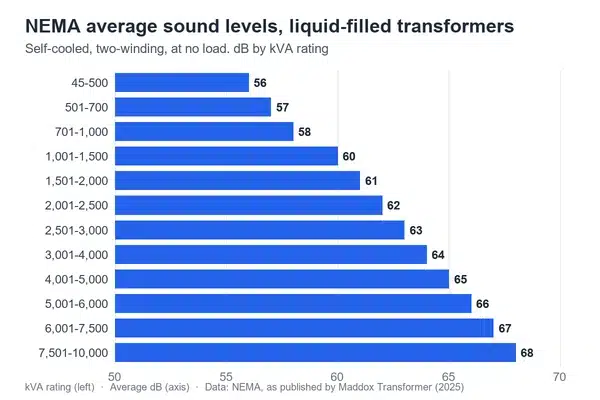
A reference level. Many buyers start from the long-standing NEMA table for liquid-filled transformers and then ask for a margin below it. Maddox Transformer publishes the values: 56 dB for 45–500 kVA, rising to 68 dB for 7,501–10,000 kVA, for self-cooled two-winding units at no load.
| What to state | Example wording | Why it matters |
|---|---|---|
| Limit and quantity | “No-load sound power level ≤ X dB(A)” or “average sound pressure ≤ X dB(A) at 1 m” | Pressure and power are different numbers for the same unit |
| Condition | At rated voltage and frequency, no load; load noise stated separately | Core steel drives no-load noise; windings drive load noise |
| Test standard | IEC 60076-10, or the standard named in your contract | Fixes distance, measurement surface and corrections |
| Supply frequency | 50 Hz or 60 Hz | The main core tone is twice the supply frequency |
| Margin | Design target a few dB below the guarantee | Steel lots and assembly vary |
Once the transformer has a limit, the designer chooses a flux density and core build to meet it. The steel order then has to support that design, which is where the next three sections come in. For the difference between distribution and power units, see distribution vs power transformer steel.
Which Steel Properties Actually Predict Core Noise?
Magnetostriction, its harmonics, and how sensitive it is to stress. Core loss and B8 help, but they are not a noise measurement.
Magnetostriction amplitude and harmonics. Grain-oriented steel changes length slightly as it is magnetized. Nippon Steel noted in a 2002 US patent that noise in the higher-pitched range, where the ear is more sensitive, is scarcely lowered just by using a material with smaller magnetostriction. The shape of the strain waveform matters, not only its peak. That is why newer work uses an A-weighted velocity level. In the 2026 Nippon Steel application, Lva is worked out by converting the magnetostriction waveform to velocity, splitting it into frequency components and applying A-weighting to approximate human hearing.
How it is measured. IEC TR 62581:2010 describes methods for measuring magnetostriction on single sheets and on Epstein strips, using optical sensors and accelerometers under sinusoidal induction. It includes examples of stress effects and coating tension. It is a technical report, not a product standard, so it does not set limits. Our explainer on Epstein frame core loss testing shows the strip test that certificates are based on.
Treat the data as a guide. A 2012 thyssenkrupp Electrical Steel study by L. Lahn and colleagues built three-phase model cores from several laser domain-refinement variants. It found that optimised laser conditions need not raise core noise compared with non-refined steel, and that magnetostriction data give only a rough indication of real core noise. Model-core results or noise results from earlier transformers built with the same grade are stronger evidence.
| Property | What it tells you | On a standard mill certificate? | How to ask for it |
|---|---|---|---|
| Core loss (e.g. P1.7/50) | Energy lost in the steel | Yes | Grade and guaranteed maximum |
| B8 | How well the grains are aligned | Yes | Minimum value |
| Magnetostriction / Lva | Vibration that becomes noise | No | Typical or lot data, test method, induction and frequency |
| Remanence / hysteresis loop | Early warning of the Hitachi effect in laser-scribed grades | No | Loop from the same batch for thin domain-refined grades |
| Coating type and condition | Tension in the steel, insulation | Coating type, not tension | Coating class and visual limits |
None of the mill certificates we have checked from past orders reports a noise or magnetostriction value. If noise data is part of your acceptance, agree it before the order, not at delivery.
Laser-Scribed or Heat-Resistant: Which Grade Suits Your Core?
Match the domain-refinement type to how the core is built. The wrong choice can cost you both loss and noise.
Stacked cores. Cores built from cut laminations are often used without annealing after cutting. Laser-scribed domain-refined grades work here, and they give the lowest losses. For a noise-critical stacked core, ask the supplier how the laser process is controlled, and for thin gauges, ask for a hysteresis loop or remanence value from the batch you will receive. That is the property the Hitachi Energy team linked to extra noise.
Wound cores. Wound cores are stress-relief annealed after winding to remove bending stress. Baosteel states in a 2022 US patent that domain refinement from ordinary laser scoring “disappears after stress-relief annealing”, and that heat-resistant scoring is what makes a product suitable for wound cores that need annealing. For wound cores, order a heat-resistant domain-refined grade, or a conventional or Hi-B grade without laser refinement.
Hi-B or conventional. Hi-B steel has higher B8 and lower loss than conventional grain-oriented steel. Our comparison of Hi-B vs standard CRGO explains the difference. For noise, the useful question is not only which class, but whether the supplier can show noise or magnetostriction results for the exact grade and thickness.
| Core type | Annealed after forming? | Suitable domain-refinement | Ask the supplier |
|---|---|---|---|
| Stacked (cut-to-length laminations) | Often not | Laser-scribed or heat-resistant | Laser process control; remanence for thin gauges |
| Wound (distribution, toroidal) | Yes | Heat-resistant, or none | Confirm the grade keeps its loss after annealing |
How Do Slitting and Handling Change Core Noise?
They add stress, and grain-oriented steel is very sensitive to it. Compressive stress in particular raises magnetostriction, which is why laminations need to stay flat and undamaged on their way into the core.
Most of the stress comes from three places. Slitting and cutting leave burrs and a strained zone along the edge. Poor coil handling creates edge waves, dents and coating scratches. And tight bends or uneven stacking press the steel out of flat. None of these show up on the mill certificate, because the certificate describes the steel before it was slit.
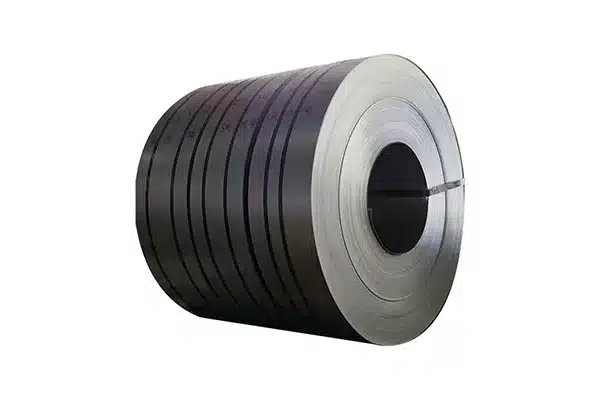
For a low-noise order, write these into the slit-strip specification:
- Burr limit and how it is measured, agreed with the slitter before the first coil.
- Camber and edge wave limits per metre of strip. Our guide to slitting tolerances and camber lists working values for width, burr and camber by gauge.
- Width tolerance suited to your stacking method, so laminations do not have to be forced into place.
- Coating condition: no scratches through the coating, no rust, no oil stains, checked on arrival.
- Packing: eye-to-sky or eye-to-wall as agreed, with edge protection, so coils are not crushed in transit.
What Should a Low-Noise CRGO RFQ Include?
Everything above, in one place. A clear RFQ also gets you faster, comparable quotes.
| RFQ item | What to write | Reason |
|---|---|---|
| Application and noise target | Transformer type, rating, frequency, guaranteed dB and test standard | Lets the supplier propose a suitable grade |
| Grade and thickness | E.g. Hi-B 0.23 mm, guaranteed loss and minimum B8 | Sets the loss baseline |
| Domain refinement | Laser-scribed for stacked cores; heat-resistant or none for wound cores | Avoids losing the benefit in annealing |
| Noise-related data | Magnetostriction or Lva data if available: method, induction, frequency | Shows the grade’s vibration behaviour |
| Batch data for thin DR grades | Hysteresis loop or remanence from the delivered batch | Screens for the reduced-remanence effect |
| Coating | Coating class and condition limits | Coating tension and insulation |
| Slit-strip limits | Width tolerance, burr, camber, edge wave | Keeps cutting stress low |
| Certificates and traceability | EN 10204 3.1 certificate per lot; coil numbers on labels | Lets you trace a noisy unit back to its steel |
| Sample | Sample from the same lot for a model core or first unit | Proves the combination before volume |
For what a type 3.1 certificate does and does not cover, see our guide to EN 10204 3.1 vs 3.2 mill certificates.
We supply grain-oriented coil and slit strip, including Hi-B CRGO in 0.23, 0.27 and 0.30 mm, with domain-refined options in 0.23 mm. Tell us your core type and noise target and we will say which grades fit and send the mill certificate for the offered lot. Coil orders typically start at about 5 tonnes, and smaller lots can be cut from coil. Sheet orders typically start at about 500 kg; if you need less, tell us and we’ll do our best to meet the request. Samples typically cost USD 200 including freight, refunded when you place a production order.
FAQ
What is low-noise transformer core steel?
It is grain-oriented electrical steel chosen and processed to keep transformer core noise low. In practice that means a high-B8 grade with low magnetostriction, a domain-refinement type that suits the core, an intact coating, and slit edges with low burr and good flatness. There is no single standard “low-noise grade”; the noise target has to be written into the order.
Does the mill certificate show how noisy the steel will be?
No. A standard mill certificate reports core loss, magnetic polarization such as B8, thickness and coating, not noise. Magnetostriction is measured separately, using methods like those in IEC TR 62581. If noise data matters, ask the supplier before ordering whether typical or lot-specific data is available.
Are laser-scribed grades louder?
Not necessarily. A thyssenkrupp study found that optimised laser refinement need not raise core noise. But a 2025 Hitachi Energy study measured up to 14 dB(A) more noise in prototypes built from some laser-scribed steels with reduced remanence, mostly in thin gauges. For noise-critical units, ask how the laser process is controlled and check the batch.
Which grade should I use for a wound core?
Use a heat-resistant domain-refined grade or a grade without laser refinement. Wound cores are stress-relief annealed after winding, and ordinary laser domain refinement disappears in that anneal. A heat-resistant grade keeps its low loss after annealing. Confirm with the supplier that the offered grade is meant for annealed cores.
How do I put a noise limit in a transformer specification?
State the limit in dB(A), whether it is sound pressure or sound power, the operating condition (usually no load at rated voltage), the supply frequency and the test standard, such as IEC 60076-10. Design to a target a few dB below the guarantee to allow for variation between steel lots and assembly.
Planning a low-noise transformer or core? Contact us with the grade, thickness, width, core type and quantity you need, and we’ll come back with options and a quote.
References
- D. Weinberg, C. Carrander (Hitachi Energy AB), 27th Soft Magnetic Materials Conference, Torino, 2025 — On the connection between remanence and core noise in transformers (PDF)
- Nippon Steel Corporation, EP 4737608 A1, published 6 May 2026 — Grain-oriented electrical steel sheet
- IEC 60076-10:2016 — Power transformers – Part 10: Determination of sound levels
- IEEE C57.136-2023 — IEEE Guide for Audible Sound of Liquid-Immersed Power Transformers
- M. Estelle, Maddox Transformer, 2025 — Audible sound levels in liquid-filled transformers
- IEC TR 62581:2010 — Electrical steel – Methods of measurement of the magnetostriction characteristics by means of single sheet and Epstein test specimens
- Nippon Steel Corporation, US Patent 6,387,522 B2, 2002 — Grain-oriented electrical steel sheet for low-noise transformer
- L. Lahn, C. Wang, A. Allwardt, T. Belgrand, J. Blaszkowski, IEEE Transactions on Magnetics 48(4), 2012, 1453–1456 — Improved transformer noise behavior by optimized laser domain refinement at ThyssenKrupp Electrical Steel
- Baoshan Iron & Steel Co., US Patent 11,459,634 B2, 2022 — Method for manufacturing stress-relief-annealing-resistant, low-iron-loss grain-oriented silicon steel
- Reddit threads behind this topic: r/AskElectronics, r/hometheater, r/AskEngineers, r/explainlikeimfive (transformer hum questions; see our hum guide)
Image credits
- Grain-oriented steel master coils in warehouse: Zhongxin Steel
- Slit set of grain-oriented steel strip: Zhongxin Steel
- NEMA sound level chart: Zhongxin Steel, data from Maddox Transformer


