Most order profiles cover a single transaction. This one covers a rhythm. The buyer is a US transformer core manufacturer that has placed a grain-oriented strip order with us most months for several years — same two grades, same two slit widths, same item numbers on every proforma invoice.
This profile documents the June order specifically, because June had a wrinkle. Ocean freight out of China tightened partway through the month, and the buyer needed to cut the shipment down to fit the space they could actually book. The order flexed to 15,000 kg without a renegotiation, a new qualification, or a reset production slot — which is the part of a standing supply relationship that only shows its value when something goes sideways.
It includes the full paper trail: the proforma invoice, the email exchange that resized the order, the master-coil mill test certificate, the container loading photos, and the seal. Customer-identifying details and all pricing are redacted under our confidentiality terms.
Core Key Points
- 15,000 kg of grain-oriented electrical steel strip for a US transformer core manufacturer — a recurring monthly order, resized mid-cycle for ocean freight congestion.
- Two grades on one PI: M3 (0.23mm) slit to 12.70mm / 0.500 in, and M4 (0.27mm) slit to 139.70mm / 5.500 in — 4,000 kg and 11,000 kg respectively.
- Master coil sourced from a first-tier Chinese mill (WISCO 27QG120-class Hi-B, J800 ≈ 1.91T, core loss P1.7/50 ≈ 0.88–0.93 W/kg) and slit in-house to the buyer’s two widths.
- The June load was cut from a larger figure to 15,000 kg by email; the PI was revised the same week and production proceeded on a deposit — no lead-time reset, because the grades, widths, and item numbers were already standing.
- Full order documentation included below — proforma invoice, the resize email thread, mill test certificate, loading photos, and container seal — with customer details and pricing redacted.
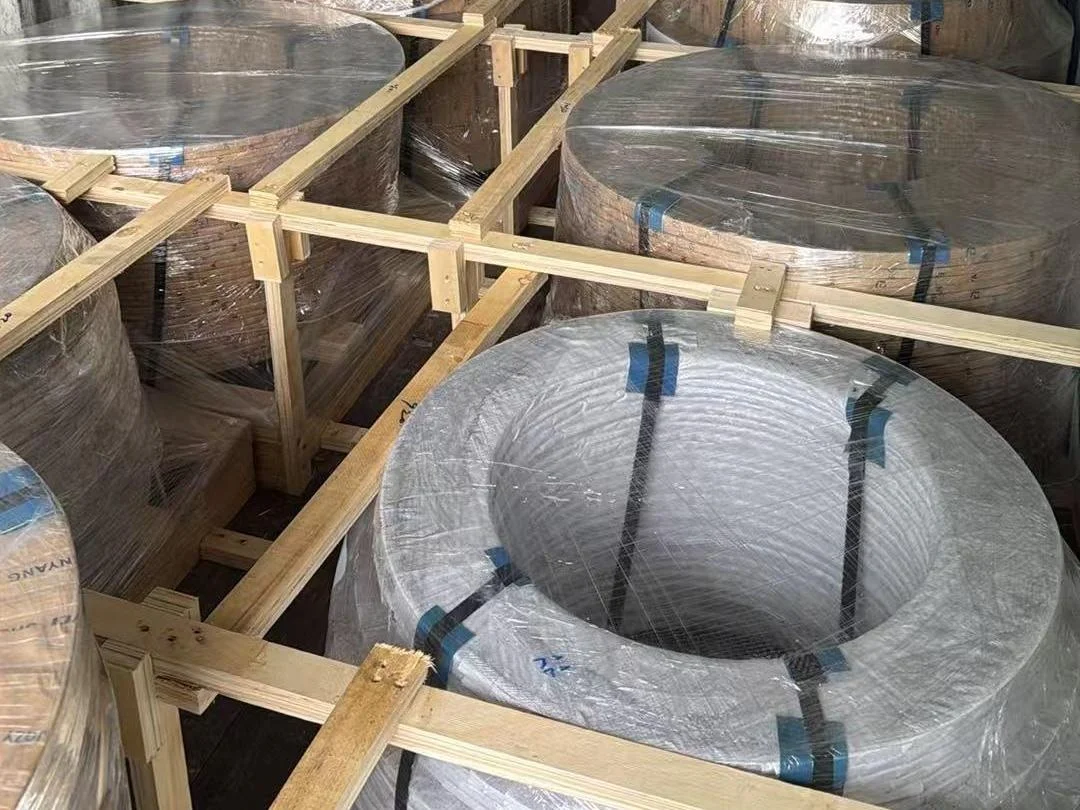
- Slit coils packed eye-vertical, stretch-wrapped with edge protection, and braced with a timber dunnage frame in a 20ft container; bolt-seal number recorded against the shipping documents.
Customer Requirements
The buyer stamps and winds transformer cores from two grain-oriented grades and two strip widths, and has run the same specification with us long enough that each item carries a fixed internal number on our side (67-0158 and 67-0380). A monthly order is, in practice, a quantity update against a standing spec rather than a fresh RFQ.
| Specification | Customer Requirement |
|---|---|
| Product Type | Grain-oriented electrical steel strip (CRGO), slit to width |
| Grade / Thickness — Item 67-0158 | M3, 0.23mm |
| Grade / Thickness — Item 67-0380 | M4, 0.27mm |
| Slit Width — Item 67-0158 | 0.500 in (12.70mm) |
| Slit Width — Item 67-0380 | 5.500 in (139.70mm) |
| Order Quantity (June, revised) | 4,000 kg (M3) + 11,000 kg (M4) = 15,000 kg |
| Master Coil Grade | WISCO 27QG120-class Hi-B, ≈ AISI M4 for the 0.27mm |
| Coating | C5 insulation |
| Core Loss (0.27mm, per mill certificate) | P1.7/50 ≈ 0.88–0.93 W/kg |
| Magnetic Polarization (J800, 0.27mm) | ≈ 1.91–1.92T |
| Lamination Factor | ≥ 98% |
| Documentation | Mill test certificate + Zhongxin export test report |
| Delivery Basis | Priced USD/kg, delivered Wuxi; buyer’s forwarder lifts from there |
| Cadence | Monthly, quantity confirmed per PI |
The number a buyer in a monthly arrangement should watch isn’t the core-loss figure — that’s locked by the standing grade. It’s slit-width consistency month to month. A 12.70mm strip that drifts to 12.85mm on one month’s run will bind in a winding head tuned to the nominal, and the buyer won’t see it until the core shop floor. We log actual width per coil against the nominal on every run, not once per grade.
Why the Order Is Specified in Inches
The buyer designs and tools in imperial, so the order arrives in inches — 0.500 in and 5.500 in — and we slit to the exact millimetre equivalents, 12.70mm and 139.70mm, rather than rounding to a metric nominal. A rounded 12.7mm to 13mm looks trivial on paper but is 0.3mm of extra strip feeding a die set to the half-inch dimension.
Grade names follow the same imperial lineage. M3 and M4 are the old AISI thickness-and-loss designations — M3 at 0.23mm, M4 at 0.27mm — still standard shorthand in the North American transformer trade even though the coil ships against a Chinese mill’s GB grade. Part of running this account is holding both naming systems in the same spec sheet without a translation error.
The June Order, and a Mid-Cycle Change
June started as a larger order. Before the deposit cleared, the buyer’s purchasing lead emailed to say ocean freight out of China had tightened and they had to reduce the load to 15,000 kg to match the space they could book — and listed the two line items to keep, at 4,000 kg and 11,000 kg.
That kind of change is disruptive on a first order and routine on a standing one. Nothing about the grades, widths, coating, or item numbers moved — only the tonnage. We revised the proforma invoice the same week, reissued it against the June reference, and the buyer approved it in one line: “This is approved, please proceed with production.”
The reason it stayed simple is that everything except quantity was already agreed. On a new relationship, resizing an order mid-cycle usually reopens price breaks, minimum-order terms, and the production schedule. Here it reopened one field.
Proforma Invoice
The proforma invoice is the whole order on one page: the two items, the revised quantities, the delivery basis, and our bank details for the deposit. For a monthly account, the PI reference also carries the month, so both sides can file it against the right shipment.
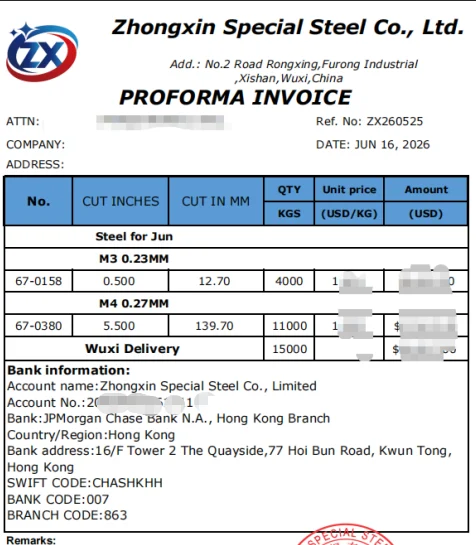
| Field | Detail |
|---|---|
| PI Ref. No. | ZX260525 |
| Date | June 16, 2026 |
| Item 67-0158 | M3 0.23mm, cut 0.500 in / 12.70mm, 4,000 kg |
| Item 67-0380 | M4 0.27mm, cut 5.500 in / 139.70mm, 11,000 kg |
| Unit Price (USD/kg) | [redacted] |
| Amount (USD) | [redacted] |
| Delivery | Wuxi delivery, 15,000 kg |
| Payment | Deposit against revised PI, balance per standing terms |
| Beneficiary Bank | JPMorgan Chase Bank N.A., Hong Kong Branch (details on the PI) |
Two things on this PI matter more than the line items. The delivery basis is “Wuxi delivery” — priced per kilogram to a handoff point, with the buyer’s freight forwarder taking the container onward, so our responsibility and theirs meet at a defined place rather than a vague “FOB somewhere.” Our Incoterms guide for steel imports covers how that split changes who books and insures each leg.
The other is the fixed item numbers. 67-0158 and 67-0380 aren’t line descriptions typed fresh each month — they’re standing SKUs on our system tied to the exact grade, thickness, width, and coating. That’s what lets a resize email name two numbers and be unambiguous.
From Change Request to Approval: The Communication Record
The exchange that resized the order ran over three short emails across two days — request, revised PI, approval.
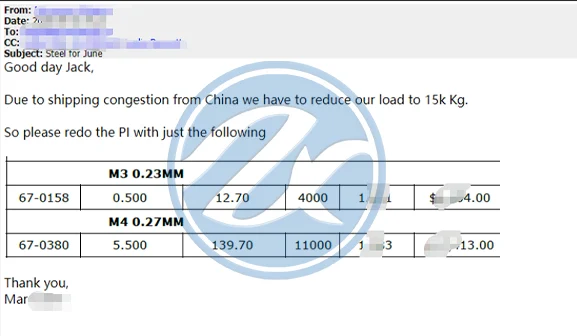
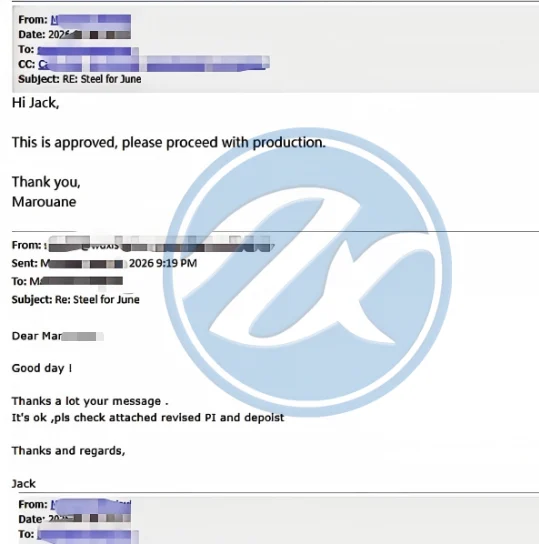
| Step | Channel | Content |
|---|---|---|
| 1 | Email from buyer | “Due to shipping congestion from China we have to reduce our load to 15k Kg” — plus the two line items to retain |
| 2 | Email from Zhongxin | Revised PI (Ref. ZX260525) attached, deposit requested |
| 3 | Email from buyer | “This is approved, please proceed with production” |
No call, no meeting, no renegotiation. On a monthly account the communication record for a change is usually this thin, because the only open question is a number. The value of the standing spec is that it keeps the conversation that small.
Payment
Payment on the June order followed the account’s standing pattern: a deposit against the revised proforma invoice, with the balance settled per the monthly terms already in place between the two companies.
What the deposit released was slitting and finishing capacity, not raw-coil procurement — because the master coil for this grade was already in stock (covered next). On a first order, a deposit starts a mill booking and the clock on a multi-week lead time. On this one, it started a slitting run against material already on the floor.
Our LC versus TT payment terms explainer covers when a monthly buyer should move from repeat T/T deposits to a revolving letter of credit.
Sourcing the Master Coil
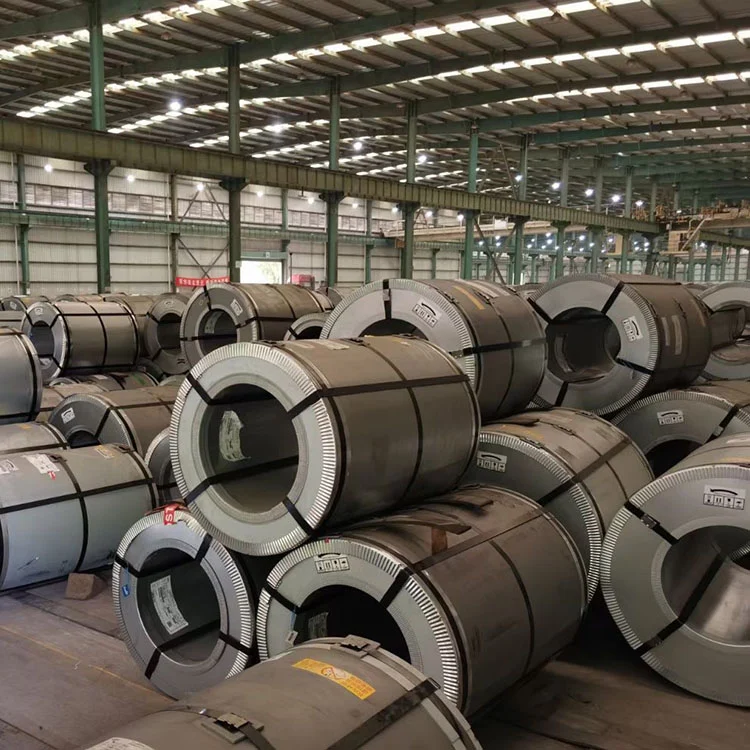
We don’t roll electrical steel. What we control is which mill the master coil comes from and how tightly the slitting downstream is managed.
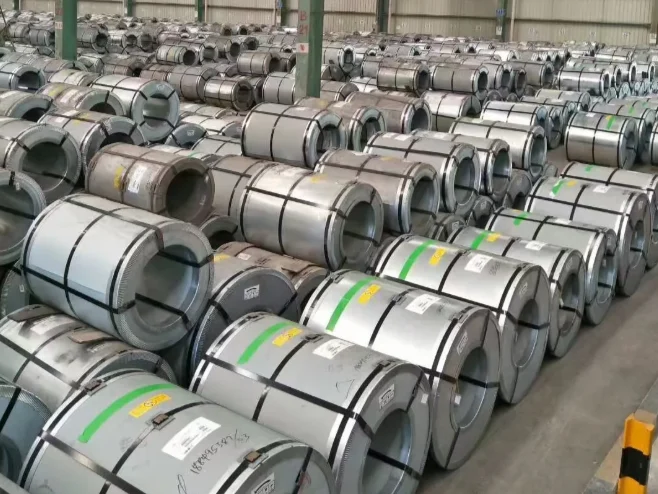
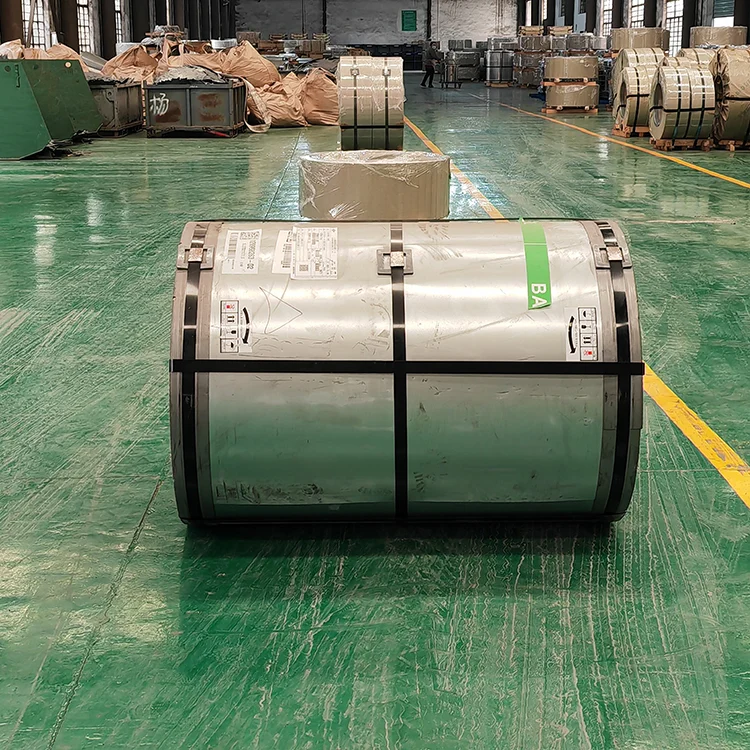
The 0.27mm master coil for this account comes from WISCO — Wuhan Iron & Steel, part of the Baowu group — at 27QG120-class Hi-B grain-oriented, 1,010mm wide. It’s a first-tier source, the same class of mill feeding the grid-scale transformer market, and we cover how that tier compares with Japanese and Korean supply in our China versus Japan and Korea CRGO breakdown.
Because this is a recurring grade, we carry master coil in stock rather than booking it per order. That’s the reason June’s resize didn’t cost the buyer any time: a smaller order against stocked coil is a scheduling change, not a re-procurement. The Hi-B CRGO product page covers where this grade sits against standard grain-oriented.
Slitting to Width
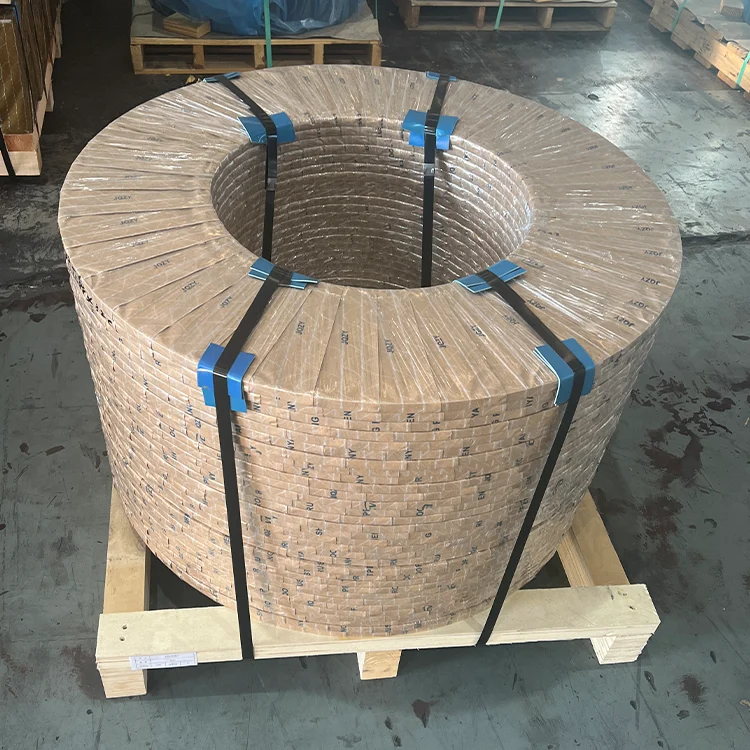
Both widths — 12.70mm and 139.70mm — are slit on our own lines from the 1,010mm master coil. The narrow strip is the harder job: roughly 79 cuts across the master width, which is 79 knife-and-spacer positions that all have to hold the same gap.
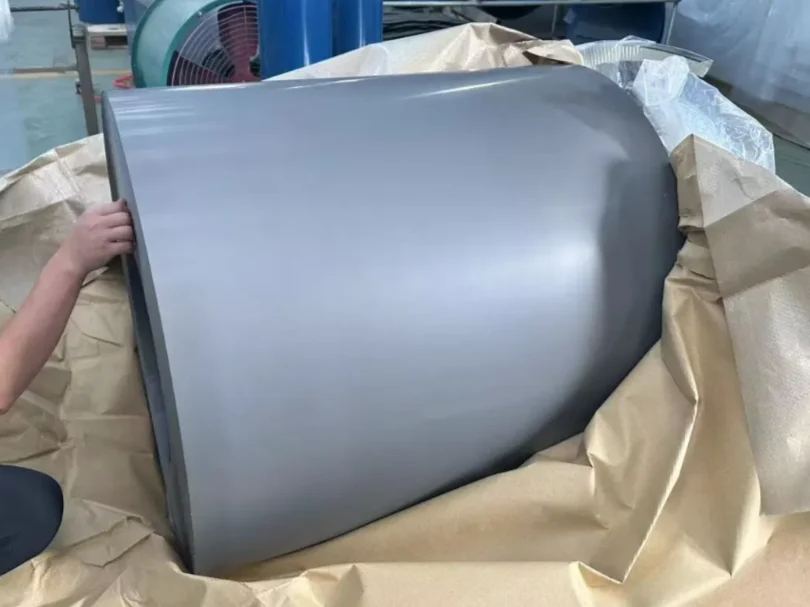
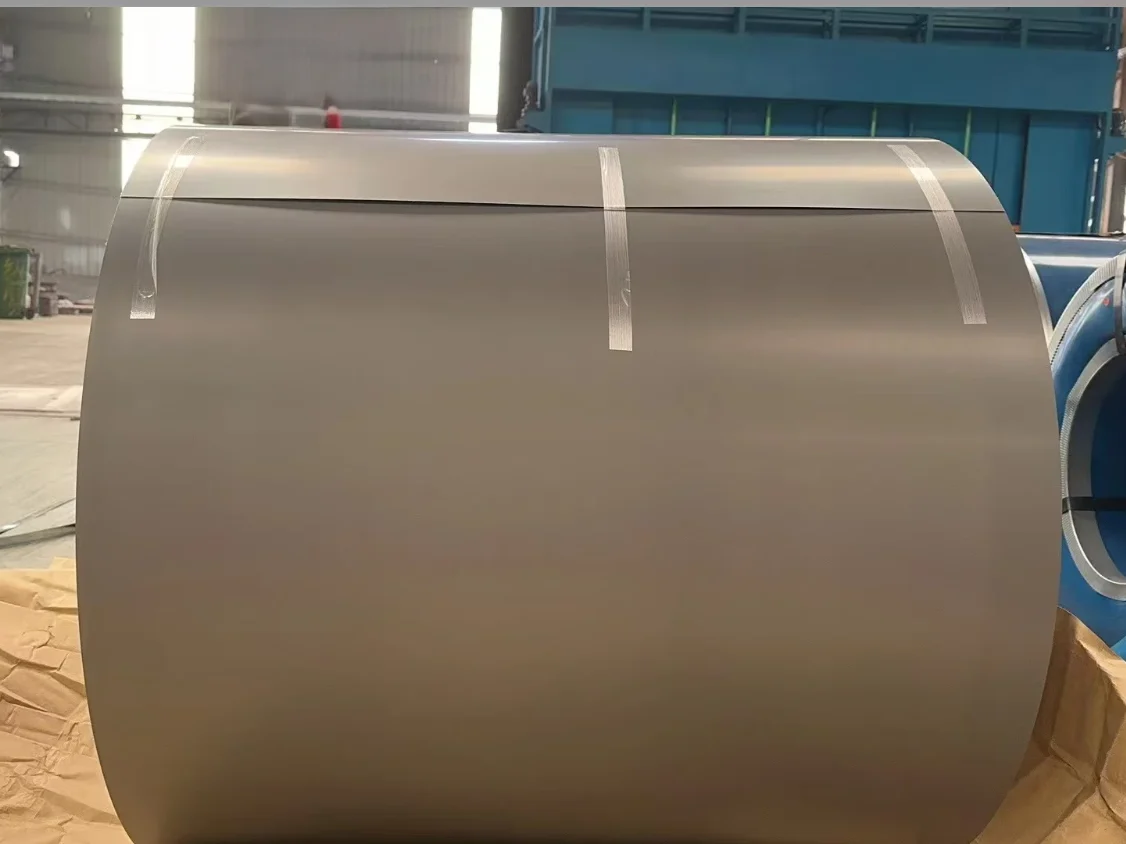
The wound edge visible above is where slit quality shows up: burr height, edge camber, and any wave from an uneven knife gap. On a strip feeding a winding head, a tall burr or a few tenths of camber per metre translates directly into stacking-factor loss and winding-tension problems in the buyer’s core.
We measure width and check edge condition per coil against the nominal, and our slitting tolerance and camber reference covers what those numbers mean on the shop floor.
Before a master coil enters the slitting queue it’s checked against its mill test certificate by heat number — so the certificate that travels with the finished strip describes the coil it was actually cut from. On a monthly account that discipline matters more, not less: the buyer is trusting that this month’s strip performs like last month’s, and heat-level traceability is what backs that up if a question ever comes.
Quality Documentation
The master coil ships with its mill test certificate, tied to heat number, plus our own export test report.
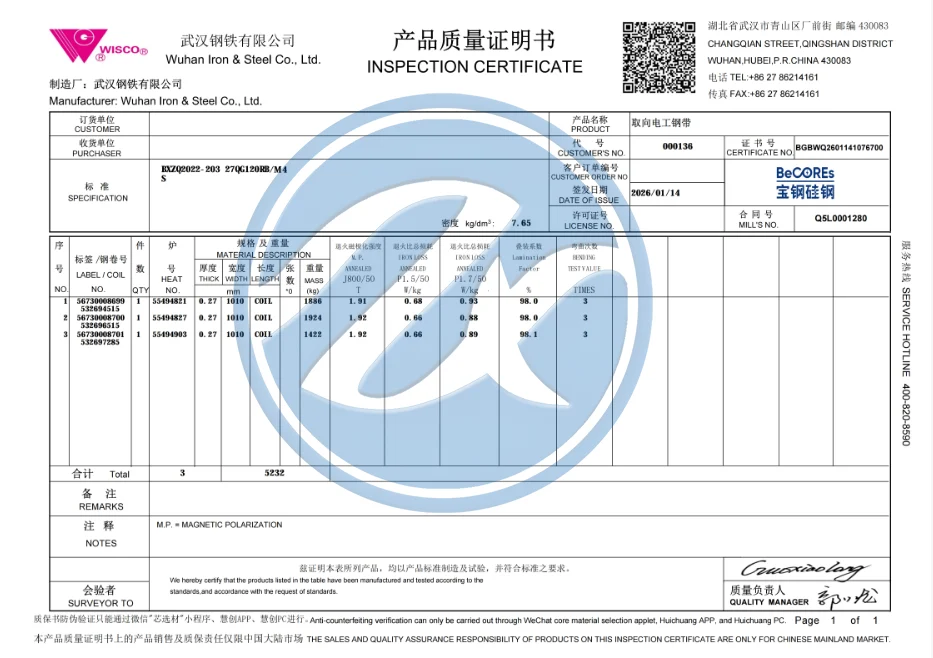
| Coil / Heat No. | Thick × Width (mm) | Mass (kg) | J800 (T) | P1.5/50 (W/kg) | P1.7/50 (W/kg) | Lamination Factor |
|---|---|---|---|---|---|---|
| 567300086699 / 55494821 | 0.27 × 1,010 | 1,886 | 1.91 | 0.68 | 0.93 | 98.0% |
| 567300087700 / 55494827 | 0.27 × 1,010 | 1,924 | 1.92 | 0.66 | 0.88 | 98.0% |
| 567300087701 / 55494903 | 0.27 × 1,010 | 1,422 | 1.92 | 0.66 | 0.89 | 98.1% |
| Total | 5,232 |
Certificate No. BGBWQ2601141076700, issued 2026-01-14, against mill specification BXZQ2022-203 27QG120RB. The actual core loss — 0.88 to 0.93 W/kg at 1.7T/50Hz — sits comfortably inside the grade’s guaranteed ceiling, and J800 near 1.92T confirms it’s a genuine high-induction grade rather than conventional grain-oriented relabelled.
One detail on this certificate is easy to miss: it states that the mill’s sales and quality-assurance responsibility applies to the Chinese mainland market only. That’s standard for a domestic mill cert, and it’s why we issue our own export test report alongside it — the mill data is real and unaltered, but the document that carries responsibility across the border is ours.
Our EN 10204 3.1 versus 3.2 explainer covers the certificate types, and where a buyer wants an independent pass on top, the SGS, BV, TÜV comparison covers that step. Core loss is re-confirmed on our own Epstein frame testing before shipment.
Packing and Container Loading
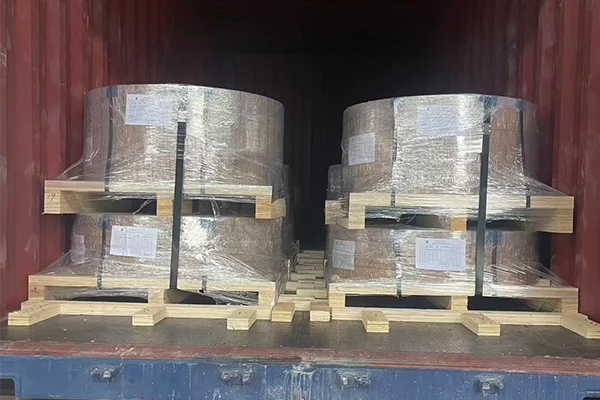
Slit strip coils are packed and loaded differently from wide coil. They’re stood eye-vertical, stretch-wrapped over an inner moisture layer, taped at the wrap seams, and set on and between a timber dunnage frame built up inside the container.
The frame does two jobs: it spreads the point load of narrow coils across the container floor, and it stops the coils rolling or walking during the sea leg and the truck transfer at the destination. Narrow strip coils are more prone to shifting than a single heavy wide coil, so the bracing pattern is denser. Our container loading and packaging reference covers the dunnage build for slit product.
For a 15,000 kg load of slit coil, weight is spread down the length of the container rather than concentrated, keeping axle loads within limits for the inland trucking leg on the US side. The two grades were kept identifiable within the load so the buyer’s receiving team can route the 0.23mm and 0.27mm strip to different lines without unwrapping to check.
Sealing and Dispatch
Once loaded, the container was closed and a bolt seal applied to the door locking bar.
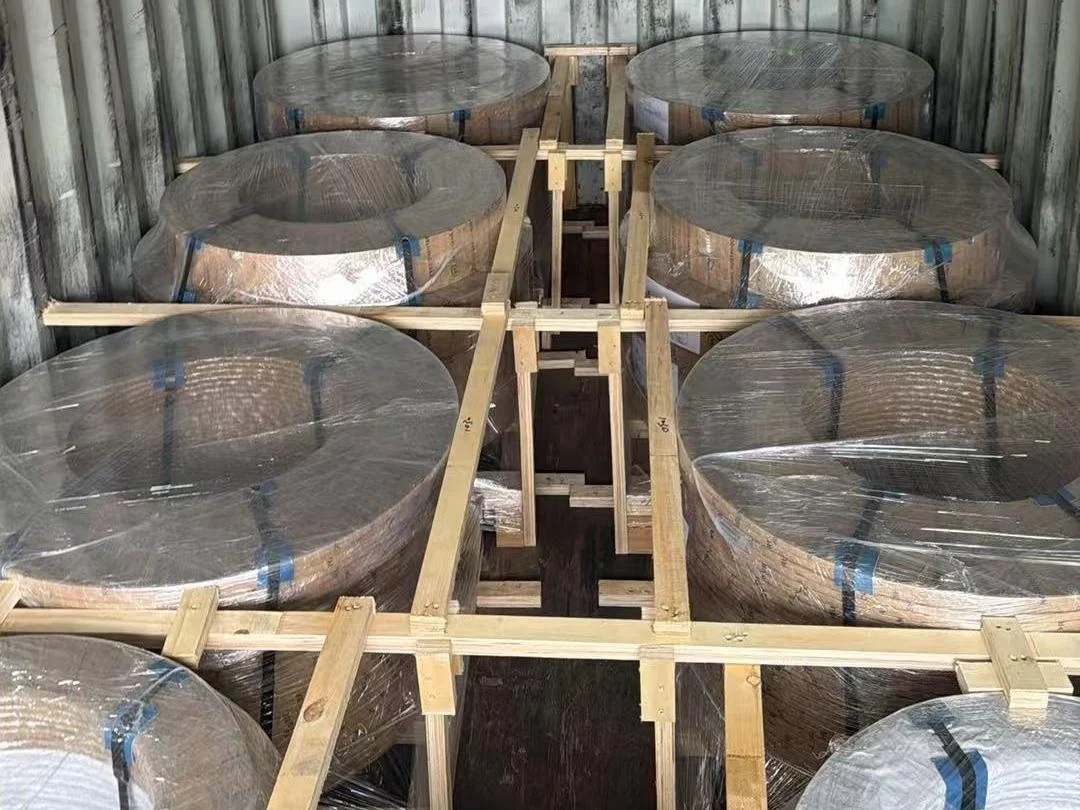
The seal number was photographed and recorded against the packing list and bill of lading before the container left our yard, so the buyer can confirm on arrival that the box wasn’t opened in transit. On a monthly account the buyer keeps a running file of seal numbers against shipments — a small habit that turns a disputed claim into a quick check.
From there the container moved to the buyer’s nominated forwarder under the Wuxi-delivery basis on the PI, and onward to the US port and inland destination on the buyer’s routing.
Why Buyers Choose Zhongxin
- A standing spec that absorbs change. Grades, widths, coating, and item numbers are fixed on our system, so a monthly quantity update — or a mid-cycle resize like June’s — moves one field, not the whole order.
- Master coil in stock for recurring grades. A repeat account’s grade is carried, not re-procured per order, so a smaller or later order is a scheduling change rather than a new lead time.
- Slit-width consistency, run to run. Width is logged per coil against the nominal every month, because a strip that drifts between shipments shows up in the buyer’s winding head, not on a certificate.
- A verifiable document set every shipment. Proforma invoice, mill test certificate, export test report, packing list, and recorded seal number — the same set shown in this profile ships with every month’s order.
For a buyer weighing a first order with us, our supplier verification process walks through the checks worth running before a relationship becomes a monthly one.
FAQ
What are M3 and M4 electrical steel?
They’re AISI grade designations for grain-oriented electrical steel, still used in the North American transformer trade. M3 is 0.23mm thick and M4 is 0.27mm, each with a defined maximum core loss. A coil sold as M4 typically ships against an equivalent mill grade such as a 27QG120-class Hi-B in the Chinese GB system.
Why buy CRGO cut to width instead of slitting it in-house?
Slitting grain-oriented strip to a tight width and low burr needs a dedicated line and its own quality discipline — capital and floor space a transformer core shop often doesn’t want to commit to a secondary process. Sourcing pre-slit strip shifts that step, and its tolerance risk, to a supplier already running it.
Can a monthly order be changed after the PI is issued?
Yes — on a standing account, a quantity change is a PI revision, not a renegotiation. On this order the buyer cut the June load to 15,000 kg by email for freight reasons; the PI was reissued the same week and production proceeded on a deposit, because only the tonnage changed.
Are the documents in this article from a real transaction?
Yes. The proforma invoice, email thread, mill test certificate, and loading and seal photos are from an actual completed monthly order. Customer-identifying details — company name, contacts, address — and all pricing have been redacted under our confidentiality terms. Grades, widths, quantities, dates, and certificate data are unaltered.
Why is the pricing blacked out?
Unit and total pricing are commercially sensitive to the buyer and to our other accounts. Redacting them lets us show the full process and paperwork without exposing one customer’s terms to another.
Why does the mill test certificate say it applies to the Chinese mainland market only?
That’s a standard scope statement on a domestic mill certificate. The magnetic and dimensional data on it are real and unaltered — but for an export shipment we issue our own test report alongside it, which is the document that carries quality-assurance responsibility across the border.
What lead time applies to a repeat monthly order versus a first order?
For a standing grade held in master-coil stock, a monthly order is mostly slitting, finishing, testing, and loading time — days, not the multi-week lead time of a first order that has to start with a mill booking. A mid-cycle resize against stocked coil doesn’t reset that.
Can you hold specific widths and grades as standing items for a recurring buyer?
Yes. That’s how this account runs — each grade-and-width combination is a fixed item number on our system, master coil for the recurring grade is carried in stock, and each month’s PI updates the quantity against that standing spec.
Lessons for Buyers Running a Monthly Supply Relationship
A few things about this account generalize to any buyer moving from spot orders to a standing monthly arrangement.
- Fix the spec so only quantity changes month to month. Grade, thickness, width, coating, and a shared item number per line means a reorder — or a freight-driven resize — is one number, not a fresh RFQ. That’s what kept June’s change to a single email.
- Confirm your supplier stocks master coil for your recurring grade. If they book raw coil per order, a smaller or delayed order still carries the full lead time. If they carry it, a resize is a scheduling change.
- Ask for the export test report, not just the mill certificate. A domestic mill cert may be scoped to its home market. The data can still be sound, but you want a document that carries responsibility for your import.
- Log width per coil, every shipment. On a monthly strip order, run-to-run width drift is the failure mode that reaches your winding line — ask for the per-coil width record, not a per-grade average.
- Record the container seal number against your documents. It costs nothing on dispatch and turns a transit-tampering question into a two-minute check on arrival.
Bottom Line
A 15,000 kg monthly CRGO strip order isn’t a large transaction, and the interesting part isn’t the tonnage — it’s that the June quantity could be cut for freight congestion with one email and a revised PI, because everything except the number was already standing between the two companies. The grades, the two slit widths, the item numbers, the delivery basis, and the master coil in stock were all in place before June started.
For a buyer weighing whether to consolidate spot purchases into a monthly relationship, that’s the payoff: not a better price on any single order, but an order that bends instead of breaking when the shipping market does.
Confidentiality and Documentation Note
The proforma invoice, email exchange, mill test certificate, and loading and seal photographs referenced in this profile are from a real completed monthly order. Customer-identifying information — company name, personnel, and address — has been redacted, and all unit and total pricing has been blacked out. Grades, thicknesses, slit widths, quantities, dates, certificate numbers, and shipping details are unaltered.
Our own beneficiary-bank details appear on the proforma invoice image as issued; buyers should confirm current bank details directly with us before remitting.