
Key Takeaways
- Width tolerance is the spec everyone asks for. Burr height and camber are the two that actually cause problems on the production line, and they’re not automatically covered by a “tight tolerance” request.
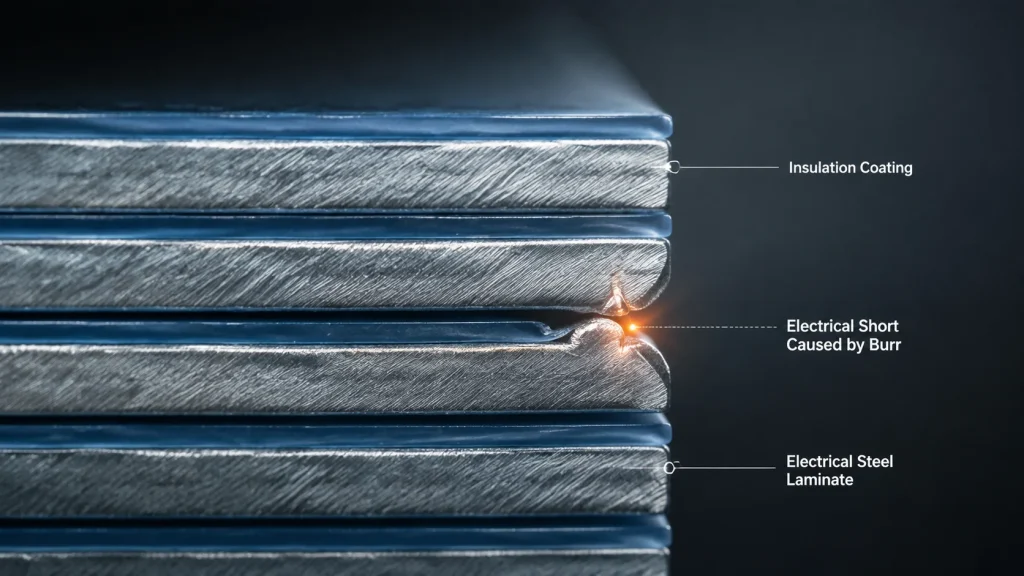
- Burr height matters more for electrical steel than ordinary steel. A burr that bridges the insulation coating between stacked laminations creates a localized short circuit path — right where you can’t see it happening.
- Camber beyond spec doesn’t show up as a visible defect on the coil. It shows up as feed misalignment and scrap rate on your press, sometimes weeks after the coil arrives.
- Tighter gauges make every tolerance harder to hold. Our slitting line runs different blade-clearance settings for a 0.50mm coil than for a 0.20mm ultra-thin coil — if a supplier quotes identical numbers across the board, they probably haven’t recalibrated for the gauge.
- None of this shows up on a standard mill certificate. If width tolerance, burr height, and camber limits aren’t written into your slitting order, you’re relying on the slitter’s default settings, not a spec.
Why Slit Quality Matters More for Electrical Steel Than Ordinary Steel
Slitting a coil of mild steel for structural brackets and slitting a coil of CRGO or CRNGO for a transformer or motor core are not the same problem, even though the machinery looks nearly identical from across the shop floor. Ordinary steel slit edges just need to be dimensionally consistent. Electrical steel slit edges sit inside a stack of hundreds of thin laminations, each one carrying an insulation coating whose entire job is to keep adjacent laminations electrically isolated from each other.
Here’s the part that surprises people who are used to buying ordinary steel: a burr is a small tongue of metal pushed out past the strip surface during the cut. On structural steel, nobody cares. On electrical steel, that same burr can physically punch through or bridge the coating on the lamination stacked next to it. Metal touches metal where there’s supposed to be insulation. One bridge point doesn’t sound like much. Multiply it across a core built from hundreds of compressed layers, and you’ve quietly built a network of eddy current paths straight through material that was sold to you as “insulated.”
That’s the piece a lot of buyers miss when they focus purely on width tolerance: the slit edge isn’t just a dimensional feature, it’s part of the electrical design of the finished core.
Width Tolerance: What “Precision Slit” Actually Means
Width tolerance is the easiest spec to compare between suppliers, because it’s one number. It’s also the one that gets over-indexed on. Standard commercial slitting for electrical steel typically runs in the ±0.10mm range on strip widths up to a few hundred millimeters. Precision slitting — the tier most transformer and motor lamination buyers actually need — tightens that to roughly ±0.03mm to ±0.05mm, depending on strip width and gauge.
The catch: “precision slit” as a phrase on a spec sheet doesn’t guarantee a specific number. We’ve quoted against competitor “precision slit” offers that turned out to mean ±0.10mm once we asked for the actual figure in writing — same label, more than double the deviation of what we’d call precision in-house. Ask for the tolerance in millimeters, tied to your specific width and thickness, not the tier name on the quote.
Burr Height: The Spec Most Buyers Forget to Ask For
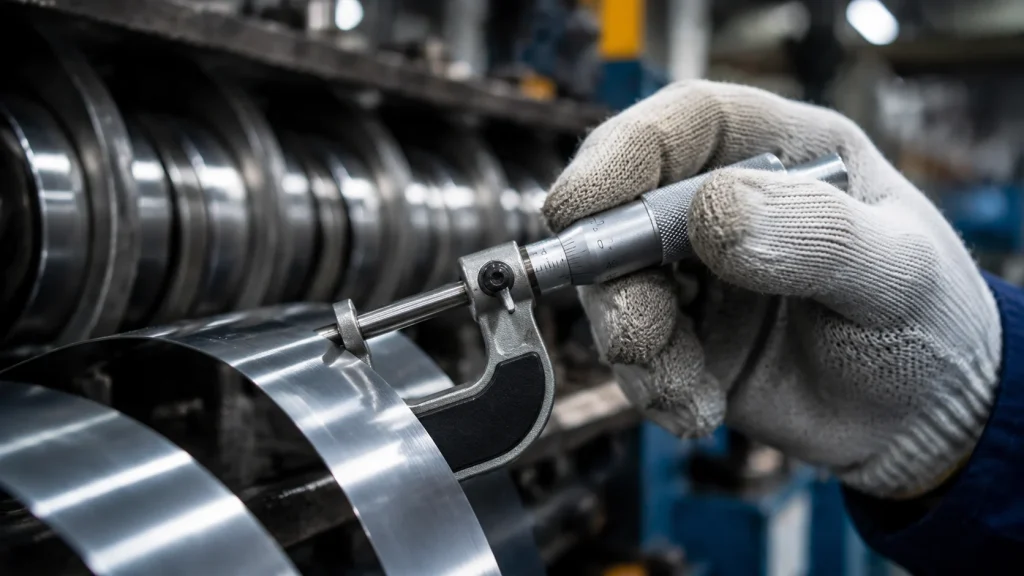
Burr height is usually specified as a percentage of strip thickness rather than a fixed number, because a burr that’s negligible on a 0.50mm strip can be a real problem on a 0.10mm ultra-thin strip. A common working rule across the industry is keeping burr height under roughly 5-10% of strip thickness for standard electrical steel applications, tightening toward the low end — or to an absolute micron limit instead of a percentage — for thin and ultra-thin gauges used in high-frequency motor cores, where the coating itself is thinner and leaves less margin.
Excessive burr height causes two separate problems worth naming separately:
- Interlaminar shorting — the mechanism above, where the burr bridges the coating between stacked laminations and creates localized eddy current paths.
- Die wear on your end — if you’re stamping laminations yourself, a rough or burred edge accelerates wear on your punch and die. It shows up as a slowly rising scrap rate, and it’s easy to blame the die steel before anyone thinks to check the incoming coil.
We check burr height on every precision-slit lot before it ships, not because regulation requires it, but because it’s the one dimension a buyer usually can’t verify with a tape measure on arrival — by the time it’s a problem, it’s already inside a lamination stack. If your order doesn’t specify a maximum burr height, you’re accepting whatever the slitter blade’s current condition happens to produce that day.
Camber: Why a “Straight Enough” Coil Still Jams Your Press
Camber is the lateral curvature along the length of a slit strip, measured as deviation from a straight edge over a given length — commonly expressed as millimeters of deviation per meter, since camber isn’t linear and tends to worsen over longer spans. It’s caused mainly by uneven rolling tension across the coil width and by slitter blade wear or misalignment during the cut.
Camber rarely looks like a defect when you unroll a coil on a table. It shows up downstream: the strip feeds into a progressive die and drifts off-center a fraction of a millimeter more with every stroke, until the punch stops landing where it should. By the time an operator notices rising scrap or die contact issues, the cause is often several coils back — not the one currently running, which is exactly why camber complaints are so hard to trace without a paper trail.
A commonly referenced working limit for electrical steel strip is camber under roughly 2mm per meter, tightening for narrower, thinner strip used in high-precision stamping. Ask your supplier for their camber limit in those terms — deviation per unit length — not a vague “straight” or “within standard mill tolerance.”
Tolerance Reference by Thickness Range
| Thickness Range | Typical Width Tolerance | Typical Burr Height Limit | Typical Camber Limit |
|---|---|---|---|
| 0.50mm – 0.35mm (standard CRNGO) | ±0.08 – 0.10mm | ≤10% of thickness | ≤2mm/m |
| 0.35mm – 0.23mm (standard CRGO/CRNGO) | ±0.05 – 0.08mm | ≤8% of thickness | ≤1.5mm/m |
| 0.23mm – 0.20mm (thin gauge) | ±0.03 – 0.05mm | ≤6% of thickness | ≤1.2mm/m |
| 0.20mm – 0.05mm (ultra-thin) | ±0.02 – 0.03mm | Absolute limit, typically ≤0.01-0.02mm | ≤1mm/m, tighter on narrow widths |
These are working reference ranges, not a universal standard. Every mill and slitter sets its own achievable tolerances based on line condition and blade maintenance schedule — ours included. Treat the table as a starting point for what to ask your supplier to confirm in writing, not a spec you can assume any supplier meets by default.
How Thickness Affects What’s Achievable
Every tolerance in the table above tightens as gauge gets thinner. That’s not suppliers being conservative — it’s physics. Thinner strip flexes more under the same blade pressure, tracks less predictably through tensioning rollers, and leaves less material margin for a burr to be “small” relative to the strip itself. A supplier quoting the same width tolerance, burr height, and camber limit for a 0.50mm coil and a 0.10mm ultra-thin coil is either overstating what they can hold on the thin end, or leaving performance on the table on the standard end. The numbers shouldn’t be identical, and honestly, if they are, that’s usually the first sign the quote wasn’t built around your actual gauge.
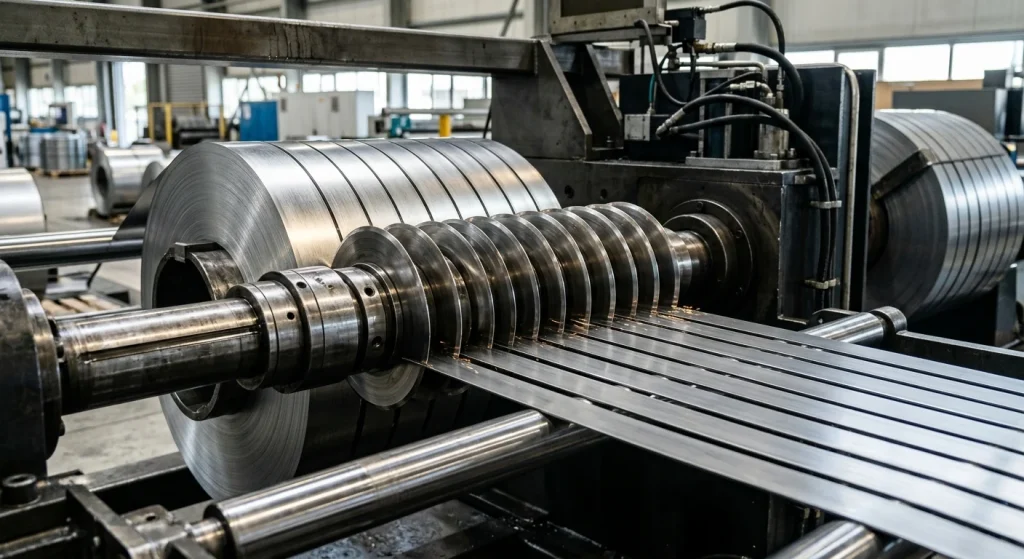
This is also where line capability starts to matter more than the number on a quote sheet. Holding ±0.02mm width tolerance on ultra-thin gauge takes slitter tooling, blade clearance control, and tension regulation that a line built mainly for standard-gauge commercial slitting isn’t set up for. It’s part of why we run laser scribing and precision slitting as a dedicated capability rather than an add-on to standard commercial lines — the tolerances at the thin end genuinely need different equipment, not just a tighter setting on the same machine.
What to Put on Your Slitting Order — A Checklist
Most slitting quality disputes trace back to a purchase order that specified thickness, width, and grade — and left tolerance, burr height, and camber to the supplier’s discretion. Before finalizing an order, confirm in writing:
- Target width and tolerance class — in millimeters, not a tier name like “precision” or “standard.”
- Maximum burr height — an absolute figure for thin/ultra-thin gauge, or a percentage of thickness for standard gauge.
- Camber limit — deviation per unit length, not “straight” or “mill standard.”
- Edge condition — whether a deburred or rounded edge finish is required, separate from the burr height number itself.
- Coil ID/OD and maximum coil weight — confirmed against your own line’s handling limits, not just the supplier’s default coil build.
- Inspection documentation — whether you need a slit quality report (width, burr, camber measurements) per coil or per lot, and how often.
A Common Mistake: Tight Width Tolerance Isn’t the Whole Story
The most common gap we see in incoming slitting orders: a buyer specifies a tight width tolerance — sometimes tighter than the application actually needs — and leaves burr height and camber unspecified entirely. Width tolerance is the easiest number to compare across quotes, so it gets all the attention. Burr height and camber are harder to picture from a spec sheet, so they get waved off as “standard practice.” Standard practice varies by supplier, and it isn’t written down anywhere you can hold anyone to later.
If a coil arrives dimensionally within width tolerance but still causes stacking or stamping problems on your line, burr height or camber is usually the actual cause, not width. We’d rather a customer push back and ask us to write down all three numbers than assume “precision slit” on our quote means the same thing it meant on someone else’s.
Related Grades and Reading
- Stacking laminations from slit coil? See our lamination stacking factor guide — burr height and edge condition directly affect how tightly laminations actually stack versus their nominal thickness.
- Ordering ultra-thin gauge for EV or high-frequency motor cores? Ultra-thin silicon steel covers the thickness range where slitting tolerance is hardest to hold.
- Coating condition also affects edge insulation performance — see electrical steel coating types explained for how C-2 vs C-5 coatings interact with slit edge quality.
- Sourcing CRGO coil for step-lap or wound transformer cores? CRGO Steel Coil covers master coil vs mill-edge coil, standard dimensions and tolerances before you place a slitting order.
FAQ
What is burr height and why does it matter for electrical steel?
Burr height is the small ridge of metal pushed out along a slit edge during cutting. On electrical steel, an oversized burr can bridge the insulation coating between stacked laminations, creating localized metal-to-metal contact that raises eddy current loss in the finished core — a problem specific to laminated electrical applications, not ordinary structural steel.
What’s a typical camber tolerance for electrical steel coil?
A commonly referenced working limit is roughly 2mm of lateral deviation per meter for standard-gauge strip, tightening toward 1mm/m or less for narrower, thinner precision-slit strip. Actual limits vary by supplier and line condition, so confirm the specific figure in writing rather than assuming a “straight” coil meets your requirement.
Does thinner electrical steel have tighter or looser slitting tolerances?
Tighter. Thinner strip flexes more during cutting and offers less material margin for burrs relative to its own thickness, so width tolerance, burr height limits, and camber limits all tighten as gauge decreases — a supplier quoting identical numbers for standard and ultra-thin gauge likely hasn’t calibrated the spec to the thickness.
Can I request a slit quality inspection report with my order?
Yes, and for custom-width or ultra-thin orders it’s worth requiring one. A slit quality report documenting measured width, burr height, and camber per coil or per lot gives you a paper trail if a dimensional issue shows up later on your stamping or stacking line, rather than a dispute based on memory of what was verbally agreed.
Is width tolerance enough to specify on its own?
No. Width tolerance is necessary but not sufficient — a coil can be perfectly within width tolerance and still cause problems from excessive burr height (interlaminar shorting, die wear) or out-of-spec camber (press feed misalignment). All three should be specified separately on any custom slitting order.
Ordering custom-width or ultra-thin gauge coil? Contact Zhongxin Special Steel with your target width, thickness, and application, and we’ll confirm the width tolerance, burr height limit, and camber spec our precision slitting line can hold — including laser-scribed options for high-efficiency grades.

