
Prototype motor laminations are usually laser-cut or wire-EDM-cut, because neither needs a die. Stamping is the cheapest per part, but only after you’ve paid for tooling that runs to tens of thousands of dollars. The method also changes the steel itself: every cut edge loses some magnetic quality, and laser cutting tends to lose the most.
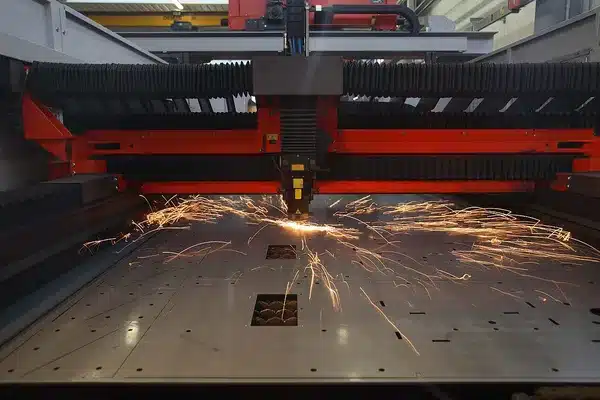
The questions in this article come from engineers building drone, robot and small EV motors who posted on engineering forums in the past few years. They were quoted $500 to $1,200 per prototype stator. They found that online laser services don’t stock silicon steel. They also wanted to know whether a laser-cut prototype would tell them the truth about efficiency. Below we compare the methods on cost, lead time and magnetic damage, using published test data.
Key Takeaways
- Stamping needs a die, typically $10,000 to $100,000 for motor laminations, plus weeks to build it. It pays off only at volume.
- Laser cutting needs no tooling and is the normal prototype route. Forum users report $100 to $1,000 per prototype stator, depending on size and supplier.
- In published tests, laser-cut edges usually raised core loss more than punched edges, and wire EDM raised it least.
- The narrower the tooth, the more the cut edge matters. On 4 mm strips one study measured about 100% extra loss for laser cutting and about 50% for punching.
- Stress-relief annealing restored guillotine-cut and EDM-cut samples in one study, but not laser-cut ones.
- Online laser services rarely stock electrical steel. You can buy the sheet separately and have a local laser or EDM shop cut it.
Which Cutting Method Should You Use for Prototype Laminations?
Use laser cutting for most prototypes, wire EDM when you need edge quality closer to production, and stamping only once the design is frozen and the volume justifies a die.
| Method | Tooling | Typical use | Edge effect on magnetic properties | Main drawback |
|---|---|---|---|---|
| Laser cutting | None, cuts from a DXF file | Prototypes and small batches | Usually the largest increase in loss | Heat damage near the edge |
| Wire EDM | None, can cut a stack at once | Prototypes where edge quality matters | Smallest increase among common methods | Slow, so costly per part |
| Stamping (punching) | Die, often $15,000–$100,000 | Production | Moderate, mostly from plastic deformation | Tooling cost and lead time |
| Abrasive waterjet | None | Occasional prototypes | Low, the least invasive in one review | Slow; rough edges |
| Chemical etching | Photo tool only | Thin, small, detailed parts | No comparative data in our sources | Limited to thin sheet and small parts |
Suppliers also publish typical tolerance, burr and lead-time figures. These are their own claims for their own equipment, not guarantees, but they show the pattern.
| Supplier figure | Laser cutting | Stamping | Wire EDM |
|---|---|---|---|
| Typical tolerance | ±0.025 mm (Yucca) | ±0.02 mm (Yucca) | ±0.003 mm in one shop’s test (CustomParts) |
| Burr height | Under 5 µm (Yucca) | Under 12 µm, can vary (Yucca) | Burr-free edges (review) |
| Time to first parts | Days (Yucca); a few days or weeks (Laser Technologies Inc.) | 5–16 weeks or more to build the die (Laser Technologies Inc.) | Slowest per part |
Not every laser shop reaches ±0.025 mm on thin silicon steel. A drone motor builder reported about ±0.2 mm after tuning their own process, so ask the shop what it holds on your gauge.
The Manufacturing Technology Centre (MTC), a UK research centre that has tested lamination cutting, summarizes the trade-off. Stamping is “the state-of-the-art process for mass production,” but it is “impractical for prototyping.” Laser cutting is “already used for small batch production.” Wire EDM has “minimal impact on the material’s magnetic properties,” but its cutting rates are slow, “making it uneconomical for anything except prototyping.”
If you’re still choosing the steel itself, start with our guide on how to choose electrical steel, which covers grade and thickness by frequency.
Why Is Stamping So Expensive for a Prototype?
Because the cost sits in the die, not the part. A stamping die is a hardened tool built for one lamination geometry. Each stroke takes a fraction of a second, so the part cost is low, but you pay for the tool before the first part comes out.
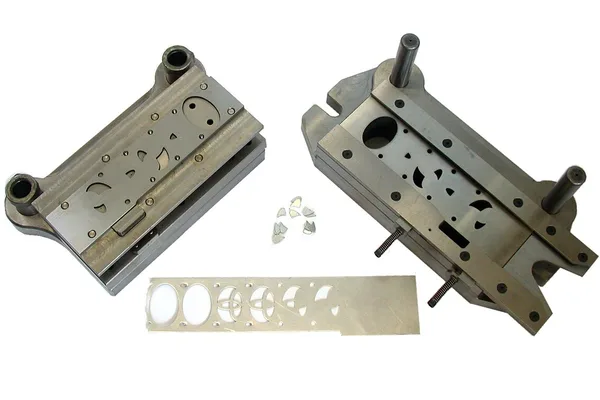
One motor manufacturer answered this on a forum. In their experience, lamination stamping tools run “anywhere from 15k–100k” per geometry. Suppliers give similar ranges. Yucca, a lamination maker, puts progressive dies at $10,000 to $100,000 or more. Laser Technologies Inc., a laser-cutting shop, quotes as little as $5,000 for a simple die and up to $500,000 for a large complex one. The same company prototypes with laser-cut laminations and moves to a die only once the design is fixed. Another engineer asked why a standard 36-slot, 80 mm stator costs about $15 off the shelf while a custom one costs hundreds. The answer is the same: the $15 part sits on a die that has already been paid for over millions of strokes.
You can estimate the point at which a die pays off with simple arithmetic. Yucca’s own example uses a $40,000 die, $4.50 per laser-cut lamination and $0.30 per stamped one, which breaks even at about 9,500 laminations. Lamination counts are hard to picture, so the table below converts them to stators of about 67 laminations each, roughly a 23 mm stack of 0.35 mm sheet. These figures are an illustration, not quotes.
| Stators | Laser cutting, $300 each | Stamping, $40,000 die + $20 each | Cheaper |
|---|---|---|---|
| 50 | $15,000 | $41,000 | Laser |
| 143 | $42,900 | $42,860 | Break-even |
| 500 | $150,000 | $50,000 | Stamping |
| 1,000 | $300,000 | $60,000 | Stamping |
Below about 140 stators of this size, laser cutting is cheaper even though each part costs more. Above it, the die wins, and keeps winning with every unit. Real numbers depend on size, thickness, tolerance and the shop, so ask for both quotes once your design is close to final. Once the volume justifies a die, our guide to motor lamination stamping covers burr limits, die clearance and what to put in the RFQ.
There is one more stamping limit for high-speed motors. The MTC notes that stamping is unsuitable for laminations thinner than 0.2 mm, because the sheet deforms. Those thin gauges are the ones used in high-frequency drone and traction motors. Our ultra-thin silicon steel page covers the range from 0.05 to 0.20 mm.
How Much Does Each Cutting Method Damage the Steel?
Every method damages a thin zone along the cut edge, where the steel’s magnetic properties get worse. The methods differ in how wide that zone is and how badly it is affected. A 2024 review of non-oriented electrical steel in Materials (Paltanea et al.) collected the published measurements.
| Method | Width of the degraded zone at the edge | What causes it |
|---|---|---|
| Punching | About 0.10–0.15 mm in one study; up to 0.22 mm magnetically hardened in another | Plastic deformation and residual stress |
| Laser cutting | About 0.3 mm in one study; 0.07–0.08 mm in another | Heat input and thermal stress |
| Wire EDM | Under 0.1 mm | Very little mechanical or thermal load |
| Guillotine shearing | About 0.2 mm hardened; magnetic effect up to about 0.7 mm | Plastic deformation |
The laser figures disagree because laser results depend heavily on the machine and settings. One study cited in the review found that a continuous-wave laser produced the highest losses, compared with pulsed settings.
What the damage costs in watts depends on how much of the part sits near an edge. The review reports these results.
- Naumoski et al., 50 Hz and 1.5 T: laser 2.86 W/kg, punching 2.78 W/kg, spark erosion 2.75 W/kg. On these samples the methods were close.
- Narrow strips (Dems et al.): at 4 mm wide, punched samples showed about 50% higher normalized loss and laser-cut samples about 100%. At 60 mm wide, punching added a few percent and laser up to 15%.
- Mechanical cutting versus spark erosion (Hofmann et al.): mechanical cutting raised loss by 30 to 70%, spark erosion by 5 to 22%.
- Permeability (Shi et al.): maximum relative permeability was about 4,000 for laser-cut samples and about 11,500 for abrasive waterjet samples.
The pattern holds in complete machines too. Researchers at Aalto University built two stators, one laser-cut and one wire-EDM-cut, and measured a significant increase in core loss from laser cutting.
This is why small motors are hit hardest. A drone stator tooth may be only a few millimetres wide, so a degraded zone of 0.1 to 0.3 mm on each side is a large share of it. If your prototype will be used to measure efficiency, either cut it the way production will be cut, or allow for the difference in your model. Our guide to core loss testing on an Epstein frame explains how loss is measured on standard strips, which are wider than most motor teeth.
Is Wire EDM Worth the Wait?
For a prototype that has to give realistic loss figures, often yes. Wire EDM cuts with electrical sparks from a moving wire submerged in fluid. It puts very little mechanical or thermal load on the steel, and the review notes that EDM edges are burr-free.
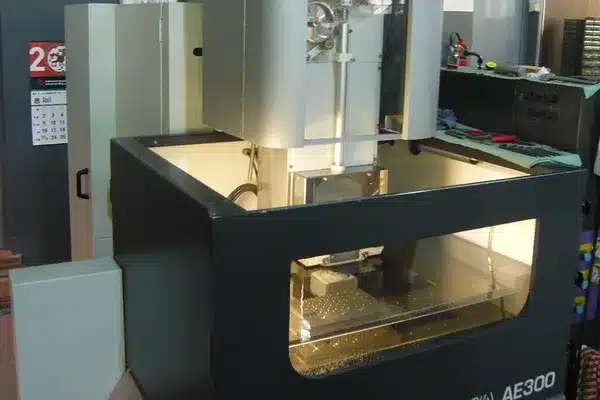
The drawback is speed. A laser cuts a lamination in seconds; wire EDM takes far longer. You can soften that by cutting a stack at once. A forum reply on prototype BLDC stators described this as a growing low-cost service: the shop clamps the required number of sheets together and cuts them all in one pass.
In our view, stack cutting has two catches.
- The sheets must be held flat and tight. Any gap lets the wire wander and leaves uneven teeth.
- The cut edges need checking. Look for sheets fused or bridged together along the cut, because laminations that touch electrically defeat the point of laminating. We explain why in why transformer and motor cores are laminated.
How Do You Get Clean Laser Cuts on Thin Silicon Steel?
Mostly through settings and setup, not just the machine. Engineers on laser-cutting forums ask whether burr-free cuts depend on the laser source, the cutting head or the parameters. The published work points at parameters. The review cites results showing continuous-wave cutting gave the highest losses, and its sources report very different damage widths for laser cutting, from under 0.1 mm to about 0.3 mm.
One builder of heavy-lift drone motors reported getting laser cutting of 0.20 and 0.35 mm silicon steel to about ±0.2 mm tolerance with no visible heat-affected zone, after working on the process.
When you send a laser job, agree on these points with the shop.
- Pulsed or continuous cutting. Ask what mode they use for thin electrical steel, and whether they have cut it before.
- Burr limit. Burrs raise the stack height, which lowers the stacking factor. They can also bridge the insulation between sheets.
- Test parts. Cut a few laminations, check burrs and flatness, and measure one stack before cutting a full set.
- Kerf and tolerance. Ask what tolerance they hold on 0.20 or 0.35 mm sheet. Slot and tooth widths depend on it.
If burrs are lifting the stack, our article on lamination stacking factor explains how much height they cost.
Can Annealing Undo the Cutting Damage?
Partly, and not equally for every method. Stress-relief annealing heats the cut laminations, typically around 700 to 750 °C for about two hours in a protective atmosphere, so that the stressed zone at the edge recovers.
The review reports two results that matter for prototypes.
- Hofmann et al. found that after stress-relief annealing, guillotine-cut and spark-erosion samples recovered their magnetic behaviour, but laser-cut samples stayed degraded.
- Shi et al. measured hardness at punched edges falling from about 460 HV to 260 HV after annealing at 750 °C for two hours in nitrogen. Laser-cut and waterjet edges changed less.
So annealing helps punched and sheared parts most. Before annealing, check that the insulation coating can take the temperature. Some coatings are made to survive stress-relief annealing and some are not. Our guide to electrical steel coating types explains which is which.
Why Don’t Online Laser Services Cut Electrical Steel?
Most consumer laser services stock a fixed menu of materials, and electrical steel is rarely on it. Forum users building transformers and motors found that services such as SendCutSend and OshCut don’t offer it. One reply put it down to the steel’s brittleness and specialised cutting needs.
The workaround is to separate the material from the cutting. Buy electrical steel sheet cut to a size that fits a local laser or EDM shop’s bed, and have that shop cut your DXF file. One forum member asked whether this was possible. It is, and it’s how many prototype stators are made.
Order the sheet size the cutting shop uses, so you don’t pay for offcuts twice. Our guide on where to buy electrical steel in small quantities covers mills, distributors and service centres. We cover the grade and the certificate here.
What About Waterjet, Chemical Etching and Water-Jet Guided Laser?
Each has a niche.
- Abrasive waterjet uses no heat. The review describes it as the least invasive method but slow, and its edges are rough. In Shi et al., waterjet samples kept roughly three times the permeability of laser-cut ones.
- Chemical etching dissolves the outline through a photo mask, so it needs no hard tooling. Precision Micro, an etching company, says the process helps reduce costs and minimise lead times. We found no independent magnetic comparison for it, so ask the supplier for test data.
- Water-jet guided laser runs the laser inside a thin water jet that cools the cut. The MTC reported negligible thermal damage and cutting speeds of 600 mm/min. It also cut a stack of 20 laminations (about 4 mm) at once, and found it more productive than wire EDM.
What to Send When You Order Steel for Prototype Laminations
Whether you’re buying sheet for a cutting shop or asking a lamination shop to quote, these details avoid a round of questions.
- Grade and thickness. For example M270-35A at 0.35 mm, or the loss and frequency you need.
- Coating. Name the class, and whether the parts will be welded, bonded or annealed.
- Sheet size. Match the cutting machine’s bed, for example 500 × 1,000 mm.
- Quantity. Number of laminations, stack height and spares for test cuts.
- Drawing. A DXF with tolerances on slot, tooth and bore.
- Certificate. A mill test certificate showing the grade’s measured loss.
We supply non-oriented steel as CRNGO steel coil, slit strip and cut sheet. We also cut laminations to your drawing, by laser for prototypes and by stamping for production, so you can get the steel and the cutting quoted together. Sheet orders typically start at about 500 kg. If you need less, tell us and we’ll do our best to meet the request. Samples typically cost USD 200 including freight, refunded when you place a production order.
Bottom Line
- Prototype: laser cutting, no die. Expect the highest edge damage.
- Prototype that must predict efficiency: wire EDM, or the same method production will use.
- Production: stamping, once volume pays back a die costing $15,000 to $100,000.
- Small motors suffer most: narrow teeth mean the cut edge is a large share of the steel.
- Annealing helps punched and sheared parts, and helps laser-cut parts much less.
Cover photo: laser cutting machine, Ptmtechnology, Wikimedia Commons, CC BY-SA 4.0. Stamping die: Glenn McKechnie, Wikimedia Commons, CC BY-SA 3.0. Wire EDM machine: Ricard Polls, Wikimedia Commons, public domain.
FAQ
What is the cheapest way to make prototype motor laminations?
For a handful of parts, laser cutting is usually cheapest, because it needs no die. Forum users report $100 to $1,000 per prototype stator, depending on size and supplier. Stamping is far cheaper per part but needs a die costing tens of thousands of dollars, so it only pays at volume.
Does laser cutting damage electrical steel?
Yes, along a narrow zone at the cut edge. Published studies measure a degraded zone from under 0.1 mm to about 0.3 mm wide. On narrow teeth this matters: one study found about 100% extra loss on 4 mm laser-cut strips. Settings, especially pulsed rather than continuous cutting, change the result.
Is wire EDM better than laser for motor laminations?
For magnetic quality, yes. Wire EDM leaves a degraded zone under 0.1 mm and burr-free edges, and one study measured only 5 to 22% added loss for spark erosion. It is much slower, so it suits prototypes and small batches rather than production.
How much does a lamination stamping die cost?
A motor manufacturer on an engineering forum put lamination stamping tools at $15,000 to $100,000 per geometry. The price depends on size, complexity and whether the die is a progressive tool. Get a die quote only once your design is frozen.
Can you prototype motor laminations with stamping?
Rarely, because a full die costs too much for a design that may change. Some makers move first to simpler tooling, such as blank-and-notch dies that punch slots one at a time, before building a progressive die. For a first prototype, laser cutting or wire EDM is the usual choice.
Can I send my own electrical steel to a laser cutting shop?
Yes. Many shops will cut customer-supplied material. Buy sheet cut to the size of their machine bed, send it with your DXF file, and agree on tolerance and burr limits first. Online services with fixed material menus usually won’t accept it.
Need prototype laminations or sheet for your own cutting shop? Contact us with your DXF drawing, grade, thickness and quantity, and we’ll quote laser-cut or stamped laminations, or the sheet alone.
References
- Paltanea, G. et al., Materials 17(6):1345, 2024 — Mechanical and Magnetic Properties Variation in Non-Oriented Electrical Steels with Different Cutting Technology: A Review
- Manufacturing Technology Centre (MTC) — Water jet guided laser: application and implementation
- Sundaria, R. et al., Aalto University, IEEE Transactions on Industrial Electronics 67(9), 2020 — Effect of Laser Cutting on Core Losses in Electrical Machines: Measurements and Modeling
- Precision Micro — Motor lamination manufacturing processes: a comparison of stamping, laser cutting and chemical etching
- Yucca Motor Lamination — From prototype to production: choosing between laser cutting and stamping
- Laser Technologies Inc. — Laser cutting vs. stamping
- CustomParts — Laser cutting vs. wire EDM for ultra-precision metal prototypes


