
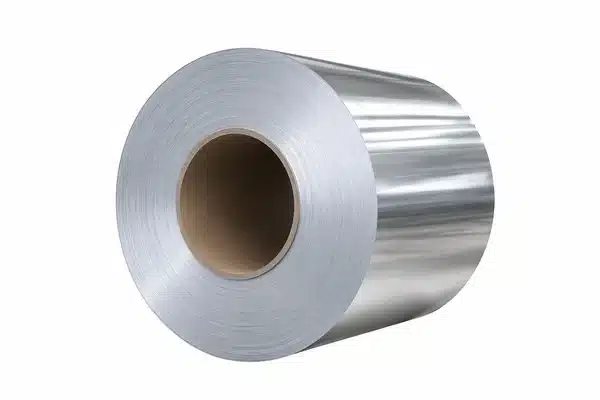
M270-35A (GB 35W270) costs more per ton than a standard 0.35mm grade from our non-oriented silicon steel line like 35W300, and the reason is narrow: it guarantees roughly 10% lower core loss at the same thickness — 2.70 W/kg versus 3.00 W/kg at P1.5/50. Whether that’s worth paying for depends entirely on what the motor does with that saved loss, and that answer is different for a servo motor than for an EV traction motor, even though both show up on the same spec sheet asking for “low-loss CRNGO.”
We started getting this question from both directions at once this month: a servo drive OEM asking whether M270-35A was overkill for a compact positioning motor, and an EV Tier 1 asking whether it was the minimum bar for a traction stator. Neither buyer was wrong to ask — they were just weighing the same grade against two different loss mechanisms. Wuxi Zhongxin Special Steel, the Chinese mill and exporter behind both grades, works through what actually drives the M270-35A premium below, why servo duty and EV duty pull on that premium differently, and a worked comparison against standard CRNGO so the decision doesn’t have to rest on a grade code alone.
Key Takeaways
- M270-35A (35W270, 0.35mm) guarantees core loss P1.5/50 ≤ 2.70 W/kg, against ≤ 3.00 W/kg for standard 35W300 at the identical 0.35mm gauge — a same-thickness, apples-to-apples ~10% core-loss cut, not a thickness change in disguise.
- Eddy-current loss scales with the square of both frequency and lamination thickness, which is why the loss gap between grades widens as electrical frequency climbs — a servo motor’s PWM-driven harmonic content and an EV traction motor’s high-speed field frequency both sit well above the 50/60Hz a standard grade is rated against.
- Servo and EV motors reach for the same premium grade for different reasons: servo duty is dominated by frequent accel/decel cycling and harmonic-rich switching in a compact, often poorly-cooled housing; EV traction duty is dominated by sustained high-speed cruise, where even a small core-loss cut compounds over a drive cycle.
- China’s GB 18613-2020 Grade 1 voluntary tier already sits close to what a 0.20mm ultra-thin NGOES grade would need to hit — buyers chasing servo/EV efficiency targets should confirm which tier a quoted M270-35A coil actually certifies to, not assume the grade code alone settles it.
- The premium buys loss reduction, not thickness reduction — a buyer who actually needs a high-frequency lamination gauge below 0.20mm is solving a different problem than a buyer who needs a lower-loss 0.35mm coil, and pricing the wrong lever wastes the premium either way.
What “Low-Loss” Actually Means on an NGO Grade Code
A non-oriented grade code carries two numbers, and buyers routinely read only one of them. In GB 35W270, “35” is thickness in hundredths of a millimeter (0.35mm) and “270” is guaranteed core loss in hundredths of a watt per kilogram (2.70 W/kg) at the P1.5/50 test condition — 1.5 Tesla, 50 Hz. Our full grade-decoding breakdown covers the GB/EN/JIS cross-references in more depth; for this comparison, the number that matters is the loss figure, because thickness is held constant.
That’s the fork buyers miss: standard CRNGO at 0.35mm ships as 35W300 (≤3.00 W/kg), and M270-35A at the identical 0.35mm ships as 35W270 (≤2.70 W/kg) — same gauge, same stacking factor target (≥0.95), same C5 coating class. The premium isn’t buying a thinner lamination. It’s buying a tighter loss ceiling at a gauge you may already be running.
That distinction matters because the other lever buyers reach for — going thinner, not lower-loss — is a separate spec entirely. Ultra-thin gauges below 0.20mm cut eddy-current loss through thickness reduction and solve a high-frequency problem; M270-35A cuts loss through tighter metallurgical control at a conventional 0.35mm thickness and solves a different one. Confusing the two means paying a premium for the wrong lever, which we come back to below.
Why the Premium Exists: What Actually Costs More to Produce
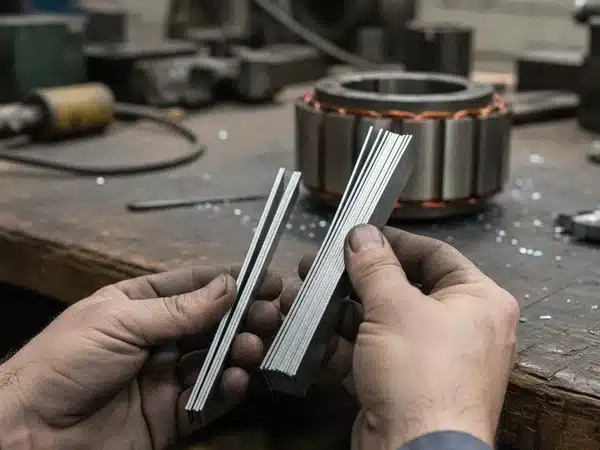
Core loss in non-oriented steel comes from three components — hysteresis loss, eddy-current loss, and a residual “anomalous” loss — and all three respond to how tightly a mill controls grain size, silicon/aluminum content, and rolling texture during cold reduction. Tightening the loss ceiling by 10% at a fixed thickness, the way 35W270 does against 35W300, isn’t a different recipe so much as a narrower tolerance on the same one: more consistent silicon content through the coil, tighter grain-growth control during final annealing, and lower yield on out-of-spec sections that would pass for a standard grade but not a premium one.
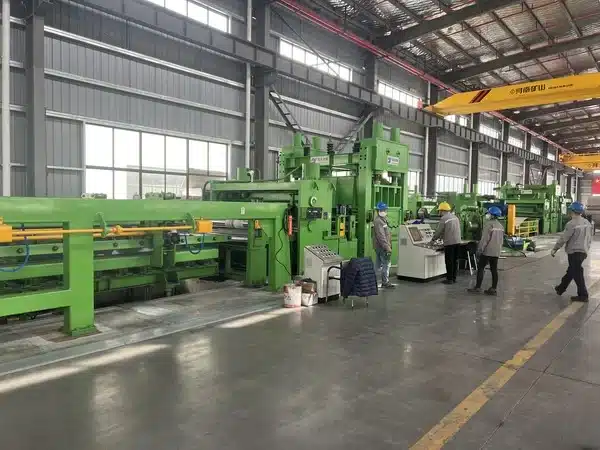
That’s a manufacturing-yield story, not a raw-material story — the Si+Al content on both grades sits in the same roughly 2.0–2.5% band. A mill running a slitting and processing line to a tighter loss window rejects more marginal coil to hold that ceiling, and that rejection rate is what shows up as the per-ton premium on a quote, not a fundamentally different alloy.
Servo Motors vs. EV Traction Motors: Same Grade, Different Reasons to Pay
Buyers on both ends of this comparison are chasing the same core-loss number for structurally different reasons, and it’s worth naming the difference before pricing either one.
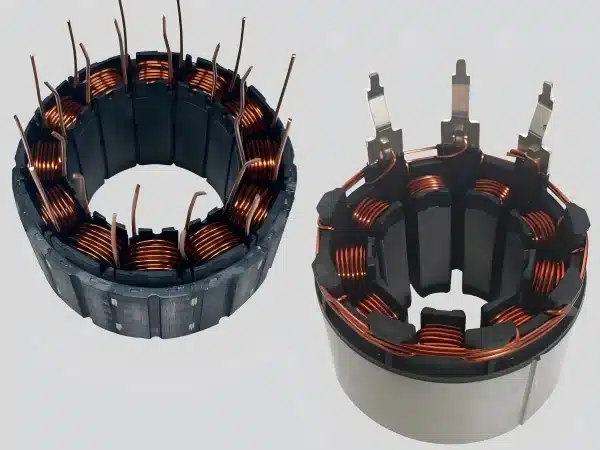
Servo motors run duty cycles built around frequent, aggressive acceleration and deceleration rather than sustained speed — a pick-and-place axis or a CNC spindle drive reverses direction constantly, and the PWM switching that drives it injects harmonic content well above the fundamental frequency. Research on high-speed permanent-magnet and servo-class motors consistently points to the same mechanism: because eddy-current loss scales with the square of frequency, harmonic-rich switching drives core loss up sharply even when the motor’s rated speed looks modest on a nameplate. Servo motors also tend to sit in compact, tightly-packaged housings with limited surface area for heat rejection, so a given watt of core loss raises winding temperature — and therefore shortens insulation life or forces a derate — more than the same watt would in a larger, better-ventilated frame.
EV traction motors face a different profile: long stretches of sustained high-speed rotation at highway cruise, where the vehicle spends most of a drive cycle’s energy budget. EV traction motor core loss at cruise speed is smaller in absolute terms than copper loss under hard acceleration, but it’s also loss that never stops accumulating for as long as the motor spins — closer in character to a transformer’s always-on no-load loss than to the intermittent spikes a servo motor sees. We’ve covered the broader CRNGO-for-EV case in more depth elsewhere; the relevant point here is narrower: shaving 10% off core loss at cruise-speed frequency compounds over hundreds of thousands of highway kilometers in a way it simply can’t in a servo axis that spends most of its life accelerating and stopping.
| Servo Motor | EV Traction Motor | |
|---|---|---|
| Dominant loss driver | Harmonic-rich PWM switching, frequent accel/decel | Sustained high-speed rotation at cruise |
| Where the loss shows up | Heat in a compact, poorly-cooled housing | Small but continuous drain on drive-cycle range |
| What the premium mainly buys | Thermal headroom / insulation life at a fixed frame size | Marginal efficiency gain compounding over distance |
| Where a thinner gauge helps more than a lower-loss grade | Very high switching frequencies (above several kHz) | High-speed rotor designs above typical 0.35mm territory |
A Worked Comparison: M270-35A vs. Standard 35W300 at the Same Gauge
Here’s the comparison stripped down to the two verified numbers, with the cost side clearly flagged as an illustrative range rather than a quoted price — per-ton pricing varies by mill, order volume, and month, and any buyer using this framework should confirm current figures on a real RFQ rather than treat the assumption below as a quote.
Verified inputs (from our own 0.35mm product lines):
- Standard 35W300: core loss P1.5/50 ≤ 3.00 W/kg
- M270-35A (35W270): core loss P1.5/50 ≤ 2.70 W/kg
- Loss reduction: ~10% at identical thickness, stacking factor, and coating class
Illustrative cost assumption (not a site-specific quote): mills we’ve discussed pricing with typically position a tighter-loss-ceiling grade like 35W270 roughly 8–15% above the next standard grade at the same gauge, reflecting the lower yield described above rather than a materially different alloy cost. Use your own quoted numbers in place of this range — it exists here only to show how the math works, not to promise a figure.
| Scenario | Core Loss per kg | Relative Loss vs. Standard | Where the Case Is Strongest |
|---|---|---|---|
| Standard 35W300, continuous-duty servo axis | 3.00 W/kg | Baseline | Low-duty-cycle, cost-sensitive designs |
| M270-35A, continuous-duty servo axis | 2.70 W/kg | ~10% lower | Compact housings where thermal headroom is the constraint, not raw material cost |
| Standard 35W300, EV cruise-speed operation | 3.00 W/kg | Baseline | Short-range/low-volume programs where upfront cost dominates |
| M270-35A, EV cruise-speed operation | 2.70 W/kg | ~10% lower | High-mileage fleet or passenger platforms where cruise-efficiency compounds over vehicle life |
The pattern that matters more than either row alone: the 10% loss delta is fixed by the grade codes and doesn’t change with application, but what that 10% is worth changes completely depending on whether the motor spends its life switching on and off (servo) or holding a steady high speed (EV cruise) — which is why the same premium can be an easy yes for one buyer and a genuine question mark for another.
When the Premium Is Worth It: A Decision Framework
| Your Situation | M270-35A Likely Worth It | Standard 35W300 Likely Fine |
|---|---|---|
| Duty cycle | Continuous operation at rated frequency (EV cruise, industrial servo axis run near-continuously) | Intermittent, low-duty-cycle, or mostly idle |
| Thermal environment | Compact housing, limited airflow, insulation life is a known constraint | Well-ventilated frame with thermal margin to spare |
| Frame size flexibility | Fixed frame — can’t just make the motor bigger to shed more heat | Frame size has room to grow if loss becomes a problem later |
| Program volume / lifetime | High-volume or long-service-life program where the per-unit premium is amortized over many hours or many units | Prototype, low-volume, or short-service-life program |
| Efficiency target driver | Chasing IE5-class or equivalent GB 18613-2020 Grade 1 targets | No formal efficiency class driving the spec |
If none of the left-column conditions apply strongly, standard 35W300 at the same 0.35mm gauge is very likely the more defensible choice — the loss delta is real, but so is the premium, and a motor that idles most of its life or has thermal margin to spare won’t collect enough benefit to clear it.
The Mistake Buyers Keep Making
The single most common mistake we see on incoming servo and EV RFQs is treating “low-loss” and “thin-gauge” as the same request. They aren’t. A buyer chasing high-frequency performance above a few kHz — some servo drives, high-speed spindle motors, drone motors — needs thickness reduction first, because eddy-current loss scales with the square of thickness and no amount of loss-tier tightening at 0.35mm closes that gap. That buyer should be pricing ultra-thin sub-0.20mm gauges, not M270-35A.
A second, quieter mistake: assuming a “35W270” quote from every mill certifies to the same tier. China’s GB 18613-2020 standard has included a voluntary Grade 1 efficiency tier since 2020 that some mills test against and others don’t advertise — worth asking for explicitly if the application is chasing a formal efficiency class rather than just a lower number on a datasheet, since two coils can both carry a “35W270”-adjacent label without both being tested to the same benchmark.
Sourcing M270-35A from China: MOQ, Lead Time, Certification
Premium loss-tier NGO grades ship from a narrower set of qualified mills than standard 50W470/50W600 commodity coil, which in practice means slightly longer lead times and less MOQ flexibility than a buyer used to sourcing standard-grade CRNGO will expect. Ask for the mill test certificate up front rather than after the coil ships — a certified P1.5/50 figure on an EN 10204 3.1 MTC is the only way to confirm the loss ceiling a given lot actually met, as opposed to the nominal grade printed on the packing list.
For buyers weighing whether the sourcing complexity is worth it, the underlying calculation is the same one that applies to any premium-grade silicon steel sourcing decision: a tighter spec narrows the supplier pool relative to sourcing standard CRNGO, and that narrowing is worth pricing into lead-time planning before it becomes a production bottleneck.
Before You Send an RFQ
- Confirm which loss ceiling you actually need against your operating frequency, not just the nameplate 50Hz P1.5/50 figure — ask the mill for high-frequency loss data if your application runs meaningfully above 50/60Hz.
- Decide whether you’re solving a thickness problem or a loss-ceiling problem before requesting a quote; ask for both a 0.35mm M270-35A quote and an ultra-thin quote if you’re not sure which lever your application actually needs.
- Request the mill test certificate (EN 10204 3.1 minimum) with the actual tested P1.5/50 value, not just the grade code, especially if a formal efficiency-class target is driving the spec.
- Get current per-ton pricing for both 35W300 and M270-35A from the same mill on the same RFQ — the premium in this article is illustrative; a same-mill, same-batch quote is the only number worth deciding on.
FAQ
Is M270-35A worth the extra cost for a servo motor?
It depends on duty cycle and thermal margin more than on the motor being called “servo.” A servo axis that runs near-continuously in a compact, poorly-ventilated housing gets real value from the ~10% loss cut; one that idles most of the time or has thermal headroom to spare often doesn’t need it at standard 0.35mm gauge.
How much lower is M270-35A’s core loss than standard CRNGO?
At the identical 0.35mm thickness, M270-35A (35W270) guarantees core loss P1.5/50 ≤ 2.70 W/kg versus ≤ 3.00 W/kg for standard 35W300 — roughly a 10% reduction at the same gauge, stacking factor, and coating class.
Do EV traction motors need M270-35A specifically, or is standard CRNGO enough?
Standard CRNGO works and ships in plenty of EV programs, particularly lower-volume or cost-sensitive ones. M270-35A’s case strengthens for platforms with high mileage or long service life, where the core-loss saving compounds over sustained highway-speed operation rather than mattering only during short test cycles.
What’s the difference between paying for a lower-loss grade versus paying for a thinner gauge?
A lower-loss grade like M270-35A tightens the loss ceiling at a fixed thickness through tighter metallurgical control. A thinner gauge cuts loss by reducing lamination thickness itself, which matters more at high switching frequencies since eddy-current loss scales with the square of thickness. They solve different problems and aren’t interchangeable line items on a quote.
Can I mix M270-35A and standard CRNGO in the same motor to save cost?
Some designs stack a premium grade only where flux density is highest and use standard grade elsewhere, but this adds manufacturing complexity — two coils to stock, slit, and stack correctly — that only pays off at meaningful production volume. For most programs, a single grade across the full stator is simpler to source and quality-control.
What should I ask for when requesting an M270-35A quote from a Chinese mill?
Ask for the actual tested P1.5/50 value on the mill test certificate (not just the grade code), confirm whether the coil is certified against GB 18613-2020 Grade 1 if that matters to your efficiency target, and request a same-batch quote for standard 35W300 alongside it so the premium is a real, comparable number rather than an assumption.
Bottom Line
The ~10% core-loss cut M270-35A offers over standard 35W300 at the same 0.35mm gauge is real and verifiable — it’s the premium, and the payoff, that depend on what the motor actually does. Continuous, near-rated-frequency duty in a thermally-constrained servo housing or a high-mileage EV traction application both collect real value from that 10%; a motor that idles most of the time or has thermal margin to spare usually doesn’t need to pay for it. Get a same-mill quote for both grades before deciding, and if the real question is high-frequency performance rather than a lower loss number at 0.35mm, price an ultra-thin gauge instead — the grade code and the gauge spec solve two different problems, even when they show up on the same RFQ.
References
- AIP Advances — Study on the influence of ultra-thin non-oriented silicon steel sheet on the performance of ultra-high-speed permanent magnet motor
- Arnold Magnetics — Energy Savings with Thin Gauge Silicon-Iron
- E-Mobility Engineering — Motor Laminations
- GB/T 2521.2-2022 — Cold-rolled non-oriented electrical steel sheet and strip (grade equivalence for 35W270/35W300)