
A distribution transformer core manufacturer in western India came to us for standard CRGO coil after domestic mill lead times outran their production schedule. This was their first order with us: 26 tons, quoted and documented against India’s IS 649 electrical steel standard.
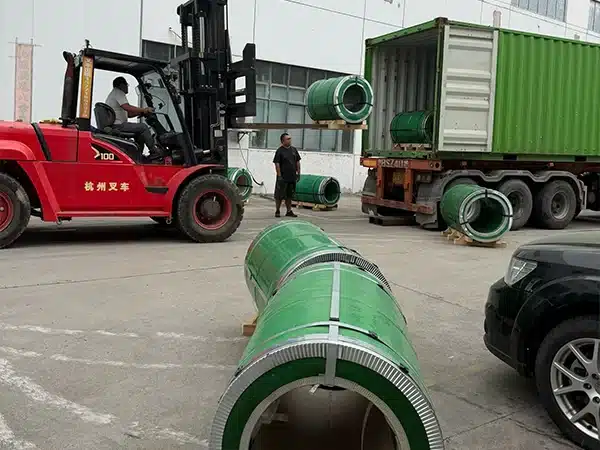
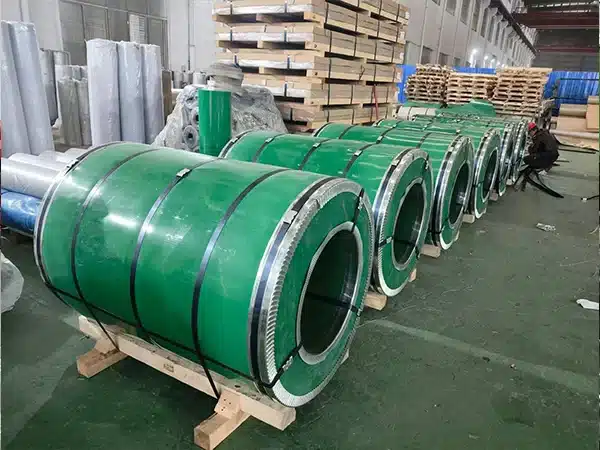
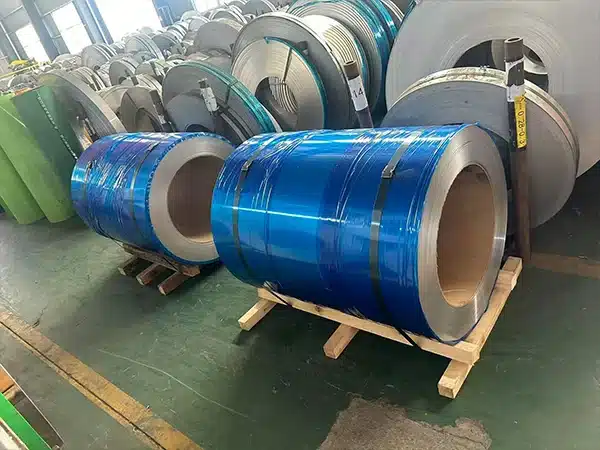
The coils below were staged and loaded in our yard for the Shanghai–Mundra sailing.
Core Key Points
- 26 tons of standard CRGO electrical steel coil (M140-30S5 class), ordered by a distribution transformer core manufacturer serving western and southern India.
- Core loss ≤1.40 W/kg at 1.7T/50Hz, B8 ≥1.82T — documented against IS 649 test parameters, not just a generic mill certificate.
- Test data bundled to support the buyer’s BEE Star-rating filing, alongside standard customs clearance documents.
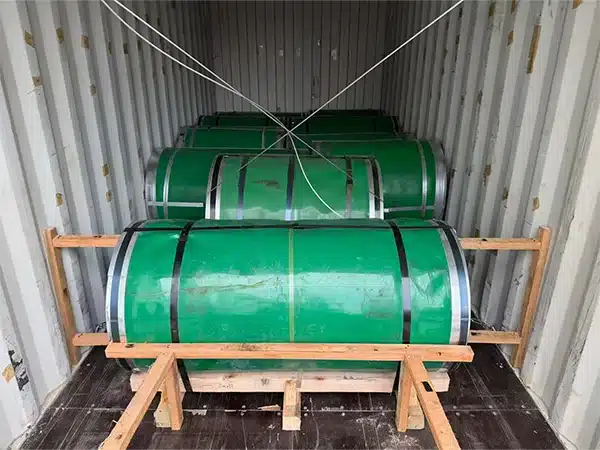
- Loaded coil-on-end into a single 20ft container with wooden cradle dunnage, sized for the Shanghai–Mundra transit and India’s inland trucking weight limits.
- First order for this buyer — a trial quantity ahead of a larger annual-volume agreement.
Customer Requirements
The buyer manufactures distribution transformer cores for utility and industrial customers across Gujarat and Maharashtra, and had been sourcing CRGO domestically until Indian mill lead times outran their production schedule. They wanted a grade equivalent to what they already used, documented so their compliance team could map it directly onto IS 649.
| Specification | Customer Requirement |
|---|---|
| Product Type | Standard CRGO electrical steel coil (M140-30S5 class) |
| Order Quantity | 26 tons |
| Core Loss | ≤1.40 W/kg at 1.7T/50Hz |
| Magnetic Induction (B8) | ≥1.82T |
| Thickness / Width | 0.30mm / 1000mm |
| Coating | C5 insulation coating |
| Inner Diameter | 508mm |
| IS 649 Grade Reference | Nearest equivalent to M4 grade band |
| Documentation | Mill test certificate + IS 649-mapped parameter sheet |
| Delivery Terms | FOB Shanghai, 20ft container, discharge at Mundra |
| Lead Time | 28 days, deposit to vessel loading |
What mattered most wasn’t the core loss ceiling — most CRGO suppliers can hit ≤1.40 W/kg on a standard grade. It was whether we could hand their compliance team a report mapped to IS 649, not a certificate built for a different national standard.
Why Standard CRGO, Not Hi-B
India’s BEE Star-rating bands can generally be met on standard CRGO at this buyer’s voltage class, without a Hi-B upgrade. Hi-B narrows the loss ceiling further, at a premium that only pays off when the star tier requires it.
Buyers new to Indian compliance sometimes assume BIS means the steel itself needs its own certification mark. In practice, that burden sits with the finished transformer’s star-rating filing — complete, traceable test data on the steel just makes that filing easier.
Sourcing and Documentation
Raw wide coil came from the same first-tier domestic mill we’ve used on prior CRGO orders of this class. Each incoming coil was logged against its own mill certificate and heat number before entering our slitting queue — standard practice on any first order from a new buyer.
Slitting to the buyer’s 1000mm width happened on our own lines. This order didn’t need a multi-width split like our Middle East distribution transformer order — a single width suited a low-complexity trial ahead of a larger commitment.
| Stage | Duration | What Can Slip |
|---|---|---|
| Raw coil procurement | 8–9 days | Mill scheduling for the exact chemistry/thickness |
| Slitting to width | 3–4 days | Minimal — single width, no changeovers |
| Testing & IS 649 mapping | 5–6 days | Building the parameter sheet for a first-time buyer |
| Packaging & loading | 4–5 days | Container booking on the lower-frequency Mundra lane |
A real share of the pre-production work went into translating our grade nomenclature into the IS 649 band this buyer’s compliance team works from. We built a one-page equivalence reference alongside the formal certificate, similar in structure to our published grade equivalents reference.
A returning buyer already has that mapping on file. A first-time buyer’s team is doing it cold, so we send the translation rather than leave them to trust an unfamiliar grade name.
Quality Inspection
Every coil was tested before packaging, reported in two formats: our standard mill certificate, and a parameter sheet cross-referenced to IS 649’s test methods.
| Test | Standard | What It Confirms |
|---|---|---|
| Specific core loss | IEC 60404-2, cross-mapped to IS 649 | Actual W/kg against the 1.40 ceiling |
| Magnetic induction (B8) | IEC 60404-2 | Directional magnetic performance |
| Thickness & width | Laser gauge, per coil | Tolerance against 0.30mm / 1000mm nominal |
| Coating & insulation resistance | ASTM A717 | Interlaminar insulation integrity |
| Surface quality | Visual + automated scan | Scratches, burrs, coating defects |
Our Epstein frame testing ran against every coil, not a sample subset. IS 649 and IEC 60404-2 align closely on core loss and induction measurement, so the data just needed reporting in a format the buyer’s team could use directly.
The buyer skipped third-party inspection on this trial order, though we flagged our SGS/BV/TÜV comparison as worth revisiting once volume scales. The mill certificate followed EN 10204 3.1 format, already familiar to their customs broker.
Packaging and Export
CRGO headed to an Indian west-coast port faces warmer, more humid port handling than a direct European route, plus inland trucking to Gujarat or Maharashtra that adds days beyond port discharge.
Each coil was wrapped in moisture-barrier film under steel strapping and set on end in wooden cradle dunnage built to this coil’s outer diameter — a mismatched cradle is a common cause of in-transit movement on this class of shipment.
We sized the order for a single 20ft container rather than a partial 40ft, both for cost efficiency on a 26-ton trial and to keep per-axle weight within limits on the Mundra-to-factory leg. Heaviest coils sat lowest and nearest the doors.
Documentation traveled as one bundled package — mill certificate, IS 649 mapping sheet, packing list — so the buyer’s broker had a complete file at first submission. On a first-time import relationship, a document discovered missing after sailing costs more time than the same gap on a fifth or sixth shipment.
Why Buyers Choose Zhongxin
- Documentation mapped to the destination standard. IS 649 for this order, EN or JIS equivalents for others — not one certificate format for every buyer.
- Full per-coil testing on first orders. Same rigor as our largest repeat accounts, every coil traced to its heat number.
- Packaging sized to the actual route. Cradle dunnage built to the coil’s own dimensions, container sizing that respects inland weight limits at the specific destination.
- A trial-order structure that doesn’t cut corners. A 26-ton first order gets the same lead time and documentation as a much larger one — most long-term relationships with buyers new to Chinese sourcing start exactly this way.
If you’re evaluating a Chinese electrical steel supplier for the first time, our supplier verification process walks through the qualification steps worth running before committing to any new relationship, including ours.
FAQ
Does electrical steel imported into India need its own BIS certification mark?
For most transformer core manufacturers importing raw CRGO as an input material, the compliance burden sits with the finished transformer’s BEE Star-rating filing, not a separate mark on the raw steel. Requirements can vary by product category, so confirm current rules with your broker or compliance counsel before ordering.
Why map test data to IS 649 instead of sending a standard mill certificate?
The underlying data is largely the same — mapping it saves the buyer’s compliance team from translating parameter formats themselves, which matters most on a first order when neither side has a shorthand for the other’s documentation yet.
Is standard CRGO enough for BEE Star-rated transformers, or do I need Hi-B?
Depends on the star tier and duty cycle. Many lower and mid-band designs meet their loss targets on standard CRGO; higher tiers or higher-duty applications often need Hi-B’s tighter loss ceiling.
Why order a small trial quantity instead of full annual volume?
It lets you verify grade accuracy, documentation quality, and delivery reliability before committing production volume to a new source — most buyers scale up only after a trial shipment performs as specified.
How is packaging different for a Mundra-bound shipment versus Europe or the Middle East?
Moisture-barrier wrap, coil-specific dunnage, and inland weight limits apply broadly, but cradle sizing, container fill, and document bundling get adjusted per route’s transit time and destination requirements.
What lead time should I plan for a first CRGO order into an Indian port?
Roughly 28–35 days from deposit to vessel loading for a single-width order, plus sea transit — longer on the Shanghai–Mundra lane than higher-frequency Europe or US West Coast routes.
Lessons for Buyers Sourcing Into India
- Ask for test data mapped to your compliance standard, not just a default certificate that forces your team to translate it.
- Confirm where the compliance burden actually sits before assuming the raw material itself needs a certification mark — for most buyers it’s the finished transformer’s filing, not the input steel.
- Start with a trial quantity on a new supplier relationship, fully documented and tested the same way a larger order would be.
- Size packaging and container loading for your actual inland route, not a generic export default — port-to-factory trucking limits and transit humidity vary enough to matter.
Bottom Line
A 26-ton first order is modest by tonnage. Standard CRGO at this loss ceiling is a commodity most qualified suppliers can deliver — what made this a workable trial was documentation mapped cleanly to IS 649, full per-coil testing at first-order rigor, and packaging built for the Mundra-bound container’s real handling conditions.
For a buyer testing a new Chinese supplier before committing full annual volume, that’s the calculus: verify accuracy, documentation, and reliability on a manageable first shipment, with a clear path to scale once it proves out.
Note on This Order Profile
This profile is based on an actual shipment; the loading photographs above are unedited images from that order. Buyer identity, exact commercial terms, and full transaction paperwork (proforma invoice, payment record, packing list, bill of lading) are not included in this version — they’re scheduled for a documentation backfill pass consistent with how our other Order Profiles articles are being upgraded over time.