
To choose electrical steel, make three decisions in order. Pick non-oriented (NGO) steel for rotating machines and grain-oriented (GO) steel for cores where the flux runs in one direction. Pick the thickness from the operating frequency. Then pick the grade from your core loss budget. Electrical steel is also sold as silicon steel, lamination steel and transformer steel.
Those three steps settle most orders. The harder questions come up around them: whether mild steel will do for a prototype, whether pure iron or a cobalt alloy is “better”, what a code like M250-35A means, and which material to load into a simulation. This guide answers eight of those questions, all of them asked repeatedly on engineering forums, with the numbers and sources behind each answer.
We’re Wuxi Zhongxin Special Steel (ZHX Steel). We supply grain-oriented and non-oriented silicon steel as coil and slit strip, so these are the questions we answer before most quotations.
Key Takeaways
- Motors and generators use NGO steel. Transformers and reactors use GO steel. The flux path decides, not the quality level.
- Classical eddy-current loss scales with the square of thickness. Moving from 0.35 mm to 0.20 mm cuts that part of the loss by about 67%.
- In M250-35A, “250” is a maximum loss of 2.50 W/kg at 1.5 T and 50 Hz, and “35” is 0.35 mm.
- Mild steel such as 1008 or 1018 has roughly one third of the electrical resistivity of a 3% silicon grade. It works for a geometry prototype and misleads on efficiency.
- Cobalt-iron saturates higher (2.4 T) and mu-metal has higher permeability, but neither replaces silicon steel in an ordinary motor or transformer.
- A standard guarantees a maximum loss at one test point. For simulation you need the supplier’s B-H and loss tables.
What Do NGO and GO Mean, and Which One Does a Motor Need?
NGO means non-grain-oriented and GO means grain-oriented. A motor needs NGO. In GO steel the grains are aligned with the rolling direction, so loss is very low along that direction and much worse across it. NGO steel has similar properties in every direction in the plane of the sheet.
| Non-oriented (NGO, CRNGO) | Grain-oriented (GO, CRGO) | |
|---|---|---|
| Magnetic behaviour | Similar in all directions | Best along the rolling direction only |
| Typical thickness | 0.20–0.65 mm | 0.20–0.35 mm |
| Loss is specified at | 1.5 T, 50 or 60 Hz | 1.7 T, 50 or 60 Hz |
| Product standard | IEC 60404-8-4, EN 10106, ASTM A677 | IEC 60404-8-7, EN 10107 |
| Used in | Motors, generators, small transformers | Power and distribution transformers, reactors |
The reason is the flux path. In a transformer limb the flux always runs the same way, so the core can be built with the rolling direction along it. In a motor the field rotates, and every tooth and every part of the yoke sees flux from changing angles. GO steel would be good in one direction and poor in the others.
If your core is a transformer, the type is settled and the work is in the grade: standard or Hi-B, and which efficiency class it has to meet. That route is covered step by step in how to select silicon steel grade for transformers. The rest of this guide stays with motors, generators and prototypes.
One forum answer claims small brushless motors “used to” use GO steel. That is not normal practice. Small drone and BLDC stators are punched from thin NGO sheet.
GO steel is not a higher class of NGO steel. They are two products for two flux patterns. We compare them in more depth in grain-oriented vs non-oriented electrical steel.
Does an Axial Flux Motor Change the Answer?
Sometimes. It depends on how the stator is built, because that sets which way the flux crosses the steel.
Wound, slotted stator. Strip is wound into a ring like a roll of tape, and slots are cut into one face. The rolling direction runs around the ring. Flux in the yoke also runs around the ring, which would suit GO. Flux in the teeth runs along the motor axis, which is across the width of the strip. That is the worst direction for GO steel. For this construction NGO strip is the safe choice.
Yokeless, segmented stator. Each tooth is a separate stack of flat laminations with no yoke joining them. The flux runs straight through each segment, so the laminations can be cut with the rolling direction along the axis. Traxial, an axial flux motor developer, describes this straight flux path as what makes GO steel usable in the design. A Harbin Institute of Technology comparison of GO and NGO stator cores in this type of machine reported higher torque and lower iron loss with GO.
There is a caveat. Researchers at Aalto University note that these small segments have a lot of cut edge relative to their area, so damage from punching or laser cutting costs more of the benefit than it would in a core with a yoke.
If you’re building a wound stator, order NGO strip slit to width. If you’re building a segmented stator and want to test GO, order grain-oriented silicon steel and mark the rolling direction on the cutting drawing.
How Thick Should Electrical Steel Be: 0.20 mm or 0.35 mm?
Choose thickness from the electrical frequency in the core. Classical eddy-current loss rises with the square of thickness and the square of frequency. At 50 Hz the eddy part is small and 0.35 mm or 0.50 mm is enough. At several hundred hertz it dominates, and 0.20 mm pays for itself.
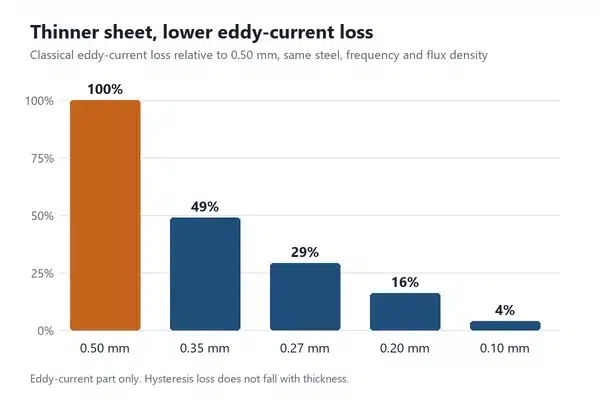
The chart is simple arithmetic on the thickness-squared rule. Going from 0.35 mm to 0.20 mm removes about 67% of the eddy-current part. It doesn’t touch hysteresis loss, so the total falls by less than that.
| Electrical frequency | Typical rotating machine | Common non-oriented thickness |
|---|---|---|
| 50–60 Hz | Industrial motors, generators | 0.50 mm, or 0.35 mm for high-efficiency motors |
| About 200–400 Hz | Servo motors, EV traction motors, aircraft-frequency equipment | 0.35–0.20 mm |
| Above 400 Hz | High-speed motors, drone motors | 0.20–0.10 mm |
Remember that electrical frequency is not shaft speed. It is speed in revolutions per second multiplied by the number of pole pairs. A 14-pole drone motor at 6,000 rpm runs at 700 Hz. Our electrical steel thickness guide covers each gauge from 0.05 to 0.65 mm.
Thinner isn’t free. More sheets are needed for the same stack height, and each one has to be cut. voestalpine gives a worked example for a stator of 250 mm outer diameter and 120 mm stack height: output falls from 32 stacks an hour with 0.35 mm sheet to 19 with 0.25 mm sheet. Thin sheet also costs more per kilogram.
So the rule for a prototype is practical. Under about 200 Hz, 0.35 mm is easier to buy, cut and stack. Above about 400 Hz, use 0.20 mm or thinner. We cover the thin end in ultra-thin silicon steel for EV motors.
How Do You Read a Grade Like M250-35A?
M250-35A is a European and IEC name for a non-oriented grade. It reads in four parts.
| Part | Meaning |
|---|---|
| M | Electrical steel |
| 250 | Maximum core loss of 2.50 W/kg at 1.5 T and 50 Hz, multiplied by 100 |
| 35 | Nominal thickness of 0.35 mm, multiplied by 100 |
| A | Non-oriented, fully processed |
The same steel carries other names in other standards. The codes hold the same two facts, loss and thickness, in a different order.
| System | Example | How it reads |
|---|---|---|
| EN 10106 / IEC 60404-8-4 | M250-35A | Loss 2.50 W/kg, 0.35 mm |
| GB (China) | 35W250 | 0.35 mm, non-oriented, loss 2.50 W/kg |
| JIS (Japan) | 35A250 | 0.35 mm, non-oriented, loss 2.50 W/kg |
| ASTM A677 (USA) | 36F155 | 0.36 mm, fully processed, 1.55 W/lb at 1.5 T and 60 Hz |
The ASTM example is the grade long sold as M-19 at 0.014 inch. Its number looks lower because it is in watts per pound at 60 Hz, not watts per kilogram at 50 Hz. Don’t compare the digits across systems. Our grade equivalents guide maps the systems against each other.
A lower loss number at the same thickness is a better grade and costs more. These are common starting points.
| Grade (EN / GB) | Thickness | Max loss | Where it usually fits |
|---|---|---|---|
| M800-50A / 50W800 | 0.50 mm | 8.00 W/kg at 1.5 T, 50 Hz | Small and general-purpose motors |
| M470-50A / 50W470 | 0.50 mm | 4.70 W/kg at 1.5 T, 50 Hz | Industrial motors, generators |
| M300-35A / 35W300 | 0.35 mm | 3.00 W/kg at 1.5 T, 50 Hz | High-efficiency motors |
| M250-35A / 35W250 | 0.35 mm | 2.50 W/kg at 1.5 T, 50 Hz | Premium-efficiency, servo and traction motors |
The loss figures are the limits the grade names themselves state. Actual coils test below them. The table covers non-oriented grades only, because grain-oriented grades are chosen by a different route. For the full non-oriented range, see non-oriented electrical steel grades explained.
Can Mild Steel Replace Silicon Steel in a Prototype?
Yes for checking geometry and basic function. No for measuring efficiency. Mild steel such as 1008 or 1018 is magnetic and will carry flux, but it loses more energy as heat for two reasons.
Resistivity. Wikipedia’s resistivity table lists 1010 carbon steel at 14.3 µΩ·cm and grain-oriented electrical steel at 46.0 µΩ·cm. A supplier table for M-19 non-oriented steel gives 45–55 µΩ·cm. Eddy-current loss is inversely proportional to resistivity, so at the same thickness and frequency the eddy part is roughly three times higher in mild steel. That ratio is our calculation from those figures.
Permeability and hysteresis. Wikipedia’s reference table lists carbon steel at a relative permeability of about 100 and electrical steel at 2,000 to 38,000. The values are approximate and tied to specific field strengths, but the gap is large. You need more current to reach the same flux.
Proto Laminations, a US lamination maker, puts the trade-off this way: carbon steel suits jobs where higher core loss is acceptable and low first cost matters most, such as DC pole pieces and low-duty-cycle machines. It also notes that purpose-made cold-rolled motor lamination steel, properly annealed, can rival the lower grades of silicon steel. That is a different product from hardware-store 1018 sheet.
| Prototype goal | Mild steel acceptable? |
|---|---|
| Check fit, winding space, assembly | Yes |
| Confirm the machine turns and produces torque | Yes, expect extra heating |
| Measure efficiency, no-load loss or temperature rise | No |
| Validate a simulation model | No, unless the model uses the mild steel’s own data |
If you do use mild steel, keep the sheets thin (0.5 mm or less) and insulate them from each other. A solid block behaves far worse than a stack.
One more caution from the same forums. Sheet sold as “silicon steel” on consumer marketplaces has turned out to be stainless steel. Ask for the grade and the mill certificate. Our guide to EN 10204 mill test certificates shows what the certificate should state.
Is Pure Iron, Cobalt-Iron or Mu-Metal Better Than Silicon Steel?
Each one beats silicon steel on a single property and loses on cost or on AC loss. For a motor or transformer running at power frequencies, silicon steel is still the practical choice.
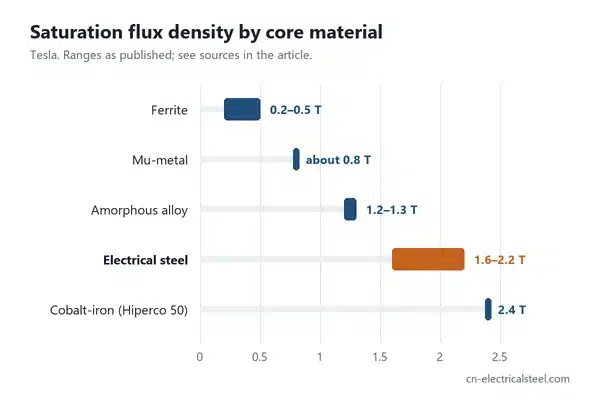
| Material | Saturation | Relative permeability (max, approximate) | Where it wins | Why it doesn’t replace silicon steel |
|---|---|---|---|---|
| Electrical (silicon) steel | 1.6–2.2 T | 2,000–38,000 | AC cores at 50 Hz to a few kHz | The baseline |
| Pure iron, 99.8% | Near the top of the steel range | 5,000 | DC electromagnets, pole pieces | Low resistivity, so high eddy loss in AC |
| Cobalt-iron (Hiperco 50) | 2.4 T | 18,000 for high-permeability strip | Aerospace machines where weight matters most | About half cobalt, so very expensive |
| Mu-metal, permalloy | About 0.8 T | 50,000–100,000 | Magnetic shielding, sensors | Saturates early; nickel cost |
| Ferrite (MnZn) | 0.2–0.5 T | 350–20,000 | Tens of kHz and above | Low saturation; brittle ceramic |
Three points explain the table.
Pure iron. The figure of 200,000 often quoted is for 99.95% iron annealed in hydrogen, a laboratory material. Commercial 99.8% iron is listed at 5,000, inside the range for electrical steel. Silicon is added to iron precisely because it raises resistivity and cuts AC loss. Pure iron’s resistivity is only 9.7 µΩ·cm, about a fifth of the figure for 3% silicon steel.
Cobalt-iron. Carpenter lists Hiperco 50 at 24 kilogauss, which is 2.4 T, with a nominal 48.5% cobalt. That extra flux density shrinks a machine. It is used where a kilogram saved is worth a great deal.
Ferrite against steel. Ferrite has the lowest saturation in the table. It wins at high frequency because it barely conducts, so eddy currents are small. At 50 Hz a ferrite core would need several times the cross-section of a steel one.
Can the Rotor and Stator Use Different Steel?
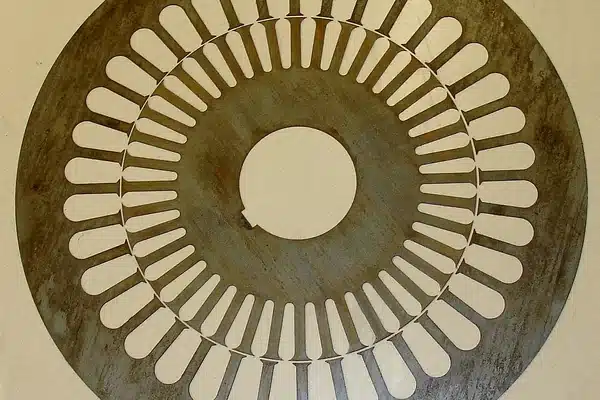
They can, but most motors use the same sheet for both, because the rotor is punched from the disc left inside the stator. The cover photo shows it: one stroke, one sheet, two parts. Buying a second material means throwing that inner disc away.
The two parts want different things. In a synchronous permanent-magnet machine the rotor turns with the field, so its core loss is small and stator loss is what matters. The rotor instead carries mechanical stress at speed. voestalpine makes the same point about traction motors: thin steel raises efficiency mainly in the stator, while the rotor more often needs high strength than low thickness.
That leaves three workable options.
- One standard grade for both. The default. Choose it for the stator’s loss target.
- One high-strength grade for both. Used in high-speed rotors with thin bridges. Check the yield strength on the data sheet as well as the loss.
- Two materials. Technically straightforward, and done in some high-performance machines. It doubles the tooling and the scrap, so it rarely makes sense below large volumes.
Thickness is tied the same way. If both parts come from one sheet, the stator’s gauge is the rotor’s gauge. For the cost side of moving up a grade, see our comparison of M270-35A against standard CRNGO.
Which Material and Data Should You Use in a Simulation?
Use a named electrical steel grade with a nonlinear B-H curve and loss data, not a generic “soft iron”. A lossless soft iron entry gives no core loss at all, and its curve doesn’t match laminated steel near saturation.
There are three places to find data.
- The software’s own library. COMSOL’s Nonlinear Magnetic material library includes non-oriented silicon steels such as 35JN200, the 35PN and 50PN series and M-14, M-22 and M-36, plus grain-oriented entries such as M-6. Other packages ship similar lists. Pick the entry closest in thickness and loss to the steel you’ll buy.
- Published data sets. Magnetization and core loss curves for 0.014 inch M-19 from the Lamination Steels compilation are posted with MIT OpenCourseWare course material. They are widely used as a reference case.
- Your supplier. This is the one that matches the real steel.
The third source matters because of how standards work. A product standard guarantees a maximum loss at one point, for example 1.5 T and 50 Hz. It says nothing binding about loss at 400 Hz or about the shape of the B-H curve. Two coils of the same grade can differ in both.
So ask for three things with the quotation: the typical B-H table, loss curves at the frequencies you run at, and the test method. Loss measured on an Epstein frame and on a single sheet tester are not identical. Our guide to core loss testing on an Epstein frame explains what the report contains.
Remember that cutting changes the material. Punched or laser-cut edges have higher loss than the sheet data shows, and the effect grows as teeth get narrower. Leave margin in the model.
A Five-Step Selection Checklist
- Flux path. Rotating field: NGO. Fixed direction: GO. Axial flux: decide by stator construction.
- Electrical frequency. Speed in rev/s times pole pairs. Under 200 Hz start at 0.35 or 0.50 mm. Above 400 Hz start at 0.20 mm.
- Loss budget. For a motor, take the efficiency target, work back to allowable core loss, and choose the non-oriented grade whose limit sits under it. For a transformer, use the efficiency-class route in our transformer guide.
- Manufacturing route. Punching, laser cutting or wire EDM. Check that the coating and thickness suit the route and that the stack height is practical.
- Verification. Agree the grade name in one standard, the test conditions and the certificate type before ordering.
What to Send When You Ask for a Quote
A complete inquiry gets a faster and more accurate answer. Send these six items.
- Grade, or the loss limit and test condition you need
- Thickness and width, with tolerance if it matters
- Form: master coil, slit strip or cut sheet
- Coating requirement, if any
- Quantity, and whether it is a trial lot or a repeat order
- Destination and the certificate you need
Minimum quantities depend on grade, thickness and whether the width is a stock size. Our page on lead times and minimum order quantities sets out what to expect.
If you’re not sure which grade fits, send the application, frequency and efficiency target instead. Request a quote and we’ll reply with a grade recommendation and the data sheet.
Bottom Line
Choosing electrical steel comes down to three decisions and two checks.
- Type: NGO for anything that rotates, GO where the flux keeps one direction.
- Thickness: set by electrical frequency. 0.35–0.50 mm at mains frequency, 0.20 mm or less above about 400 Hz.
- Grade: set by the loss you can afford. Read the number in the grade name as a maximum at a stated test point.
- Check the substitute: mild steel proves a shape, not an efficiency figure.
- Check the data: simulate with the supplier’s curves, not a library default.
Cover photo: a stator and rotor lamination punched from one sheet. Zureks, Wikimedia Commons, CC BY-SA 3.0.
FAQ
What is electrical steel?
Electrical steel is an iron alloy with up to 6.5% silicon, usually about 3% or less in commercial grades, rolled into thin insulated sheet for the magnetic cores of motors, generators and transformers. Silicon raises electrical resistivity, which cuts eddy-current loss. It is also called silicon steel, lamination steel or transformer steel.
Is silicon steel the same as electrical steel?
Yes, in normal trade use. Both names describe thin, low-loss steel sheet for magnetic cores. “Silicon steel” names the alloying element. “Electrical steel” names the use. CRGO and CRNGO are the cold-rolled grain-oriented and non-oriented forms of the same family.
Can I use grain-oriented steel in a motor?
Not in a conventional radial-flux motor. Its low loss applies only along the rolling direction, and a rotating field crosses the steel at every angle. The exception is a segmented axial flux stator, where each tooth can be cut with the rolling direction along the flux. See our guide to CRGO steel grades for the GO range.
Is thinner electrical steel always better?
No. Thinner sheet cuts eddy-current loss, which matters at high frequency. At 50 or 60 Hz the gain is small, and you pay for more sheets, slower stacking and a higher price per kilogram. Match the thickness to the electrical frequency.
What is the difference between M250-35A and 35W250?
They describe the same grade in two naming systems. M250-35A is the EN and IEC name. 35W250 is the Chinese GB name. Both mean non-oriented steel, 0.35 mm thick, with a maximum core loss of 2.50 W/kg at 1.5 T and 50 Hz.
What is the saturation flux density of silicon steel?
Published ranges for electrical steel run from about 1.6 to 2.2 T, depending on silicon content and grade. That is far above ferrite at 0.2 to 0.5 T and mu-metal at about 0.8 T, and below cobalt-iron at 2.4 T.
Not sure which grade fits your core? Contact our team with the application and frequency.
References
- Wikipedia — Permeability (electromagnetism): values for some common materials
- Wikipedia — Saturation (magnetic)
- voestalpine isovac — Is thinner better? Just the right electrical steel thickness in the motor
- Sko-Die, Inc. — Non-Oriented Electrical Steel Fully Processed (FP) ASTM A677
- ASTM International — A677: Standard Specification for Nonoriented Electrical Steel, Fully Processed Types
- Wikipedia — Electrical resistivity and conductivity: resistivity of various materials and Electrical steel
- Proto Laminations — Cold Rolled Motor Lamination Steel (CRMLS)
- Carpenter Technology — Hiperco 50 alloy
- Traxial — The theory: fundamental advantages delivering substantial performance improvements in axial flux motors
- Yu, Hao, Bi and Pei, Harbin Institute of Technology, ICEMS 2019 — Performance analysis between Grain-oriented and Non-oriented Material on Yokeless And Segmented Armature Machine
- Ravi et al., Aalto University, IECON 2019 — accepted manuscript on cutting effects in grain-oriented steel for yokeless axial flux machines
- COMSOL — Nonlinear Magnetic Material Library
- MIT OpenCourseWare — 6.685 Electric Machines: M-19 lamination steel data
- VDE Verlag — IEC 60404-8-4:2022: Cold-rolled non-oriented electrical steel strip and sheet delivered in the fully-processed state


