Non-oriented electrical steel grades split along two axes that a single grade code rarely makes obvious: whether the coil is semi-processed or fully processed, and which loss tier it sits in once it is fully processed. A “50W470” or “M400-50A” on a quote tells you thickness and a guaranteed loss ceiling — it does not tell you whether that coil is ready to punch and stack, or whether a cheaper, higher-loss grade would have done the job just as well.
We get this confusion from buyers more often on the non-oriented side than on grain-oriented. A transformer buyer asking about CRGO usually already knows they want low loss at any reasonable cost. A motor or pump manufacturer sourcing CRNGO is choosing between a wide loss range on purpose, because the cheapest grade that still meets the motor’s efficiency target is the right answer — and the grade codes make that comparison harder than it should be.
This article works through the semi-processed/fully-processed fork, the four commercial tiers inside fully-processed material, and how GB, AISI, EN and JIS number codes decode so you can compare a quote against the actual numbers rather than the string.
Key Takeaways
- Non-oriented electrical steel first splits into semi-processed and fully-processed material. Fully processed steel arrives with its magnetic properties already developed at the mill; semi-processed steel still needs a final anneal after stamping, and that anneal becomes the buyer’s responsibility, not the mill’s.
- Inside fully-processed material, commercial grades fall into four rough tiers by loss ceiling and thickness: high-loss commercial grades (0.50–0.65mm, GB 50W600 and up), standard motor grades (0.50mm, around 50W400–50W470), low-loss premium grades (0.35mm and thinner, around 35W250–35W300), and ultra-thin/high-frequency grades below 0.20mm for traction and high-speed motors.
- GB/T 2521.2 and EN 10106 codes both encode thickness and loss directly in the number — GB’s 50W470 and EN’s M470-50A describe the same 0.50mm coil with a guaranteed core loss around 4.70 W/kg, just written in a different order.
- AISI grades (ASTM A677) use an M-number ladder — M-15, M-19, M-22, M-27, M-36, M-43, M-47 — where a lower number means lower loss and better performance, the opposite direction from GB’s loss-coded numbers, which is where a lot of cross-standard confusion starts.
- IEC 60034-30-1:2025’s new IE5 efficiency class is pulling motor designers toward the low-loss tier and toward fully-processed material generally, which is the main reason “which non-oriented grade tier do I actually need” has become a more common question in 2026 than it was a few years ago.
What “Non-Oriented” Means, and Why the Grade Range Is So Wide
Non-oriented electrical steel — also written CRNGO (cold-rolled non-grain-oriented), NGOES, or just NOES — is silicon steel rolled so its magnetic properties are roughly uniform in every direction in the plane of the sheet, unlike grain-oriented steel, which is deliberately textured to perform best along one rolling axis.
That uniformity is exactly what a rotating machine needs: a motor or generator core sees a rotating magnetic field, not a fixed one, so a material with a strong axis and a weak axis would waste energy every time the field swept through the weak direction.
The trade-off is that non-oriented steel never reaches grain-oriented steel’s best-case core loss, because it gives up directional grain alignment for uniformity. What it gains instead is an enormous usable grade range, because a rotating machine’s tolerance for core loss varies hugely by application.
A cheap fan or fractional-horsepower appliance motor that runs a few hours a day does not need the same steel as an IE4 premium-efficiency industrial motor running three shifts, and the grade system exists mainly to price that difference correctly.
That range is also why the loose keyword “non-oriented electrical steel grades” covers such different products depending on who is searching it: a buyer comparing 50W1300 against 50W600 for a cost-driven appliance motor is having a completely different conversation than one comparing 35W250 against a premium low-loss grade for an IE5-class motor core. The rest of this article separates those conversations by tier.
Semi-Processed vs Fully-Processed — The Fork Most Buyers Miss
Before any tier discussion, non-oriented steel splits into two processing states, and this fork changes who is responsible for the final magnetic properties.
Fully-processed non-oriented steel — the type covered by ASTM A677 and the type sold on essentially every current non-oriented silicon steel product page, including ours — arrives from the mill already annealed to its final grain structure and coated with an insulating film. Core loss, permeability and other magnetic properties are guaranteed on the mill test certificate as shipped.
A buyer stamps laminations from it, stacks the core, and the material performs to spec with no further heat treatment.
Semi-processed steel is finished to final thickness and temper by the mill, but it is deliberately left in a cold-worked, unannealed state. The magnetic property development — the anneal that produces the final grain structure — is left for the buyer to perform after stamping, typically as a batch anneal on the finished laminations.
That is not an oversight in the product; it exists because stamping cold-worked, unannealed strip produces cleaner die-cut edges than stamping the same steel after annealing, and some motor manufacturers with in-house annealing furnaces prefer to control that final step themselves.
For a buyer without in-house annealing capability, ordering semi-processed material by mistake — because a quote line just said “CRNGO” without specifying — means receiving steel that will not meet its rated core loss until it goes through a furnace the buyer does not have. Confirming fully-processed status explicitly, rather than assuming it, is the single question that avoids the most expensive version of this mix-up.
We had a small pump-motor manufacturer contact us last spring after stamping a full batch of laminations from a cheaper “CRNGO” quote elsewhere, only to find the finished stator failed its no-load loss test — the coil had been semi-processed all along, and nobody on either side had asked the annealing question out loud before the order was placed.
The Four Tiers of Fully-Processed Non-Oriented Steel
Once fully-processed is confirmed, commercial non-oriented steel sorts into four rough tiers by thickness and guaranteed core loss. Unlike CRGO’s four tiers, which each add a distinct manufacturing step, non-oriented tiers are mostly a continuum of composition and rolling reduction — thinner and lower-silicon-optimized grades cost more to produce and carry a lower guaranteed loss.
| Tier | Typical thickness | Indicative core loss (P1.5/50) | Bought for |
|---|---|---|---|
| 1. High-loss commercial | 0.50–0.65mm | ≈ 6.0–13.0 W/kg | Ballasts, small appliance motors, low-duty-cycle fans |
| 2. Standard motor grade | 0.50mm | ≈ 4.0–4.7 W/kg | General industrial motors, pumps, compressors (typical IE2/IE3) |
| 3. Low-loss premium | 0.27–0.35mm | ≈ 2.3–3.0 W/kg | Premium-efficiency motors (IE4), generators, high-duty-cycle equipment |
| 4. Ultra-thin / high-frequency | below 0.20mm | Rated at higher frequency (e.g. 400Hz), not P1.5/50 | EV traction, servo and drone motors, high-speed spindles |
These loss figures are indicative ranges to show the shape of the ladder, not a specific grade guarantee — the guaranteed number for any single grade is whatever is stated on that grade’s mill test certificate.
Tier 1 is where GB codes like 50W800 and 50W1300 sit, alongside AISI’s higher M-numbers (M-43, M-47). This is the cheapest fully-processed non-oriented steel commercially available, and it is the correct choice for equipment where core loss barely affects the total cost of ownership — a shaded-pole fan motor running two hours a day does not repay the premium for a lower-loss grade within any reasonable equipment lifetime.
Tier 2 is the volume tier: GB 50W470 and 50W400, roughly corresponding to the AISI M-22 to M-27 range, at 0.50mm. This is the default grade for general-purpose three-phase induction motors, pumps and compressors built to a normal efficiency class, and it is the grade most buyers mean when they search “non oriented electrical steel” or “motor lamination steel” without a more specific spec in mind.
Tier 3 moves to thinner gauge — 0.35mm and below — with GB codes like 35W300 and 35W250, corresponding roughly to AISI’s lower M-numbers (M-15, M-19). Thinner laminations cut eddy-current loss directly, since eddy losses scale with the square of thickness, and the tighter processing needed to hold magnetic performance at that gauge is what the price premium is paying for.
This is the tier premium-efficiency motor builders reach for when a standard 0.50mm grade cannot meet an IE4-class efficiency target at a workable core size.
Tier 4 is a separate product family rather than a thinner version of Tier 3, the same way ultra-thin grain-oriented steel is a separate family from standard CRGO. Below roughly 0.20mm, non-oriented steel is rated at an operating frequency well above 50/60Hz.
That is because of where it is actually used: EV traction motors, servo drives and drone motors that spin at electrical frequencies where a 0.50mm lamination would lose an unworkable amount of energy to eddy currents on every rotation.
How GB, AISI, EN and JIS Grade Codes Actually Decode
Non-oriented grade codes look intimidating mainly because three different standards encode the same two numbers — thickness and guaranteed core loss — in three different orders, and a fourth (AISI) abandons that logic entirely in favor of an arbitrary ranking.
GB/T 2521.2 writes the thickness first: in 50W470, “50” is nominal thickness ×100 (0.50mm) and “470” is the guaranteed core loss at 1.5T/50Hz ×100 (4.70 W/kg). The same logic gives 35W300 as 0.35mm at ≤3.00 W/kg, and 50W600 as 0.50mm at ≤6.00 W/kg.
EN 10106 writes the same two numbers in the opposite order with a suffix: M400-50A is loss first (4.00 W/kg), then thickness (0.50mm), with the “A” suffix marking it as fully-processed, cold-rolled non-oriented material. M270-35A follows the same pattern — 2.70 W/kg at 0.35mm. Once you know the order, an EN code and a GB code for materially the same coil are easy to cross-check against each other without a lookup table.
JIS C 2552 uses a similar thickness-then-loss structure to GB, written with an “A” in place of “W” — a JIS coil close to GB’s 50W470 is typically written 50A470. Some supplier catalogs add a house prefix letter in front of the JIS-style string (candidates like “B50A470” turn up in supplier listings); that prefix is not part of the JIS standard itself, so treat it as a mill’s internal product-line marker and confirm the underlying thickness and loss numbers rather than relying on the letter.
AISI’s M-number system, standardized through ASTM A677, breaks from all three by ranking grades with a single number rather than encoding thickness and loss directly: the current commercial ladder runs M-15, M-19, M-22, M-27, M-36, M-43 and M-47, and — unlike GB or EN — a lower M-number means lower core loss and better magnetic performance, not a thinner gauge on its own.
M-19 at 0.35mm is a common mid-tier motor grade; M-36, thicker and higher-loss, is a cheaper commercial-grade choice. Because the M-number hides both thickness and the actual loss ceiling, two suppliers can both quote “M-19” material with different guaranteed loss figures depending on which edition of the specification and which specific sub-grade they are shipping — the same trap that AISI’s M-numbers create on the grain-oriented side.
| GB/T 2521.2 | EN 10106 | Commonly cited AISI range | Nominal thickness |
|---|---|---|---|
| 50W1300 | M1300-50A | ≈ M-47 | 0.50mm |
| 50W600 | M600-50A | ≈ M-36 | 0.50mm |
| 50W470 | M470-50A | ≈ M-27 | 0.50mm |
| 50W400 | M400-50A | ≈ M-22 / M-19 | 0.50mm |
| 35W300 | M300-35A | ≈ M-19 | 0.35mm |
| 35W250 | M250-35A | ≈ M-15 | 0.35mm |
Treat the AISI column as a commonly cited approximation rather than an exact equivalence — GB, EN and AISI were standardized independently and their loss test conditions are not identical in every edition, so the reliable check is always the guaranteed core loss and thickness on the mill test certificate, not the grade string on the quote. We still get quote requests that just say “M-19 or equivalent,” and the honest answer is that “equivalent” needs a number attached before we can price it properly.
Reading a Non-Oriented Mill Test Certificate
The certificate that ships with a non-oriented coil reports core loss and induction measured against IEC 60404-2 (Epstein frame) or, increasingly for thinner and higher-performance grades, single sheet testing methods.
The reference condition for non-oriented steel is 1.5T at 50Hz (P1.5/50), which is a different test point from grain-oriented steel’s 1.7T/50Hz (P1.7/50) — a detail worth knowing before comparing a GO and NO certificate side by side and wondering why the numbers look so different.
Three figures matter for a buyer verifying a non-oriented certificate against a grade code. Core loss (P1.5/50) is the primary spec that defines the tier, guaranteed as a maximum in W/kg. Magnetic induction, usually reported at a specified field strength, indicates how efficiently the material carries flux — relevant mainly for motor designers sizing the core cross-section.
Lamination factor, the ratio of actual steel volume to the stacked core’s total volume, is affected by coating thickness and flatness rather than the base grade, and a certificate showing a low lamination factor points to a coating or flatness issue rather than a bad steel grade.
A certificate that shows a fully-processed status, a P1.5/50 figure inside the tier the grade code implies, and a lamination factor in the high-90s percent range is consistent with a normal, correctly-specified coil. A mismatch between the stated grade and the measured loss is the specific thing worth raising with a supplier before accepting a shipment, the same way it would be for grain-oriented material.
Matching a Grade Tier to Your Application
| Application | Typical tier | Why |
|---|---|---|
| Ballasts, shaded-pole fan motors, low-duty appliance motors | Tier 1 (high-loss commercial) | Core loss is a small fraction of total operating cost; lowest material cost wins |
| General industrial motors, pumps, compressors (IE2/IE3) | Tier 2 (standard motor grade) | Balances loss and cost for continuous-duty three-phase induction motors |
| Premium-efficiency motors (IE4), generators, high-duty-cycle equipment | Tier 3 (low-loss premium) | Meets tighter efficiency mandates without an oversized core |
| EV traction motors, servo drives, drone motors, high-speed spindles | Tier 4 (ultra-thin / high-frequency) | Electrical frequency far above 50/60Hz makes standard-gauge eddy loss unworkable |
A motor builder who over-specifies — ordering Tier 3 material for a Tier 1 application — pays a real premium for efficiency the equipment’s duty cycle will never recover in energy savings. Under-specifying is the more common costly mistake in the other direction: ordering Tier 2 material against an IE4 target and finding the finished motor cannot pass its efficiency test without a larger, heavier core than the design budget allowed.
Why This Matters More in 2026
IEC 60034-30-1:2025 formally added the IE5 efficiency class in December 2025, and industry coverage through 2026 has treated it as pulling motor designers toward the lowest-loss non-oriented tiers well before any mandate requires it, the same dynamic covered in more detail in our IE5 standard article. That shift shows up as motor manufacturers asking non-oriented steel suppliers for Tier 3 material, and sometimes Tier 4 thin-gauge stock, on programs that would have specified Tier 2 material three or four years ago.
At the same time, more buyers are sourcing non-oriented steel from mills they have not qualified before, as the wider electrical steel market works through the supply tightness already documented on grain-oriented grades. A buyer moving between suppliers on an unfamiliar grade code benefits directly from being able to check the thickness and loss numbers behind that code rather than trusting the string, which is the practical skill this article is built around.
Quoting and Documenting Non-Oriented Grades at Zhongxin
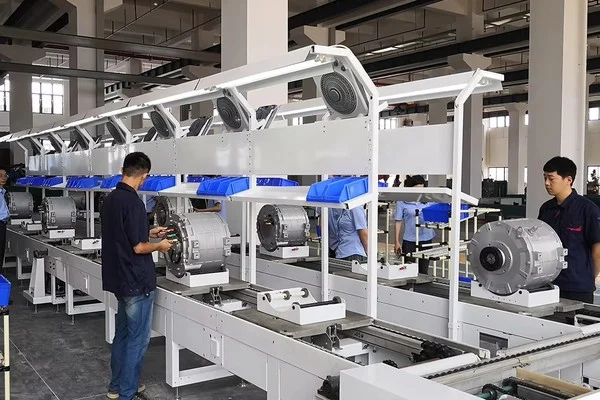
We are Wuxi Zhongxin Special Steel Co., Ltd., an electrical steel manufacturer and exporter founded in 2017 in Wuxi, with 200,000 tons per year of silicon-steel capacity shipping to more than 40 countries. Non-oriented coil and sheet across the tiers above make up a regular share of our order book, alongside the grain-oriented material most of our other technical articles cover.
When a buyer sends us a grade code we have not seen written that way before — a house-prefixed JIS-style string, or an older GB code — we map it to thickness and guaranteed core loss before quoting, rather than quoting against the string alone.
Every shipment carries a mill test certificate reporting core loss and induction against the standard the grade was ordered under, and for export orders we issue our own test report alongside the mill’s certificate, since domestic-market certificates from some Chinese mills are marked for mainland use only and do not independently satisfy an overseas buyer’s import documentation.
We ask new buyers directly whether their application needs fully-processed material — the answer is almost always yes for anyone without in-house annealing capability — and we tell buyers plainly when a target price only clears at a higher-loss tier than their efficiency target actually allows, rather than letting that mismatch surface after a motor fails its test bench.
FAQ
What are the different grades of non-oriented electrical steel?
Non-oriented grades split first into semi-processed and fully-processed material, then into four rough commercial tiers within fully-processed steel: high-loss commercial grades (GB 50W800–50W1300, roughly AISI M-43/M-47), standard motor grades (GB 50W400–50W470, roughly AISI M-22–M-27), low-loss premium grades (GB 35W250–35W300, roughly AISI M-15/M-19), and ultra-thin/high-frequency grades below 0.20mm for traction and high-speed motors.
How is semi-processed electrical steel different from fully-processed?
Fully-processed steel is annealed at the mill and arrives with its magnetic properties already developed — no further heat treatment is needed. Semi-processed steel is finished to final thickness but deliberately left unannealed; the buyer must anneal the stamped laminations to develop the final core loss and permeability, which requires in-house annealing capability the buyer must actually have.
How do you decode a grade code like M400-50A?
M400-50A is an EN 10106 grade code for fully-processed non-oriented steel: “400” is the guaranteed core loss at 1.5T/50Hz ×100 (4.00 W/kg), “50” is nominal thickness ×100 (0.50mm), and the “A” suffix marks it as cold-rolled non-oriented fully-processed material. It corresponds roughly to GB 50W400.
How do 50W470 and 50W600 differ?
Both are GB/T 2521.2 grades at 0.50mm nominal thickness. 50W470 carries a guaranteed core loss of ≤4.70 W/kg at 1.5T/50Hz; 50W600 allows up to ≤6.00 W/kg, a higher-loss, lower-cost grade typically used for less duty-intensive equipment than 50W470.
Why do lower AISI M-numbers mean better steel, not thinner steel?
AISI’s M-number system ranks non-oriented grades by guaranteed magnetic performance rather than encoding thickness directly the way GB or EN codes do. M-15 and M-19 sit at the low-loss end of the ladder; M-36 and M-47 sit at the high-loss, lower-cost end. Two grades with different M-numbers can share a nominal thickness, which is a common source of confusion when comparing an AISI quote against a GB or EN one.
Which non-oriented grade should I use for a general industrial motor?
For a standard continuous-duty three-phase induction motor at IE2 or IE3 efficiency, a Tier 2 grade — GB 50W400–50W470, roughly AISI M-22–M-27, at 0.50mm — is the usual starting point. Move to a Tier 3 low-loss grade only when the design’s efficiency target or core-size budget cannot be met with Tier 2 material.
Is fully-processed non-oriented steel always more expensive than semi-processed?
Not necessarily on a per-kilogram basis, but the comparison is incomplete without accounting for the anneal. Semi-processed material shifts the annealing cost and furnace time to the buyer; unless that buyer already runs annealing in-house at a lower marginal cost than the mill would charge, fully-processed material is usually the lower total-cost choice.
Bottom Line
Non-oriented electrical steel grades are not one ladder but two decisions stacked on top of each other: whether the coil is semi-processed or fully-processed, and which of four cost/loss tiers it sits in once fully processed. GB and EN codes encode thickness and guaranteed core loss directly, just in opposite order; AISI’s M-numbers rank performance instead and hide both thickness and the exact loss ceiling behind a single digit.
Compare a quote on the numbers that actually define the coil — processing state, nominal thickness, and guaranteed P1.5/50 core loss — rather than the grade string, and confirm which tier your application genuinely needs before paying a premium tier’s price for a commercial-tier job, or under-buying a premium-efficiency program.
References
- ASTM International — A677-16(2023): Standard Specification for Nonoriented Electrical Steel, Fully Processed Types
- Sko-Die, Inc. — Non-Oriented Electrical Steel Fully Processed (FP) ASTM A677
- Cleveland-Cliffs (AK Steel) — NO-DI-MAX Non-Oriented Electrical Steel: M-15, M-19, M-22, M-27, M-36, M-43, M-47 Datasheet
- Aperam — Electrical Steels: Grain-Oriented (GO) and Non-Oriented (NGO)
- IEC Webstore — IEC 60404-2: Magnetic Materials — Methods of Measurement of the Magnetic Properties of Electrical Steel Strip and Sheet by Means of an Epstein Frame