
A buyer asked us last month whether they could use leftover CRGO stock for a small batch of motor stampings instead of ordering CRNGO — the coil was already in the warehouse, and a new order felt like avoidable cost and lead time. It is a reasonable question on the surface. The answer is almost always no, and the reason is the whole point of this guide.
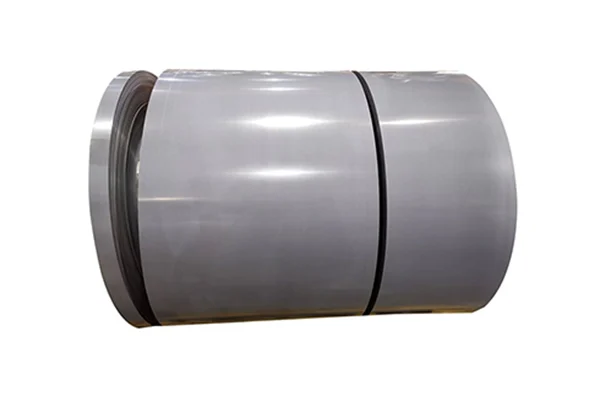
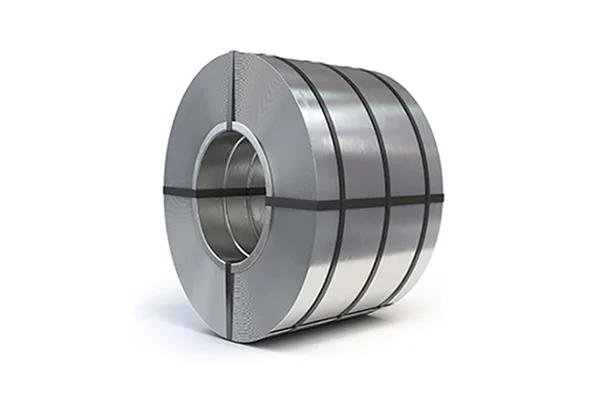
Grain-oriented (CRGO) and non-oriented (CRNGO) silicon steel look almost identical on a coil rack — same colour, same coating sheen, often the same thickness. They are not two price points on one material; they are built for physically different jobs. Put non-oriented steel in a transformer core and no-load loss climbs steeply; put grain-oriented steel in a motor stator and the rotating flux fights the grain structure. Below: the three differences that decide which one you buy, the numbers to check on a mill certificate, the substitutions that do and do not work, and the 2026 trade conditions that move the price.
The three key differences at a glance
- Magnetic anisotropy. Grain-oriented silicon steel is strongly anisotropic — very high permeability and very low core loss in the rolling direction only. Non-oriented silicon steel is isotropic: near-uniform magnetic properties in every direction.
- Silicon content. Grain-oriented grades run high, roughly 3.0%–3.5% Si. Non-oriented grades run lower and across a wider band, roughly 0.5%–3.5% Si, with most common motor grades below 3.0%.
- Application. Grain-oriented steel goes into static equipment — power transformer and distribution transformer cores, reactors. Non-oriented steel goes into rotating machines — motor and generator stator and rotor cores, including EV traction motors.
What the difference looks like inside the steel
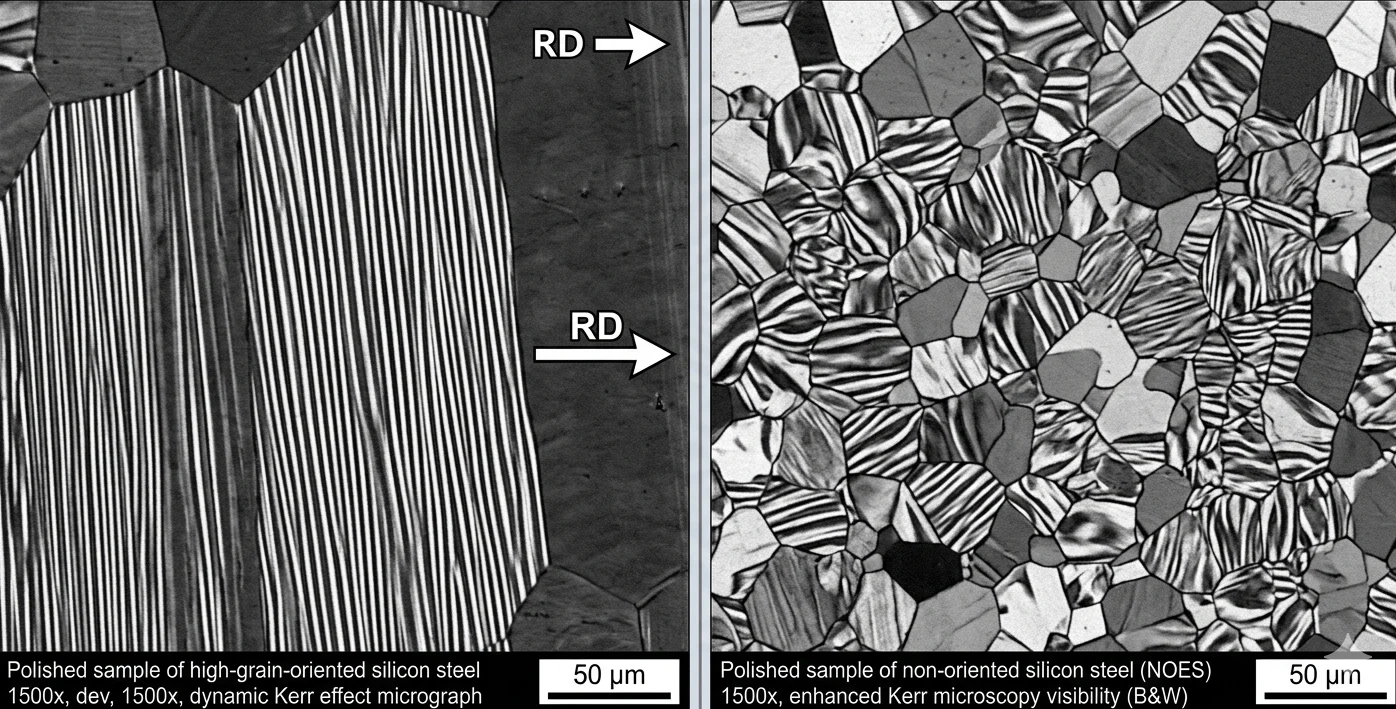
Grain-oriented silicon steel. Cold rolling and high-temperature annealing force the crystal grains to align along the rolling direction, toward the {110}<001> “easy magnetisation” axis. The steel then carries flux far more efficiently in that one direction — and correspondingly less efficiently in others, because the process trades isotropy for directional performance. That is exactly what a static device such as a transformer needs.
Non-oriented silicon steel. This step is deliberately skipped. The grains stay in a more random orientation, so permeability is roughly the same whichever way the flux runs. That is not a manufacturing shortcut — it takes its own control of grain size and silicon distribution to keep performance consistent in every direction rather than optimised in one. It is what a rotating magnetic field requires.
Differences in magnetic domain structure
Grain-oriented. Virtually all magnetic domains line up along the rolling direction — iron’s easy axis. That creates the unidirectional permeability and cuts iron loss sharply.
Non-oriented. No orientation is deliberately developed. Grains are distributed randomly and domains point irregularly, so the material behaves consistently when magnetised in any direction on a rotor.
| Aspect | Grain-oriented silicon steel | Non-oriented silicon steel |
|---|---|---|
| Domain alignment | Highly aligned, nearly all parallel to the rolling direction | Randomly oriented, no dominant direction |
| Magnetic anisotropy | Strongly unidirectional — best permeability and lowest core loss along the rolling direction | Strongly isotropic — near-uniform magnetic properties in all directions |
| Domain wall motion | Easy axis lies along the rolling direction, so domain walls move at low energy cost | Domain walls meet different crystal resistance depending on direction, so more energy is needed |
| Typical applications | Transformer and reactor cores — static, flux along a fixed path | Motor and generator stator/rotor cores — rotating flux |
Technical parameters: a quick reference
| Parameter | Grain-oriented (CRGO) | Non-oriented (CRNGO) |
|---|---|---|
| Core loss | Low: P1.7/50 ≈ 0.85 W/kg (Hi-B) to 1.55 W/kg (conventional 0.35 mm) | Higher: P1.5/50 ≈ 2.5–6.0 W/kg for common motor grades |
| Magnetic induction | High, along the rolling direction: conventional CGO B8 ≈ 1.78–1.85 T; Hi-B grades B8 ≥ 1.88 T, up to about 1.93 T | Lower and isotropic: B50 ≈ 1.60–1.75 T |
| Directionality | Highly anisotropic — best in the rolling direction, worst across it | Roughly isotropic — consistent in every direction |
| Coating type | Inorganic insulating coating (forsterite / magnesium silicate glass film plus a phosphate top coat), survives high-temperature annealing | Organic, semi-organic or inorganic–organic composite coating (e.g. C-3, C-5, C-6 classes) |
| Thickness range | Thinner: 0.23, 0.27, 0.30, 0.35 mm; ultra-thin CRGO down to 0.18 and 0.20 mm | 0.35, 0.50, 0.65 mm for general motors; ultra-thin CRNGO at 0.20–0.30 mm for high-frequency and EV traction motors |
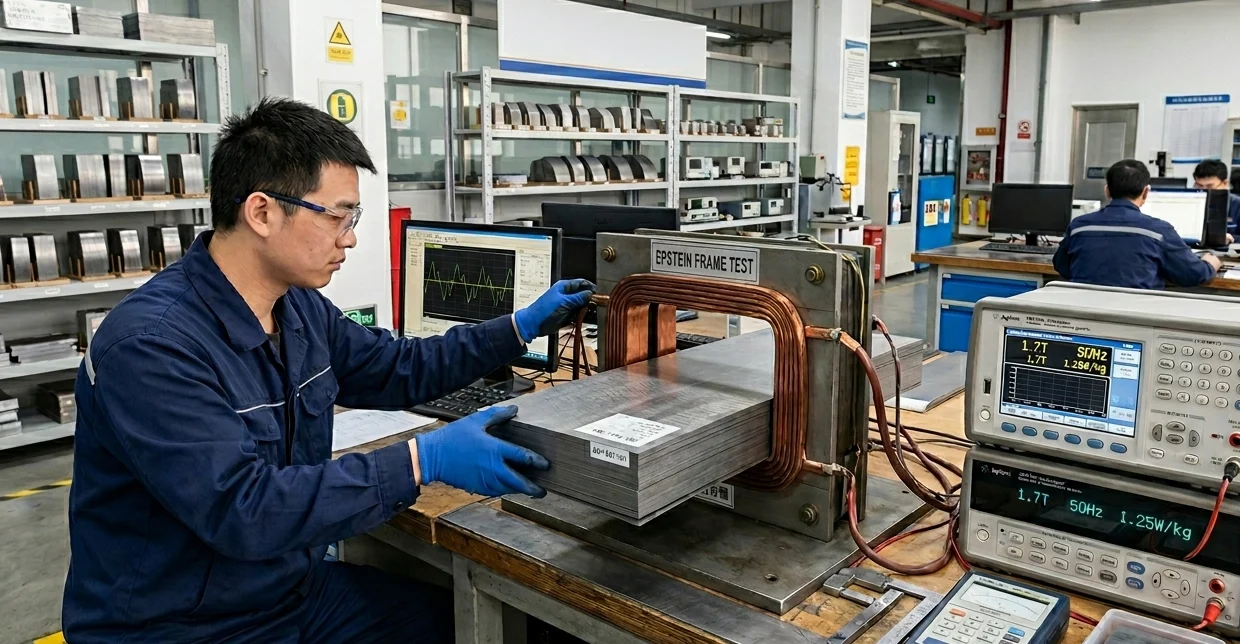
Reading the numbers: the two core-loss figures are not measured under the same conditions and cannot be compared directly. Grain-oriented steel is specified at 1.7 T / 50 Hz, non-oriented at 1.5 T / 50 Hz. Induction is also referenced at different field strengths — B8 at 800 A/m, B50 at 5000 A/m. Always confirm which reference condition your quotation and mill certificate use. Full data by grade is on our grades page and grade equivalents table.
Where each one goes
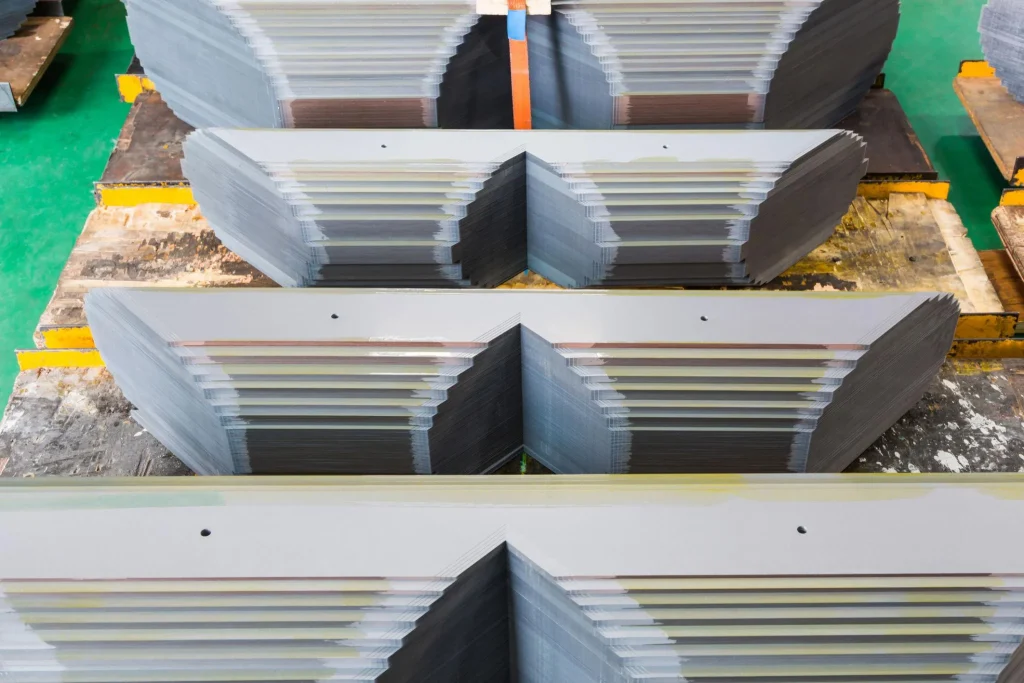
Grain-oriented silicon steel is made for static electromagnetic devices. In power transformers, distribution transformers and reactor cores the flux runs along a fixed path — set the core so that path follows the rolling direction and CRGO’s aligned domains give very low hysteresis and eddy-current loss. In a like-for-like transformer core, CRGO commonly cuts core loss by roughly 40–60% against CRNGO run in the same application — but that reduction assumes the field is aligned with the grain, which a transformer allows and a motor does not.
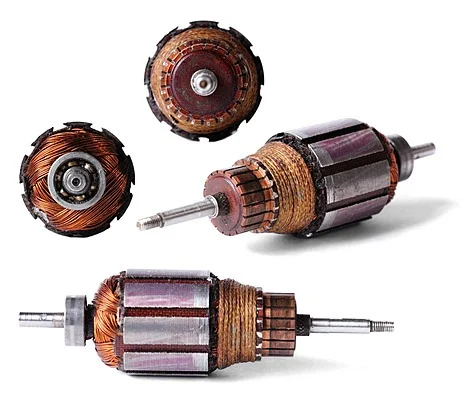
In motors and generators the field direction changes constantly as flux rotates between stator and rotor. Isotropy is not a nice-to-have here, it is the requirement: randomly oriented domains keep core loss down and efficiency up wherever the flux is pointing. That is why non-oriented silicon steel is the core material for EV traction motors, appliance motors and large generators.
Choose CRGO when
- The magnetic circuit is designed around a fixed flux path — power and distribution transformer cores
- Core geometry can be built so the field follows the rolling direction, e.g. step-lap stacked cores
- Cutting no-load loss is commercially critical enough to justify the higher price — utility-scale transformers with steep loss penalties
Choose CRNGO when
- The equipment has a rotating magnetic field — induction motors, generators, alternators
- The core design does not isolate a single flux direction — small transformers, some reactors
- Appliance and general-purpose motors, where isotropy is required and cost matters more than the last fraction of a watt
| Application | Family | Typical gauge | Why |
|---|---|---|---|
| Large power transformer | CRGO — Hi-B preferred | 0.23–0.27 mm | Fixed flux path; no-load loss is commercially critical |
| Distribution transformer | CRGO — conventional | 0.27–0.35 mm | Fixed flux path; cost-balanced against loss |
| High-frequency / 400 Hz transformer | Ultra-thin CRGO | 0.10–0.20 mm | Fixed flux, but eddy-current loss climbs with frequency |
| General-purpose & appliance motor, generator, alternator | CRNGO | 0.35–0.50 mm | Rotating flux — isotropy is required |
| High-efficiency (IE4/IE5) & EV traction motor | Ultra-thin CRNGO | 0.20–0.30 mm | Rotating flux at higher speed and frequency |
| Small reactor, ballast, instrument transformer | CRGO or CRNGO — by field geometry | 0.30–0.50 mm | Depends whether the core isolates a single flux direction |
Can you substitute one for the other?
Both are electrical steel and both will carry flux, so technically yes. Whether it makes engineering sense depends on direction:
CRGO into a motor: generally a bad swap. You pay a premium for directional performance you cannot use, and in some rotor positions the material underperforms standard CRNGO — you are now in CRGO’s worst direction rather than CRNGO’s average one.
CRNGO into a transformer: technically works, and is sometimes done for small, low-cost transformers where core loss is not commercially significant. But you give up the loss reduction CRGO would have delivered in that exact core — worth doing deliberately for a cost-driven design, not by accident because a CRNGO coil was on hand.
Mixing both in one machine is normal — a transformer with an integrated reactor might use CRGO for the main core and CRNGO for a component with a different field geometry. Decide per magnetic circuit, not per piece of equipment.
Manufacturing process and cost
We are Wuxi Zhongxin Special Steel, and we have spent years in the silicon steel trade. Here is how the process and the market actually work.
Secondary recrystallisation: the heart of the process
Cold rolling grain-oriented silicon steel is not simply a matter of reducing thickness. The essence of it is secondary recrystallisation. After several cold rolling passes bring the strip to target thickness (0.23–0.30 mm, for example), it goes into high-temperature annealing. At that point not every grain is allowed to grow: by controlling the pinning effect of inhibitors such as MnS and AlN, only the grains with the most accurate orientation — the Goss texture, {110}<001> — can consume their neighbours and grow abnormally. That is secondary recrystallisation, and it produces the near-perfect unidirectional alignment that makes extremely low no-load loss possible in a transformer core.
What moves the price
Grain-oriented silicon steel pricing responds to three things:
- Silicon content. Silicon raises resistivity and reduces core loss, but too much makes the steel brittle and hard to roll. Grain-oriented grades sit at 3.0%–3.5% Si, so movement in the silicon-to-iron cost ratio feeds straight into the alloy cost.
- Energy cost. From hot rolling through cold rolling — and above all the long high-temperature box annealing, which reaches around 1200 °C — electricity and gas consumption is heavy. Hi-B grades add another tightly controlled process stage, which is part of why they cost more again. When energy prices rise, production cost rises with them and reaches the final price.
- Trade policy by region. This is now the single most volatile input in a landed-cost calculation. See below.
CRNGO is typically the cheaper of the two per tonne at equivalent thickness — it skips the extra cold-rolling passes and the tightly controlled orientation anneal, so it carries less processing time and yield loss. That does not make it “the budget option”: for a rotating-field application it is the correct choice, not a compromise.
Trade conditions to check before you budget (as of 2026)
- European Union. Grain-oriented electrical steel has been under anti-dumping measures from China, Japan, South Korea, Russia and the United States, structured as a minimum import price rather than a flat percentage — imports above that price enter free of anti-dumping duty. In March 2026 the European Commission additionally opened a safeguard investigation into GOES imports, so EU buyers should confirm the current position before committing to a delivery schedule.
- United States. Section 232 now applies to the full customs value of steel articles rather than the metal content alone, at 50% for products that are entirely or almost entirely steel — which covers electrical steel coil and sheet. Chinese-origin material stacks Section 301 on top. Finished electrical grid equipment such as transformers sits in a temporarily reduced band through the end of 2027, so the duty on the finished unit and on the core material are not the same number.
- Brazil. Brazil brought in further anti-dumping measures on Chinese flat steel during early 2026, with duties on some categories running into the hundreds of dollars per tonne, and has had electrical steel under trade-defence investigation. Buyers there are actively developing alternative origins.
Trade measures change frequently and product scope is defined by HS/NCM code, not by product name. Treat the above as a prompt to verify, not as a duty quotation. We can check the classification of a specific grade for your destination — ask us.
FAQ
Is CRGO always better than CRNGO because it has lower core loss?
No. CRGO’s lower core loss only applies when the field runs in the rolling direction — true in a transformer core, not in a motor’s rotating field. In a rotating-field application CRNGO’s isotropic performance makes it the better engineering choice despite CRGO’s better headline numbers.
Why is grain-oriented silicon steel more expensive than non-oriented?
The process is harder — long high-temperature annealing to achieve secondary recrystallisation means high energy consumption and lower yield — and the performance is genuinely better, with very low core loss engineered for high-efficiency transformers. You are paying a technical premium, and in a transformer it pays back over the service life through reduced no-load loss.
What happens if I use CRGO in a motor by mistake?
The motor will not get the efficiency benefit CRGO’s core-loss figures suggest, and depending on the rotor’s orientation relative to the rolling direction, performance in some positions can be worse than if standard CRNGO had been used from the start. The reverse — CRNGO in a transformer — works but gives up the loss reduction CRGO would have provided.
Is CRNGO just a cheaper, lower-quality version of CRGO?
No. CRNGO is engineered for a different requirement — isotropic performance — not a lower standard of the same requirement. For rotating machinery it is the correct choice, not a money-saving compromise, even though it typically costs less.
Can I use CRGO and CRNGO in the same piece of equipment?
Yes, and it is common — a transformer with an integrated reactor might use CRGO for the transformer core and CRNGO for a component with a different field geometry. Make the decision per magnetic circuit, not per piece of equipment as a whole.
How do I tell them apart from the grade code — 23Q110 vs 35W300?
In the Chinese GB designation the code is thickness, then a letter for the type, then core loss × 100:
- 23Q110 — Q means grain-oriented (transformers). Thickness 0.23 mm, core loss 1.10 W/kg at 1.7 T / 50 Hz.
- 35W300 — W means non-oriented (motors). Thickness 0.35 mm, core loss 3.00 W/kg at 1.5 T / 50 Hz.
The letters come from the Chinese: Q for qǔxiàng (oriented), W for wúqǔxiàng (non-oriented). The trap is the loss figure — 1.10 against 3.00 looks like a threefold difference, but the two are measured at different flux densities, so the comparison is not like for like. European codes work the other way round, loss first: EN 10107 grain-oriented grades look like M120-27S, EN 10106 non-oriented grades like M330-35A. Our grade equivalents table maps GB, JIS, EN and ASTM designations side by side.
Need help choosing a grade?
Tell us the equipment type and operating frequency — transformer core, motor lamination, reactor — plus your target core loss, stacking factor and annual volume, and we will tell you plainly which family fits and come back with matching grades, current availability and a landed-cost indication for your port. Mill test certificates and samples are available for every grade we supply.

