
Electrical steel mechanical properties change more from grade to grade than most buyers expect: in one mill’s catalogue, typical yield strength runs from 256 MPa to 435 MPa and hardness from HV 112 to HV 222 across non-oriented grades of the same family. The low-loss grades are the strong, hard ones. That affects how fast punching dies wear, how many bends a strip survives, and whether a rotor lamination can carry its centrifugal load. This guide gives typical values by grade, explains what the standards actually guarantee, and shows how to put strength and hardness into an order.
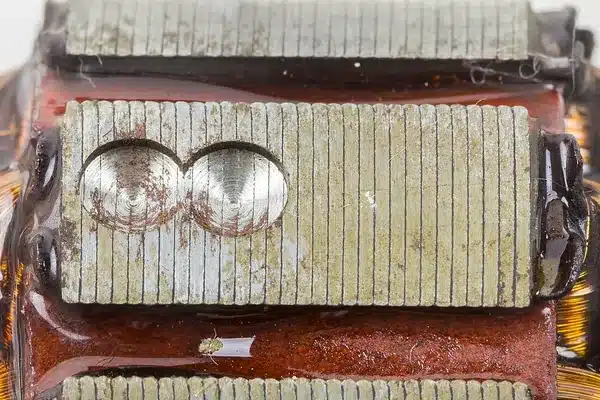
Grades are normally chosen on core loss first; our non-oriented silicon steel page lists them that way. The numbers below are the mechanical side of the same choice.
| Property | Non-oriented (JFE JN grades, along rolling) | Grain-oriented (thyssenkrupp powercore) |
|---|---|---|
| Yield strength | 256–435 MPa | 300–340 MPa along rolling, 330–360 MPa across |
| Tensile strength | 358–557 MPa | 330–370 MPa along rolling, 390–420 MPa across |
| Elongation | 19–39 % | 6–14 % along rolling, 24–48 % across |
| Hardness | HV1 112–222 | HV0.1 185–200 |
| Density | 7.60–7.85 kg/dm³ | 7.65 kg/dm³ |
All of these are typical values published by the mills, not guaranteed minimums. The two hardness columns use different test loads, so compare them with care.
Typical Values by Non-Oriented Grade
JFE Steel publishes one of the most complete tables. Its values were measured on sheared specimens (JIS Z 2241 No. 13A) and are labelled “typical ones, not for guarantee.” The number in each grade name is the maximum core loss at 1.5 T and 50 Hz, times 100: 35JN210 is a 0.35 mm sheet with 2.10 W/kg.
| Grade | Yield point, MPa | Tensile strength, MPa | Elongation, % | Hardness, HV1 | Number of bends |
|---|---|---|---|---|---|
| 35JN210 | 432 | 555 | 19 | 222 | 5 |
| 35JN250 | 405 | 531 | 20 | 215 | 5 |
| 35JN300 | 393 | 523 | 24 | 201 | 11 |
| 35JN440 | 278 | 418 | 32 | 150 | 15 or more |
| 50JN250 | 407 | 534 | 21 | 213 | 4 |
| 50JN400 | 332 | 476 | 29 | 184 | 15 or more |
| 50JN470 | 285 | 423 | 34 | 153 | 15 or more |
| 50JN800 | 275 | 390 | 36 | 125 | 15 or more |
| 50JN1300 | 256 | 358 | 39 | 112 | 15 or more |
Values are for specimens cut along the rolling direction. Across the rolling direction, JFE’s yield and tensile figures are a few percent higher; 35JN210 goes from 432 to 450 MPa yield.
The pattern is consistent. Lower loss means higher strength and hardness, lower elongation, and far fewer bends before cracking. The reason is alloy content. Silicon “increases the electrical resistivity of iron by a factor of about 5,” which is how mills cut eddy current loss, and the same element hardens the steel. Commercial alloys usually stay at or below about 3.2 % silicon because “higher concentrations result in brittleness during cold rolling.” JFE’s own table shows the difference: resistivity of 59 µΩ·cm for 35JN210 against 15 µΩ·cm for 50JN1300.
So a buyer who moves from a 4.70 W/kg grade to a 2.50 W/kg grade to save energy is also buying a stronger, harder and less ductile sheet. How to weigh loss against cost and thickness is covered in our guide on how to choose electrical steel.
Grain-Oriented Steel Depends on Direction
Grain-oriented steel is strongly directional, and its mechanical data shows it. thyssenkrupp’s typical values for its powercore grades:
- Yield strength: 300–340 MPa along the rolling direction, 330–360 MPa across it
- Tensile strength: 330–370 MPa along, 390–420 MPa across
- Elongation (A80): 6–14 % along, 24–48 % across
- Hardness: HV0.1 185–200
JFE’s figures for its grain-oriented grades are close to these, with HV1 hardness of 188–204 and about 20 bends along the rolling direction against 12–15 across it.
For a transformer core, these numbers rarely decide the order; loss and polarisation do. They matter on the slitting and cut-to-length lines, where the strip is sheared, and wherever it is bent. Our grain-oriented silicon steel page lists the grades and gauges we supply.
What EN 10106 Actually Guarantees
Of all the electrical steel mechanical properties, it guarantees only one: the number of bends. EN 10106, the European standard for fully processed non-oriented strip, defines it as the “number of alternate bends possible before the appearance of the first crack in the base metal visible to the naked eye.” Its Table 1 sets a minimum for each grade. For the 0.35 mm and 0.50 mm grades:
| Grades (EN 10106) | Minimum number of bends |
|---|---|
| M210-35A to M270-35A, M230-50A to M290-50A | 2 |
| M300-35A, M330-35A, M310-50A, M330-50A | 3 |
| M350-50A, M400-50A | 5 |
| M470-50A to M800-50A | 10 |
The same table covers loss, polarisation, anisotropy, stacking factor and density. It has no yield strength, tensile strength or hardness. The standard only asks that the material “be able to be cut or punched at any point and in the usual shapes.”
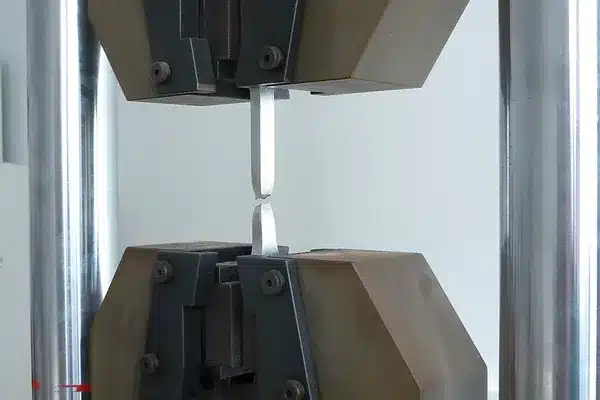
That leaves a gap. Mill catalogues print typical strength and hardness, but JFE states plainly that its figures are “not for guarantee.” If your design depends on a minimum yield strength or a hardness range, it has to be written into the order and reported on the certificate. Our article on EN 10204 3.1 and 3.2 certificates explains what a 3.1 certificate should carry.
Hardness, Punching and Die Wear
Hardness is the property a stamping shop feels first. Protolam, a lamination maker, puts it simply: “The added silicon has a marked impact on the life of stamping tooling.” In JFE’s table, 35JN210 is HV 222 and 50JN800 is HV 125, so the low-loss grade is almost 1.8 times as hard. Expect shorter intervals between die regrinds when you move to a lower-loss grade. Burr limits and die clearance are covered in our motor lamination stamping guide.
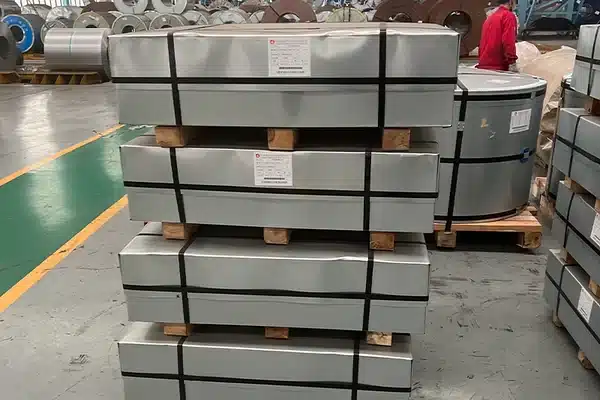
The coating adds its own wear. Protolam notes that “the main drawback to C-5 is an increase in tool wear due to abrasiveness,” which is one reason the coating choice belongs in the same discussion as the grade. Our overview of electrical steel coating types compares the classes.
The bend count is the quickest check on ductility. A grade rated at 4 or 5 bends will crack sooner than one rated at 15 or more if the part is folded, clinched or re-straightened.
Hardness is also a useful incoming check. A 2023 study of non-oriented silicon steel strip from Valahia University reported correlation coefficients of 0.91–0.98 between hardness and strength. A hardness reading on a sample from each coil is a fast way to spot a coil that does not match the grade’s usual strength.
Strength for High-Speed EV Rotors
This is where yield strength stops being a catalogue figure and becomes a design limit. A rotor lamination carries its own centrifugal load, and that stress rises with the square of rotor speed. Traction motors for electric vehicles run fast, so the rotor sheet needs a yield strength the designer can count on.
Standard grades do not give one. Their strength follows the grade: in JFE’s table, the low-loss 0.35 mm grades sit above 390 MPa, while the high-loss 0.50 mm grades sit at 256–285 MPa. None of it is guaranteed.
High-strength grades close that gap. thyssenkrupp’s powercore traction 035-180Y400, in a product sheet issued in August 2025, states that its “guaranteed min. yield strength to DIN EN ISO 6892-1 is 400 MPa.” Its typical values along the rolling direction are 437 MPa yield, 498 MPa tensile strength, 16 % elongation and HV5 222, with magnetic properties referenced to EN 10303 for thin-gauge steel. We supply high-strength CRNGO for rotors in 0.20–0.35 mm gauges.
Two more checks belong in a rotor specification:
- Temperature. A 2023 University of Waterloo study of 0.20–0.27 mm non-oriented sheets found that raising the test temperature to 150 °C reduced tensile properties, most of all yield strength and elongation. Ask for data at the rotor’s operating temperature, not only at room temperature.
- Direction. The same study found rolling and transverse results similar, but results at 45° to the rolling direction “noticeably different.” A rotor lamination is loaded in every direction, so ask how the minimum was measured.
The same study found no conclusive effect of sheet thickness on tensile properties across 0.20, 0.25 and 0.27 mm.
What to Write on the Order
EN 10106 gives an example order line: “18 t – strip – EN 10106 — M270-35A – 1000 mm – max. 3500 kg – v – 3.1.” That line fixes the magnetic grade. It says nothing about strength. If electrical steel mechanical properties matter to your part, add them:
- Minimum yield strength (Rp0.2), with the test standard (for example ISO 6892-1) and the direction: rolling, transverse or both.
- Hardness range, with the method and load. Mills report HV0.1, HV1 and HV5, and the readings are not interchangeable.
- Minimum number of bends, if parts are bent or clinched after punching and the EN 10106 minimum is not enough.
- Test temperature, if the part runs hot, such as a rotor at 150 °C.
- Reporting: ask for tensile and hardness results on the 3.1 certificate for each coil or lot.
We supply non-oriented and grain-oriented electrical steel in coil, slit strip and sheet. Send us the grade together with your minimum yield strength or hardness range, and we’ll confirm which grades can meet it before quoting. Our CRNGO steel coil page lists the grades and gauges available. Coil orders typically start at about 5 tonnes with delivery in about 15 days, and smaller lots can be cut from coil. Sheet orders typically start at about 500 kg; if you need less, tell us and we’ll do our best to meet the request. Samples typically cost USD 200 including freight, refunded when you place a production order.
FAQ
What is the yield strength of electrical steel?
It depends on the grade. In JFE’s catalogue, typical yield strength of non-oriented grades along the rolling direction runs from 256 MPa for 50JN1300 to 435 MPa for 50JN230. Grain-oriented steel is about 300–340 MPa along the rolling direction and 330–360 MPa across it. These are typical values. High-strength rotor grades are sold with a guaranteed minimum, such as 400 MPa.
How hard is silicon steel?
Typical Vickers hardness for non-oriented grades runs from about HV 112 for high-loss grades to HV 222 for low-loss grades, measured as HV1 in JFE’s catalogue. Grain-oriented steel is about HV 185–204. The more silicon a grade carries, the harder it is. Always check the test load, because HV0.1, HV1 and HV5 readings are not directly comparable.
Does EN 10106 specify tensile strength or hardness?
No. EN 10106 sets core loss, polarisation, anisotropy, stacking factor, density and a minimum number of bends for each grade. For 0.35 and 0.50 mm grades, that minimum runs from 2 bends for the lowest-loss grades to 10 for M470-50A to M800-50A. Yield strength, tensile strength and hardness are not part of it. If you need them, write a minimum into the order.
Why are low-loss grades harder on punching dies?
Low-loss grades get their low loss mainly from more silicon, which raises resistivity but also makes the steel harder. In JFE’s table, a 2.10 W/kg grade is HV 222 while an 8.00 W/kg grade is HV 125. Harder steel wears punches and dies faster. Coatings play a part too; C-5 coatings are known to be more abrasive than organic ones.
What yield strength does a high-speed rotor lamination need?
That comes from the rotor’s stress calculation, with a margin for operating temperature. Standard grades do not guarantee any yield strength, so high-speed rotors usually use high-strength non-oriented grades with a stated minimum, for example 400 MPa. Ask for data at the operating temperature, because a 2023 study found yield strength falls at 150 °C.
Need electrical steel with a guaranteed strength or hardness? Contact us with the grade, gauge, minimum yield strength or hardness range, and test standard, and we’ll confirm the matching grade before quoting.
References
- JFE Steel — Electrical steel sheets catalogue F1E-001: JFE N-CORE and JFE G-CORE typical mechanical properties
- thyssenkrupp Steel — powercore grain-oriented electrical steel: typical physical properties
- thyssenkrupp Steel, August 2025 — Product information: powercore traction 035-180Y400
- EN 10106:2015 — Cold rolled non-oriented electrical steel strip and sheet delivered in the fully processed state (SIST preview)
- Wikipedia — Electrical steel
- Protolam — Silicon steel / electrical steel lamination materials
- T. Tolofari, University of Waterloo, 2023 — Characterization of the mechanical and microstructural properties of thin non-orientated electrical steel sheets
- E. V. Stoian, M. C. Enescu, C. I. Petre, C. O. Rusanescu, Scientific Bulletin of Valahia University – Materials and Mechanics, 2023 — Analysis of the mechanical properties of electrical steel


