
Electrical steel density is the input that turns nominal dimensions into an estimated steel weight. For a flat sheet, multiply thickness in millimetres by density in g/cm³ to get kg/m². A representative grain-oriented value published by thyssenkrupp is 7.65 kg/dm³; non-oriented grades use grade-dependent reference values, so a generic 7.85 steel figure can misstate an order. This guide shows the unit math, worked sheet and coil examples, and how to keep theoretical net weight separate from scale weight and export gross weight.
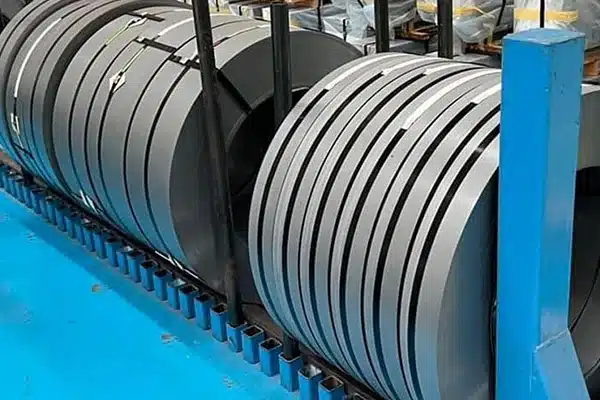
The focus here is estimating and reconciling material mass—not selecting magnetic performance. For interactive dimensions and grade inputs, see the electrical steel weight calculator. Its outputs are estimates from nominal inputs; a supplier’s weighed coil and packing list remain the documents to use for shipment reconciliation.
Quick reference: the main weight conversions
| What you need | Formula | Example |
|---|---|---|
| Flat material mass per area | kg/m² = thickness (mm) × density (g/cm³) | 0.27 mm × 7.65 = 2.0655 kg/m² |
| Flat sheet or cut length | kg = thickness × width × length × density ÷ 1,000,000 | 0.27 × 1,000 × 2,000 × 7.65 ÷ 1,000,000 = 4.13 kg |
| Strip mass per metre | kg/m = thickness (mm) × width (mm) × density ÷ 1,000 | 0.27 × 1,000 × 7.65 ÷ 1,000 = 2.0655 kg/m |
| Approximate area in one metric tonne | m²/t = 1,000 ÷ (thickness × density) | 1,000 ÷ (0.27 × 7.65) ≈ 484.1 m²/t |
| Coil estimated from OD and ID | annular volume × density × a coil-specific fill factor | Use only when the factor is appropriate to that wound coil |
The worked figures in this article are nominal estimates. They do not replace a mill test certificate, a customer-approved weight basis, or the actual weighing record for a particular coil.
What “density” means on a steel datasheet
Density is mass divided by volume. It is not the same thing as a coil’s apparent bulk density, the mass of a core assembly, or the ratio of steel mass to the outside dimensions of a wound coil. A datasheet may also list a conventional density used in a standard’s magnetic-test calculations. That reference value is useful for consistent engineering estimates, but it should not be read as a laboratory measurement of every point in every coil.
Electrical steel is an iron-based alloy with silicon and, depending on grade, other alloying additions. Its density therefore need not be the same as a generic carbon-steel handbook value. More importantly for a purchase calculation, a supplier may use a grade- or standard-specific conventional value. Ask which value is being used if the mass affects a design, a shipment plan, or a commercial settlement.
thyssenkrupp publishes 7.65 kg/dm³ for its listed grain-oriented powercore product data. The Zhongxin calculator’s displayed reference values likewise use 7.65 g/cm³ for grain-oriented material and show non-oriented examples from 7.60 to 7.85 g/cm³ by grade. Those are useful estimating anchors, not a universal promise that every producer, grade, or test calculation uses an identical value. The grade’s technical data and the agreed order basis take precedence.
Mill catalogues show the same spread. JFE lists its non-oriented JN grades at 7.60–7.85 kg/dm³, and thyssenkrupp gives 7.60 kg/dm³ for its high-strength powercore traction 035-180Y400. In both the mill data and the calculator examples, the low-loss grades sit at the low end and the high-loss grades at the high end, which is consistent with silicon being lighter than iron. Our guide to electrical steel mechanical properties puts the JFE density range next to yield strength, hardness and bend counts.
| Material example | Reference density for the example | How to interpret it |
|---|---|---|
| Grain-oriented electrical steel (published powercore data) | 7.65 kg/dm³ | Manufacturer-published figure for that product data |
| M250-50A non-oriented example in the site calculator | 7.60 g/cm³ | Calculator default; check the selected grade and supplier data |
| M270-35A non-oriented example in the site calculator | 7.65 g/cm³ | Calculator default; not a guaranteed coil measurement |
| M470-50A non-oriented example in the site calculator | 7.70 g/cm³ | Calculator default; another grade may use a different reference |
| M940-50A non-oriented example in the site calculator | 7.85 g/cm³ | Example at the upper end of the calculator’s displayed range |
The table is a selection, not a grade-density matrix. It shows why electrical steel density is a grade-specific input rather than one number for every silicon steel.
The choice matters more than it looks. Using a generic 7.85 where the grade’s reference is 7.65 overstates theoretical mass by about 2.6%, roughly 130 kg on a 5-tonne order; against 7.60 the gap is about 3.3%. EN 10106, the standard for fully processed non-oriented strip and sheet, lists density among the technological characteristics of each grade. Take the value for your grade from the standard or the mill’s datasheet, and remember that even then a theoretical volume calculation is not a weighed invoice.
Density units: g/cm³, kg/dm³ and kg/m³
The numerical value is the same in g/cm³ and kg/dm³: 7.65 g/cm³ = 7.65 kg/dm³. In SI units, multiply by 1,000 to convert to kg/m³, so 7.65 g/cm³ = 7,650 kg/m³. Be careful not to multiply a thickness in millimetres by kg/m³ in a formula that expects g/cm³; that mixes unit scales and produces an answer off by a factor of 1,000.
Electrical steel weight per square metre
For sheet, strip, and an unpunched rectangular blank, the mass per area is:
Mass per area (kg/m²) = thickness (mm) × density (g/cm³).
The shortcut works because one square metre of material, one millimetre thick, has a volume of one litre. At 7.65 kg per litre, each millimetre of thickness contributes 7.65 kg/m². If you have the density in kg/m³ instead, convert thickness to metres and use:
Mass per area (kg/m²) = thickness (m) × density (kg/m³).
With the same illustrative density of 7.65 g/cm³, the reference mass by nominal thickness is:
| Nominal thickness | Estimated mass per m² | Estimated mass per 1,000 m² |
|---|---|---|
| 0.20 mm | 1.53 kg/m² | 1,530 kg |
| 0.23 mm | 1.76 kg/m² | 1,760 kg |
| 0.27 mm | 2.07 kg/m² | 2,066 kg |
| 0.30 mm | 2.30 kg/m² | 2,295 kg |
| 0.35 mm | 2.68 kg/m² | 2,678 kg |
| 0.50 mm | 3.83 kg/m² | 3,825 kg |
These are flat-steel estimates before punching scrap, slit-edge trim, packaging, or any adjustment for the chosen grade’s density. The last column uses unrounded arithmetic, which is why it may not equal a rounded kg/m² figure multiplied by 1,000. Which gauges suit which cores is covered in our electrical steel thickness guide.
A sheet and a cut-length example
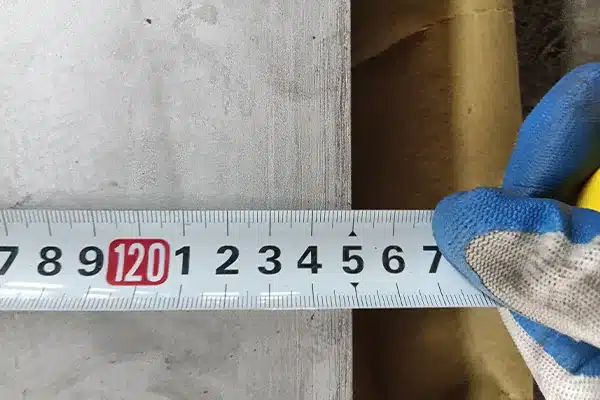
Take a nominal 0.27 mm sheet that is 1,000 mm wide and 2,000 mm long, and use 7.65 g/cm³ for the example. In millimetres:
0.27 × 1,000 × 2,000 × 7.65 ÷ 1,000,000 = 4.13 kg.
The same answer follows from area: the sheet is 2 m², and 2 × 2.0655 kg/m² = 4.131 kg. If the selected grade’s agreed density were 7.60 g/cm³ instead, the estimate would be 4.104 kg. That difference is small for one sheet, but the same assumption repeated across a large production run can affect material planning.
For punched motor laminations, subtracting the slots and windows changes the part mass, while skeleton and scrap remain part of the coil material issued to the press. Do not equate the net mass of finished laminations with the mass of coil consumed. Nesting yield, skeleton width, part count, setup pieces, and scrap recovery belong in the manufacturing yield calculation, not in the flat-sheet density formula. Burr and die specifications for the press are covered in our motor lamination stamping guide.
From kilograms per square metre to one metric tonne
The reverse conversion is useful for estimating how much sheet area, strip length, or production coverage a tonne represents:
Area per metric tonne (m²/t) = 1,000 kg ÷ mass per m².
At 0.27 mm and 7.65 g/cm³, the mass per area is 2.0655 kg/m², so one metric tonne represents approximately:
1,000 ÷ 2.0655 = 484.1 m².
At a 1,000 mm strip width, 484.1 m² corresponds to about 484.1 metres of strip. A five-metric-tonne order at the same width and thickness would therefore contain about 2,420.7 metres, before considering actual thickness variation, width, coil-end losses, or the supplier’s measured net mass. This is a material estimate, not a promise of exact coil length.
For one linear metre of strip, the shortcut is:
kg/m = thickness (mm) × width (mm) × density (g/cm³) ÷ 1,000.
For a 0.27 mm strip, 1,000 mm wide, at 7.65 g/cm³, the result is 2.0655 kg/m. A 5,000 kg net coil divided by 2.0655 kg/m gives about 2,421 m. Use net steel mass, not gross shipping mass, in this calculation. Pallets, bands, edge protectors, and moisture barrier do not become usable strip.
If the width changes, the mass per linear metre changes in direct proportion. A 500 mm strip with the same gauge and density weighs half as much per metre as 1,000 mm strip. Its theoretical area per tonne remains the same, because the area calculation is independent of how that area is divided between width and length.
Estimating coil weight from dimensions
If you know coil net mass and strip dimensions, estimating strip length is straightforward. The reverse problem—estimating mass from the coil’s outside diameter—is less direct because the measured coil envelope contains small spaces between wraps and may not be perfectly cylindrical.
For a level-wound coil with outside diameter (OD), inside diameter (ID), and width b, the annular envelope volume is:
V (mm³) = π ÷ 4 × (OD² − ID²) × b.
If that annulus were solid steel, its theoretical mass would be:
W (kg) = π ÷ 4 × (OD² − ID²) × b × density ÷ 1,000,000.
All three dimensions must be in millimetres and density in g/cm³. A real wound coil is not a solid annulus. If the calculation is intended to estimate real coil mass from OD, it needs a coil-specific fill or packing factor that accounts for winding tightness, interwrap gaps, edge condition, telescoping, and other features of the actual coil. Do not assume that a lamination stacking factor is automatically the right coil factor.
For scale, take a hypothetical coil with OD 900 mm, ID 508 mm, width 800 mm, and density 7.65 g/cm³. Its solid-annulus calculation is about 2,653 kg. If a supplier had independently established a 0.97 coil-specific fill factor for that configuration, the arithmetic estimate would be about 2,573 kg. The 0.97 is only an illustration, not a recommended or verified factor for electrical steel coils; obtain the actual method and calibration basis from the supplier.
A stack factor and a coil packing factor are different
The lamination stacking factor describes how much solid electrical steel occupies the measured volume of a stack of flat laminations. Coatings, flatness, burrs, compression pressure, and the test method affect that value. It is used when translating a core’s stack dimensions into effective steel cross-section or estimated mass. Our separate guide to lamination stacking factor explains that measurement and the core-design implications.
A coil packing factor, by contrast, describes how the metal occupies the annular envelope of a wound coil. Winding tension, wrap-to-wrap contact, coating, edge build, coil shape, and handling can influence it. The two factors refer to different geometries and are not technically interchangeable merely because both are ratios below 1.
The current site calculator presents one stacking-factor input across multiple modes, including its coil-from-OD estimate. Treat that coil result as an indicative calculator output using its selected adjustment—not as proof that a lamination stacking-factor test is a validated coil packing factor. For a commercial or logistics decision, request the supplier’s coil net weight, OD, ID, width, and stated method. This article does not change the calculator or its behavior.
Theoretical weight, actual net weight, and gross weight
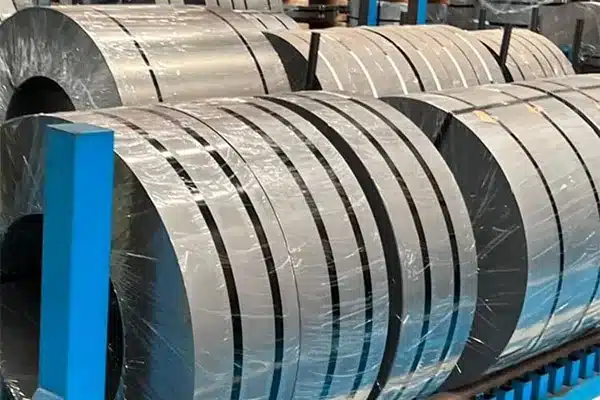
These three weights answer different questions. A clear purchase order or packing list should identify which one is being quoted, shipped, and invoiced.
| Weight term | What it means | Use it for |
|---|---|---|
| Theoretical weight | Calculated from nominal dimensions and an agreed density/reference value | Early budgeting, design estimates, comparing quotes on a common basis |
| Actual net steel weight | Steel mass recorded by weighing the coil, sheet bundle, or slit coil, excluding packaging tare as agreed | Shipment reconciliation and the commercial weight basis specified in the order |
| Gross shipping weight | Net steel plus packaging, pallet, bands, protection, and other shipment materials | Freight booking, vehicle and lifting limits, export documents where gross is requested |
“Net” and “gross” conventions can differ by contract and document. A coil may have bands or edge protection left on during weighing; make sure the supplier states whether these items are included in the declared net. For shipment planning, confirm the gross weight per package as well as the package dimensions and lifting arrangement. Our guide to container loading and packaging for steel coil export covers how coils are packed and loaded for shipment.
The theoretical mass of flat steel is built from nominal thickness, width, length, and the density used in the estimate. Actual scale weight can differ because actual dimensions are not infinitely exact, trim and end losses affect usable length, and individual coils may have different measured mass. Gross weight adds a separate packaging allowance. It is therefore normal for one theoretical calculation not to match a gross shipping figure; the comparison is meaningful only after the weight definitions match.
What tolerances do to an estimate
The basic sensitivity is easy to understand. If all other inputs stay fixed, a 1% change in thickness produces approximately a 1% change in theoretical mass. The same direct relationship holds for width, length, and density. For small percentage variations, the combined relative change is approximately the sum of the individual relative changes; the exact relationship is multiplicative.
Consider a hypothetical example only, not a product tolerance or guarantee: 0.27 mm nominal material with an assumed thickness variation of ±0.01 mm, at constant width, length, and density. The relative thickness change is 0.01 ÷ 0.27, or about 3.7%. The example shows why small absolute differences matter more proportionally on thinner gauges. It does not state that ±0.01 mm is an applicable standard, mill capability, or acceptance limit. The actual tolerance must be taken from the specified grade, thickness, applicable standard, and supplier’s written offer.
Coil diameter readings add further uncertainty to an OD-based estimate. A roundness assumption, measuring-point choice, strip edge telescoping, and a nonuniform edge build may all affect the annular estimate. For regular receipts, compare the same things: actual net scale weight to actual net scale weight, or theoretical net to theoretical net using the same declared density and dimensions. Never compare a theoretical net estimate directly with a gross packing-list value and call the difference a steel shortage.
Choosing the right estimate for each job
Use the simplest calculation that matches the decision:
- For material yield or sheet count: use kg/m² from nominal thickness and the supplier’s stated density/reference value. Add the expected cutting or stamping yield separately.
- For strip length from a known coil mass: divide actual net steel mass by the nominal kg/m value. Keep thickness and width assumptions visible.
- For an early coil OD estimate: use the annular formula with a coil-specific fill assumption only if its source is known. Otherwise, request a measured net weight.
- For core stack or finished-core mass: include the measured lamination stacking factor and the geometry of the finished core. Account for cutouts and non-steel items separately.
- For freight and lifting: plan with declared gross package weight and dimensions, not theoretical steel mass alone.
Our CRGO steel coil and CRNGO coil pages show the product families and supply forms. This guide does not replace those product specifications or determine whether a grade is suitable for a core-loss requirement.
What to put in an RFQ or weight query
When you ask a supplier to estimate coil mass, give enough information to make the calculation reproducible:
| RFQ field | What to provide |
|---|---|
| Grade and standard | Exact designation and edition/standard if specified |
| Nominal thickness | Include the permitted tolerance or call out that the tolerance is still to be confirmed |
| Strip width | State nominal width and width tolerance |
| Density basis | Ask which grade-specific or conventional density is used for theoretical weight |
| Quantity basis | Metric tonnes, kilograms, sheets, square metres, or strip length |
| Coil geometry | OD, ID, width, maximum coil mass, and measuring convention if these are constraints |
| Weight declaration | State whether the requested value is theoretical net, actual net, or gross |
| Packaging | Request package tare, gross mass, and dimensions when transport planning depends on them |
| Reconciliation | State whether invoicing is based on actual scale net or another agreed basis |
If your line has a maximum mandrel load, coil diameter, or crane capacity, specify the limit as a per-coil maximum, not only a total order tonnage. A 10-tonne order split into several smaller coils creates a different handling plan from a single 10-tonne coil. Also state whether partial coils, split widths, and slit-edge trim are acceptable; each can change usable length and handling weight without changing the grade’s density.
For quotes on grain-oriented or non-oriented coil, include your grade, thickness, width, ID, maximum coil weight, and requested packing basis. Coil orders typically start at about 5 tonnes, with delivery in about 15 days; smaller quantities may be slit from a master coil.
Sheet orders typically start at about 500 kg, and our cut-to-length CRGO steel sheet page covers grain-oriented sheet. If your requirement is below those typical quantities, send the grade, dimensions, and quantity and we will do our best to meet it. Samples typically cost USD 200 including freight and may be refunded with a production order; confirm the current sample terms when requesting them.
FAQ
What is the density of electrical steel?
There is no single value that applies to every grade and supplier. thyssenkrupp publishes 7.65 kg/dm³ for its listed grain-oriented product data, while JFE lists its non-oriented JN grades from 7.60 to 7.85 kg/dm³. Use the exact grade’s datasheet or agreed calculation basis for a quotation or shipment decision.
How do I calculate electrical steel weight per square metre?
Multiply thickness in millimetres by density in grams per cubic centimetre. For example, 0.27 mm × 7.65 g/cm³ = 2.0655 kg/m². The result is a theoretical flat-steel estimate; use a different density if the grade or supplier specifies another reference value, and do not add a stacking factor to a flat sheet.
How much does a 0.27 mm electrical steel coil weigh?
Thickness alone is not enough to determine a coil’s mass. You also need width and strip length, or coil OD, ID, and a suitable coil-specific fill assumption. At 7.65 g/cm³, a 1,000 mm-wide strip weighs about 2.0655 kg per metre, so 2,421 metres is about 5,000 kg net before packaging.
Is lamination stacking factor the same as coil packing factor?
No. Lamination stacking factor describes the solid-steel fraction in a stack of flat sheets, while a coil packing factor describes the steel fraction inside the coil’s annular envelope. They relate to different geometries and measurement conditions. Do not use one as the other without a documented method that validates the conversion for that coil.
Why is the invoice weight different from the calculated weight?
The calculation usually uses nominal dimensions and a selected density, while an invoice may use the actual scale net weight or another contractually agreed basis. Thickness and width variation, trim, coil geometry, and rounding can change the comparison. Packaging adds weight only to gross shipment weight, so first confirm that both figures use the same net/gross definition.
Need a weight estimate for an electrical steel order? Contact us with the grade, gauge, width, coil ID/OD limits, quantity, and whether you need theoretical net, actual net, or gross shipping weight.
References
- JFE Steel — Electrical steel sheets catalogue F1E-001. Used for the 7.60–7.85 kg/dm³ density range of the non-oriented JN grades.
- thyssenkrupp Steel, August 2025 — Product information: powercore traction 035-180Y400. Used for the 7.60 kg/dm³ density of that grade.
- thyssenkrupp Steel — powercore grain-oriented electrical steel: typical physical properties. Used for the published 7.65 kg/dm³ example and its product-specific context.
- Zhongxin Special Steel — Electrical Steel Weight Calculator. Used to inspect the site’s displayed formulas, illustrative grade reference values, and current calculator behavior. Its grade list is not reproduced here.
- EVS-EN 10106:2015 — Cold rolled non-oriented electrical steel strip and sheet delivered in the fully processed state. Scope and product-standard context only; no density value is quoted from it. The statement that the grade table carries density follows the preview text cited in the mechanical-properties guide.
- Zhongxin Special Steel — Lamination stacking factor explained. Used for the distinction and separate treatment of lamination stacking factor.


