
A buyer in Vietnam bought 24 tons of slit silicon steel strip from us: 0.50mm non-oriented grade 50A310, slit to 113mm wide, in 5 coils averaging about 4.8 tons each. Every coil carries several 113mm strips wound side by side.
The order was simple on paper. What made it worth documenting is the shape of the shipment: several narrow strips wound side by side into heavy coils, which decides how the steel has to be slit, wrapped and secured in the container.
Core Key Points
- 24 tons of 0.50mm non-oriented strip, grade 50A310, slit to 113mm, in 5 multi-strip coils averaging about 4.8 tons.
- Each 113mm strip weighs about 0.43 kg per metre, so a 4.8-ton coil holds roughly 11 km of strip in total across its strips, and slit edge quality has to hold over a very long run.
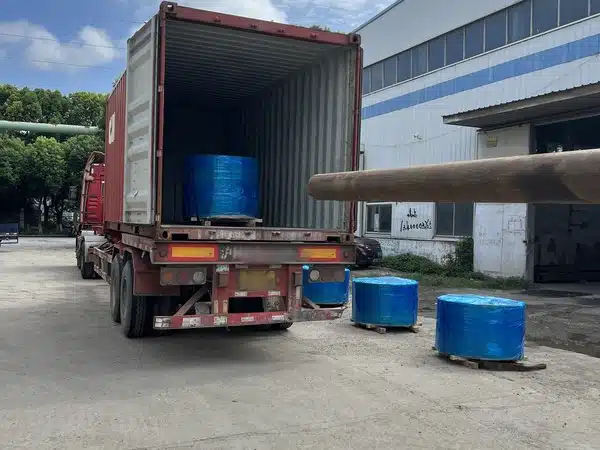
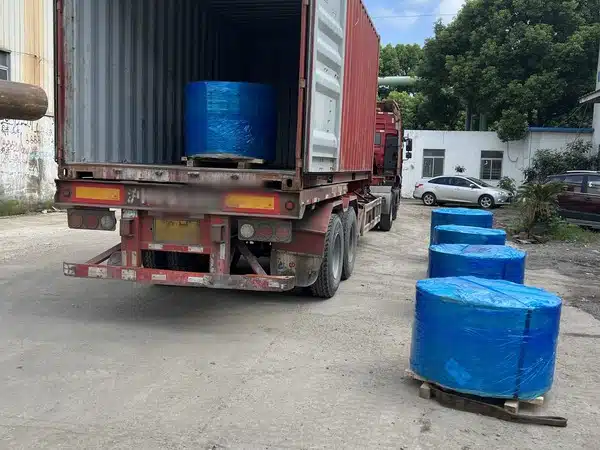
- Coils were stretch-wrapped, palletised eye-to-sky and shipped in one 20GP container on Wuxi delivery (ex-works) terms.
Customer Requirements
The buyer, based in Vietnam, asked for the steel already slit to width instead of buying wide coil and slitting it locally.
| Specification | Order Detail |
|---|---|
| Product Type | Cold-rolled non-oriented silicon steel strip, fully processed |
| Grade | 50A310 (≈ M310-50A / 50W310) |
| Thickness | 0.50mm |
| Slit Width | 113mm |
| Order Quantity | 24 tons, 5 coils (about 4.8 tons each) |
| Coil Format | Multi-strip coils: several 113mm strips wound side by side on one coil |
| Core Loss (grade guarantee) | P15/50 ≤3.10 W/kg |
| Delivery Terms | Wuxi delivery (ex-works basis), destination Vietnam |
| Container | 1 × 20GP |
| Documentation | Mill test certificate |
Slit Strip or Master Coil
Master coil suits a buyer with its own slitting line, because width and edge quality are then in the buyer’s hands. Slit strip moves both to the supplier, and adds a slitting step after the base coil is produced. This buyer had no need to slit locally, so it ordered strip at 113mm.
The trade-off is that width tolerance, burr height and camber now have to be agreed in the order, which the Documentation section below covers.
Reading the Grade: 50A310, M310-50A and 50W310
The same physical grade is written three ways depending on the standard, which is a common source of confusion on purchase orders.
| Standard | Designation | How to read it |
|---|---|---|
| JIS C 2552 | 50A310 | 50 = 0.50mm thickness, A = non-oriented, 310 = max core loss 3.10 W/kg ×100 |
| EN 10106 / IEC 60404-8-4 | M310-50A | M = magnetic, 310 = loss figure, 50 = thickness ×100 |
| GB/T 2521 | 50W310 | 50 = thickness, W = non-oriented, 310 = loss figure |
Nippon Steel’s published equivalence table lists the three at the same 3.10 W/kg maximum core loss (P15/50). A purchase order should name the standard designation rather than a mill’s brand code. Our grade equivalents chart lists the GB, EN, JIS and AISI cross-references, and we confirmed the match before quoting this order.
Where 50A310 Sits in the 0.50mm Range
At 0.50mm, the number after the letter is the whole story. It is the maximum core loss in W/kg at 1.5T and 50Hz, multiplied by 100. This buyer chose the low-loss end of the range.
| GB grade | JIS grade | Max core loss P15/50 | Allowed loss vs 50A310 |
|---|---|---|---|
| 50W310 | 50A310 | ≤3.10 W/kg | Baseline |
| 50W470 | 50A470 | ≤4.70 W/kg | 52% higher |
| 50W600 | 50A600 | ≤6.00 W/kg | 94% higher |
| 50W800 | 50A800 | ≤8.00 W/kg | 158% higher |
These are guaranteed maximums for each grade. They are not typical or measured values for this shipment.
Lower loss means less heat and higher efficiency in a motor or generator that runs for long hours, and in that kind of duty the premium can pay back. Higher-loss grades cost less and suit appliance motors and intermittent duty, where unit cost matters more than efficiency. Our standard CRNGO page describes the same trade-off within its 50W470, 50W600 and 50W800 grades. 50W470 has the lowest loss and the highest cost of the three, and 50W800 the reverse.
Why Narrow, Heavy Slit Coils Are Different
At 0.50mm × 113mm and a typical density of 7.65 g/cm³, each strip weighs about 0.43 kg per metre, so one ton of strip is roughly 2.3 km long. A slitting line cuts a wide master coil into several strips at once and rewinds them side by side, so each 4.8-ton coil here holds about 11 km of strip in total, shared across its strips. That has four practical consequences.
Edge quality repeats thousands of times. Burr height is measured on a short sample, but the buyer’s line will run kilometres of it. A small, consistent burr is manageable. One that drifts during a long slitting run is not. Our slitting tolerances and camber guide explains how burr, camber and width tolerance are controlled.
Camber accumulates. On a narrow strip, a small sideways bow per metre adds up across the coil and can make the strip walk off an uncoiler guide. Our published limit for standard non-oriented strip is 5 mm or less over 2,000 mm.
Strips share one coil. When strips are wound side by side, they have to be wound with even tension so that none telescopes or drifts sideways against its neighbour. Strip-to-strip consistency in width and edge position matters as much as the figures on any one strip.
Handling damage shows up at the slit edge. The slit edges form the end face of the coil. A coil that is dropped, dragged or set down on a dirty or uneven surface damages exactly the part the buyer’s line cares about, so packing and loading matter as much as slitting.
Packaging and Container Loading
The coils were sealed in blue stretch film, labelled, and set on wooden pallets with the eye facing up (eye-to-sky). With the coil axis vertical, the whole coil rests on the pallet, so its weight is spread over the full end face and it cannot roll. The slit edges make up that end face, so the pallet surface has to be flat and clean, and lifting should go through the coil eye.

- Moisture protection. Stretch film keeps condensation off the coating during the sea voyage.
- Identification. Each coil label carries grade, size, lot number and weight, so the buyer can match every coil to its test record at incoming inspection.
- Securing. Pallets are positioned to spread the load across the container floor and blocked or strapped so nothing shifts at sea. Securement has to stop three separate movements: lateral rolling, fore-aft shift and bouncing. Our general approach is in container loading for steel coil export.
Whether coils go eye-to-sky (axis vertical) or eye-to-side depends on coil weight, floor loading and the handling equipment at the destination. At about 4.8 tons per coil, eye-to-sky on pallets was the practical choice for this order.
Why One 20GP Container Was Enough
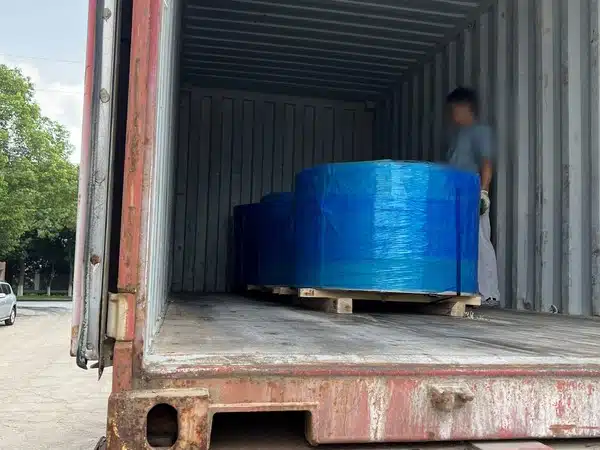
Steel is dense cargo, so a container fills by weight long before it fills by volume. A 20-foot container typically takes somewhere around 28 tons of cargo, depending on the container and the shipping line’s limits. Twenty-four tons of coil plus pallets and blocking sits close to that ceiling.
A 40-foot container carries a similar payload, so for cargo like this the extra length adds freight cost without adding capacity. The buyer’s forwarder should still confirm the actual payload limit of the container and the shipping line before booking.
Documentation and Delivery
The shipment went out on Wuxi delivery terms with a mill test certificate for the buyer’s incoming inspection, and the buyer’s forwarder handled sea freight to Vietnam. Our standard export set also includes a packing list, commercial invoice and certificate of origin.
A standard mill certificate reports core loss, magnetic induction and thickness. It does not list slit width, burr height or camber, because those are set at the slitting line, not the rolling mill. On slit strip they belong in the order as numbers: width tolerance in millimetres, burr height as a percentage of thickness or an absolute limit, and camber in millimetres per metre. If they are not written down, the buyer is accepting the slitting line’s default settings.
If a buyer needs independent verification, the certificate level should be fixed at the RFQ stage. A 3.1 certificate comes from the mill’s own quality department, and a 3.2 adds third-party verification and takes longer to arrange. See EN 10204 3.1 and 3.2 certificates for the difference.
A Slit Strip Specification Template
Because the certificate is silent on slitting, the order itself has to carry the numbers. This is the shape of specification we ask buyers to complete for slit non-oriented strip, with the values we publish where they exist.
| Parameter | How to write it | Published reference |
|---|---|---|
| Grade | Standard designation, e.g. 50A310 or M310-50A | Cross-references on our grade equivalents chart |
| Thickness | Nominal and tolerance in mm | ±0.02mm for standard non-oriented strip |
| Slit width | Nominal and tolerance in mm | Coil width 8–1,250mm; tolerance agreed per order |
| Camber | mm per length, e.g. mm per 2,000mm | 5mm or less over 2,000mm |
| Burr height | Percentage of thickness or an absolute limit | Agreed per order |
| Strips per coil | Number of strips wound side by side on one coil | Agreed per order |
| Coil weight and ID | Maximum weight and inner diameter | About 3–8 tons, ID 508 or 610mm |
| Coating | Coating type | C5 inorganic is standard; C6 and C3 on request |
| Certificate | 3.1 or 3.2 | Mill test certificate with every shipment |
Where the last column says “agreed per order”, the number has to come from the buyer’s process, because only the buyer knows how tight a fit its part needs.
Check Your Uncoiler Before You Order
Heavy narrow coils have to run on the buyer’s own line, so the line’s limits belong in the order. Our standard non-oriented coils are supplied at roughly 3 to 8 tons with a core inner diameter of 508 or 610mm, and the 4.8 tons average on this order sits inside that range.
Before ordering, a buyer should confirm five things on its own line:
- Maximum coil weight. The uncoiler and any coil car must be rated for the heaviest coil, with margin.
- Mandrel range. The mandrel has to expand to the coil’s inner diameter, whether 508 or 610mm.
- Maximum outside diameter. The coil has to clear the machine frame and any pit or guard.
- Guide width. A 113mm strip needs side guides that hold a narrow strip steady without marking the edge.
- How strips come off the coil. A multi-strip coil has to be separated or fed strip by strip, so tell us how your line handles this before the order, not after.
None of these appear on a certificate, so they have to be agreed in the quotation.
Incoming Inspection for Slit Strip
These are general checks a buyer can run on receipt. They are not a record of what this buyer did.
- Match each label to the paperwork. Grade, lot number, size and weight on every coil label should agree with the mill certificate and packing list.
- Inspect packaging and edges. Look for torn film, water marks, dented slit edges or rust at the coil face before unwrapping.
- Measure width and thickness. Take readings at several points along each strip with calipers or a micrometer and compare them with the agreed tolerances.
- Check burr and camber. Check burr height at the slit edge against the agreed limit. For camber, lay a length of strip against a straight edge and compare the gap with the agreed millimetres per metre.
- Verify magnetic properties if the contract requires it. Core loss is measured on cut samples in an Epstein frame. Our guide to core loss testing with an Epstein frame explains the method.
Run these before the first coil goes onto the line.
FAQ
What is 50A310 silicon steel?
50A310 is a JIS C 2552 grade of cold-rolled non-oriented electrical steel, 0.50mm thick, with a maximum core loss of 3.10 W/kg at 1.5T and 50Hz. It corresponds to M310-50A in EN/IEC and 50W310 in GB, and is used in motor and generator cores.
How narrow can you slit 0.50mm non-oriented strip?
Narrow widths such as the 113mm in this order are routine. The limit is set by the buyer’s burr, camber and width tolerance requirements, so send your width, tolerances and downstream process with the inquiry.
What is a multi-strip slit coil?
A slitting line cuts a wide master coil into several narrow strips in one pass and rewinds them side by side on one mandrel. The coils in this order were wound that way, with several 113mm strips per coil. Tell us how many strips per coil your line can take, and what total coil weight and inner diameter it is rated for.
Can I buy 50A310 under an EN or GB name?
Yes. State the designation you work to (M310-50A or 50W310) and we will confirm the match before quoting.
How long does a slit strip order take?
Delivery timing is confirmed in the quotation for the specific grade, slitting scope and inspection requirements. Our published guidance puts custom orders (specified grade, custom slitting, certification) at roughly 4–6 weeks, and lead time lengthens when slitting queues behind other orders or third-party certification is added late. See our lead time guide.
What documents come with a slit strip order?
A mill test certificate and packing list are standard to request. Put slit width, burr and camber limits in the order as numbers, since the certificate does not list them, and tell us if you need a 3.2 certificate or third-party inspection.
What should I send to get a quote for slit strip?
Send the standard designation of the grade, thickness, slit width and tolerance, burr and camber limits, your uncoiler’s weight and inner diameter limits, quantity, destination and delivery terms, and the certificate level you need. You can request a quote with those details and we will confirm the grade match and the schedule.


