
A high-frequency reactor manufacturer in South Korea placed their first order with us for high frequency reactor core steel: 12 tons of 0.10mm ultra-thin CRGO, our GT-100 grade. They slit it to their own width, packed it as six coils, and shipped it FOB Shanghai.
Three requirements shaped this order. The steel had to be specified by core loss at P1.0/400 rather than at the 50Hz power frequency. It had to be slit to the buyer’s winding width. And it had to ship fast.
Core Key Points
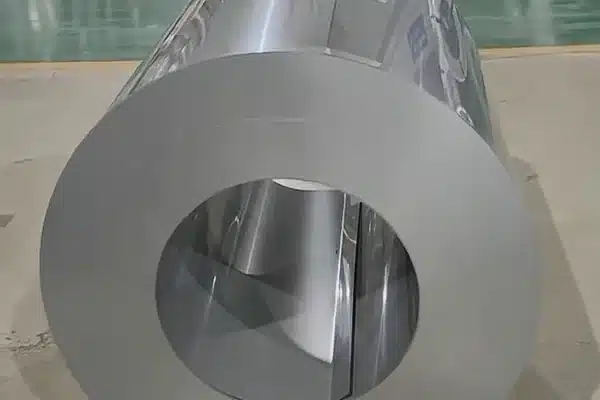
- 12 tons of 0.10mm GT-100 ultra-thin grain-oriented electrical steel in six slit coils, bought by a South Korean manufacturer of high-frequency reactors.
- The buyer set their acceptance criterion as core loss at P1.0/400 (1.0T, 400Hz), the frequency band the reactors actually run in, not the P1.7/50 figure used for power transformer steel.
- The steel was slit to the buyer’s winding width on our own line, with burr and edge condition treated as acceptance items alongside core loss.
- The buyer asked for fast delivery, so production and loading were scheduled to hit the earliest workable FOB Shanghai sailing.
- This was a first order and a trial of a new source. We tested and documented it the same way we would a repeat account.
Customer Requirements
The buyer designs and builds reactors for power-electronics equipment, where the magnetic core runs at hundreds of hertz or more instead of the 50/60Hz a distribution transformer sees. At those frequencies, eddy-current loss in the lamination dominates the core’s heat budget, and the steel’s thickness becomes the main design lever.
That is why the inquiry for high frequency reactor core steel arrived with the operating-frequency loss figure as the headline requirement. A 50Hz loss number on its own tells a reactor designer very little about how the core will behave at 400Hz.
| Specification | Customer Requirement |
|---|---|
| Product Type | Ultra-thin grain-oriented electrical steel (GT-100) |
| Order Quantity | 12 tons, 6 coils |
| Thickness | 0.10mm |
| Core Loss Criterion | P1.0/400 (1.0T, 400Hz) ≤14 W/kg (GT-100 grade guarantee) |
| Magnetic Induction | B8 ≥1.85T (GT-100 grade guarantee) |
| Form | Slit coil |
| Slit Width | 200mm |
| Priority | Fast delivery on a first order |
| Delivery Terms | FOB Shanghai, destination South Korea |
| Documentation | Mill test certificate with P1.0/400 results per coil |
Specifying High Frequency Reactor Core Steel at P1.0/400
Most CRGO trade is quoted at P1.7/50: 1.7 tesla at 50 hertz, the working point of a power transformer. A reactor in an inverter or filter circuit usually runs at lower flux density and much higher frequency, so 1.0 tesla at 400 hertz is the standard reference point for thin-gauge grades.
The two figures don’t convert reliably from one to the other, because eddy-current loss scales roughly with the square of both thickness and frequency. A grade that looks good at 50Hz can fall behind at 400Hz. Asking for P1.0/400 directly is the right way to buy steel for this application, and it’s what this buyer did.
Why 0.10mm Grain-Oriented, Not Standard CRGO
Standard CRGO at 0.23–0.35mm is optimised for power-frequency cores. Above a few hundred hertz, the range where high-frequency transformer and reactor cores operate, its thickness works against it and loss climbs quickly. Our GT-series grades roll the same grain-oriented material down to 0.05–0.20mm for exactly this reason.
Within that range, 0.10mm is the most common middle ground:
| Gauge | Grade | P1.0/400 Guarantee | Typical Fit |
|---|---|---|---|
| 0.05mm | GT-050 | ≤9 W/kg | Highest-frequency cores, 400Hz aerospace power |
| 0.08mm | GT-080 | ≤11 W/kg | HF reactors and chokes |
| 0.10mm | GT-100 | ≤14 W/kg | HF reactors, DC-DC converters, onboard chargers |
| 0.15mm | GT-150 | ≤19 W/kg | Mid-frequency transformers |
Going thinner than 0.10mm cuts loss further. It also raises the price per ton, lowers the stacking factor and makes the strip harder to handle and wind. For this buyer’s frequency band and cost target, GT-100 was the grade that met the loss requirement without paying for performance the design wouldn’t use.
Grain-oriented rather than non-oriented steel suited the application because the reactor core carries flux mainly along one direction, which is exactly where grain-oriented steel performs best.
Slitting and Production
The buyer supplied their own winding width, and every coil was slit to it on our line. At 0.10mm, slitting is where ultra-thin orders are most often won or lost. The strip is a third the thickness of standard CRGO, so any burr, edge wave or damage to the coating is proportionally much larger.
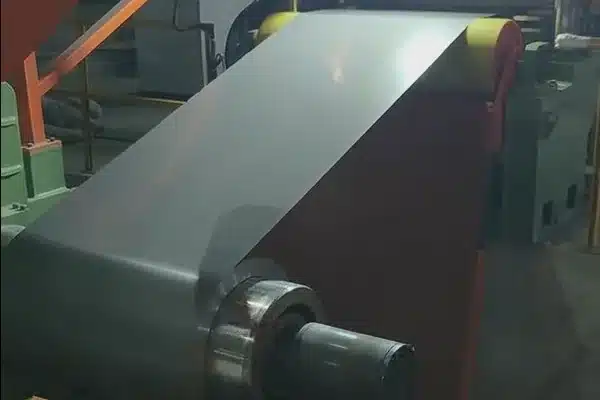
On this order we paid attention to three things:
- Burr height. On a wound reactor core, a burr that bridges the insulation between adjacent turns creates a local short. That short adds eddy loss exactly where the design didn’t budget for it. Knife condition and clearance are set for the gauge, not carried over from thicker material.
- Strip tension. Ultra-thin strip deforms under tension that a 0.27mm strip would shrug off. Tension is kept low and even across the width so the slit coils rewind flat, without edge wave.
- Edge straightness. Camber that is tolerable on a stacked transformer core becomes a winding problem on a narrow wound core. We check slitting tolerances and camber against the buyer’s width before release.
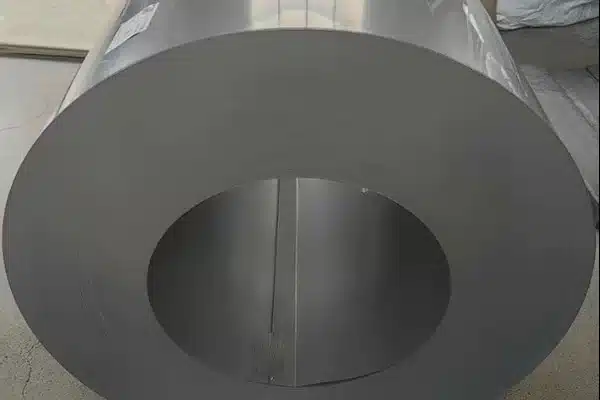
The buyer’s fast-delivery request shaped the schedule more than the process. Slitting, testing and packing were lined up against a target FOB Shanghai sailing from the start. The quality steps themselves were not compressed. On a first order, a late shipment costs the relationship less than a coil that fails incoming inspection.
Quality Inspection
Every coil was tested before packing, and results were reported at the buyer’s own reference point.
| Test | What It Confirms |
|---|---|
| Specific core loss at P1.0/400 | Actual W/kg at 1.0T / 400Hz against the GT-100 guarantee |
| Magnetic induction (B8) | Directional magnetic performance of the grain-oriented structure |
| Thickness | Gauge held at 0.10mm nominal across the coil |
| Slit width and camber | Width tolerance and edge straightness for winding |
| Burr and edge condition | No burr or edge damage that could bridge interlaminar insulation |
| Surface and coating | Insulation coating intact through slitting, no scratches or dents |
The mill test certificate carried P1.0/400 values per coil, so the buyer’s engineers could check them directly against their design loss budget. They didn’t have to extrapolate from a power-frequency figure. For more on why thickness matters so much at these frequencies, see our article on the thickness-frequency tradeoff in ultra-thin silicon steel.
Packaging and Export
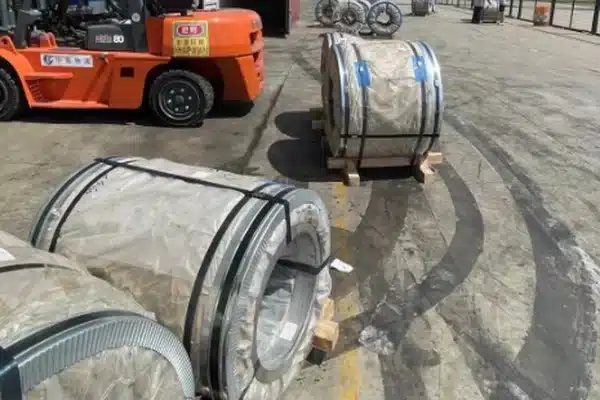
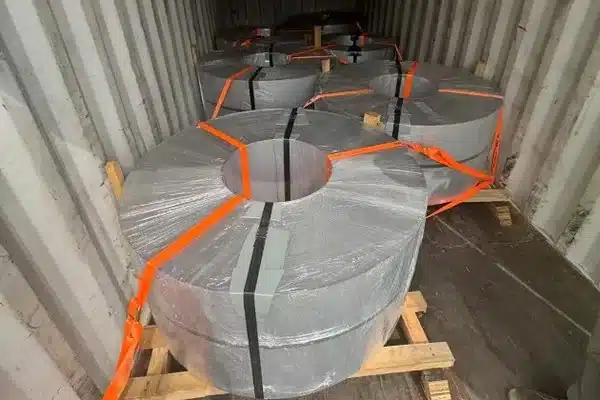
Thin-gauge slit coils need different packing from wide master coils. We laid all six coils eye-to-sky, flat on wooden pallets, instead of standing them on end in cradles. This keeps the full weight of each coil off its slit edge, which is the part of an ultra-thin coil that is easiest to damage and the part the buyer winds from.
Each coil was stretch-wrapped against moisture, strapped through the eye to its pallet, and secured to the container floor with ratchet straps across the top. The goal is to stop any lateral shift during the sea voyage, because at 0.10mm even a small knock can dent the edge. Our general container loading practice is the same as for any coil shipment. Only the orientation and edge protection change for ultra-thin gauges.
The Shanghai–Korea sea leg is short, which suited the buyer’s fast-delivery request. Under FOB terms, the buyer’s forwarder handled freight and import clearance from the vessel onward. Our responsibility ended once the goods were loaded at Shanghai. The mill certificate and packing list went out with the shipping documents so the buyer could book incoming inspection before the container arrived.
Why Buyers Choose Zhongxin
- Grades specified at the buyer’s operating frequency. GT-series ultra-thin CRGO is guaranteed and tested at P1.0/400, not only at 50Hz.
- Slitting done in-house, set up for the gauge. Knife setup, tension and edge checks are adjusted for 0.10mm strip rather than carried over from standard CRGO.
- Packing designed around the slit edge. Eye-to-sky on pallets with the edge protected, because that edge is what the buyer’s winding line depends on.
- Tested the same on first orders as on repeat business. Six coils on a trial order get the same per-coil testing and documentation as a large repeat account.
- Schedules built for fast delivery. Urgency sets the sailing target. It doesn’t shorten the inspection.
We have supplied ultra-thin steel into high-frequency applications before. Our 20-ton ultra-thin CRNGO order for North American EV motors covers the non-oriented side of the same thin-gauge work.
FAQ
What is GT-100 ultra-thin CRGO?
GT-100 is our grade code for 0.10mm grain-oriented electrical steel, guaranteed at P1.0/400 ≤14 W/kg and B8 ≥1.85T. It is used in high-frequency reactors, DC-DC converter transformers and onboard chargers, where the operating frequency is well above 50/60Hz.
Why specify core loss at P1.0/400 instead of P1.7/50?
P1.7/50 describes a power transformer’s working point. A high-frequency reactor runs at lower flux density and much higher frequency, and loss doesn’t scale predictably from one condition to the other. Specifying at P1.0/400 tests the steel where it will actually work.
Is 0.10mm grain-oriented steel suitable for reactors, or only transformers?
It is used in both. Reactor cores that carry flux mainly in one direction benefit from grain orientation in the same way transformer cores do. The deciding factors are operating frequency, flux density and core geometry, so send those with your inquiry.
How tight can you slit 0.10mm strip?
Narrow widths for wound cores are standard. What matters as much as width tolerance at this gauge is burr height and camber, so tell us your winding method and we’ll confirm edge requirements before quoting.
Why pack ultra-thin slit coils eye-to-sky?
Laying the coil flat on a pallet keeps its weight off the slit edge, the most vulnerable part of a thin-gauge coil. Coils standing on end in cradles are fine for thicker wide coils, but that orientation raises the risk of edge damage at 0.10mm.
Can a first order be a small trial quantity?
Yes. This order was 12 tons in six coils. A trial of that size lets a new buyer check core loss at their frequency, slit quality and delivery before committing to larger volumes.
Lessons for Buyers Specifying High-Frequency Core Steel
- Specify loss at your operating frequency. A 50Hz loss figure is not a reliable proxy for 400Hz performance.
- Treat edge quality as an acceptance criterion. At 0.10mm, burr and camber affect a wound core’s losses and windability as much as the grade does.
- Choose the thinnest gauge your loss budget needs, and no thinner. Every step down in thickness adds cost and makes the strip harder to handle.
- Ask how slit coils will be packed. Eye-to-sky on pallets protects the edge. Ask before the coils are loaded, not after they arrive.
Bottom Line
Twelve tons is a modest order. What made it work was specifying the steel where the reactor actually operates: GT-100 checked at P1.0/400, slit to the buyer’s winding width with edge quality treated as seriously as core loss, and packed to protect the slit edge on a short, fast route to Korea.
For a reactor maker testing a new source of high frequency reactor core steel, that is the right way to run a first shipment. Check the numbers that matter at your frequency on a manageable quantity, then scale up once they hold.
Note on This Order Profile
This profile is based on an actual shipment, and the photographs are on-site images from our production and loading. Buyer identity, pricing and transaction paperwork (proforma invoice, payment record, packing list, bill of lading) are not included in this version. They will be added in a documentation update, in line with how our other Order Profiles articles are being upgraded over time.

