
Key Takeaways
- An Epstein frame doesn’t test your finished core. It tests a small stack of standardized strip samples cut from the coil, under lab conditions your actual application won’t fully match.
- Core loss numbers are meaningless without their subscripts. P1.5/50 and P1.7/50 measure loss at different magnetic induction levels, and comparing them directly is like comparing prices without checking the currency.
- Grain-oriented steel gets tested with strips cut both parallel and perpendicular to the rolling direction, because CRGO’s whole value proposition — lower loss in one direction — only shows up when you test it that way.
- The core loss on your mill certificate is a floor, not a promise. Cutting stress, stacking factor, and assembly method all push real-world loss higher than the as-tested number, sometimes by a wide margin.
- We’ve had customers compare our P1.7/50 figure against a competitor’s P1.5/50 figure and conclude the competitor’s steel performed better. It didn’t — they were reading two different test points as if they were the same number.
What an Epstein Frame Actually Measures
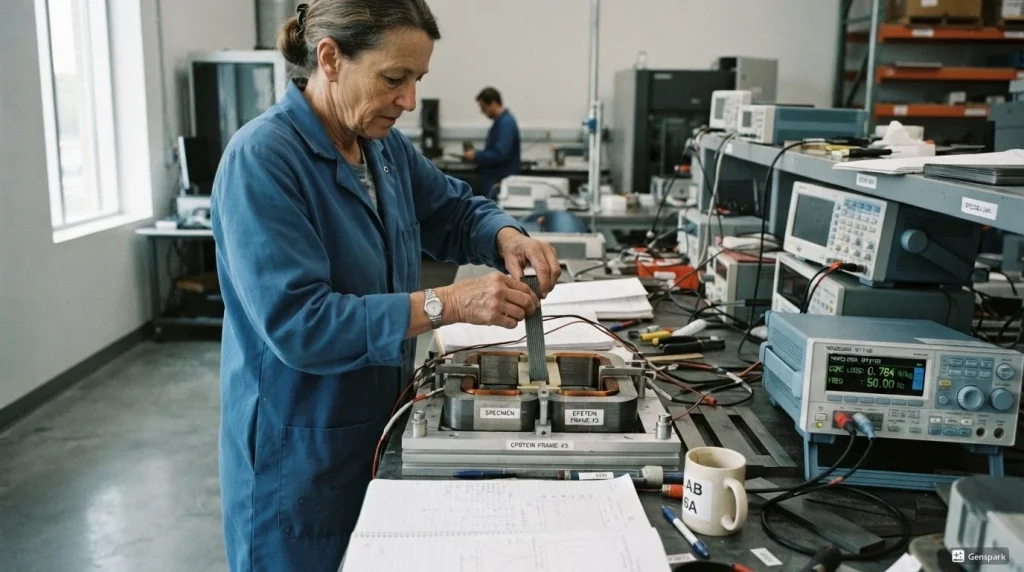
An Epstein frame is a standardized test rig: four coil windings arranged in a square, with strips of electrical steel — usually 30cm long, cut to a fixed width — laid inside to form a closed magnetic loop. A known AC magnetic field is applied, and the equipment measures how much energy the steel dissipates as heat while that field cycles the material’s magnetic domains back and forth. That dissipated energy, normalized to the mass of the sample, is specific core loss — expressed in watts per kilogram.
It’s not testing your transformer core or your motor lamination stack. It’s testing a small, carefully prepared sample under controlled lab conditions, cut specifically to match the test standard’s geometry. That distinction matters more than it sounds like it should, and we’ll come back to it.
Reading the Numbers: What P1.5/50 and P1.7/50 Mean
Core loss figures always come with two subscript numbers, and both matter. Take P1.5/50 = 1.10 W/kg as an example: the 1.5 is the peak magnetic induction in tesla the sample was driven to during the test, and the 50 is the test frequency in hertz. So this figure says: at 1.5 tesla and 50Hz, this material loses 1.10 watts per kilogram to heat.
Change either number and the loss changes with it — often substantially. P1.7/50 tests the same material at a higher induction level, and the loss figure will be noticeably higher, because core loss doesn’t scale linearly with induction; it rises faster as you push the material harder. A grade rated at P1.5/50 = 1.10 W/kg might show something like P1.7/50 = 1.55-1.65 W/kg on the same coil. Neither number is wrong. They’re answering different questions.
This is the single most common point of confusion we see in incoming technical inquiries: a buyer quotes us a competitor’s core loss figure without the subscript, and we genuinely can’t tell whether it’s a strong number or an unremarkable one until we know what induction and frequency it was measured at.
IEC 60404-2 vs. ASTM A343 — Two Standards, One Method
IEC 60404-2 is the international standard for Epstein frame testing, used across most of Europe, Asia, and the export markets we ship into most often. ASTM A343 is the equivalent North American standard. Both use the same underlying Epstein frame principle — four windings, standardized strip samples, controlled AC excitation — but differ in some procedural details: sample preparation, demagnetization steps, and how effective magnetic path length is calculated.
For most buyers this distinction matters less than it might seem, because the two standards produce broadly comparable results for the same material. Where it does matter is in documentation: if your quality system or your end customer specifies one standard by name, make sure your mill certificate references that specific standard, not just “Epstein test” generically. A certificate that says “core loss tested per IEC 60404-2” is a materially different document than one that just says “core loss: 1.10 W/kg” with no standard cited at all.
Why Grain-Oriented Steel Gets Tested in Two Directions
Non-grain-oriented steel is isotropic — its magnetic properties are roughly the same regardless of which direction you test it in, so a single Epstein test result reasonably characterizes the coil. CRGO is a different story entirely. Its entire value proposition is built on directionality: the grain structure is engineered so magnetic flux flows with dramatically lower loss along the rolling direction than across it.
That means testing CRGO in only one direction tells you an incomplete story, and testing it in the wrong direction can make an excellent grade look mediocre. A proper CRGO core loss report shows results with strips cut parallel to the rolling direction (where the low-loss figure that justifies the grade actually shows up) — and buyers evaluating CRGO for a transformer core, where flux is expected to flow predictably along that rolling direction in the finished lamination, should confirm the quoted core loss figure reflects that orientation, not an average or a cross-direction measurement that understates the material’s real performance in its intended use.

Typical Core Loss Reference by Grade
| Grade Category | P1.5/50 (W/kg, typical) | P1.7/50 (W/kg, typical) | Notes |
|---|---|---|---|
| CRGO standard | 1.00 – 1.10 | 1.40 – 1.55 | Tested parallel to rolling direction |
| CRGO Hi-B | 0.85 – 0.95 | 1.15 – 1.30 | Lower loss from tighter grain orientation control |
| CRNGO standard | 2.50 – 3.50 | 3.80 – 5.20 | Isotropic — single test direction representative |
| Ultra-thin (0.10-0.20mm) | Varies by frequency point | Often tested at 400Hz+ instead of 50Hz | Standard 50/60Hz test points less relevant for high-frequency applications |
These are typical reference ranges across common commercial grades, not a guarantee for any specific coil — always work from the actual test certificate for the lot you’re buying, not a grade-level average.
The Gap Between Lab-Tested Core Loss and Real Core Loss
Here’s the part that catches people off guard the first time they measure a finished core against the mill certificate: the number on the certificate is close to the best-case loss that material can achieve, and your finished core will almost never match it exactly.
A few reasons why:
- Cutting and stamping stress — punching laminations from a coil introduces mechanical stress along the cut edge that measurably increases local core loss. A rough or burred edge (the same issue we cover in our slitting tolerance guide) makes this worse.
- Stacking factor — air gaps between imperfectly stacked laminations reduce the effective magnetic cross-section, which shows up as apparent loss increase relative to the material’s true properties. See our stacking factor explainer for the mechanism.
- Assembly and clamping stress — how tightly a core is clamped, and whether the clamping introduces uneven mechanical stress, affects real-world loss in ways an Epstein test on a flat strip sample simply can’t capture.
None of this means the mill certificate is misleading — it’s testing exactly what it’s designed to test, under the conditions the standard specifies. It just means treating the certificate number as a floor for your finished assembly’s performance, not a promise about it, will save you a confusing conversation later when your core loss measurement comes in higher than the coil’s paperwork suggested.
What to Check on a Core Loss Test Report
- The full subscript notation — induction level and frequency, not just a bare W/kg figure.
- Test standard cited — IEC 60404-2, ASTM A343, or another named standard, not “Epstein test” with no reference.
- Test direction, for CRGO — confirm the reported figure is along the rolling direction if that’s the orientation your application uses.
- Sample source — whether the tested sample represents the specific coil/lot you’re receiving, or a grade-level typical value.
- Date and lab — in-house mill lab versus third-party accredited lab (CNAS-accredited, in our case) can matter for customers with their own quality system requirements.
A Common Mistake: Comparing Numbers at Different Test Points
We’ve had customers compare our P1.7/50 figure against a competitor’s P1.5/50 figure and conclude the competitor’s steel performed better — it didn’t. They were reading two different test points as if they described the same thing. It’s an easy mistake to make when a quote sheet lists just “core loss: 1.10 W/kg” without the full notation, and it’s exactly why we always report both induction level and frequency, not a bare number that looks impressive out of context.
If a supplier’s core loss figure doesn’t include the subscript, ask for it before comparing quotes. Otherwise you’re not comparing steel — you’re comparing incomplete paperwork.
FAQ
What does P1.5/50 mean on a core loss test report?
It’s the specific core loss measured at 1.5 tesla peak magnetic induction and 50Hz test frequency, expressed in watts per kilogram. Both numbers matter — changing either the induction or frequency changes the loss figure, so a bare “core loss: X W/kg” without this notation is incomplete.
What’s the difference between IEC 60404-2 and ASTM A343?
Both are Epstein frame core loss test standards using the same underlying method, with IEC 60404-2 used internationally and ASTM A343 as the North American equivalent. They differ in some procedural details like sample preparation and demagnetization steps, but produce broadly comparable results — the important thing is confirming which standard your mill certificate references.
Why is CRGO tested in two directions but CRNGO isn’t?
CRGO’s grain structure is engineered to give dramatically lower loss along the rolling direction than across it, so testing only one direction — or the wrong one — gives an incomplete or misleading picture. CRNGO is isotropic, meaning its magnetic properties are roughly consistent regardless of direction, so a single test result reasonably characterizes the material.
Will my finished core match the core loss number on the mill certificate?
Not exactly, and it shouldn’t be expected to. Cutting stress from slitting and stamping, imperfect stacking factor, and assembly clamping stress all push real-world core loss above the lab-tested figure. Treat the certificate number as a best-case floor for the material itself, not a guarantee for your finished assembly.
Can I request core loss testing at a specific induction or frequency point?
Yes, particularly for high-frequency applications like ultra-thin gauge motor cores, where standard 50Hz/60Hz test points may not reflect your actual operating frequency. Confirm with your supplier whether they can test and certify at the induction/frequency combination relevant to your application.
Need core loss data at a specific test point for your application? Contact Zhongxin Special Steel with your grade, induction level, and frequency requirements, and we’ll provide CNAS-accredited test data for your lot.

