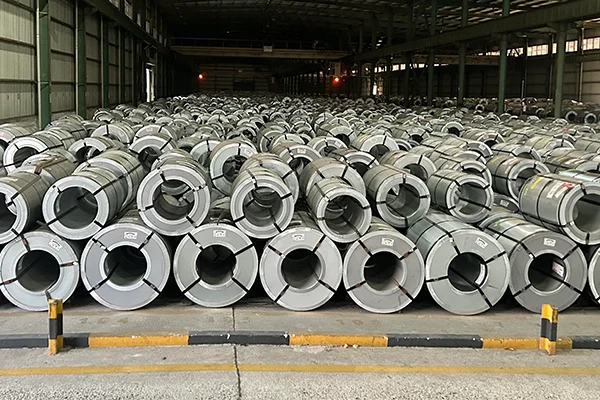
Core Key Points
- A typical CRGO Hi-B order for a distribution or power transformer core specifies core loss of 0.75-0.90 W/kg, magnetic induction (B800) of 1.88-1.95T, thickness of 0.23-0.27mm, and a C5 insulation coating — standard-grade orders run 0.90-1.10 W/kg loss at 0.23-0.35mm.
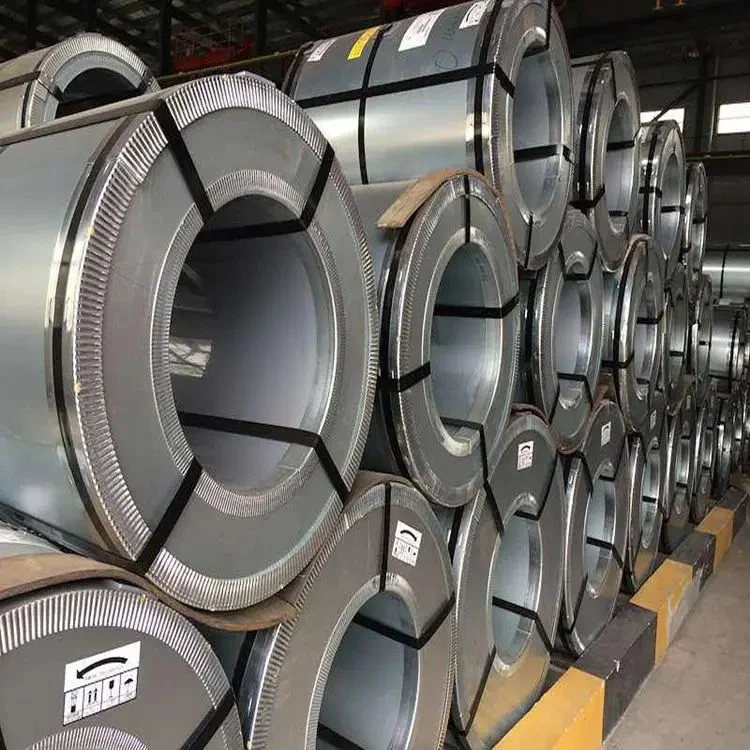
- Coils ship at standard inner diameters of 508mm or 610mm, in coil weights typically ranging 3-8 tonnes, cut to customer-specified widths within a ±0.02mm thickness tolerance.
- Every coil is tested on an Epstein frame per IEC 60404-2 before shipment — core loss, magnetic induction, and lamination factor are measured and reported per batch, not sampled periodically.
- Standard lead time on a confirmed specification runs 25-40 days depending on grade and coating, per our lead time and MOQ guide; most export orders ship FOB Shanghai or Ningbo, with CIF available on request.
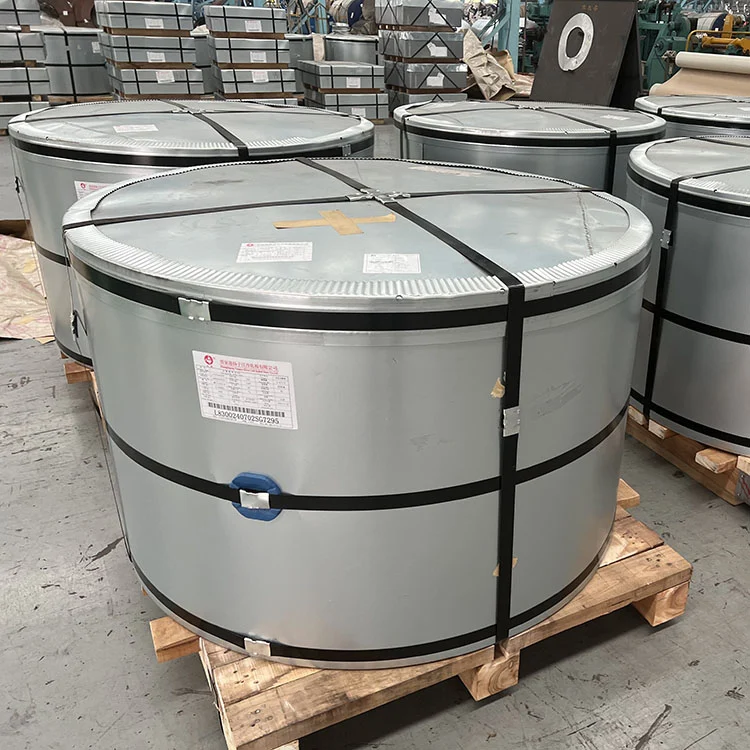
- Packaging for export runs VCI paper interleaving, waterproof kraft or steel outer wrap, and steel strapping over wooden pallets or wooden reels — with ISPM 15-compliant, heat-treated pallets as the default for every international shipment.
Customer Requirements: What a Typical CRGO Order Specifies
Most CRGO buyers come to us already knowing their application — a distribution transformer manufacturer, a power transformer OEM, sometimes a smaller electrical equipment fabricator sourcing through a trading company. What changes order to order is how tightly the spec is written. Here’s what a well-specified 45-tonne Hi-B order for power transformer cores actually looks like once the buyer’s engineering team has done their homework — roughly 7-8 coils at the coil weights below:
- Product: Cold-Rolled Grain-Oriented Electrical Steel (CRGO), Hi-B grade
- Order Size: 45 tonnes (approx. 7-8 coils)
- Core Loss: ≤0.85 W/kg at 1.7T/50Hz (typical Hi-B mid-range spec)
- Magnetic Induction (B800): ≥1.90T
- Thickness: 0.23mm or 0.27mm, ±0.02mm tolerance
- Coating: C5 (glass film + phosphate insulation coating), insulation resistance ≥ specified per ASTM A717 or equivalent
- Width: 900-1200mm (customer-specified cut width)
- Coil Weight: 3-8 tonnes per coil
- Inner Diameter: 508mm (standard) or 610mm (on request)
- Surface: free of visible scratches, edge burr, or coating discontinuity
- Delivery Time: 25-40 days from confirmed PI, depending on grade availability
- Trade Term: FOB Shanghai/Ningbo standard; CIF/CFR quoted on request
- Documentation: Mill Test Certificate (EN 10204 3.1 or 3.2), Certificate of Origin, packing list matched to actual coil weights
- Packaging: VCI paper interleaving, waterproof outer wrap, steel strapping, ISPM 15-compliant wooden pallets or reels
The two line items buyers most often under-specify on a first order are coating class and thickness tolerance — both directly affect stacking factor and core loss in the finished transformer, and both are worth writing into the PO explicitly rather than assuming “CRGO” alone communicates enough. If your engineering spec only says the grade name without the loss/induction numbers, that’s usually the gap worth closing before the PI gets issued.
Production: How This Order Gets Made
CRGO production for an order like the one above runs through cold rolling, decarburization annealing, high-temperature secondary-recrystallization annealing (this is the step that actually develops the Goss texture responsible for CRGO’s directional grain orientation), and insulation coating application, before final slitting to the customer’s specified width and recoiling to the requested inner diameter and coil weight.
We run this at 200,000 tonnes of annual production capacity, with precision slitting and laser scribing done in-house rather than outsourced to a third-party processor — which matters most on orders with a non-standard width or a scribing requirement (laser scribing reduces core loss further for high-efficiency transformer applications), since it means the finishing step doesn’t add a separate vendor and a separate lead time to the order.
For the profile above — Hi-B grade, 0.23-0.27mm, C5 coating — the coating is applied and cured in-line immediately after annealing, then the coil is slit to width and cut to the specified inner diameter before packaging. Buyers who need a non-standard combination (unusual width, non-standard coil weight, or a coating variant outside C5) should raise it at PI stage, since it can shift the production slot rather than being a packaging-stage adjustment.
Quality Inspection: What Gets Tested Before It Ships
Every coil in an order gets tested — not a percentage sample — before it ships. The core tests run:
| Test | Standard | What It Verifies |
|---|---|---|
| Specific core loss | IEC 60404-2 (Epstein frame) | Actual W/kg loss at rated frequency and induction |
| Magnetic induction (B800) | IEC 60404-2 | Directional magnetic performance |
| Thickness and width | Micrometer/laser gauge | Dimensional tolerance compliance |
| Coating thickness and insulation resistance | ASTM A717 or equivalent | Interlaminar insulation performance |
| Surface quality | Visual + automated surface inspection | Scratches, edge burr, coating discontinuity |
| Coil set/camber | Mechanical measurement | Flatness for downstream stamping/winding |
Testing runs through our CNAS-accredited lab, and the quality system operates under ISO 9001 and IATF 16949 (relevant if the finished transformer or motor feeds an automotive supply chain), with RoHS/REACH compliance data available for buyers who need it for their own downstream documentation. Each shipment ships with a Mill Test Certificate reflecting the actual measured values for that coil — see our breakdown of EN 10204 3.1 vs 3.2 certificates for which format applies to your contract. We also support third-party pre-shipment inspection through SGS, BV, or TÜV if your procurement process requires independent verification — our comparison of those three covers what each one actually checks differently.
Why Buyers Choose Zhongxin
- Reliable, measured quality — every coil tested on an Epstein frame per IEC 60404-2, CNAS-accredited lab, ISO 9001 and IATF 16949 quality systems, 200,000 tonnes annual production capacity.
- In-house finishing capability — precision slitting and laser scribing done on our own lines, so non-standard widths or scribed laminations don’t add a third-party processing step or its lead time.
- Documentation matched to your compliance needs — Mill Test Certificates in EN 10204 3.1 or 3.2 format, RoHS/REACH data on request, and support for third-party inspection (SGS/BV/TÜV) when your process requires it.
- English-language technical support across time zones — direct answers on core loss tolerance, coating adhesion, and stacking factor questions, without a translation-lossy 24-hour round trip.
- Export packaging built for the destination, not a single default spec — ISPM 15-compliant pallets as a baseline, with region-specific adjustments depending on where the coil is headed.
We’d rather a buyer verify these against our sourcing guide — the same vetting questions worth asking any CRGO supplier — than take the list above at face value.
FAQ
What core loss and induction values should I specify for a CRGO Hi-B order?
A typical Hi-B specification runs core loss ≤0.85 W/kg at 1.7T/50Hz and magnetic induction (B800) ≥1.90T, at 0.23mm or 0.27mm thickness. Standard-grade CRGO (non-Hi-B) runs 0.90-1.10 W/kg at 0.23-0.35mm — write both the loss and induction numbers into your PO, not just the grade name.
What’s a typical coil weight and inner diameter for export CRGO orders?
Coils typically run 3-8 tonnes with a standard inner diameter of 508mm, or 610mm on request. Width is cut to the customer’s specification, most commonly in the 900-1200mm range.
How is CRGO steel tested before it ships?
Every coil is tested on an Epstein frame per IEC 60404-2 for core loss and magnetic induction, plus dimensional, coating-thickness, insulation-resistance, and surface-quality checks. Results are reported per coil on the Mill Test Certificate, not sampled periodically across a batch.
What’s the standard lead time and trade term for a CRGO export order?
Standard lead time runs 25-40 days from a confirmed proforma invoice, depending on grade and coating availability. Most orders ship FOB Shanghai or Ningbo, with CIF or CFR quoted on request.
If a quote comes back without core loss and induction numbers attached to the grade name, or without a stated coil weight and inner diameter, ask for them before the PI is issued — those four numbers are what actually determine whether the material fits your transformer design.