
Pure aluminum melts at 660.3°C (1220.6°F, 933.5 K). Commercial alloys don’t have a single melting point. They melt over a range that starts anywhere from about 475°C to 645°C and finishes by roughly 595°C to 657°C, depending on the alloy. The popular 6061, for example, starts to melt at about 582°C and is fully liquid at about 652°C.
That’s low for a structural metal. Steel needs well over twice the temperature. Copper melts at 1,085°C. The low melting point is why aluminum is so easy to cast and so cheap to recycle, and also why it needs careful handling anywhere heat is involved.
We’re Wuxi Zhongxin Special Steel (ZHX Steel). We don’t melt aluminum. We supply non-oriented silicon steel and grain-oriented electrical steel. But aluminum’s melting point shapes a surprising amount of what happens to our steel after it leaves us, especially inside die-cast motor rotors. We’ll get to that after the basic numbers.

Key Takeaways
- Pure aluminum melts at 660.3°C / 1220.6°F. It boils at about 2,470°C.
- Alloys melt over a solidus-to-liquidus range. 6061: ~582–652°C. 7075: ~477–635°C. 1100: ~643–657°C.
- Aluminum loses much of its strength far below its melting point. Heat-treated tempers like 6061-T6 soften noticeably once held above roughly 200°C.
- It gives no visual warning: aluminum doesn’t glow like steel before it melts, which makes it easy to overheat by accident.
- Remelting scrap takes about 5% of the energy needed to make new aluminum, largely thanks to that low melting point.
- In induction motors, molten aluminum is cast straight into stacks of silicon steel laminations. So any stress-relief anneal of the steel, typically 750°C or more, has to happen before casting, not after.
660°C in Celsius, Fahrenheit, and Kelvin
| Property | °C | °F | K |
|---|---|---|---|
| Melting point (pure Al) | 660.3 | 1220.6 | 933.5 |
| Boiling point | ~2,470 | ~4,478 | ~2,743 |
| Typical casting pour temperature | ~700–760 | ~1,290–1,400 | ~973–1,033 |
| Aluminum oxide (Al₂O₃) melting point | 2,072 | 3,762 | 2,345 |
The last row explains something every first-time caster notices. The skin of oxide on molten aluminum doesn’t melt at 660°C. It’s a ceramic that melts above 2,000°C, so it floats on the melt as dross and has to be skimmed off. The same tough oxide film is why aluminum resists corrosion at room temperature.
Some useful physics for anyone sizing a furnace: aluminum’s specific heat is about 0.90 J/g·K and its latent heat of fusion is about 397 J/g. Taking 1 kg from room temperature to fully molten therefore needs roughly 0.97 MJ, or about 0.27 kWh in theory. Real furnaces use several times that because of heat losses.
Melting Ranges of Common Aluminum Alloys
An alloy starts melting at its solidus temperature and becomes completely liquid at its liquidus. Between the two it’s a slush of solid grains and liquid metal. For welding, brazing, and heat treatment, the solidus is the number that matters, because that’s where parts start to fail.
| Alloy | Type | Solidus (°C) | Liquidus (°C) | Liquidus (°F) |
|---|---|---|---|---|
| 1100 | Commercially pure | ~643 | ~657 | ~1,215 |
| 3003 | Al-Mn | ~643 | ~654 | ~1,210 |
| 5052 | Al-Mg | ~607 | ~649 | ~1,200 |
| 6061 | Al-Mg-Si | ~582 | ~652 | ~1,206 |
| 6063 | Al-Mg-Si | ~616 | ~654 | ~1,210 |
| 2024 | Al-Cu | ~502 | ~638 | ~1,180 |
| 7075 | Al-Zn-Mg-Cu | ~477 | ~635 | ~1,175 |
| A356 | Cast Al-Si-Mg | ~555 | ~615 | ~1,139 |
| A380 | Die-cast Al-Si-Cu | ~540 | ~595 | ~1,103 |
Published values vary by roughly ±10°C between sources and with exact composition. Treat these as typical figures, not guaranteed limits.
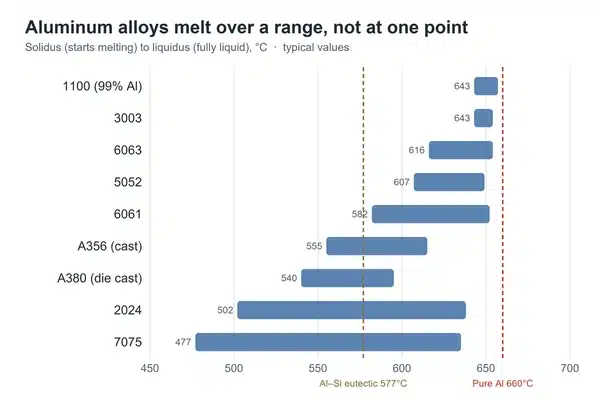
Look at the high-strength alloys at the bottom of the chart. 7075 begins to melt at about 477°C, nearly 200°C below pure aluminum. Its zinc and copper form low-melting phases along the grain boundaries. That’s one reason 7075 is considered unweldable by ordinary fusion welding: the metal next to the weld partially melts and cracks.
The casting alloys tell the opposite story. Silicon and aluminum form a eutectic at 12.6% silicon that melts at a single temperature, 577°C. Alloys near that composition, such as A380, flow well and fill thin die cavities, which is exactly what a caster wants. Silicon lowers the melting point of aluminum. In steel, silicon plays a very different role, as we’ll see below.
Density shifts with alloying too, though far less than the melting range does. Our guide to aluminum density has the alloy-by-alloy figures.
Why Aluminum Melts So Much Lower Than Steel
| Metal | Melting point (°C) | Melting point (°F) |
|---|---|---|
| Tin | 232 | 449 |
| Lead | 327 | 621 |
| Zinc | 420 | 787 |
| Magnesium | 650 | 1,202 |
| Aluminum | 660 | 1,221 |
| Copper | 1,085 | 1,984 |
| Silicon | 1,414 | 2,577 |
| Carbon steel | ~1,425–1,540 | ~2,600–2,800 |
| Iron (pure) | 1,538 | 2,800 |
| Titanium | 1,668 | 3,034 |
Melting point tracks how tightly atoms hold each other. Aluminum’s metallic bonds are relatively weak, so its atoms break free of the crystal at a modest temperature. Iron’s bonds are much stronger, which puts steel roughly 800 to 900°C higher.
That gap shows up in manufacturing. Aluminum is cast at around 700°C in a simple crucible. Steel making runs well above 1,500°C, and even the hot rolling of electrical steel slabs happens at temperatures above aluminum’s melting point. Our article on the CRGO coil manufacturing process walks through those steps.
Have you ever wondered why aluminum pots don’t melt on a gas stove, when the flame runs near 1,900°C? The pot conducts heat into the food and water very quickly, so the metal stays far below 660°C. Leave an empty pot on a high flame long enough and the base can soften or even melt.
It Gets Weak Long Before It Melts
For design work, the melting point is almost never the real limit. Strength is.
Heat-treated alloys get their strength from fine precipitates formed during aging. Hold them hot for long enough and those precipitates coarsen. A 6061-T6 part starts losing its temper once it spends time above roughly 200°C, and by around 300°C it keeps only a fraction of its room-temperature strength. Welding does the same thing locally, which is why the zone beside a weld in 6061-T6 is weaker than the base metal.
Fire is the extreme case. An aluminum structure can lose most of its load-bearing capacity well before any part of it melts. Building codes treat aluminum’s fire performance very differently from steel’s for that reason.
So when someone asks, “Can this aluminum part handle 400°C?”, the honest answer is usually “it won’t melt, but it won’t be the same part afterward either.”
Aluminum Meets Silicon Steel: Die-Cast Rotors
This is the part of the aluminum story our customers deal with directly.
Most induction motors use a squirrel-cage rotor. It starts as a stack of punched silicon steel laminations. Then molten aluminum, typically at 700°C or more, is die-cast through the slots to form the conductor bars and end rings in one shot. The steel carries the magnetic flux, and the aluminum carries the induced current.
That casting step sets three rules for the laminations.
The anneal has to come first. Punching strains the edge of each lamination and raises its core loss. Motor makers often restore it with a stress-relief anneal, commonly around 750 to 800°C. That’s above aluminum’s melting point. Once the cage is cast, the rotor can’t go back in the furnace, so any anneal must happen before casting.
The coating has to survive the heat. The preheated stack and the molten aluminum expose the lamination surface to several hundred degrees. Purely organic insulation coatings can char or break down at those temperatures. Coating choice for die-cast rotors therefore leans toward inorganic or semi-organic types. Our guide to electrical steel coating types compares their temperature tolerance.
Aluminum can bridge the laminations. Under casting pressure, molten aluminum sometimes seeps between laminations or smears across the slot walls. The result is electrical contact between sheets that should be insulated, which adds stray load loss. Tight slot tolerances and a well-controlled stack pressure keep that in check.
These trade-offs are why high-efficiency motors are sometimes built with die-cast copper instead. Copper conducts better, but it pours at over 1,100°C, which is much harder on the dies and on the steel stack. For EV traction motors, many designers avoid the issue entirely with permanent-magnet rotors, which need no cast cage at all.
Transformer Windings: The Limit Is 200°C, Not 660°C
Aluminum windings are common in distribution transformers, and the relevant temperature limit is far below 660°C.
Under IEC 60076-5, an oil-immersed transformer with a 105°C insulation system must keep the average winding temperature after a short circuit at or below 250°C for copper and 200°C for aluminum. The aluminum limit is lower because aluminum conductors soften and lose strength at lower temperatures than copper. A winding that loses strength can deform under the huge electromagnetic forces of a fault.
In practice, this means an aluminum-wound unit needs a bit more conductor cross-section, or tighter protection settings, to stay within its short-circuit thermal limit. The core steel isn’t the constraint here. Grain-oriented silicon steel handles those fault temperatures without trouble. For more on how core and winding choices fit together, see our page on distribution transformers.
Safety Notes, and Why Recycling Is So Cheap
No warning glow. Steel turns red, then orange, then yellow as it heats up. Aluminum stays silvery right up to its melting point and slumps without much visible change. Anyone heating aluminum with a torch should assume it’s hotter than it looks.
Water is the main hazard. Moisture trapped in scrap, tools, or molds can flash to steam under molten aluminum and throw metal violently. Foundries preheat tools and keep scrap dry for this reason.
Recycling pays because the melting point is low. Making new aluminum from ore takes huge amounts of electricity. Remelting scrap needs only about 5% of that energy, according to the International Aluminium Institute. The global figures are about 186 GJ per tonne for primary metal against about 8.3 GJ per tonne for recycled.
Before any of that, scrap yards have to separate aluminum from steel. Since aluminum isn’t attracted to magnets, a magnet pulls the steel out first. We explain the physics in Is Aluminum Magnetic?.
Bottom Line
The number to remember is 660°C (1,221°F) for pure aluminum. For alloys, look up the solidus, because that’s where trouble starts: about 582°C for 6061 and as low as 477°C for 7075. For anything load-bearing, the practical limit is lower still, since tempered aluminum loses strength well below 300°C.
For motor builders, the melting point also fixes the order of operations. Anneal the silicon steel stack first, then cast the aluminum cage. If you’re planning a rotor lamination program and need grade, coating, or annealing data for CRNGO steel coils, we can send the figures with a quotation.
Cover photo: Kambai Akau, Wikimedia Commons, CC BY-SA 4.0.
FAQ
What is the melting point of aluminum in Fahrenheit?
Pure aluminum melts at 1,220.6°F (660.3°C). Common alloys start melting lower, for example about 1,080°F for 6061 and about 891°F for 7075.
At what temperature does 6061 aluminum melt?
6061 melts over a range: it starts at about 582°C (1,080°F), the solidus, and is fully liquid at about 652°C (1,206°F), the liquidus. Its T6 temper begins to lose strength far earlier, once held above roughly 200°C.
Does aluminum melt at a lower temperature than steel?
Yes, by a wide margin. Aluminum melts at 660°C, while carbon steel melts at roughly 1,425–1,540°C and pure iron at 1,538°C. That’s why molten aluminum can be cast directly into steel lamination stacks and steel dies.
Can you melt aluminum with a propane torch?
A propane torch flame is hot enough, but it can’t deliver enough heat to melt much aluminum quickly, because aluminum conducts heat away so fast. Small pieces can be melted. Larger amounts need a furnace and crucible.
Why doesn’t aluminum glow before it melts?
Visible glow depends on temperature. Metals start to glow dull red at around 500–550°C, and that glow is faint in normal light. Aluminum melts at 660°C, so it never reaches the bright orange or yellow that steel shows at forging temperatures. Molten aluminum looks silvery, which makes it easy to underestimate how hot it is.
How hot can aluminum get before it loses strength?
Yes. Heat-treated alloys such as 6061-T6 start losing their temper above about 200°C and keep only a fraction of their strength by around 300°C. For structural and fire design, strength loss is the real limit, not melting.
References
- Wikipedia — Aluminium
- Rapid Protos — Aluminum Melting Point: Alloy Ranges & Casting Temperatures
- Wikipedia — Aluminium–silicon alloys
- Buehler — The Al-Si Phase Diagram
- IEC — IEC 60076-5: Power transformers – Ability to withstand short circuit
- International Aluminium Institute — Aluminium recycling saves 95% of the energy needed for primary aluminium production
- Copper Development Association / NADCA — Materials & Modifications to Die Cast the Copper Conductors of the Induction Motor Rotor


