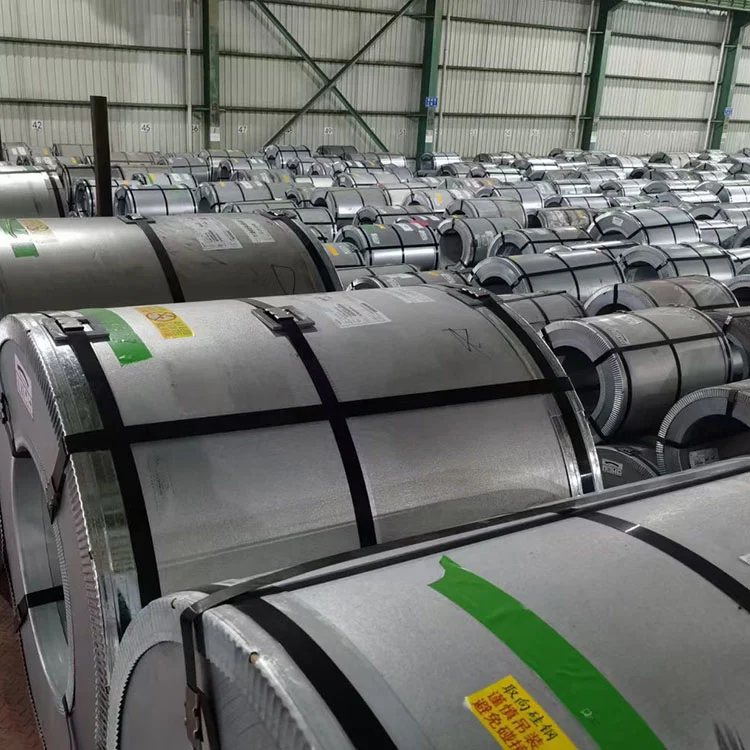
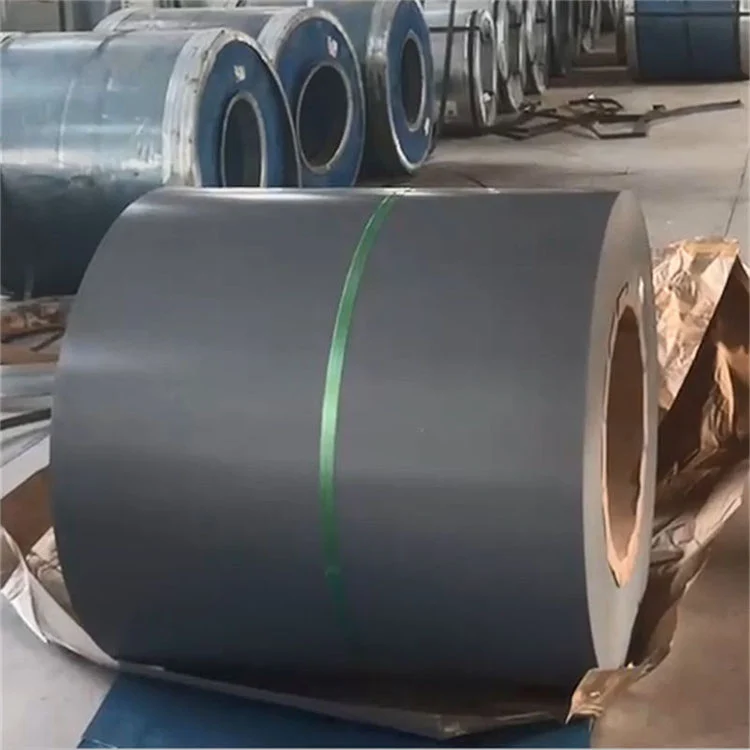
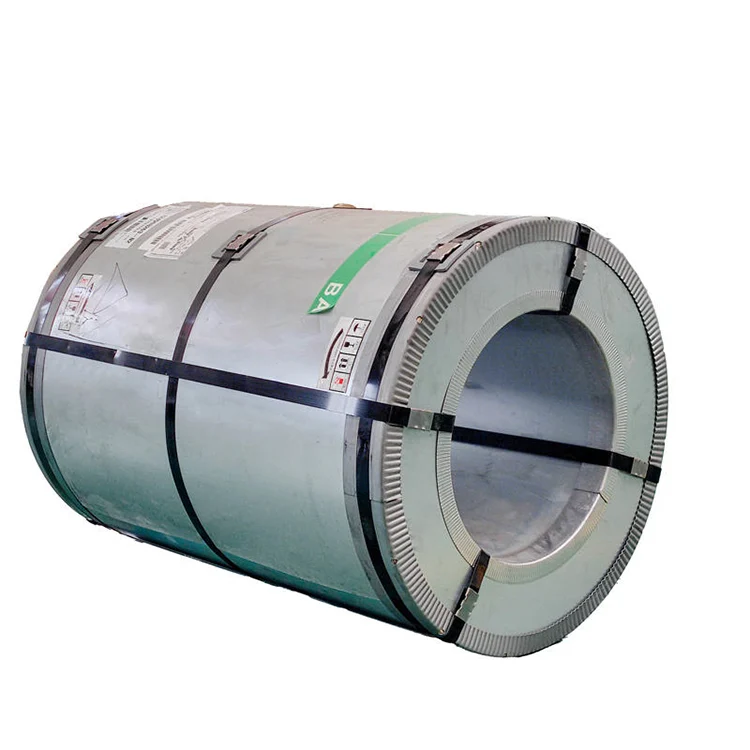
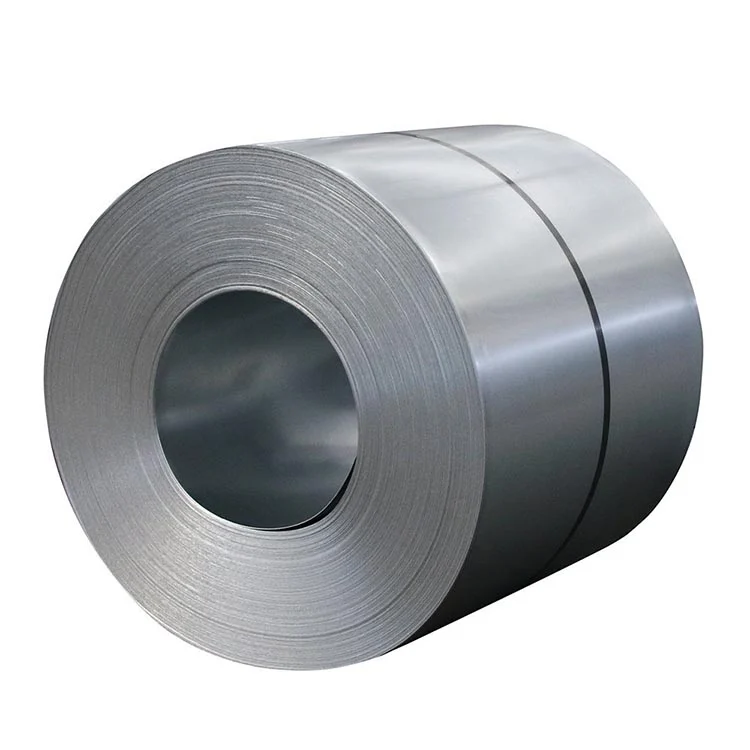
Every electric vehicle traction motor — whether in a Tesla Model Y, a BYD Seal, or a Rivian R1T — uses non-oriented silicon steel (CRNGO) in its stator core. Not grain-oriented steel. Not amorphous metal. CRNGO. This article explains the physical reason why, what specific CRNGO properties matter for EV performance, and how to select the right grade for your EV motor design.
Core Key Points
- EV traction motor stators experience rotating magnetic flux that sweeps through all radial directions as the rotor turns — requiring a material with uniform magnetic properties in all directions.
- CRGO’s grain-aligned structure provides excellent performance only in one direction; perpendicular performance is 3–5× worse — making CRGO fundamentally unsuitable for rotating machines.
- The critical CRNGO property for EV motors is high-frequency core loss (measured at 400–1,000 Hz), not the 50 Hz values used for transformer applications.
- Global demand for CRNGO in EV motors reached approximately 1.8 million tonnes in 2025 and is projected to exceed 5 million tonnes by 2030 per Wood Mackenzie’s EV Materials Outlook.
- Ultra-thin CRNGO (0.10–0.20 mm) reduces high-frequency eddy-current losses by 75–90% versus standard 0.35 mm — now standard for premium EV drivetrains.
The Rotating Flux Requirement
To understand why CRNGO is mandatory for EV motors, you need to understand how flux moves through a stator.
In a transformer core, magnetic flux travels in a fixed direction along the core limbs, looping through the yoke in a predictable pattern. The flux direction relative to any lamination remains essentially constant — ideal for grain-oriented CRGO.
In a rotating machine stator, the situation is fundamentally different:
- The stator generates a rotating magnetic field by energizing its windings in sequence.
- The rotating field creates a magnetic flux that sweeps continuously through 360° as the rotor turns.
- At any point in the stator lamination, the local magnetic flux direction rotates through all angles during each electrical cycle.
This means the stator material must perform equally well in the rolling direction, the transverse direction, and every angle in between. For a material with strong magnetic anisotropy — like CRGO — this is physically impossible to achieve efficiently.
Why CRGO Fails in Motor Applications
CRGO’s defining property — the Goss texture — concentrates magnetic permeability along one direction at the expense of all others.
Core loss comparison at 50 Hz (illustrative for 0.30 mm material):
| Direction | CRGO Core Loss | CRNGO Core Loss | Ratio |
|---|---|---|---|
| Rolling direction (0°) | 1.10 W/kg | 3.20 W/kg | CRGO wins (3×) |
| 45° to rolling | 3.80 W/kg | 3.30 W/kg | CRNGO wins |
| Transverse (90°) | 4.50 W/kg | 3.40 W/kg | CRNGO wins (1.3×) |
| Average (all directions) | 3.13 W/kg | 3.30 W/kg | Similar |
When averaged across all flux directions — which is the relevant measure for a rotating machine — CRGO provides no advantage over CRNGO. In fact, the severe performance penalty in the transverse direction (4.5 W/kg vs. 1.1 W/kg in the rolling direction) creates significant local hot spots in the stator teeth that CRGO grains are not aligned to serve efficiently.
Additionally, CRGO’s strong magnetostriction in the rolling direction (the physical dimensional change that creates transformer hum) becomes a noise and vibration source in motors where vibration is a quality attribute.
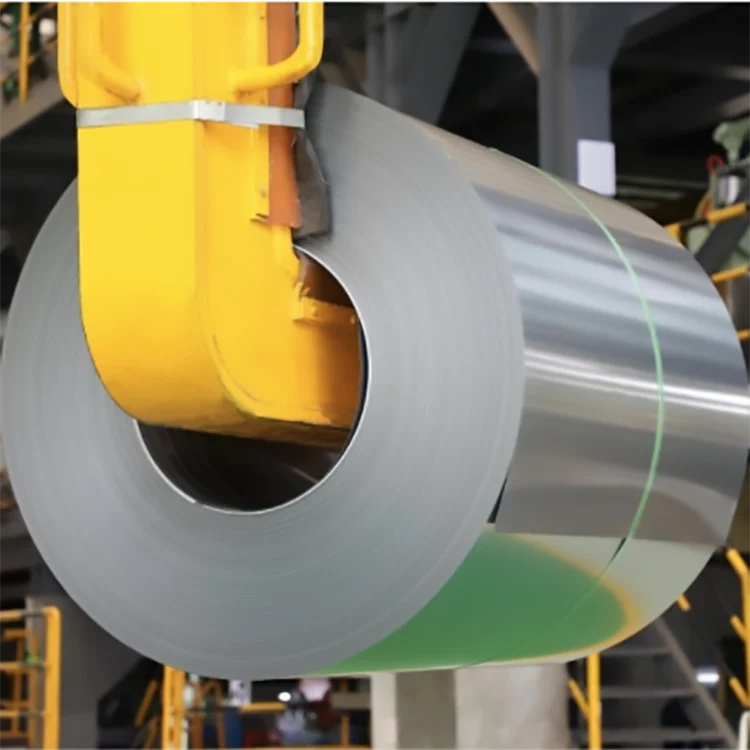
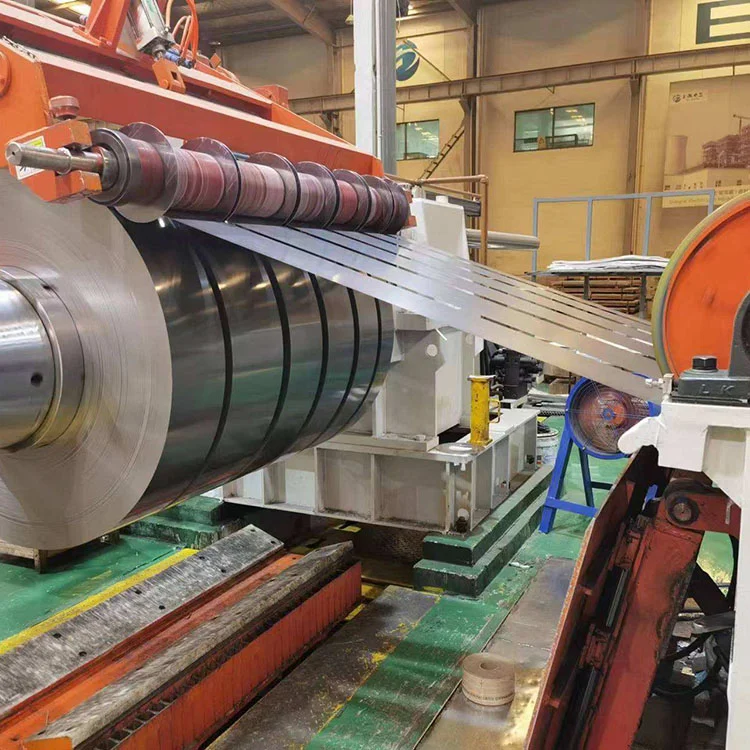
CRNGO Properties That Matter for EV Motors
The key CRNGO properties for EV motor optimization, ranked by importance:
1. High-Frequency Core Loss (P_x/f, kHz)
The most critical parameter. EV motor stators operate at fundamental electrical frequencies of 200–2,000 Hz depending on motor speed and pole count. Core loss at these frequencies — not at 50 Hz — determines motor efficiency.
Key measurement parameters:
- P₁.₀/₄₀₀ — Core loss at 1.0 T, 400 Hz
- P₁.₀/₈₀₀ — Core loss at 1.0 T, 800 Hz
- P₁.₀/₁₀₀₀ — Core loss at 1.0 T, 1,000 Hz
Standard CRNGO datasheets typically only report 50 Hz values. When sourcing CRNGO for EV motors, specifically request high-frequency core loss certificates. Zhongxin Steel provides high-frequency test data per IEC 60404-6 for all ultra-thin CRNGO grades.
2. Isotropy (Anisotropy Ratio)
The anisotropy ratio (P_RD/P_TD at a given field) should be close to 1.0 for EV motor applications. Modern CRNGO achieves anisotropy ratios of 1.0–1.2 (rolling direction vs. transverse direction core loss ratio at 1.5 T, 50 Hz), confirming near-isotropic behavior.
3. Magnetic Induction (B₅₀)
High flux density allows more compact motor designs. Premium EV CRNGO achieves B₅₀ of 1.65–1.72 T. This is slightly lower than Hi-B CRGO (1.88 T) but sufficient for EV motor stator designs where flux density is typically held to 1.2–1.6 T.
4. Punchability (for Stator Lamination Stamping)
EV motor stators require thousands of laminations punched to precise geometries — tight slot tolerances (< ±0.05 mm), clean edges, minimal burr. Higher silicon content (> 3.0%) improves electrical resistivity and reduces losses but increases brittleness. Grade selection must balance resistivity against punchability for high-volume automotive production.
5. Surface Insulation Coating
For EV motor applications, coating class C5 or C6 per IEC 60404-11 is typically specified. The coating must withstand:
- Stamping die contact without flaking
- Stack pressure during housing assembly
- Thermal cycles from −40°C to +200°C operating range
Grade Selection for EV Motor Applications
| Motor Type | Speed | Electrical Frequency | Recommended CRNGO |
|---|---|---|---|
| Mass-market EV rear motor (IPMSM) | 8,000–16,000 RPM | 400–800 Hz | 0.20 mm, Si 2.5–3.0% |
| Premium EV motor (high-speed) | 15,000–20,000 RPM | 800–1,600 Hz | 0.10–0.15 mm, Si 3.0–3.2% |
| Commercial EV / truck motor | 3,000–8,000 RPM | 150–400 Hz | 0.20–0.27 mm, Si 2.0–2.5% |
| HEV / PHEV motor | 6,000–14,000 RPM | 300–700 Hz | 0.20–0.27 mm, Si 2.5–3.0% |
| In-wheel motor | 500–2,000 RPM | 25–100 Hz | 0.35 mm (standard CRNGO acceptable) |
| E-bike / light EV motor | 2,000–6,000 RPM | 100–300 Hz | 0.27–0.35 mm |
The silicon content selection involves a trade-off:
- Higher Si (3.0–3.5%) → Higher resistivity → Lower eddy-current losses → Better high-frequency performance → More brittle → More difficult to punch at 0.10–0.15 mm
- Lower Si (2.0–2.5%) → More ductile → Better punchability → Higher eddy-current losses at frequency
For most mass-market EV applications (0.20 mm thickness), silicon content of 2.5–3.0% represents the optimal balance.
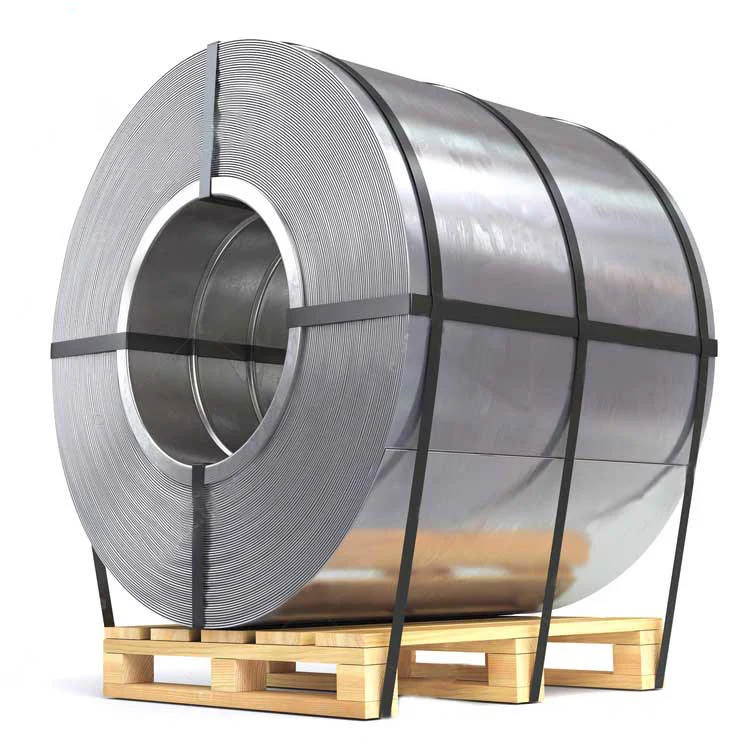
The EV Motor CRNGO Market in 2026
EV adoption is transforming the CRNGO market:
- Global EV sales reached 17.1 million units in 2024, according to the IEA Global EV Outlook 2025 — representing approximately 18% of all new car sales.
- Each EV traction motor requires approximately 15–40 kg of CRNGO depending on motor size and efficiency tier.
- At 20 million EV units/year and average 25 kg CRNGO per motor, EV applications consume approximately 500,000 tonnes/year of electrical steel — already representing 8–10% of total global CRNGO production.
- Wood Mackenzie projects this to grow to 5.2 million tonnes/year by 2030, representing approximately 35% of total global CRNGO demand.
This demand surge is driving Chinese CRNGO producers, including Zhongxin Steel, to invest in ultra-thin production capabilities. Chinese producers now supply approximately 65% of global ultra-thin CRNGO capacity, with production facilities concentrated in Jiangsu, Guangdong, and Zhejiang provinces.
Processing CRNGO Laminations for EV Stators
EV motor stator laminations are typically produced by:
1. Progressive die stamping (high volume)
The dominant production method for volumes > 1 million stators/year. A multi-station progressive die punches the stator slot pattern and OD/ID in a single pass through the CRNGO strip. Die cost: $500,000–$2,000,000 depending on complexity. Requires consistent CRNGO strip width (±0.05 mm) and surface quality.
2. Laser cutting (prototyping and low volume)
Laser cutting eliminates die investment and enables rapid design iteration. Quality is excellent (no die wear, clean edges) but speed is approximately 50–100× slower than stamping. Used for < 10,000 stators/year and prototyping.
3. Wire EDM (ultra-precision)
Used for precision aerospace or medical motor laminations requiring ±0.01 mm geometric accuracy. Not economical for automotive production.
For progressive die stamping, Zhongxin Steel recommends:
- Strip width: ±0.05 mm tolerance
- Burr height: < 10 µm (20% of thickness for 0.20 mm material)
- Surface coating: C5/C6, compatible with high-speed stamping (100+ strokes/minute)
- Coil inner diameter: ≥ 500 mm to prevent set in the strip during uncoiling
Material Alternatives: Why CRNGO Still Wins
The main alternatives to CRNGO for EV motor stators are:
Amorphous metal (metallic glass):
- 50–70% lower core loss at frequency vs. ultra-thin CRNGO
- Cannot be stamped conventionally — brittle, requires laser cutting or specialized punching
- 10× higher cost than CRNGO
- Currently limited to niche applications (appliances, drones, medical); not competitive for automotive volume production
Silicon steel + powder iron composite (SMC — Soft Magnetic Composites):
- Enables 3D-printed core shapes not achievable with laminations
- Lower in-plane magnetic performance than thin-gauge CRNGO
- Used in axial-flux motor topologies; not the primary choice for radial-flux EV motors
Conclusion: For mainstream EV traction motors in radial-flux topologies, CRNGO — specifically ultra-thin grades at 0.10–0.20 mm — remains the optimal material choice balancing performance, cost, and manufacturability through at least 2030.
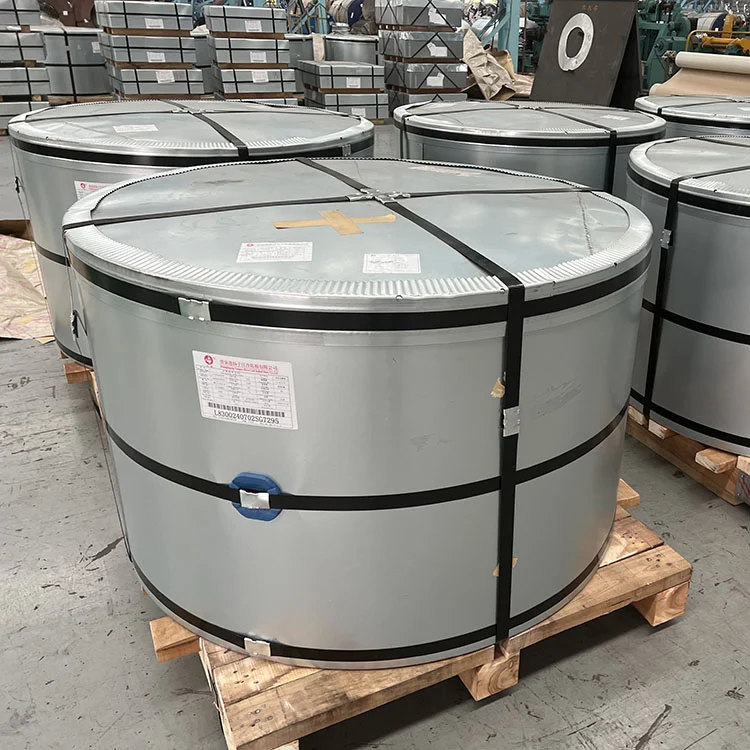
FAQ
What grade of CRNGO does the BYD SEAL use in its motor?
BYD has not publicly disclosed specific CRNGO grade specifications. Based on publicly available information about BYD’s motor operating speeds (maximum ~16,000 RPM) and publicly available teardown analyses, the SEAL motor is consistent with 0.20 mm CRNGO specifications. BYD is one of the largest CRNGO buyers globally, with the company reportedly investing in dedicated electrical steel supply chain integration.
Is amorphous metal replacing CRNGO in EV motors?
Not for mainstream automotive production. Amorphous metal’s core loss advantage is real (50–70% lower than CRNGO), but its brittleness makes high-volume stamping impractical. At $8–12/kg versus $2–4/kg for CRNGO, and with current manufacturing volume constraints, amorphous metal remains a niche option for specialized applications. The EV motor market will continue to be dominated by CRNGO through the 2030s.
How many kg of silicon steel are in a typical EV motor?
A typical mid-size EV passenger car permanent magnet synchronous motor (150–200 kW peak) contains approximately 20–35 kg of CRNGO in the stator lamination pack, plus a smaller quantity of permanent magnet material in the rotor. Larger truck or bus motors can contain 80–150 kg of CRNGO.
What is the difference between M-grade and B-grade CRNGO designations?
In US ASTM A677 designations, M-grades (M-15, M-19, M-22, M-27, M-36, M-47) classify CRNGO by maximum core loss at 1.5 T, 60 Hz. Lower M-number = lower loss = higher quality. The IEC B-grade system uses the thickness prefix (e.g., B35, B50) plus core loss number. Most Chinese suppliers provide IEC grade designations.
References
- International Energy Agency (2025). Global EV Outlook 2025. Paris: IEA. https://www.iea.org/reports/global-ev-outlook-2025
- Wood Mackenzie (2025). EV Materials Outlook 2025–2035: Silicon Steel Demand Projections. Edinburgh: Wood Mackenzie.
- Liang, P., et al. (2024). “Selection Criteria for Non-Oriented Electrical Steel in High-Speed EV Traction Motors.” IEEE Transactions on Energy Conversion, 39(2), 1220–1231.
- IEC 60404-8-4:2022 — Cold-rolled non-oriented electrical steel strip and sheet delivered in the fully-processed state. Geneva: IEC.
- IEC 60404-6:2018 — Methods of measurement of the magnetic properties of magnetically soft metallic and powder materials at frequencies in the range 20 Hz to 200 kHz. Geneva: IEC.