A CRGO coil is grain-oriented electrical steel that has passed through six controlled stages — hot rolling, cold rolling, decarburization annealing, high-temperature purification annealing with an MgO separator, insulation coating, and (for Hi-B grades) laser domain refinement — before it’s slit and shipped. Each stage sets a specific number on your mill test certificate: skip or under-run one, and a specific test result moves, not the whole sheet.
That last part is the piece most buying guides leave out. We get plenty of questions about what CRGO stands for and how it differs from CRNGO, but the question that actually protects a buyer’s purchase order is different — and it’s usually the one asked after a certificate already looks slightly off, not before.
One buyer emailed us a scanned test report last month asking, essentially, “is this bad?” The honest answer required knowing which of six process steps that specific number traces back to, not just whether it cleared the grade spec on paper.
This article walks through the six stages in order, then turns that sequence into a cross-reference a buyer can use before signing off on a new mill or a shipment.
Key Takeaways
- CRGO coil production runs through six sequential stages: hot rolling, cold rolling, decarburization annealing, high-temperature purification annealing (which forms the Goss texture and the forsterite base coating), insulation coating, and — for Hi-B grades only — laser domain refinement.
- Published process data for Hi-B CRGO shows a slab reheated below 1200°C, hot-rolled to a 2.3mm band at a ~900°C finishing temperature, then cold-rolled at roughly 88% reduction before annealing.
- Decarburization annealing has been documented at 830°C for 3 minutes in a wet 60% H2 / 40% N2 atmosphere — the step that removes interstitial carbon that would otherwise pin magnetic domain walls and raise core loss.
- Final purification annealing runs as high as 1200°C for up to 10 hours in a hydrogen atmosphere — this is where secondary recrystallization locks in the Goss texture that determines B8, and where the MgO separator reacts with the surface oxide to form the forsterite (Mg2SiO4) insulation base coat.
- Core loss and induction are measured against IEC 60404-2 using an Epstein frame, the same standard referenced on the mill test certificates buyers already receive — which means a buyer who understands the process can read a familiar document more critically, not learn a new one.
What “CRGO Coil” Actually Means Before Any Processing Starts
CRGO — Cold-Rolled Grain-Oriented electrical steel — is silicon steel whose crystal grains have been deliberately aligned along a single rolling direction (the Goss texture, {110}<001>) so the material carries a magnetic field far more efficiently along that axis than ordinary steel.
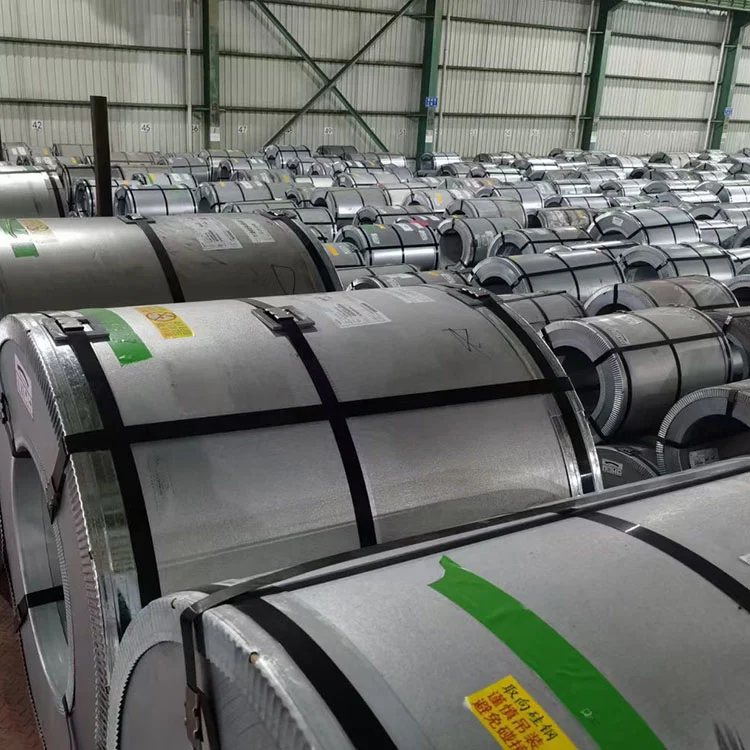
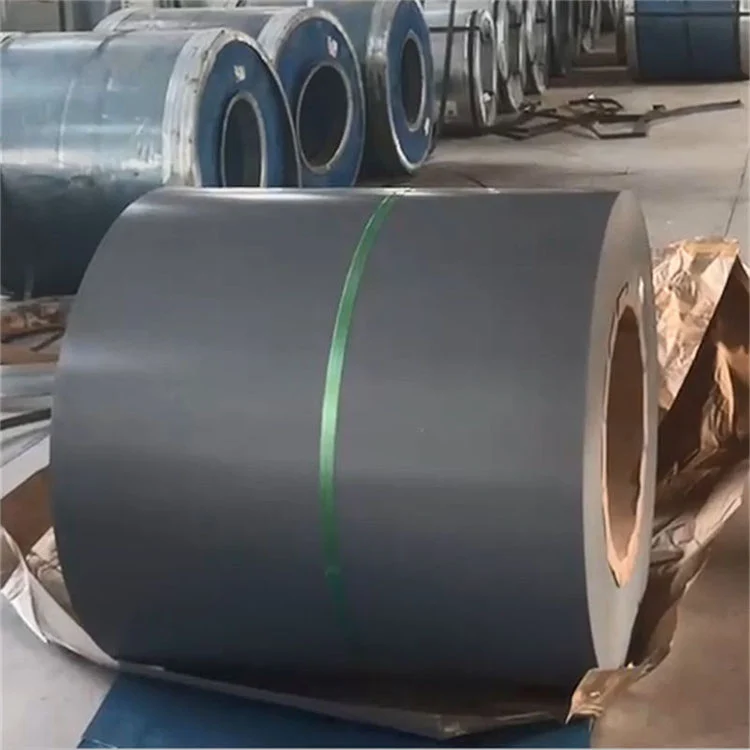
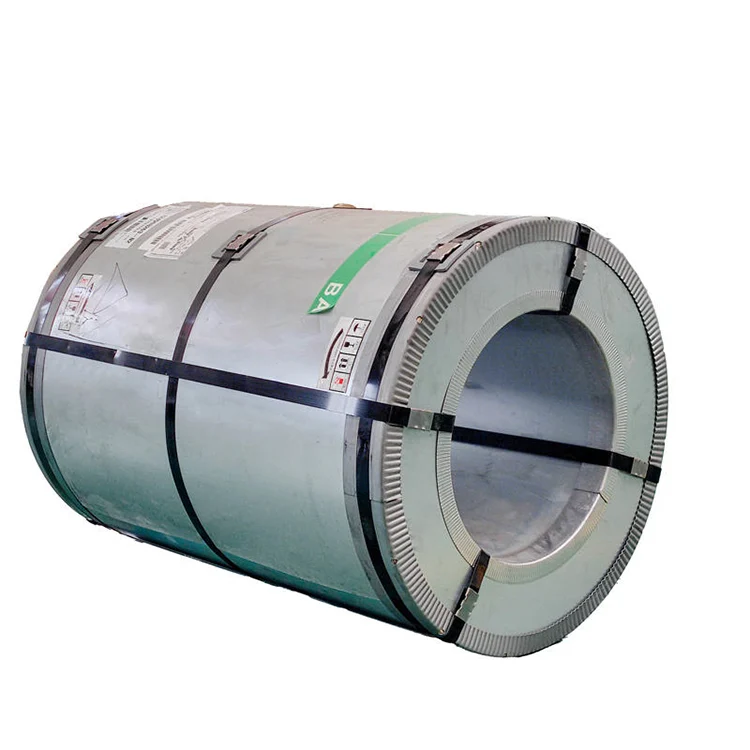
A “CRGO coil” is simply that material in its as-produced form: a continuous strip, typically 800-1,250mm wide, wound onto a steel or cardboard core after the full production sequence below is complete. What comes off that line ships as standard CRGO by default.
With one added step covered in Stage 6, the same line also produces Hi-B CRGO — a higher-permeability grade at the same base gauge.
That width detail matters for buyers, because a master coil is the input to a slitting line, not a separate product on its own. This article covers what happens before that point: the metallurgical process that turns a hot-rolled slab into the coil a slitting line, or a transformer core builder, eventually receives.
The Six-Stage Production Path, at a Glance
| Stage | What Happens | What It Sets |
|---|---|---|
| 1. Hot rolling | Slab reheated and rolled into a hot band | Starting gauge, initial grain structure |
| 2. Cold rolling | Hot band reduced to final gauge at room temperature | Final thickness, stored strain energy for later grain growth |
| 3. Decarburization annealing | Wet H2/N2 atmosphere, ~830-900°C range | Carbon content, primary recrystallization |
| 4. MgO coating + final annealing | MgO separator applied, then ~1,100-1,200°C batch anneal | Goss texture (B8), forsterite base coating |
| 5. Insulation coating | Phosphate-based C-2/C-5 topcoat applied | Interlaminar resistance, added tension |
| 6. Domain refinement (Hi-B only) | Laser scribing narrows magnetic domains | Core loss reduction beyond standard CRGO |
Every commercial CRGO coil goes through Stages 1-5. Stage 6 is what separates a Hi-B grade from a standard CRGO grade at the same gauge — which is also why Hi-B carries a small, consistent price premium over standard CRGO rather than a random one.
Stage 1-2: Hot Rolling and Cold Rolling Set the Ceiling
Production starts with a silicon steel slab, reheated and hot-rolled into a coiled band at reduced thickness. Published process data for a Hi-B CRGO route puts the slab reheat below 1200°C and the hot-rolling finishing temperature around 900°C, producing a 2.3mm hot band — the starting point every subsequent stage works from.
Cold rolling then reduces that hot band to final gauge at room temperature, without intermediate heating. The same published route documents a roughly 88% cold-reduction ratio to reach final thickness. This step doesn’t just set the number on the spec sheet; the heavy deformation stores strain energy in the grain structure that later annealing steps depend on to drive the specific grain growth CRGO needs.
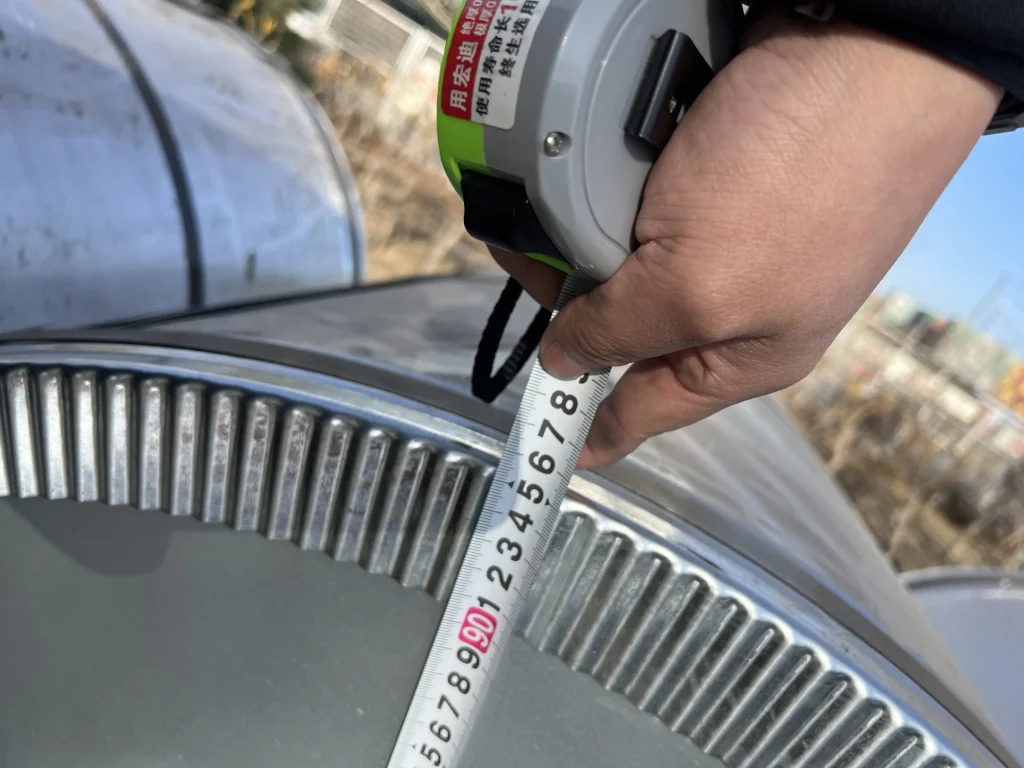
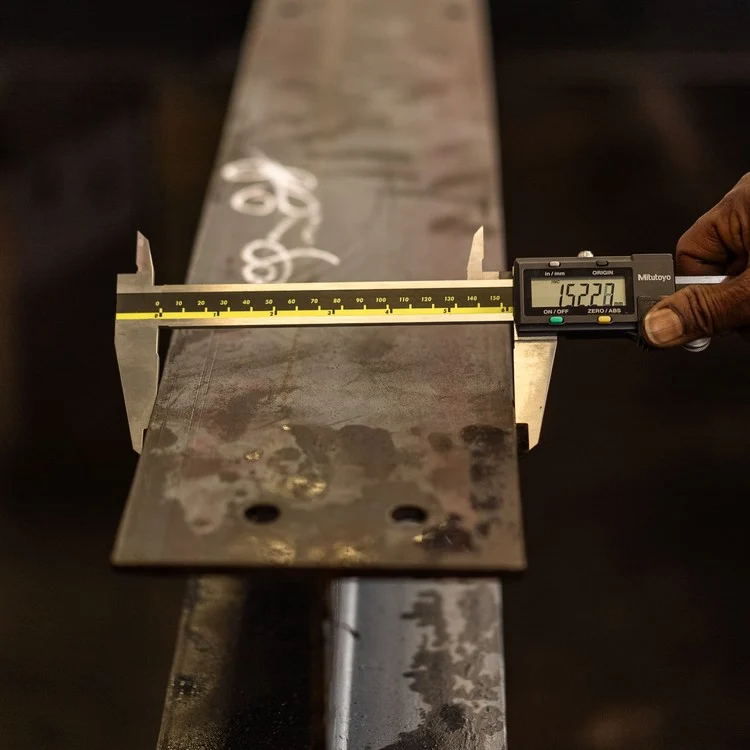
This is also the stage where gauge consistency is set for good. If a buyer later measures thickness variation across a coil width with a micrometer — the kind of check covered in more detail in our thickness guide — that variation traces back to rolling mill setup at Stage 2, not anything that happens downstream. No amount of careful annealing fixes an unevenly rolled strip.
Stage 3: Decarburization Annealing — Setting the Core-Loss Floor
After cold rolling, the strip goes through decarburization annealing in a wet, controlled atmosphere — one documented Hi-B production run specifies 830°C for 3 minutes in 60% H2 / 40% N2. Two things happen here at once: primary recrystallization (a fine, uniform grain structure that sets up the next stage) and carbon removal.
The carbon removal matters more than it sounds. Interstitial carbon atoms left in the lattice act as pinning centers for magnetic domain walls, and domain-wall pinning raises core loss directly. A separate study on re-annealing M4-grade GOES cores documented carbon dropping “from 0.013 wt.% to below the detection limit” after a controlled anneal, explicitly citing this pinning mechanism as the reason decarburization is treated as non-negotiable in any GOES production route, not an optional refinement step.
This is also the step where getting the temperature window wrong shows up later as a ceiling nobody can engineer around downstream. Too low, and primary recrystallization and decarburization don’t finish; too high, and the primary grains coarsen before the mill even reaches the final annealing furnace — and coarse or uneven primary grains make it harder for the Goss-oriented grains to win out during the secondary recrystallization that happens next.
Stage 4: MgO Coating and Final Annealing — Where B8 Actually Gets Made
Before final annealing, the strip is coated with an annealing separator — a water-based magnesium oxide (MgO) slurry — to keep coil wraps from welding together at high temperature. That coating isn’t just a release agent: during the final anneal, MgO reacts with the oxide layer on the strip surface to form forsterite (Mg2SiO4), the base insulation coating every CRGO sheet carries.
The final anneal itself is the single most consequential step in the whole sequence. It’s run as a long, high-temperature batch cycle — one documented route holds the coil at 1200°C for 10 hours in a pure hydrogen atmosphere, and patent literature on forsterite coating formation describes the same anneal running in the 1100-1200°C range in an H2-N2 atmosphere.
This is where secondary recrystallization happens: the small number of grains that happen to carry the Goss orientation consume the surrounding fine-grained matrix and grow into the coarse, sharply-aligned grain structure that gives CRGO its directional magnetic properties in the first place.
The sharpness of that Goss texture is what B8 (induction at 800 A/m) actually measures. A cleaner, more complete secondary recrystallization produces a higher, more consistent B8; a rushed or under-temperature final anneal leaves some grains un-recrystallized or misaligned, and B8 comes in lower and less consistent across the coil.
The same reaction that forms the Goss texture also builds the forsterite coating, which — beyond insulation — places the strip under a slight mechanical tension that itself lowers core loss and improves magnetostriction behavior. One anneal cycle, two separate numbers on your certificate.
Stage 5: Insulation Coating — What C-2/C-5 Protects
The forsterite base coating from Stage 4 provides some electrical insulation on its own, but most commercial CRGO carries a secondary phosphate-based topcoat — the C-2 or C-5 classifications.
That topcoat does two jobs: it adds interlaminar electrical resistance beyond what forsterite alone provides, and it adds further tension to the strip, which is part of why coating thickness and uniformity are called out on the certificate as a distinct line item from core loss.
A weak or uneven insulation coat doesn’t always show up as a visible defect. It shows up as higher-than-spec interlaminar resistance test failures, or — in a finished core — as unexpectedly high eddy-current losses between laminations that a buyer wouldn’t necessarily trace back to the coating stage without knowing that’s where that specific failure mode originates.
It’s a separate step from the final anneal, applied after it, which is why a coil can have a perfectly sharp Goss texture and a strong B8 reading and still fail on coating quality.
Stage 6: Domain Refinement — What Separates Hi-B From Standard CRGO
Everything above applies to standard and Hi-B CRGO alike. The one additional step Hi-B grades carry is domain refinement, most commonly by laser scribing: a laser scans lines across the finished, coated strip perpendicular to the rolling direction, inducing local residual stress that narrows the magnetic domain width without requiring another full annealing cycle.
Narrower magnetic domains mean less energy lost to domain-wall movement as the field alternates 50 or 60 times a second — which is why laser-scribed Hi-B reaches a lower core loss at the same gauge than a standard CRGO coil with an otherwise identical process history.
It’s also why Hi-B’s price premium over standard CRGO tends to be a small, consistent percentage rather than something that varies wildly by supplier: it’s paying for one specific, well-defined extra manufacturing step, not a vague “premium grade” markup.
On a real mill test certificate we received for a 27QG120-grade Hi-B coil sourced from WISCO, the measured figures were P1.7/50 core loss of 0.88-0.93 W/kg and J800 (B8) induction of 1.91-1.92T, against a stacking factor of 98%.
Those three numbers, read together, are effectively a report card on Stages 3 through 6 in one document: the core loss figure reflects decarburization plus domain refinement, the induction figure reflects the final anneal’s Goss texture, and the stacking factor reflects coating thickness control.
From Finished Coil to Your Dock: Slitting, Testing, the Certificate
Once the coating and (where applicable) domain refinement are complete, the coil is tension-leveled to flatten it, then tested. Core loss and induction are measured with an Epstein frame per IEC 60404-2 — the international standard that specifies the test apparatus, sample preparation (strips cut half-parallel and half-perpendicular to the rolling direction, to account for the material’s magnetic anisotropy), and standard test conditions, most commonly 1.5T at 50Hz.
That Epstein frame result is what ends up on the mill test certificate a buyer receives with every shipment — the same certificate covered in our mill certificate guide.
For higher-value orders, that certificate is often cross-checked against independent third-party inspection before the coil ships.
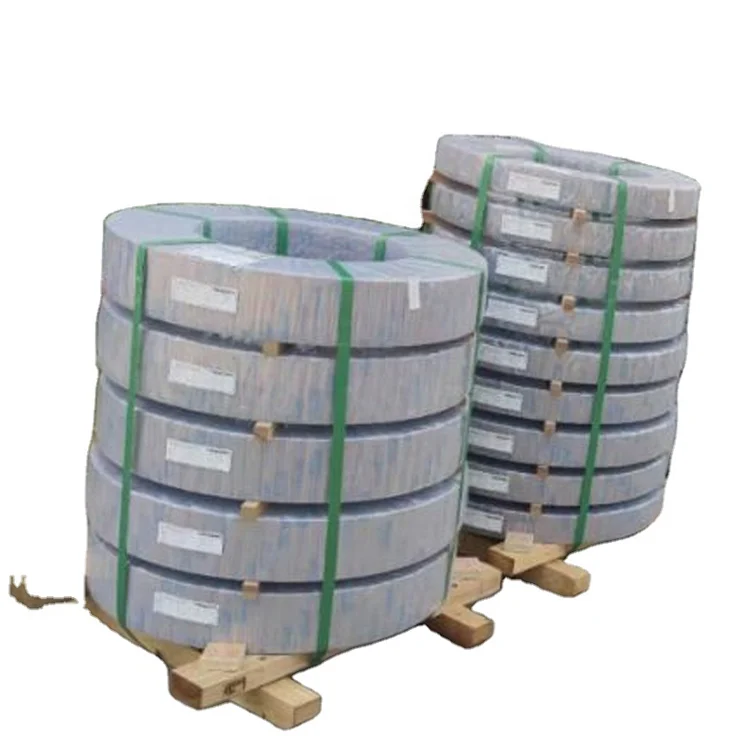
From there, the coil is either shipped as a master coil or handed to a slitting line to cut to a buyer’s specified width, then packaged for export.
The Buyer’s Cross-Reference Table
The practical use of walking through all six stages is being able to read a test result and know which part of the process to ask a supplier about, instead of treating a certificate as a single pass/fail number. This is the framework we use internally, not a formal industry standard — it’s built from the process mechanics above, and it’s meant as a starting point for a conversation with a mill, not a diagnosis on its own.
| Certificate Result | Points Back To | What to Ask a Supplier |
|---|---|---|
| Core loss (P1.7/50) higher than grade spec | Incomplete decarburization, or (for Hi-B) weak/inconsistent laser scribing | Decarburization anneal atmosphere and time; scribing line spacing and power settings |
| B8 induction lower or less consistent than grade spec | Under-temperature or short final anneal; uneven primary grain structure from Stage 3 | Final anneal peak temperature and hold time; primary grain size records |
| Stacking factor below spec | Coating applied too thick, or base gauge inconsistency from cold rolling | Coating weight per side; gauge tolerance across coil width |
| Interlaminar resistance failure | Weak or uneven C-2/C-5 topcoat | Coating type and thickness verification method |
| Coil-to-coil variation on the same grade code | Batch-to-batch furnace or atmosphere drift, not a single bad coil | Whether test results are per-coil or per-batch-average |
Each row assumes the other stages tested normally — a coil can fail on more than one of these simultaneously, in which case the underlying cause is more likely upstream (Stage 3) than downstream (Stage 5 or 6).
Why This Matters More Right Now
This kind of process literacy matters more in 2026 than it would have three years ago. The ongoing global GOES shortage is pushing transformer buyers toward mills they haven’t sourced from before, often on compressed qualification timelines.
At the same time, more secondary and non-prime CRGO material is entering the supply chain than in a normal environment.
Neither trend is inherently a problem — a new mill can be a perfectly good supplier, and secondary material has a legitimate place at the right price and application. The risk is qualifying either one on documentation alone, without a framework for what a test result actually implies about how the coil was made.
A buyer who can look at a certificate and ask “was this a decarburization issue or a final-anneal issue” gets a materially more useful answer from a supplier than one who can only ask “why is this number a little off.”
How Zhongxin Handles Each Stage
We don’t run our own hot mill — like most electrical steel exporters at our scale, we source Hi-B and standard CRGO master coil from established primary producers (WISCO/Baowu among them, as in the certificate referenced above) and handle slitting, quality verification, and export packaging in-house at our 200,000-tons-per-year facility.
That distinction matters for how we talk about this process: we’re not describing it from a textbook, we’re describing what we check on every incoming master coil before it goes anywhere near a customer order.
Every incoming coil arrives with its own mill test certificate, and we don’t treat that certificate as the end of verification — we cross-check P1.7/50 core loss, B8 induction, and stacking factor against the grade code ordered.
We’ve sent certificates back to a mill for clarification when a batch’s numbers didn’t line up with what the grade code implied, using exactly the kind of stage-by-stage reasoning in the table above. For export orders, we issue our own test report alongside the mill’s certificate, since — as the WISCO certificate referenced earlier notes — some domestic mill certificates are marked for mainland China use only and don’t independently satisfy an overseas buyer’s import documentation.
Before You Qualify a New Mill
- Ask for Epstein test data per coil batch, not a single “typical” figure for the grade — batch-to-batch consistency is a decarburization and furnace-control question, not a grade-spec question.
- Request the coating type (C-2 vs C-5) explicitly rather than assuming — it affects interlaminar resistance and isn’t always obvious from a general spec sheet.
- For Hi-B grades, confirm laser scribing is standard on every coil, not an optional or intermittent step — some mills scribe selectively depending on order size.
- If a certificate shows a core-loss or B8 figure at the edge of the grade’s normal range, ask which stage the mill attributes it to before accepting the batch — a mill that can answer specifically is a different risk profile than one that can’t.
- Confirm whether the certificate applies to the specific coil or heat number you’re receiving, not a representative sample from the same production run.
FAQ
What does CRGO stand for?
Cold-Rolled Grain-Oriented electrical steel — silicon steel that has been cold-rolled and annealed so its crystal grains align along a single direction (the Goss texture), giving it much lower magnetic losses along that rolling direction than ordinary or non-oriented steel.
How many steps does it take to make a CRGO coil?
Six sequential stages for standard CRGO: hot rolling, cold rolling, decarburization annealing, high-temperature purification annealing (which also forms the forsterite base coating), and insulation coating. Hi-B grades add a sixth step, laser domain refinement, after coating.
What temperature is CRGO steel annealed at?
Two different annealing steps run at very different temperatures. Decarburization annealing has been documented around 830°C for a few minutes in a wet hydrogen-nitrogen atmosphere. The final purification anneal that forms the Goss texture runs far hotter and longer — as high as 1200°C for up to 10 hours in a hydrogen atmosphere.
Why does Hi-B CRGO cost more than standard CRGO?
Primarily because of the laser domain refinement step, which narrows magnetic domain width and lowers core loss beyond what the standard six-stage process achieves at the same gauge. It’s one additional, well-defined manufacturing step rather than a general premium-grade markup, which is part of why the price gap tends to stay fairly consistent across suppliers for a given gauge.
How is CRGO coil quality actually tested?
Core loss and magnetic induction are measured with an Epstein frame under IEC 60404-2, typically at 1.5T and 50Hz, with test strips cut both parallel and perpendicular to the rolling direction to capture the material’s directional magnetic behavior. Those results are what appear on the mill test certificate shipped with the coil.
Can a mill test certificate be wrong even if the numbers look fine?
The numbers themselves are a real lab measurement, but “fine” depends on whether they’re read against the right grade spec and whether they represent the specific coil or heat number being shipped versus a representative batch average — which is why confirming per-coil versus per-batch reporting is worth asking about directly, as covered above.
Does understanding the manufacturing process help with sourcing decisions?
Yes, mainly by turning a borderline test result into a specific question rather than a vague red flag. A buyer who knows that a low B8 reading points toward final-anneal temperature or hold time, rather than treating any off-spec number as equally uncertain, can get a more diagnostic answer from a supplier before deciding whether to accept, reject, or requalify a batch.
Bottom Line
A CRGO coil isn’t a single manufactured object so much as the output of six sequential decisions — rolling reduction, decarburization time and atmosphere, final anneal temperature and duration, coating thickness, and (for Hi-B) domain refinement — each of which leaves its own fingerprint on a specific line of the mill test certificate you already receive. Reading that certificate against the process, rather than as a single pass/fail number, is what turns a routine QC check into an actual early warning system.
That framework matters more this year than it has in a while, with the 2026 GOES shortage pushing more buyers toward unfamiliar mills and more secondary material into the supply chain at the same time. Before you accept a new supplier’s next shipment, run the certificate through the cross-reference table above — and if a number sits at the edge of spec, ask which stage the mill attributes it to before you sign off.
References
- PMC (National Library of Medicine) — Complete Goss Secondary Recrystallization by Control of the Grain Size and Texture of Primary Recrystallization in Grain-Oriented Silicon Steel
- PMC (National Library of Medicine) — Factorial Optimization of Secondary Annealing Parameters for Enhanced Magnetic Performance in M4 Grain-Oriented Electrical Steel Toroidal Cores
- IEC Webstore — IEC 60404-2: Magnetic Materials — Methods of Measurement of the Magnetic Properties of Electrical Steel Sheet and Strip by Means of an Epstein Frame
- Google Patents — CA2920750C: Grain Oriented Electrical Steel with Improved Forsterite Coating Characteristics