Someone asked us last month whether they could just use leftover CRGO stock for a small batch of motor stampings instead of ordering CRNGO — the CRGO was already sitting in their warehouse, and ordering a new coil felt like unnecessary cost and lead time. It’s a reasonable question on the surface. The answer, though, is almost always no, and the reason why is the whole point of this article: CRGO and CRNGO aren’t just two price points on the same material, they’re built for physically different jobs.
We covered the full grade landscape — CRGO, CRNGO, and ultra-thin silicon steel — in our electrical steel grades guide. This one goes narrower: specifically CRGO vs CRNGO, when the difference actually matters for your application, and the handful of situations where it matters less than people assume.
Core Key Points
- CRGO’s magnetic performance advantage exists only along the rolling direction — that’s the entire reason it’s unsuitable for rotating machinery, regardless of how good its headline core-loss numbers look.
- CRNGO sacrifices some directional performance to stay roughly uniform in every direction, which is exactly what a spinning rotor field needs.
- In a transformer core, CRGO typically cuts hysteresis loss by 40-60% compared to CRNGO run in the same application — but that number assumes the field is aligned with the grain direction, which a transformer’s fixed-direction field allows and a motor’s rotating field doesn’t.
- Substituting CRGO into a motor application doesn’t just fail to help — in some rotor orientations it performs worse than standard CRNGO, because the material’s properties are worst in the directions away from its optimized axis.
- CRNGO typically costs less than CRGO per ton for equivalent thickness, so there’s rarely a cost reason to force CRGO into a CRNGO application even where the physics allowed it.
The Structural Difference: Why Orientation Exists
CRGO gets its name from what happens during cold rolling and annealing: the process forces the steel’s crystal grains to align along the rolling direction, specifically toward the [110] “easy magnetization” plane. Once that alignment exists, the steel becomes dramatically more efficient at carrying magnetic flux in that one direction — and correspondingly less efficient in other directions, because the alignment process trades isotropy for directional performance.
CRNGO deliberately skips this step. The grains stay in a more random orientation, which means the steel’s magnetic performance is roughly consistent no matter which direction the field runs through it. That’s not a manufacturing shortcut or a lower-effort process — it requires its own careful control of grain size and silicon distribution to keep performance consistent across all directions rather than optimized in one.
Performance Comparison
| Property | CRGO | CRNGO |
|---|---|---|
| Core loss (typical) | 0.75-1.10 W/kg | 2.5-4.5 W/kg |
| Magnetic induction | 1.78-1.95 T | 1.5-1.6 T |
| Directionality | Highly anisotropic (best in rolling direction) | Roughly isotropic |
| Typical thickness | 0.23-0.35 mm | 0.35-0.50 mm |
| Typical cost vs. the other | Higher | Lower |
| Best fit | Transformer cores (fixed-direction field) | Motors, generators (rotating field) |
Read in isolation, CRGO’s core loss numbers look strictly better — and that’s exactly the trap. Those numbers are measured with the field running in the direction the steel was engineered for. Put a rotating field through the same material and the picture changes completely.
When CRGO Is the Right Call
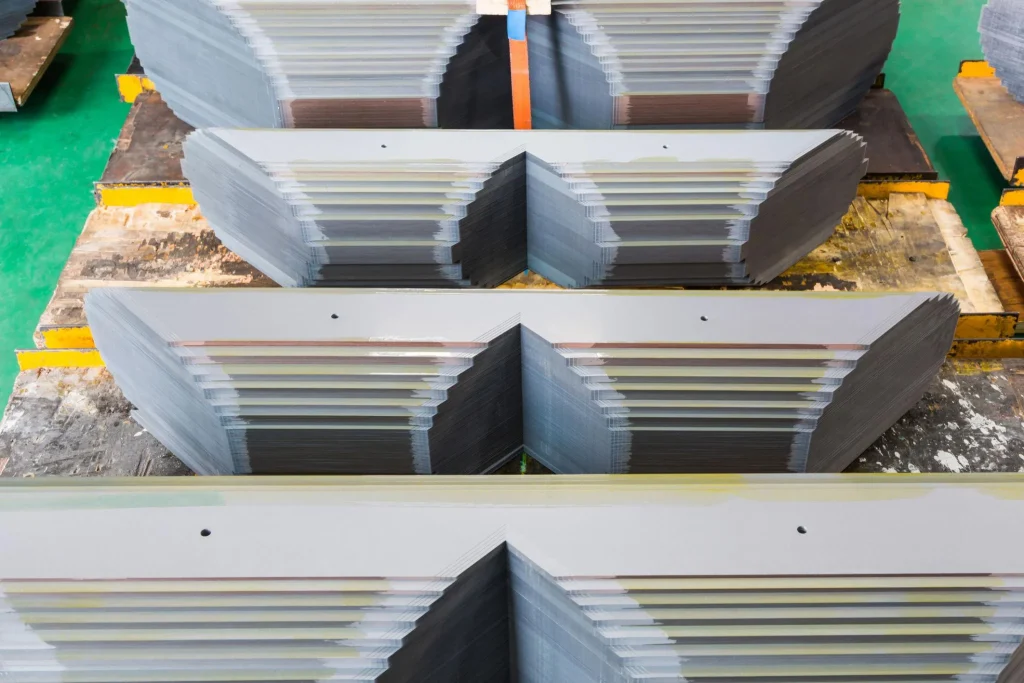
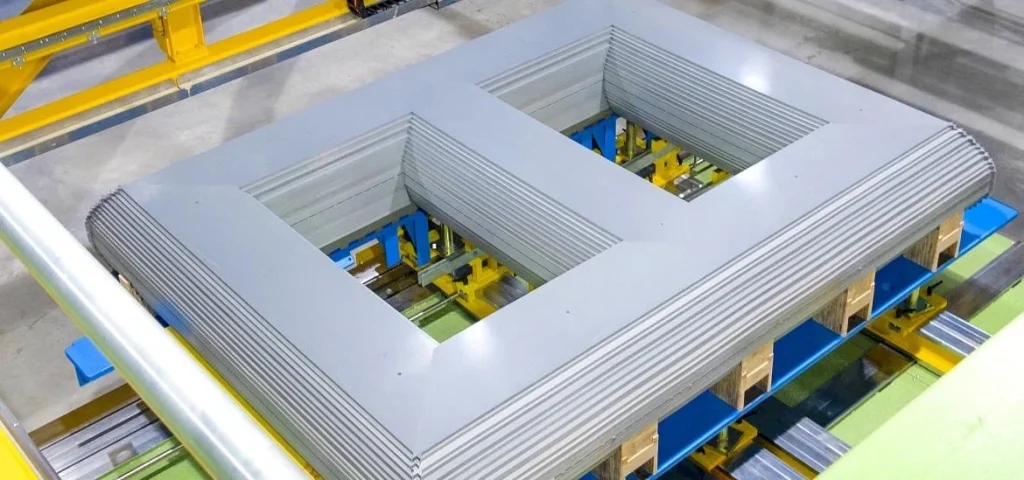
- Power and distribution transformer cores, where the magnetic circuit is designed around a fixed flux path
- Any application where the core geometry can be engineered so the field consistently follows the rolling direction (step-lap core designs, for instance)
- Cases where minimizing no-load loss is commercially important enough to justify CRGO’s higher cost — utility-scale transformers with steep loss penalties are the clearest example

When CRNGO Is the Right Call
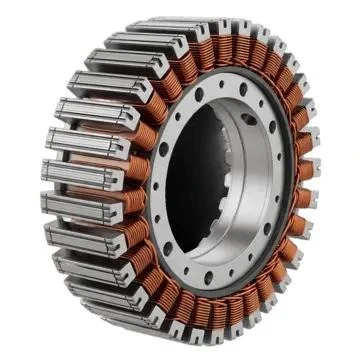
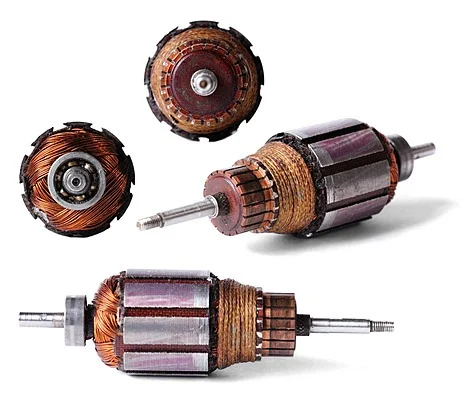
- Induction motors, generators, and any equipment with a rotating magnetic field
- Small transformers and reactors where the core design doesn’t isolate a single flux direction
- Household appliance motors, where cost matters more than shaving the last percentage points off core loss, and CRNGO’s isotropy is actually required, not just acceptable

Can You Substitute One for the Other?
Technically, yes, in the sense that both are electrical steel and both will conduct magnetic flux. Whether it makes engineering sense is a different question, and the honest answer depends on direction:
CRGO into a motor application: Generally a bad substitution. You pay a premium for directional performance you can’t use, and in some rotor positions the material actually underperforms standard CRNGO because you’re now in CRGO’s worst direction rather than CRNGO’s average direction.
CRNGO into a transformer application: Technically works, and is sometimes done for small, low-cost transformers where core loss isn’t commercially significant. But you’re giving up the 40-60% loss reduction CRGO would have provided in that exact application — worth doing deliberately for a cost-sensitive design, not by accident because CRNGO happened to be on hand.
Cost Difference and Why It Exists
CRNGO is typically the cheaper of the two per ton for equivalent thickness, mainly because the grain-orientation process CRGO goes through — additional cold-rolling passes and a more tightly controlled annealing cycle — adds processing time and yield loss that CRNGO’s production process doesn’t require. Hi-B grades of CRGO push the cost further, since the enhanced orientation control needed for the higher induction figures adds another layer of process control.
None of this means CRNGO is “the budget option” in a negative sense — for its intended applications, it’s the correct option, not a compromise.
FAQ
Is CRGO always better than CRNGO because it has lower core loss?
No. CRGO’s lower core loss only applies when the magnetic field runs in the rolling direction, which is true in a transformer core but not in a motor’s rotating field. In a rotating-field application, CRNGO’s isotropic performance makes it the better engineering choice despite CRGO’s better headline numbers.
What happens if I use CRGO in a motor by mistake?
The motor won’t get the efficiency benefit you’d expect from CRGO’s core-loss figures, and depending on the rotor’s orientation relative to the steel’s rolling direction, performance in some positions can actually be worse than if standard CRNGO had been used from the start.
Is CRNGO just a cheaper, lower-quality version of CRGO?
No — CRNGO is engineered for a different requirement (isotropic performance), not a lower standard of the same requirement. It’s the correct choice for rotating machinery, not a compromise made to save money, even though it typically does cost less.
Can I mix CRGO and CRNGO in the same piece of equipment?
Yes, and it’s common in some designs — for example, a transformer with an integrated reactor might use CRGO for the transformer core and CRNGO for a component with a different field geometry. The decision should be made per magnetic circuit, not per piece of equipment as a whole.
If you’re not sure which grade your specific application actually needs, the fastest way to find out is to tell us the equipment type and operating frequency — we’ll tell you plainly which family fits, rather than quoting whichever grade happens to be easiest to sell.