
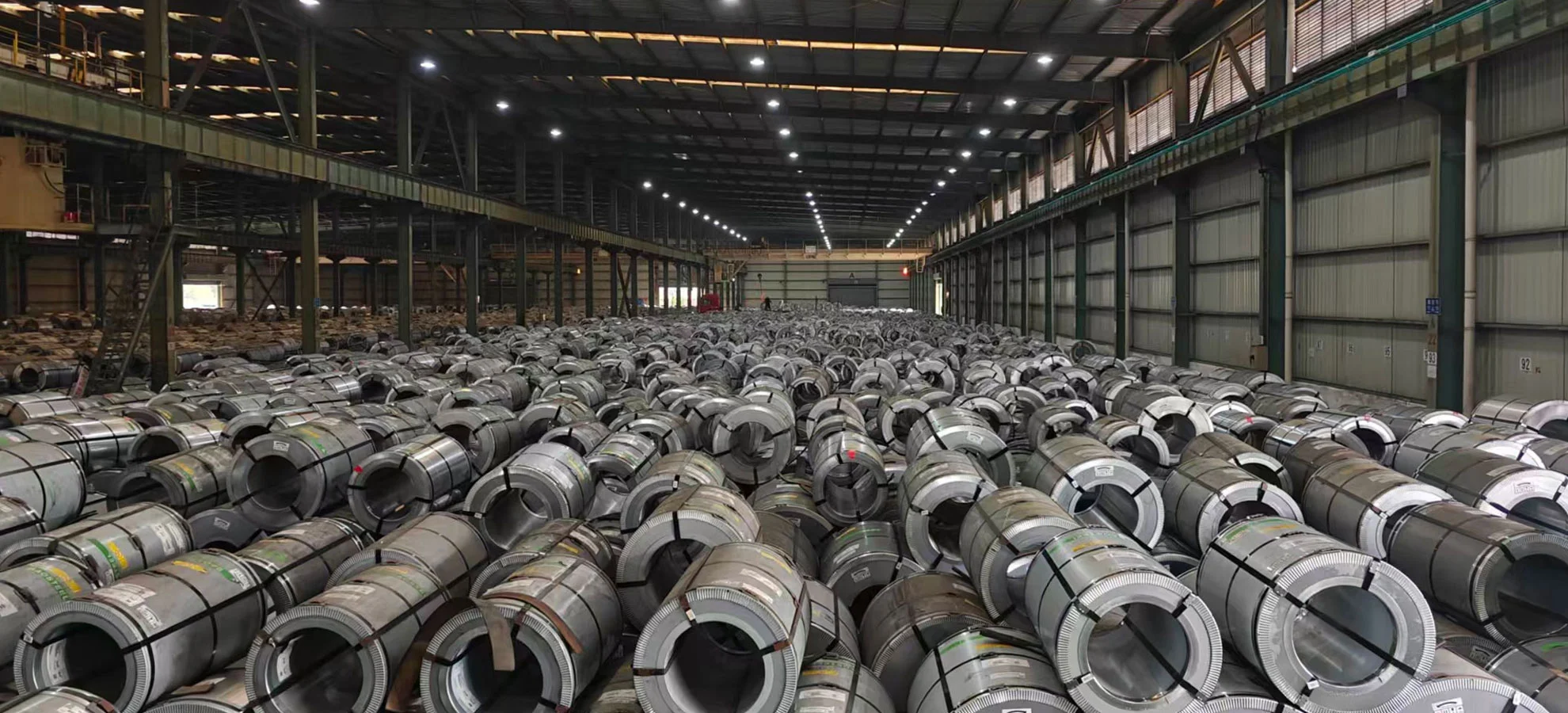
Products · Grain-Oriented
Grain-Oriented Electrical Steel (CRGO)
Grain-oriented electrical steel — also sold as grain-oriented silicon steel — is cold-rolled and annealed so its grains align along the rolling direction, giving CRGO the lowest core loss and highest permeability where transformer flux runs one way. As a grain-oriented electrical steel manufacturer in China, we supply Standard CRGO, Hi-B & laser-scribed grades, and ultra-thin high-frequency gauges down to 0.10 mm — in coil, sheet or slit strip, to GB, EN, JIS and AISI standards.
Material basics
What is grain-oriented electrical steel?
The full name, the manufacturing step that makes it work, and why it only performs where you actually need it to.
Grain-oriented electrical steel — CRGO, also sold as grain-oriented silicon steel — is a cold-rolled iron-silicon alloy processed so its crystal grains line up along one axis: the rolling direction. That alignment happens during a controlled cold-rolling and high-temperature annealing sequence called secondary recrystallisation, where inhibitor compounds such as MnS and AlN pin down every grain except the ones with the correct {110}<001> orientation, letting only those grow. The result is a strip that conducts magnetic flux with very low resistance in one direction — and noticeably more resistance everywhere else.
That trade-off is deliberate, not a limitation. Transformer cores carry flux along a single, fixed path, so a material engineered to be efficient in exactly that direction is close to an ideal fit. Aligning a core’s laminations with CRGO’s rolling direction is what delivers the low core loss and high permeability transformer designers are buying the material for — figures that fall away quickly if the field runs across the grain instead of along it. That same directional dependence is why CRGO isn’t the right choice for motors and generators, where the field rotates continuously; non-oriented electrical steel (CRNGO) is built for that case instead.
Three variables define a CRGO coil for procurement purposes: thickness (0.10–0.35 mm across our range), grade family (Standard, Hi-B/laser-scribed, or ultra-thin), and the naming standard it’s specified against (GB, EN, JIS or AISI). Those four standards didn’t emerge from a shared committee — each region’s electrical steel industry developed independently, decades apart, and never converged on one format. GB/T 2521 covers Chinese grades, EN 10107 the European system, JIS C 2553 the Japanese equivalent, and AISI the older American M-series. If your spec sheet references a grade from a standard we don’t quote in by default, the equivalence chart below translates it to the closest GB match before you commit to an order.
Hot rolling & initial cold rolling
Silicon steel slab is hot-rolled, then cold-rolled down through intermediate thicknesses toward the target gauge.
Decarburization annealing
A controlled-atmosphere anneal removes carbon and begins forming the inhibitor phases (MnS, AlN) that will later control grain growth.
Final cold rolling
The strip is rolled down to final thickness (0.10–0.35 mm depending on grade), setting up the texture the next step will refine.
High-temperature box annealing
Secondary recrystallisation, held near 1,200 °C for an extended soak — only grains with the correct {110}<001> orientation survive and grow, consuming their neighbours.
Insulation coating & slitting
A forsterite base coat plus a phosphate top coat gives interlaminar insulation, then coils are slit to final width — with laser scribing added here for Hi-B/laser-scribed grades.
Three ways to buy CRGO
Choose by thickness and permeability
All three lines share the same grain-oriented structure. Pick by gauge and loss target, then check the grade against your spec sheet.
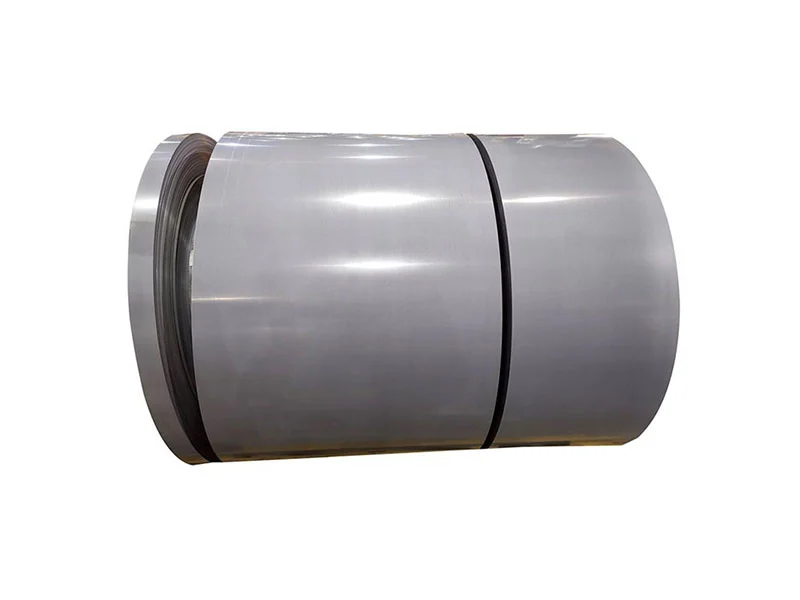 Standard CRGO
Standard CRGO
The conventional grain-oriented thicknesses transformer makers order every day.
- Thickness0.23–0.35 mm
- Core loss P1.7/50≤ 0.90 W/kg
- Induction B8≥ 1.88 T
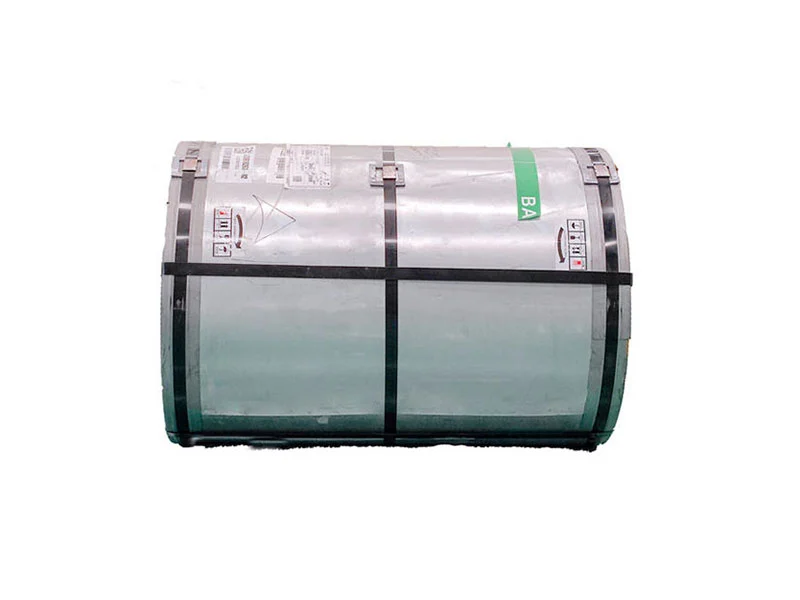 Hi-B · Laser-scribed
Hi-B & Laser-Scribed CRGO
Domain-refined, laser-scribed grades with the highest permeability for ultra-low-loss cores.
- Thickness0.23 mm
- Core loss P1.7/50≤ 0.85 W/kg
- Induction B8≥ 1.92 T
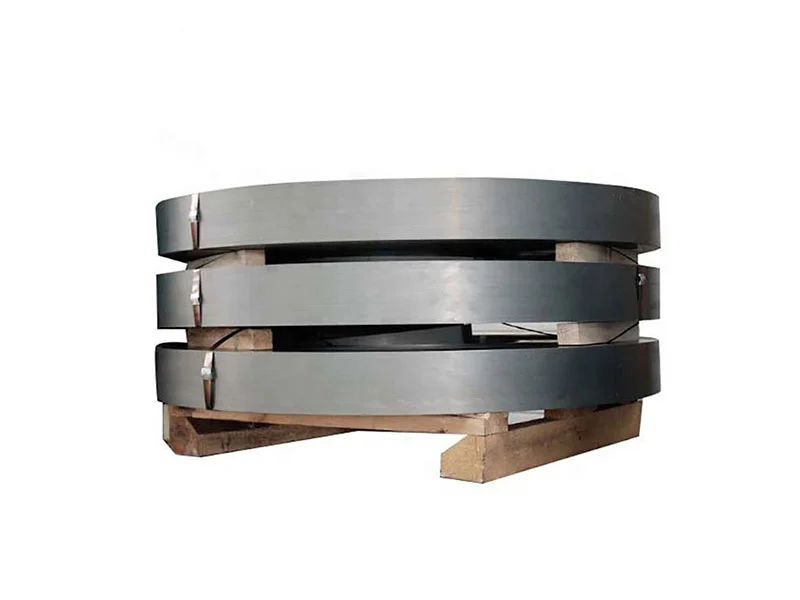 Ultra-thin · High-frequency
Ultra-Thin CRGO
Gauges down to 0.10 mm to cut high-frequency loss in transformers and reactors.
- Thickness0.10–0.20 mm
- Frequency400 Hz – high-freq
- GradeGT-050 / GT-100
Side by side
Compare the three CRGO lines
A quick reference before you send a spec sheet.
| Property | Standard CRGO | Hi-B & Laser-Scribed | Ultra-Thin CRGO |
|---|---|---|---|
| Thickness | 0.23–0.35 mm | 0.23 mm | 0.10–0.20 mm |
| Core loss (P1.7/50) | ≤ 0.90 W/kg | ≤ 0.85 W/kg | rated at frequency |
| Induction B8 | ≥ 1.88 T | ≥ 1.92 T | ≥ 1.85 T |
| Typical grades | M4 · M5 · M6 · 27Q120 | 23ZH90 · 23QG085 | GT-050 · GT-100 |
| Best for | Power & distribution cores | Premium low-loss cores | High-frequency cores & reactors |
Not sure which grade you need? Grade equivalents maps your GB, EN, JIS or AISI spec to our stock — see the cross-reference chart →
By grade & standard
Every CRGO grade to GB, EN, JIS or AISI
We supply the full grain-oriented range across all four standard systems, from conventional M-series to Hi-B laser-scribed. Working from a European or Japanese spec? Use the cross-reference to find the Chinese equivalent.
Most orders reference a GB grade directly, but a meaningful share come in against an EN, JIS or AISI designation from equipment designed years ago around a different mill’s steel. We keep grade-equivalency data current across all four systems so a design qualified against, say, M4 or 23ZH90 doesn’t need re-qualification just because the supplier changed — the GB match ships at the same thickness and core-loss ceiling the original spec called for, backed by mill test data rather than a guess.
Equivalents, at a glance
By application
Matched to your transformer core
Core steel selection isn’t just about grade family — it’s about matching CRGO thickness and loss class to how a specific transformer actually operates once it’s installed. Power and distribution transformers see different load profiles, different loss-capitalization economics, and often different regulatory minimums, which is why the same CRGO family splits into two different specification paths below.
FAQ
Sourcing CRGO from us
What is grain-oriented silicon steel (CRGO)?
CRGO is cold-rolled electrical steel processed so its grains align on one axis. Flux flowing along that axis meets far less resistance, so CRGO gives the lowest core loss and highest permeability in transformer cores where the field runs one way.
What’s the difference between Standard and Hi-B CRGO?
Standard CRGO (M4–M6, 27Q120) covers the everyday thicknesses at 0.23–0.35 mm. Hi-B and laser-scribed grades like 23ZH90 add domain refinement for higher induction and lower loss — worth the premium when no-load loss matters most.
How thin does your ultra-thin CRGO go, and what’s it for?
Down to 0.10 mm in grades GT-050 and GT-100, aimed at high-frequency transformers and reactors where thinner laminations cut eddy-current loss as frequency rises.
Which CRGO grade should I use for my transformer?
Power transformers usually call for Hi-B grades to minimise no-load loss; distribution transformers often use Standard CRGO for a better cost balance. Send us your rating and we’ll recommend a grade and gauge.
Can you match my GB, EN, JIS or AISI grade?
Yes — we supply across all four standard systems and can cross-reference your spec to the Chinese equivalent. Send the grade or a datasheet and we’ll confirm the match.
What’s the minimum order quantity and lead time?
MOQ depends on grade, thickness and width. Common grades often ship from stock in days; Hi-B and non-standard widths typically take a few weeks. Tell us your target volume and we’ll confirm.
Do you provide free samples?
Yes — free samples are usually ready within about a week, so you can test core loss and stampability before committing.
Which standards and certifications do you hold?
Production runs under ISO 9001 and IATF 16949, with material to GB, EN, JIS or AISI grades and RoHS / REACH compliance. A mill test certificate ships with every order.
How do you package and ship CRGO coils?
Seaworthy, moisture-proof packaging on coils or pallets, shipped to any port. We’ll align on payment terms at the order stage.
Are you the actual manufacturer, or a trading company?
We are the manufacturer — Wuxi Zhongxin Special Steel Co., Ltd. runs cold rolling, annealing, slitting, laser scribing and coating in-house at our own Wuxi facility. You’re buying directly from the mill, not through an intermediary, which is part of why we can hold tighter lead times and answer technical questions about the actual process rather than relaying them to someone else.
How much CRGO can you supply per month?
Our annual grain-oriented and non-oriented silicon steel capacity is 200,000 tonnes, giving us headroom for both single large-volume orders and recurring monthly supply agreements. Tell us your target monthly or annual tonnage and delivery cadence and we’ll confirm what we can commit to on a rolling basis.
Why buyers choose Zhongxin
Mill-grade CRGO, export-ready service
Wuxi Zhongxin Special Steel Co., Ltd. is a Chinese manufacturer and exporter of grain-oriented silicon steel, serving transformer makers across Europe, the Americas, Asia and beyond.
As a grain-oriented electrical steel manufacturer in China, we run the full production sequence in-house at our Wuxi facility — cold rolling, high-temperature annealing, slitting, laser scribing and coating — rather than outsourcing any stage to a third-party processor. That keeps grade consistency and lead times under our own control, from raw coil through to the finished CRGO you receive.
Buyers sourcing CRGO from China typically ask the same three questions first: can the mill hold tight core-loss tolerance batch to batch, can it certify to the standard their design was qualified against, and can it actually deliver on the promised schedule. Our CNAS-accredited lab tests every batch against GB, EN, JIS or AISI limits before it ships, and a mill test certificate goes out with every order — so those three questions get answered with data, not assurances.
Send your CRGO spec — get a quote in 24 hours
Share grade, thickness, width and coating, or upload a drawing. Free samples available.

