We still get RFQs where a buyer has specified CRGO for a motor housing because a spec sheet somewhere listed it as “the low-loss grade.” It isn’t wrong, exactly — CRGO does have lower core loss numbers than CRNGO in a lab test. But a motor’s magnetic field spins through 360 degrees, and CRGO’s advantage only exists in one direction. So the motor ends up no better off, and sometimes worse, than if standard CRNGO had been used at a lower price.
That mix-up is common enough that it’s worth a full explanation. Electrical steel splits into two structurally different families — grain-oriented (CRGO) and non-oriented (CRNGO) — plus a newer ultra-thin category (0.05–0.20 mm) built for the high-frequency world of EV traction motors. Picking the wrong one doesn’t just waste a bit of efficiency. It can be enough to drop a motor from IE3 down to IE2 efficiency class, or push a transformer past its no-load loss penalty threshold. Here’s how each grade family actually works, what the IEC grade codes on a mill certificate mean, and how to choose between them without guessing.
Core Key Points
- CRGO (grain-oriented electrical steel) aligns magnetic domains along the rolling direction through controlled cold-rolling and annealing, cutting hysteresis loss by roughly 40–60% compared to non-oriented steel — making it the default choice for transformer cores.
- CRNGO (non-oriented electrical steel) has isotropic magnetic properties, which matters because motor and generator cores see rotating magnetic fields in every direction, not the single fixed direction a transformer core sees.
- Ultra-thin silicon steel (0.05–0.20 mm) is increasingly specified for EV traction motors and high-speed generators, where switching frequencies above 400 Hz make standard 0.35 mm CRNGO too lossy.
- IEC 60404-8-4 grade codes (e.g., B27G100) are not arbitrary — the first two digits typically indicate nominal thickness in hundredths of a millimeter, and the trailing number indicates maximum core loss at a specified frequency and induction.
- Choosing the wrong grade family can increase core loss by 15–30% — enough, in our experience reviewing failed prototype tests, to be the actual root cause when a new motor design underperforms its efficiency target on the bench.
- Ultra-thin grades cost 40–80% more per ton than standard 0.35 mm CRNGO due to lower rolling yield and slower processing speed — a cost that only pays off when the application’s frequency profile genuinely requires it.
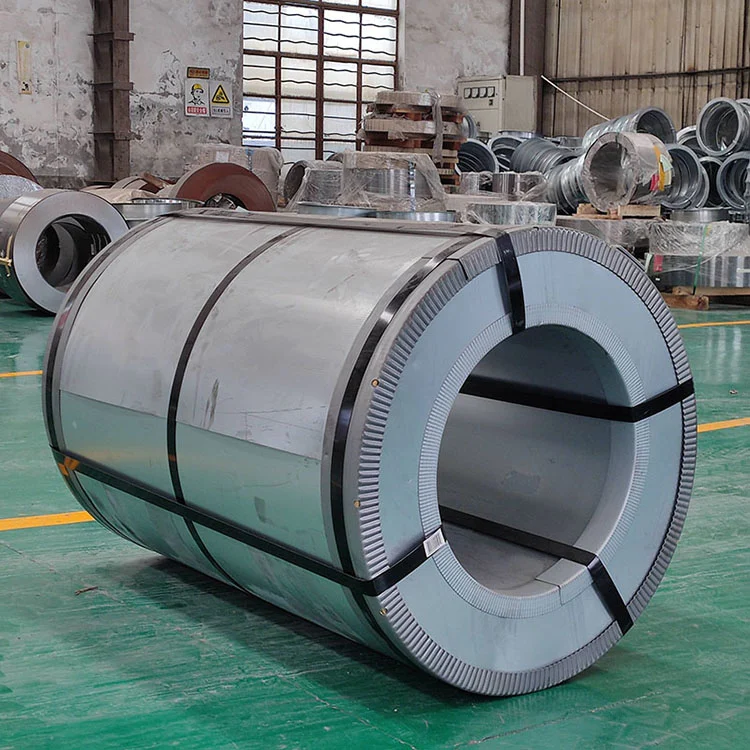
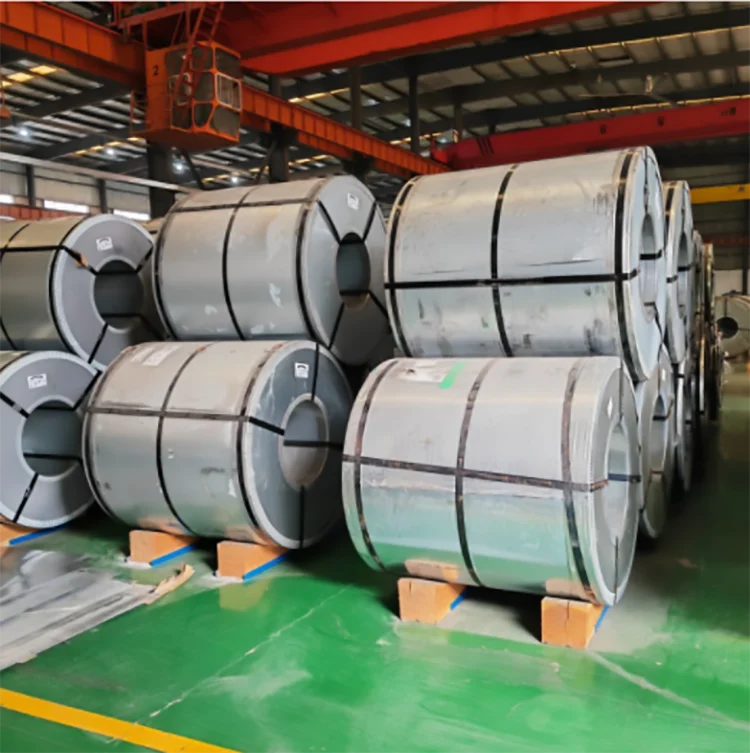
CRGO: Grain-Oriented Steel for Transformer Cores
Grain-oriented electrical steel gets its name from a manufacturing process, not a marketing label. During cold rolling and high-temperature annealing, the crystal grains in the steel are forced to align so the [110] crystallographic direction runs parallel to the rolling direction — the “easy magnetization” axis. When the magnetic field in a transformer core runs in that same direction, which it does in a properly designed core, the steel resists demagnetization far less, and hysteresis loss drops sharply.
That’s really the whole reason CRGO exists. Transformer cores see a field running in one consistent direction, so a material engineered to be efficient in exactly that direction is close to a perfect fit.
Hi-B Grades vs Standard CRGO
Within the CRGO family, “Hi-B” (high permeability, high induction) grades push the same grain-alignment principle further. Hi-B grades typically reach magnetic induction of 1.88–1.95 T at 800 A/m, versus 1.78–1.88 T for standard CRGO. In practice, that means a Hi-B core can carry more flux at the same field strength — so you either get a smaller core at the same power rating, or lower losses at the same core size.
The tradeoff is cost. We usually only see Hi-B specified where no-load loss penalties from the utility are steep enough to justify it, or on premium-efficiency distribution transformers where the last few percentage points matter commercially.
Typical CRGO Thickness Specifications
CRGO is most commonly supplied in three thickness bands:
- 0.23 mm — thinnest common grade, used where minimizing eddy current loss matters most
- 0.27 mm — the workhorse thickness for general-purpose transformer cores
- 0.30 mm — chosen when cost efficiency matters more than shaving the last percentage points off loss
CRNGO: Non-Oriented Steel for Motors and Appliances
Non-oriented electrical steel deliberately skips the directional grain alignment that defines CRGO — and that’s the correct engineering call, not a shortcut. A motor or generator core experiences a magnetic field rotating through 360 degrees as the rotor spins. A material optimized for one direction would perform well in that one orientation and progressively worse everywhere else, which is a real problem when the field direction never stops changing.
CRNGO instead offers roughly uniform magnetic performance in every direction in the plane of the sheet. We ship it primarily for:
- Induction motors and generators
- Household appliance motors (washing machines, refrigerator compressors, fans)
- Small transformers where directionality isn’t engineered into the core design
Core Loss and Silicon Content
CRNGO grades typically run 2.5–4.5 W/kg core loss at standard test conditions, noticeably higher than CRGO’s 0.75–1.10 W/kg. That’s an acceptable tradeoff, honestly, because CRNGO is solving a different problem — isotropy, not directional loss minimization. Higher-grade CRNGO (higher silicon content, typically 2.5–3.2%) trades some ductility and machinability for lower core loss and higher electrical resistivity, which reduces eddy current loss.
Ultra-Thin Silicon Steel: The EV and High-Frequency Motor Segment
Standard electrical steel thicknesses (0.27–0.50 mm) were designed around 50/60 Hz grid frequency. EV traction motors and high-speed generators run at a completely different frequency regime — often 400 Hz to several kHz at the switching frequency the core actually sees — and core loss scales roughly with the square of frequency for a fixed thickness. That’s the entire reason standard-thickness CRNGO becomes disproportionately lossy at EV motor operating frequencies, and why the industry has pushed toward 0.05–0.20 mm ultra-thin grades for this segment specifically.
Thinner laminations mean:
- Lower eddy current loss at high frequency (loss scales with the square of thickness, so halving thickness roughly quarters eddy current loss)
- Lower rolling yield and slower line speed in production — the direct driver of that 40–80% price premium
- Tighter tolerance requirements on stamping and stacking, since thinner sheets are more prone to burr and distortion
This segment moves fast. Five years ago, sub-0.20 mm electrical steel with automotive-grade consistency was mostly a Japanese-mill specialty. Chinese producers, including our own line, have closed a lot of that gap since 2018 — though the very top-performance sub-grades still carry a premium no matter where they’re rolled.
Grade Comparison Table
| Grade Type | Core Loss (W/kg) | Magnetic Induction | Typical Application | Thickness Range |
|---|---|---|---|---|
| CRGO Standard | 0.90–1.10 | 1.78–1.88 T | Mid/large power transformers | 0.23–0.35 mm |
| CRGO Hi-B | 0.75–0.90 | 1.88–1.95 T | High-efficiency transformers | 0.23–0.27 mm |
| CRNGO Standard | 2.5–4.5 | 1.5–1.6 T | Motors, generators, appliances | 0.35–0.50 mm |
| Ultra-Thin Silicon Steel | Frequency-dependent | 1.5–1.7 T | EV traction motors, high-speed generators | 0.05–0.20 mm |
| Best fit | Efficiency-critical → Hi-B | — | — | High-frequency → ultra-thin |
Want to see how Chinese CRGO stacks up against Japanese and Korean mills specifically on Hi-B performance? We’ll be publishing a dedicated origin comparison guide shortly — check back on our blog, or reach out directly if you need that data now.
How to Choose the Right Grade: A 5-Step Process
- Identify the application type. Transformer core → CRGO family. Rotating machinery (motor/generator) → CRNGO family. High-frequency EV or high-speed drive → ultra-thin silicon steel.
- Confirm the operating frequency. Standard 50/60 Hz grid applications rarely justify ultra-thin grades. Above roughly 400 Hz, thinner laminations deserve a serious look regardless of application category.
- Check the required efficiency class. IE3/IE4 motor targets and premium-efficiency transformer specs often can’t be hit with the cheapest grade in a family. Confirm the core loss ceiling your target actually requires before defaulting to the low-cost option.
- Request grade-specific test data from your supplier. Core loss and magnetic induction figures should come from mill test data at the specific frequency and induction your design uses — not a generic datasheet number.
- Validate with a small trial batch before committing to volume, especially for stamping or lamination processes sensitive to thickness tolerance and burr height. If your supplier also does custom slitting to your exact strip width, ask them upfront what width tolerance and burr height they can hold — that’s a separate guide in itself, and one we’ll be covering soon.
Common Grade Selection Mistakes
- Specifying CRGO for a motor application because the core-loss number “looks better on paper” — without accounting for the fact that CRGO’s advantage only exists in the rolling direction, and a rotating field hits the steel’s worst-case direction just as often as its best.
- Defaulting to standard 0.35 mm CRNGO for a high-frequency drive without checking whether the frequency profile actually demands ultra-thin steel. This is, in our experience, the single most common cause of an EV motor prototype underperforming on the bench.
- Comparing core loss figures measured at different test frequencies. A W/kg number means nothing without the frequency and induction it was tested at (commonly 50 Hz at 1.5 T, or 60 Hz at 1.7 T). Always confirm test conditions before comparing two suppliers’ numbers side by side.
FAQ
Can CRGO and CRNGO be used interchangeably?
Generally, no. CRGO’s core-loss advantage depends on the magnetic field running in the rolling direction, which holds true in a transformer core but not in a motor’s rotating field. Using CRGO in a motor application typically forfeits most of its theoretical efficiency benefit while adding cost.
How much more expensive is ultra-thin silicon steel than standard grades?
Ultra-thin grades (below 0.20 mm) typically cost 40–80% more per ton than standard 0.35 mm CRNGO, driven by lower rolling yield and slower production speed. The premium is justified when the application’s operating frequency genuinely requires thinner laminations — not as a default upgrade.
What does a grade code like B27G100 actually mean?
Under IEC 60404-8-4 naming conventions, the numeric portions of a grade code typically encode nominal thickness (in hundredths of a millimeter) and maximum core loss at a specified test frequency and induction. The exact decoding varies slightly by standard (IEC vs JIS vs older AISI conventions), so it’s worth confirming against the specific standard your supplier is quoting against.
Do I need Hi-B grade CRGO, or is standard CRGO enough?
Hi-B earns its cost when no-load loss penalties are steep, or when reducing core size and weight at a fixed power rating matters. For general-purpose distribution transformers without aggressive efficiency targets, standard CRGO is usually the more cost-effective choice.
Most of the grade-selection mistakes we see aren’t about bad steel — they’re about a spec sheet getting copied from one application to a different one without anyone re-checking whether the physics still applies. If you’re not sure which family fits your design, send us the application, the operating frequency, and the efficiency target, and we’ll tell you plainly whether you actually need Hi-B or ultra-thin, or whether you’re better off saving the premium.