CRGO steel grades fall into four tiers: conventional grain-oriented (CGO), high-permeability Hi-B, domain-refined or laser-scribed Hi-B, and ultra-thin grain-oriented strip for higher frequencies. Each tier adds one specific metallurgical step — and one specific line of cost — over the tier below it, and the grade code on your quote is supposed to tell you which tier you are getting.
Key Takeaways
- IEC 60404-8-7:2020 groups grain-oriented electrical steel into three formal classes — conventional, high permeability, and magnetic-domain-refined high permeability — across nominal thicknesses of 0.20, 0.23, 0.27, 0.30 and 0.35 mm. Ultra-thin grain-oriented strip below 0.20 mm sits outside that standard as a separate high-frequency product.
- The AISI M-numbers (M3, M4, M5, M6) only encode a thickness class, not quality: M4 is 0.27 mm with a guaranteed core loss of P1.7/50 ≤ 1.20 W/kg, mapping to GB 27Q120 · EN M120-27S · JIS 27G120.
- Moving from conventional CGO to Hi-B buys a sharper Goss texture — induction B8 rises from roughly 1.82–1.85 T to ≥ 1.88–1.90 T at the same gauge.
- Moving from Hi-B to laser-scribed or heat-proof domain-refined material buys one added process step that cuts anomalous eddy-current loss by roughly 8–15%; the effect is lost if a laser-scribed coil is stress-relief annealed for a wound core.
- The same coil can appear on three quotes as 27Q120, M-4 and M120-27S — verifying you are comparing the same tier, not the same number, is the practical skill this article is about.
Table of Contents
- What a “CRGO Grade” Actually Tells You (and What It Doesn’t)
- The Four Tiers of CRGO, Side by Side
- Tier 1 — Conventional CGO: the M3-to-M6 Thickness Ladder
- Tier 2 — Hi-B: Paying for a Sharper Goss Texture
- Tier 3 — Laser-Scribed and Heat-Proof DR: One Extra Process Step
- Tier 4 — Ultra-Thin Grain-Oriented Steel (0.10–0.20 mm)
- Same Steel, Four or Five Different Grade Codes
- How to Tell Which Tier a Quote or Certificate Actually Is
- What Changed in 2026 That Makes Grade Literacy Matter
- Quoting and Documenting CRGO Grades at Zhongxin
- FAQ
- Bottom Line
- References
What a “CRGO Grade” Actually Tells You (and What It Doesn’t)
CRGO — cold-rolled grain-oriented electrical steel — is silicon steel whose crystal grains have been aligned along the rolling direction (the Goss texture, {110}<001>) so it carries a magnetic field far more efficiently along that axis than ordinary steel. A “CRGO grade” is a code that packs three separate facts into one string: nominal thickness, a guaranteed maximum core loss, and — sometimes — whether the material is conventional, high-permeability, or domain-refined.
The problem is that no single grade code carries all three cleanly. The AISI M-series tells you thickness and little else. The GB/T 2521 and EN 10107 codes tell you thickness and loss but need a suffix to signal Hi-B. JIS designations and mill trade names (ORIENTCORE, G-CORE) add another layer again.
This article covers the four tiers a transformer or reactor buyer actually chooses between, what physically changes at each step up, and how to work out which tier a quote or mill test certificate really represents. It does not cover non-oriented steel (CRNGO) for motors, or the naming cross-reference in full detail — that belongs in a dedicated grade equivalents guide.
The Four Tiers of CRGO, Side by Side
Every commercial CRGO coil belongs to one of four tiers. The first three share a base production route and differ by one added step each; the fourth is a distinct thin-gauge product for frequencies above 50/60 Hz. All four are part of the same grain-oriented silicon steel family.
| Tier | What it is | Typical gauge | Core loss basis | B8 induction | Bought for |
|---|---|---|---|---|---|
| 1. Conventional CGO | Base Goss-textured material | 0.23–0.35 mm | P1.7/50 ≈ 1.05–1.55 W/kg | ≈ 1.82–1.85 T | General distribution and small power transformer cores |
| 2. Hi-B | Sharper Goss texture, higher permeability | 0.23–0.30 mm | P1.7/50 ≈ 0.85–1.00 W/kg | ≥ 1.88–1.90 T | Lower-loss power and distribution cores |
| 3. Laser-scribed / heat-proof DR | Hi-B plus magnetic-domain refinement | 0.23–0.27 mm | P1.7/50 ≈ 0.75–0.85 W/kg | ≥ 1.90 T | Large power transformers with tight no-load loss budgets |
| 4. Ultra-thin GO | Thin-gauge grain-oriented strip | 0.05–0.20 mm | P1.0/400 ≈ 9–25 W/kg | ≥ 1.88 T | 400 Hz and higher-frequency transformers, reactors, EV chargers |
The loss figures above are indicative ranges, not a single grade spec — actual guaranteed values are stated per grade code on the mill test certificate. The pattern to hold onto is that each tier costs more because it required one more controlled operation, not because it is a vaguely “premium” material.
Tier 1 — Conventional CGO: the M3-to-M6 Thickness Ladder
Conventional CGO is the base tier — Goss-textured silicon steel with no permeability enhancement or domain refinement. In North American shorthand it is sold as M3, M4, M5 and M6, and this is where most buyers first hit confusion. We still get emails asking whether M6 is “lower quality” than M4; it isn’t — those numbers are a thickness class, not a quality ranking.
The M-series comes from the ASTM A664 grade identification system referenced in ASTM A876, the specification for fully-processed grain-oriented steel. A lower M-number is thinner and lower-loss, but all four are conventional-tier material:
| AISI (A664) | Nominal thickness | GB/T 2521 | JIS C 2553 | Core loss P1.7/50 |
|---|---|---|---|---|
| M3 | 0.23 mm | 23Q110 | 23G110 | ≤ 1.05 W/kg |
| M4 | 0.27 mm | 27Q120 | 27G120 | ≤ 1.20 W/kg |
| M5 | 0.30 mm | 30Q130 | 30G130 | ≤ 1.35 W/kg |
| M6 | 0.35 mm | 35Q155 | 35G155 | ≤ 1.55 W/kg |
In EN 10107 the same conventional grades take the form M-loss-thickness-S — a 0.27 mm conventional grade is written M120-27S, for example — with high-permeability grades carrying a P suffix instead. Exact loss values differ slightly between standards, so treat the cross-references as close equivalents, not identical specifications.
M4 at 0.27 mm is the single most-quoted CRGO grade for general transformer work, which is why “M4 CRGO” is often used loosely as a synonym for standard-tier material. Note that ASTM’s current designations have actually moved to SI-based core-loss codes (23G045, 27G051 and similar), while the industry keeps saying M3–M6 — one more reason two quotes can describe the same steel differently.
If your application is ordinary 50/60 Hz distribution or small power transformers and your no-load loss budget is not unusually tight, conventional standard CRGO grades are the correct starting point, and paying up for Hi-B may not return the premium.
Tier 2 — Hi-B: Paying for a Sharper Goss Texture
Hi-B — high magnetic induction — is conventional CRGO’s production route taken further during the final high-temperature anneal, so that secondary recrystallisation produces a more complete, more sharply aligned Goss texture. The measurable result is higher induction: B8 (induction at 800 A/m) rises from roughly 1.82–1.85 T for conventional material to ≥ 1.88–1.90 T for Hi-B at the same thickness. Nippon Steel’s ORIENTCORE HI-B, the grade that established the category, is quoted at about 0.1 T higher flux density than conventional grain-oriented steel.
Higher induction means a core designer can run the same flux at a lower cross-section, or the same core at lower loss — which is why Hi-B carries a consistent, well-defined premium rather than a variable one.
In grade codes, Hi-B is signalled by a suffix: GB uses a QG marker (23QG090, 27QG100), EN 10107 uses the P class (M090-23P), and JIS Hi-B appears as designations like 23ZH90. A plain GB “23Q110” or an EN grade with an S suffix and no P is conventional material, no matter how the seller describes it in prose.
IEC 60404-8-7:2020 formalises this split, defining “high permeability grades” as a distinct class from conventional grades. If a quote claims Hi-B performance but the grade code has no high-permeability marker, that is a question worth asking before you order.
Tier 3 — Laser-Scribed and Heat-Proof DR: One Extra Process Step
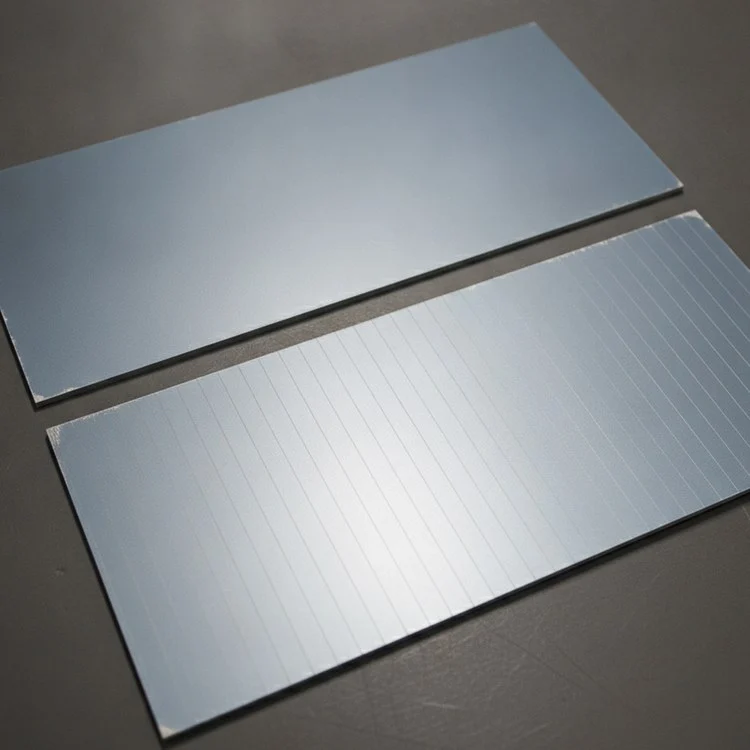
The third tier takes finished Hi-B strip and adds magnetic-domain refinement. The most common method is laser scribing: a focused laser scans fine lines across the strip perpendicular to the rolling direction, introducing localised residual stress that narrows the 180° magnetic domain walls. Narrower domains lose less energy as the field alternates, and anomalous eddy-current loss drops by roughly 8–15% compared with the same Hi-B material unscribed.
There is an important constraint. Conventional laser scribing is not heat-proof: if the coil is later stress-relief annealed — as wound (toroidal) cores routinely are — the scribing effect is annealed out. For wound cores, mills offer heat-proof domain-refined grades that use mechanically etched or grooved domain refinement instead. Nippon Steel splits these as ORIENTCORE HI-B LS (laser-scribed, for stacked cores) and heat-proof variants; JFE Steel distinguishes JGSE (non-heat-resistant, scribed) from JGSD (heat-proof, grooved).
This matters at the quoting stage: “domain-refined CRGO” is not one product. A buyer building wound cores who orders standard laser-scribed material will lose the benefit they paid for during annealing. Our laser-scribed Hi-B CRGO page sets out which refinement type suits stacked versus wound construction.
Domain-refined material also carries an extra process variable — scribe line spacing and laser power — that conventional CRGO does not, which makes it more sensitive to mill-to-mill consistency drift. That is a sourcing consideration, not a reason to avoid the tier.
Tier 4 — Ultra-Thin Grain-Oriented Steel (0.10–0.20 mm)
Ultra-thin grain-oriented steel is a separate product family, not a lower M-number. Standard CRGO is optimised for 50/60 Hz; above that, eddy-current loss climbs with the square of both frequency and thickness, so high-frequency designs need much thinner strip.
These grades are typically designated by thickness — GT-050, GT-080, GT-100, GT-150 and GT-200 corresponding to 0.05, 0.08, 0.10, 0.15 and 0.20 mm — and rated at a high-frequency loss basis such as P1.0/400 (1.0 T at 400 Hz) rather than P1.7/50. A 0.20 mm grade might be specified at P1.0/400 ≤ 25 W/kg, a 0.05 mm grade at ≤ 9 W/kg.
Applications are specific: 400 Hz aerospace and ground-power transformers, high-frequency reactors, EV on-board chargers and DC-DC converters, and switching-frequency magnetics. For a standard power transformer at line frequency, ultra-thin material adds cost with no benefit — the thinner the strip, the lower the stacking factor and the more handling and stacking labour per core. It only earns its premium above roughly 400 Hz. The full thickness and frequency trade-off is covered on our ultra-thin grain-oriented steel page.
Same Steel, Four or Five Different Grade Codes
A single 0.27 mm conventional CRGO coil can legitimately be written as M-4 (AISI), 27Q120 (GB/T 2521), M120-27S (EN 10107) or 27G120 (JIS C 2553). None is wrong. They evolved separately in the United States, China, Europe and Japan and were never merged. We have had buyers forward us three quotes convinced they were pricing three different products, when two of the three were the same coil under different standards.
The practical hazards for a buyer comparing quotes:
- The AISI M-number hides the tier. M3–M6 encode only thickness. A mill can quote “M4” for conventional, Hi-B or laser-scribed 0.27 mm material — the M-number alone will not distinguish them.
- The Hi-B suffix is easy to miss. GB 23Q110 and 23QG090 differ by two letters and one tier. An EN grade ending S versus one ending P is the same trap.
- Trade names are not grades. ORIENTCORE, G-CORE, Carlite and similar are mill product lines that span several grades each.
- The same digits can mean different things. A GB loss digit is 100× the guaranteed W/kg; an AISI SI-code digit is not. “120” in 27Q120 is 1.20 W/kg; “051” in the ASTM 27G051 designation is a different quantity in different units.
The reliable fix is to compare on the underlying numbers — thickness in millimetres, guaranteed P1.7/50 in W/kg, guaranteed B8 in tesla, and coating class — not on the grade string. A full cross-standard breakdown of GB, JIS, EN and AISI naming is the companion reference to this article.
How to Tell Which Tier a Quote or Certificate Actually Is
This is a working heuristic built from the grade logic above, not a formal standard. Use it to turn an ambiguous quote into a specific question for the supplier.
| What you see | Most likely tier | What to confirm |
|---|---|---|
| GB code with plain Q (27Q120), EN code ending S, or bare “M4” | Conventional CGO | Ask for guaranteed B8 — conventional sits around 1.82–1.85 T |
| GB code with QG or RGH, EN code ending P, JIS ZH designation, B8 ≥ 1.88 T on the cert | Hi-B | Ask whether it is domain-refined or plain Hi-B |
| “Domain-refined”, “laser-scribed”, “DR”, “LS”, or P1.7/50 at or below ~0.85 W/kg at 0.23–0.27 mm | Laser-scribed / DR Hi-B | Ask if it is heat-proof — critical for wound cores |
| Thickness below 0.20 mm, loss quoted at P1.0/400 or P1.0/1000, “GT” designation | Ultra-thin GO | Ask for the loss curve at your actual operating frequency |
| Grade code you cannot place in any standard | Unverified | Ask for the mill, the origin standard, and a sample certificate before ordering |
Two checks catch most mismatches. First, read the mill test certificate, not the quote line: the guaranteed P1.7/50 and B8 figures place the tier regardless of how the grade is named. Second, confirm whether the certificate covers the specific coil or heat number you will receive, or a representative batch average — batch-to-batch variation is larger on Hi-B and domain-refined material than on conventional CGO.
What Changed in 2026 That Makes Grade Literacy Matter
Two trends make this worth the time it takes to learn.
The grain-oriented steel market has bifurcated. Conventional grades are growing slowly while high-permeability and domain-refined material captures a disproportionate share of value as efficiency mandates such as the EU’s Ecodesign Tier 2 push transformer builders toward the lowest-loss tiers. Hi-B and domain-refined capacity is exactly the segment that is tightest, and in January 2026 Nippon Steel secured investment to expand grain-oriented capacity aimed at high-efficiency transformers and motors. The grain-oriented electrical steel market was valued at roughly USD 7.41 billion in 2025 and around USD 7.59 billion in 2026.
At the same time, the ongoing global grain-oriented steel shortage is pushing buyers toward mills they have not sourced from before, often on compressed qualification timelines — and those mills use grade codes the buyer may not have cross-checked. A buyer who can read the tier off a certificate, rather than trusting the grade string, is in a materially better position to qualify an unfamiliar supplier quickly without over- or under-buying.
Quoting and Documenting CRGO Grades at Zhongxin
We are Wuxi Zhongxin Special Steel Co., Ltd. — an electrical steel manufacturer and exporter, founded in 2017 in Wuxi, with 200,000 t/yr of silicon-steel capacity and shipments to more than 40 countries. We handle slitting, annealing and coating in-house and source Hi-B and conventional master coil from established primary producers.
When we quote a CRGO grade, we state all four numbers that actually define it — nominal thickness in millimetres, guaranteed P1.7/50 in W/kg, guaranteed B8 in tesla, and coating class — alongside the grade code in your preferred standard, so a quote can be compared against another mill’s on the same basis. If you send us an unfamiliar grade string, we will map it to GB · AISI · EN · JIS before pricing it.
Every shipment carries a mill test certificate with the measured core loss and induction for that material, tested by Epstein frame per IEC 60404-2, and for export orders we issue our own test report alongside the mill’s certificate. We tell buyers plainly when a target price is only reachable with conventional-tier material and when the application genuinely needs Hi-B or domain-refined stock — recommending up a tier that the design does not need is not in anyone’s interest on a repeat account.
FAQ
What are the different grades of CRGO steel?
CRGO grades fall into four tiers. Conventional grain-oriented (CGO), sold as M3–M6 or GB 23Q110–35Q155, covering 0.23–0.35 mm at P1.7/50 of about 1.05–1.55 W/kg. High-permeability Hi-B (GB QG codes, EN P class), with B8 ≥ 1.88–1.90 T. Domain-refined or laser-scribed Hi-B, which adds a scribing step to cut eddy-current loss a further 8–15%. And ultra-thin grain-oriented strip below 0.20 mm for frequencies above 50/60 Hz.
What does the M4 grade in CRGO steel mean?
M4 is an AISI designation for 0.27 mm conventional grain-oriented steel with a guaranteed core loss of P1.7/50 ≤ 1.20 W/kg. It maps to GB 27Q120, EN M120-27S and JIS 27G120. The M-number encodes thickness class only — it does not tell you whether the material is conventional, Hi-B or domain-refined, so “M4 Hi-B” and “M4 standard” are both possible and must be distinguished by the loss and induction figures.
What is the difference between CGO and Hi-B?
CGO (conventional grain-oriented) is the base material. Hi-B is the same production route pushed to a sharper Goss texture, raising induction B8 from around 1.82–1.85 T to ≥ 1.88–1.90 T at the same gauge and lowering core loss by roughly 15–25%. Hi-B carries a consistent price premium because it lets a designer use less core steel or accept lower loss.
Is laser-scribed CRGO always better than Hi-B?
Not always. Laser scribing lowers eddy-current loss by about 8–15% over unscribed Hi-B, but the effect is destroyed by the stress-relief annealing that wound (toroidal) cores need — so standard laser-scribed material suits stacked cores only. Wound-core builders need heat-proof domain-refined grades instead. For a stacked core with a tight loss budget, laser-scribed material is usually worth the premium; for a wound core, specify heat-proof DR or accept plain Hi-B.
How do I know a quote is Hi-B and not standard CRGO?
Check the grade code for a high-permeability marker — GB QG or RGH, EN suffix P, or a JIS ZH designation — and check the mill test certificate for B8. Conventional material reads around 1.82–1.85 T; Hi-B reads ≥ 1.88 T. A grade code with a plain GB Q or an EN S suffix is conventional regardless of how the material is described in the quote text.
How is CRGO grade performance actually verified?
Core loss and induction are measured with an Epstein frame under IEC 60404-2, using strips cut half parallel and half perpendicular to the rolling direction, typically at 1.5 T and 50 Hz. Domain-refined high-permeability grades may also be tested by single sheet tester per the IEC 60404-8-7:2020 method. Those measured figures appear on the mill test certificate shipped with the coil.
Which CRGO grade should I use for a distribution transformer?
For a standard 50/60 Hz distribution transformer with a normal loss budget, conventional 0.27–0.30 mm material (M4 or M5, GB 27Q120 or 30Q130) is the usual choice. Move to Hi-B when an efficiency class or no-load loss limit cannot be met with conventional stock, and to domain-refined only for large units where the loss budget is very tight. Ultra-thin grades are not used at line frequency.
Bottom Line
CRGO steel grades are not a single ladder of “better” numbers — they are four tiers, each defined by one more controlled manufacturing step than the tier below: conventional CGO, Hi-B, domain-refined Hi-B, and ultra-thin grain-oriented strip. The grade code on a quote is meant to tell you the tier, but between the AISI, GB, EN and JIS systems the same steel wears several names and the tier is easy to lose.
Compare quotes on the four numbers that actually define the material — thickness, guaranteed P1.7/50, guaranteed B8, and coating class — not on the grade string. Read the mill test certificate rather than the quote line, confirm whether it is per-coil or per-batch, and for domain-refined material ask whether it is heat-proof before it goes anywhere near a wound core.
References
- IEC — IEC 60404-8-7:2020, Magnetic materials — Specifications for individual materials: Cold-rolled grain-oriented electrical steel strip and sheet delivered in the fully-processed state
- IEC — IEC 60404-2, Magnetic materials — Methods of measurement of the magnetic properties of electrical steel strip and sheet by means of an Epstein frame
- ASTM International — ASTM A876/A876M-17e1, Standard Specification for Flat-Rolled, Grain-Oriented, Silicon-Iron, Electrical Steel, Fully Processed Types
- Nippon Steel Corporation — Grain-Oriented Electrical Steel Sheets (ORIENTCORE, ORIENTCORE HI-B, HI-B LS)
- JFE Steel Corporation — Grain-Oriented Electrical Steel Sheet JFE G-CORE (JGSD / JGSE domain-refined grades)