
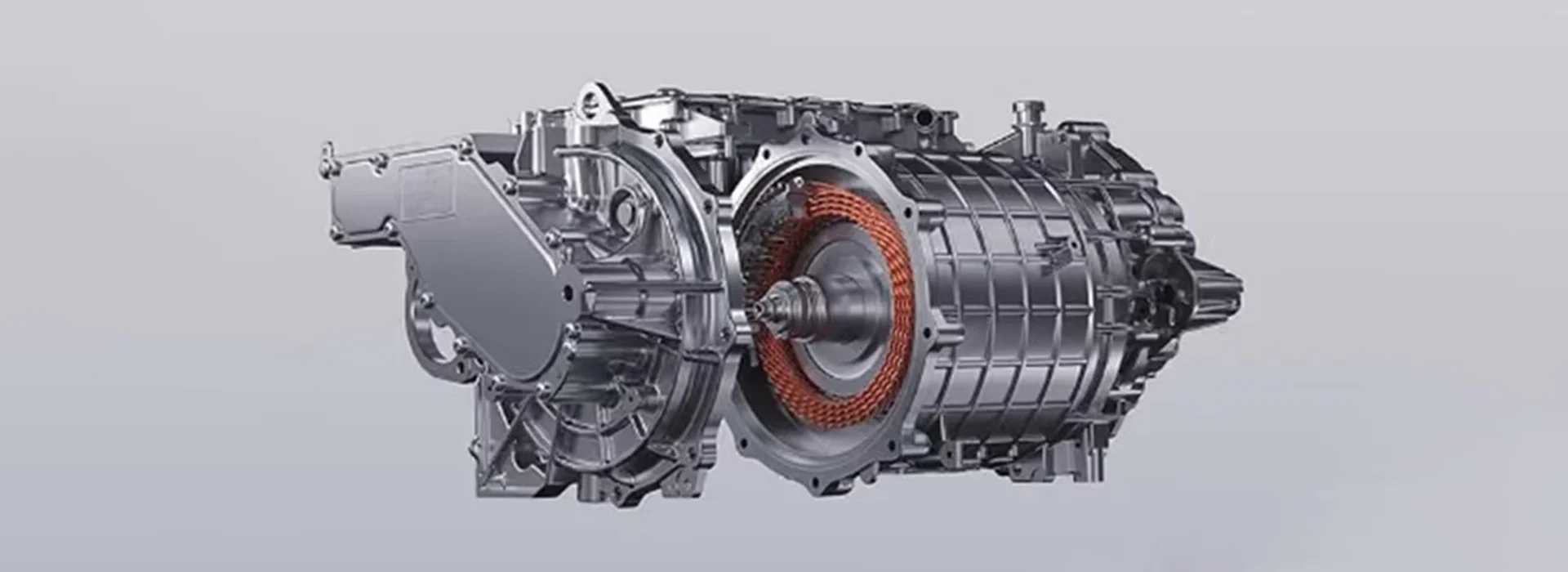
Applications · Motors
Electrical Steel for High-Speed & Industrial MotorsNon-oriented, high-strength & ultra-thin CRNGO for rotors and stators
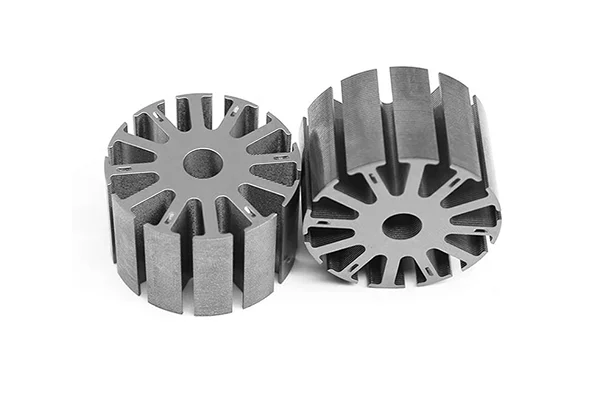
General-purpose induction motors, high-speed compressors and turbocharger-class rotors don’t run under the same stresses — and they shouldn’t run on the same lamination. We supply non-oriented silicon steel across the full range: standard-gauge CRNGO for everyday industrial duty, and high-strength or ultra-thin grades where rotor speed, centrifugal stress and electrical frequency all climb together.
Why speed changes the spec
Two problems climb together as rpm goes up
Push a motor’s speed up and two separate things get harder at once, for two unrelated reasons. First, centrifugal stress on the rotor rises with the square of speed — double the rpm and the rim loading on every lamination goes up roughly fourfold. A rotor that sits comfortably within a standard grade’s yield strength at 3,000 rpm can be flirting with plastic deformation at 15,000 rpm, and a lamination that yields even slightly distorts the air gap, unbalances the rotor and can lead to outright mechanical failure. General-purpose CRNGO, optimized for cost and core loss rather than tensile strength, simply isn’t built to take that load.
Second, and independently, higher rpm — or a higher pole count at the same rpm — pushes up the electrical frequency the core actually sees. A 2-pole motor at 3,000 rpm sees 50 Hz; the same design at 15,000 rpm, or an 8-pole motor at that same 3,000 rpm, sees several times that. Core loss climbs with frequency the same way it does in a transformer: the hysteresis component rises roughly linearly, but the eddy-current component scales with the square of frequency, so it’s the eddy-current term that dominates as electrical frequency climbs. Left unaddressed, that loss shows up as heat the rotor and stator have to shed, which eats into efficiency and, in a sealed or space-constrained housing, can become the limiting factor on how fast the motor can actually run.
The two problems don’t always arrive together and don’t always call for the same fix. A machine tool spindle spinning fast but lightly loaded may be almost purely a core-loss problem; a heavy rotor at more modest speed may be almost purely a mechanical one. That’s why we treat “motor steel” as a spread rather than one product: standard-gauge CRNGO covers the bulk of industrial duty economically, high-strength CRNGO addresses the mechanical side for high-speed or heavily loaded rotors, and ultra-thin CRNGO addresses the electrical-frequency side when speed and pole count push core loss past what a standard gauge can handle — and the most demanding designs, like turbocharger and drone motors, often need a grade that leans on both properties at once.
Match material to duty
What speed class needs what material?
A starting point for your enquiry — actual rotor stress and core loss depend on your specific design, pole count and duty cycle, so we’ll confirm the right grade once we see your spec.
| Speed class | Typical application | Recommended material | Why |
|---|---|---|---|
| General industrial (up to ~3,600 rpm) | Pumps, fans, compressors, general induction motors | Standard CRNGO, 0.35–0.50 mm (e.g. 35W300, 50W470–50W600) | Balanced loss and material cost; well-proven, widely stocked grades |
| High-speed industrial (~3,600–15,000 rpm) | Blowers, small compressors, machine tool spindles | Standard CRNGO 0.35 mm, or High-Strength CRNGO | Higher electrical frequency raises core loss; higher-strength grade resists added rotor stress |
| Very high-speed (15,000–30,000+ rpm) | Turbochargers, drone & eVTOL motors, high-speed spindles | Ultra-Thin CRNGO 0.10–0.20 mm, high-strength grades | Centrifugal stress demands high yield strength; elevated frequency needs thinner gauge to control eddy loss |
Building an EV traction motor specifically? See our dedicated EV application page — EV traction motor steel →
By application
Where our motor steel gets used
01
Pumps & compressors
Standard and high-speed rotary compressors, refrigeration and process pumps.
02
Fans & blowers
Industrial fans, HVAC blowers and high-speed centrifugal blowers.
03
Machine tool spindles
High-speed spindle motors demanding low core loss at elevated frequency.
04
Turbochargers & drone motors
Very high-speed rotors where yield strength and thin gauge both matter.
Grade & gauge
Three lines, one non-oriented family
Standard CRNGO covers general industrial duty at the lowest cost. High-Strength CRNGO trades a little core loss for the yield strength high-speed rotors need. Ultra-Thin CRNGO trades thickness for lower loss at elevated electrical frequency. Most high-speed designs end up specifying two of the three — one for the stator, one for the rotor.
Which line fits your design
How we work
From enquiry to your dock
A simple path from spec to delivery, built for overseas buyers.
Send your spec
Rpm, pole count, grade preference or drawing — whatever you have.
Quote in 24h
Grade recommendation and pricing within one business day.
Free samples
Test core loss and stampability, usually within a week.
Production & QC
Rolled, slit and tested to grade, with a mill certificate.
Export delivery
Moisture-proof packing and ocean freight to your port.
FAQ
Sourcing steel for high-speed & industrial motors
What’s the difference between standard and high-speed motor steel?
Standard CRNGO is optimized for cost and loss at typical industrial speeds. High-speed applications add centrifugal stress on the rotor and higher electrical frequency, so they need either a higher-yield-strength grade, a thinner gauge, or both — standard CRNGO isn’t rated for either extra demand.
How do I know if I need high-strength or ultra-thin CRNGO?
High-strength grades address mechanical stress — pick these when rotor yield strength is the concern. Ultra-thin grades address electrical loss at frequency — pick these when core loss at your operating frequency is the concern. Very high-speed designs often need both. Send your rpm and pole count and we’ll recommend a spec.
Can you supply stamped rotor and stator laminations, not just coil?
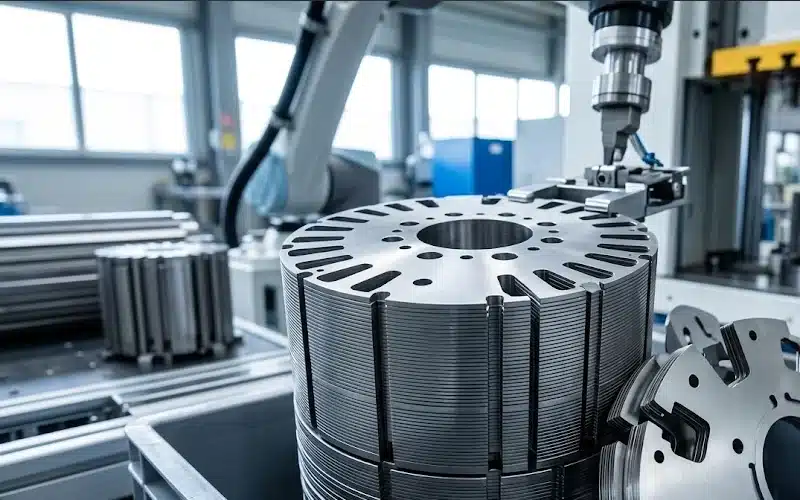
Yes — precision slitting to width, cut-to-length sheet, and stamped laminations to your drawing, in any of our standard, high-strength or ultra-thin grades.
Do you have data on yield strength for the high-strength grades?
Yes — see the High-Strength CRNGO page for typical yield strength and core loss ranges by grade. Treat published figures as reference values and confirm against mill test certificates for your specific order.
What’s the minimum order quantity?
MOQ depends on grade, thickness and width, and tends to be higher for high-strength and ultra-thin gauges than standard CRNGO. Tell us your target volume and we’ll confirm what’s workable.
How fast can you quote and ship?
Quotes come within 24 hours. Standard CRNGO often ships from stock in days; high-strength and ultra-thin grades are typically made-to-order and take a few weeks.
Do you provide samples?
Yes — free samples are usually ready within about a week, so you can test core loss and mechanical properties before committing.
Related products
Explore the rest of the range
Standard CRNGO
0.35–0.65 mm non-oriented steel for general industrial motors.
Explore →High-strength CRNGO
High-yield-strength grades for high-speed and EV traction rotors.
Explore →Ultra-thin CRNGO
0.05–0.20 mm for very high-speed, high-frequency motors.
Explore →Non-oriented hub
Compare the full non-oriented line by application.
Explore →Why buyers choose Zhongxin
Mill-grade material, export-ready service
Wuxi Zhongxin Special Steel Co., Ltd. is a Chinese manufacturer and exporter of grain-oriented, non-oriented and ultra-thin silicon steel, serving transformer and motor makers across Europe, the Americas, Asia and beyond.
Send your rpm and pole count — get a grade recommendation in 24 hours
Share speed, pole count, and rotor or stator role. Free samples available.

