Grain Oriented Silicon Steel
One-Stop Sourcing for High-Quality Grain-Oriented Silicon Steel
The main advantage of grain-oriented silicon steel is its excellent magnetic properties along the rolling direction. This comes from precise control of the Goss texture ({110}<001>). Key technical characteristics are listed below.
Low Core Loss – High-purity melting, proper inhibitors, and secondary recrystallization are used. Eddy current loss and hysteresis loss are greatly reduced. Core loss is much lower than non-oriented silicon steel. This minimizes heat generation and energy loss in transformers.
High Magnetic Induction – Magnetic polarization reaches over 1.88 T (at 800 A/m). The material carries higher magnetic flux density under the same excitation. This reduces transformer core size, weight, and cost.
Low Magnetostriction – The magnetostriction coefficient is effectively suppressed. Transformer cores vibrate less and produce lower noise at power frequency. This meets requirements for quiet urban power equipment.
Excellent Lamination Factor – Thickness tolerance is tight (within ±0.005 mm). Surfaces are smooth and flat. The stacking factor exceeds 0.96. This increases the effective magnetic circuit area.
Surface Insulation Coating – Phosphate or chromate based inorganic coatings (T1/T2/T3) are used. They provide interlayer insulation to reduce eddy current loss. They also offer good heat resistance, adhesion, and punchability. Some high-end products use laser or mechanical scribing to refine magnetic domains and further reduce loss.
In summary, grain-oriented silicon steel is irreplaceable for power and distribution transformer cores. This is due to the synergy of texture control, thin-gauge rolling, and advanced coatings.
1.The thickness and width of grain-oriented silicon steel
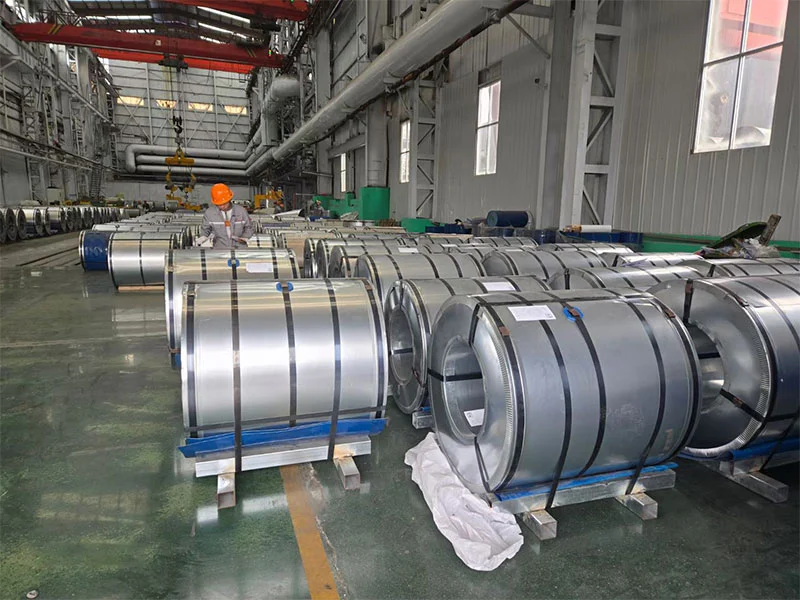
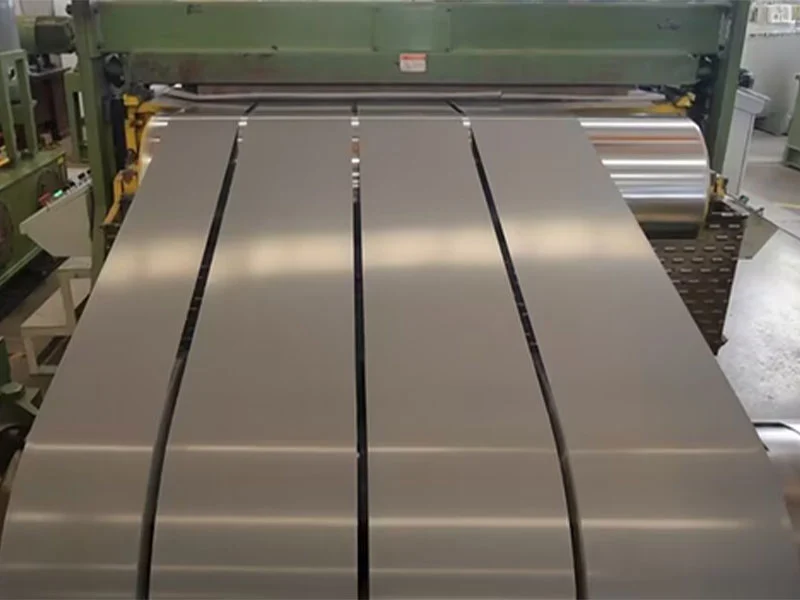
Grain-oriented silicon steel (GOES Steel) is mainly divided into conventional thickness and ultra-thin gauge categories. Conventional thickness products benefit from mature processing and wide master coils, making them suitable for high-volume transformer core production. Ultra-thin gauges, produced through more precise rolling, offer low core loss and are mainly used in medium-to-high frequency applications. Both categories can be further processed via slitting into narrow strips to meet various core size requirements. The detailed comparison is as follows:
Conventional Thickness
Thicknesses: 0.20 mm, 0.23 mm, 0.27 mm, 0.30 mm, 0.35 mm
Master coil width: 600 – 1250 mm
Width after slitting: Can be slit down to 20 – 600 mm (any narrow strip)
Applications: Power transformers and distribution transformers at power frequency (50/60 Hz)
Ultra-Thin Gauge
Thicknesses: 0.15 mm, 0.10 mm, 0.08 mm, 0.05 mm (listed from thicker to thinner)
Master coil width: 100 – 500 mm
Width after slitting: Can be slit down to 10 – 300 mm narrow strips
Applications: Medium-to-high frequency transformers, pulse transformers, magnetic amplifiers
Key Comparison
Conventional thickness → Wide master coils + flexible slitting → balances productivity and dimensional adaptability
Ultra-thin gauge → Narrower master coils + even narrower slitting → trades width for ultra-low core loss at medium/high frequencies
Iron Loss and Magnetic Induction of Grain-Oriented Silicon Steel
| \ \ \ Typical magnetic properties of major grain-oriented electrical steel grades of Baosteel | |||||
|---|---|---|---|---|---|
| Type | Grade | Specific total loss(W/kg) | Magnetic polarization (T) | Exciting power(VA/kg) | |
| P1.5/50 | P1.7/50 | J800 | Ss1.7/50 | ||
| Conventional Grades | B23G110 | 0.71 | 0.99 | 1.89 | 1.85 |
| B27G120 | 0.76 | 1.04 | 1.89 | 1.90 | |
| B30G120 | 0.79 | 1.08 | 1.89 | 1.90 | |
| B35G135 | 0.90 | 1.18 | 1.89 | 1.71 | |
| High Permeability Grades | B18P080 | 0.58 | 0.79 | 1.89 | 1.48 |
| B20P080 | 0.59 | 0.79 | 1.89 | 1.34 | |
| B23P085 | 0.62 | 0.83 | 1.92 | 1.20 | |
| B27P095 | 0.68 | 0.92 | 1.91 | 1.34 | |
| B27P100 | 0.69 | 0.94 | 1.91 | 1.42 | |
| B30P105 | 0.74 | 0.99 | 1.91 | 1.41 | |
| B30P120 | 0.76 | 1.02 | 1.91 | 1.52 | |
| Domain Refined High Permeability Grades | B18R065 | 0.48 | 0.64 | 1.91 | 1.91 |
| B20R070 | 0.51 | 0.68 | 1.91 | 1.96 | |
| B23R075 | 0.56 | 0.74 | 1.92 | 1.65 | |
| B23R080 | 0.57 | 0.77 | 1.91 | 1.86 | |
| B23R085 | 0.59 | 0.80 | 1.91 | 2.10 | |
| B27R085 | 0.62 | 0.82 | 1.91 | 1.82 | |
| B27R090 | 0.64 | 0.86 | 1.90 | 2.05 | |
| B30R090 | 0.68 | 0.88 | 1.92 | 1.67 | |
| B30R100 | 0.71 | 0.94 | 1.91 | 1.93 | |
2.Comparison Table of Standards and Grades for Grain-Oriented Silicon Steel
| 列 | 公称厚度 (mm) | 宝钢 Baosteel | 武钢 WISCO | 新日铁 NSC | JFE | Congent | 蒂森克虏伯 TKS | 浦项 Posco | 新利佩茨克 NI & SCo | 阿姆可 AK |
|---|---|---|---|---|---|---|---|---|---|---|
| Normal | 0.23 | B23G110 | 23Q105 | |||||||
| 23Q110 | 23Z110 | C110-23 | NV23S - | |||||||
| 23Q115 | ||||||||||
| B23G120 | M120 - | C120-23 | NV23S - | M-3 | ||||||
| M127 - | C127-23 | NV23S - | ||||||||
| 0.27 | 27PG110 | NV27S - | ||||||||
| B27G120 | 27Q120 | 27Z120 | 27JG120 | C120-27 | 27PG120 | NV27S - | M-4 | |||
| B27G130 | 27Q130 | 27Z130 | 27JG130 | M130 - | C130-27 | 27PG130 | NV27S - | M-4 | ||
| 27Q140 | M140 - | C140-27 | NV27S-14 | |||||||
| 0.3 | 30PG110 | |||||||||
| B30G120 | 30Q220 | 30Z120 | 30JG120 | 30PG120 | NV30S - | |||||
| B30G130 | 30Q180 | 30Z130 | 30JG130 | C130-30 | 30PG130 | NV30S - | ||||
| B30G140 | 30Q160 | 30Z140 | 30JG140 | M140 - | C140-30 | 30PG140 | NV30S - | M-5 | ||
| 30Q150 | M150 - | C150-30 | M-5 | |||||||
| 30Q140 | ||||||||||
| 30Q130 | ||||||||||
| 30Q120 | ||||||||||
| 0.35 | B35G135 | 35Q135 | 35Z135 | 35JG135 | NV35S - | |||||
| B35G145 | 35Q145 | 35Z145 | 35JG145 | M150 - | C150-35 | 35PG145 | NV35S - | M-6 | ||
| B35G155 | 35Q155 | 35Z155 | 35JG155 | M165 - | C165-35 | 35PG155 | M-6 | |||
| High magnetic induction type | 0.23 | B23P090 | 23QG090 | 23ZH090 | 23JGS090 23JGH090 | M90 -23P5 | H090-23 | 23PH090 | ||
| B23P095 | 23QG095 | 23ZH095 | 23JGS095 23JGH095 | H095-23 | 23PH095 | |||||
| B23P100 | 23QG100 | 23ZH100 | 23JGH100 | M100 - | H100-23 | 23PH100 | H-0 | |||
| 23ZH110 | ||||||||||
| 0.27 | H090-27 | |||||||||
| B27P095 | 27QG095 | 27ZH095 | H095-27 | 27PH095 | ||||||
| B27P100 | 27QG100 | 27ZH100 | 27JGH100 | M103 - | H103-27 | 27PH110 | NV27P- | |||
| B27P110 | 27QG110 | 27ZH110 | 27JGH110 | H-1 | ||||||
| 0.3 | B30P100 | 30QG100 | 30ZH100 | 30JGH100 | 30PH100 | |||||
| B30P105 | 30QG105 | 30ZH105 | 30JGH105 | M105 - | H105-30 | 30PH105 | NV30P- | |||
| B30P110 | 30QG110 | 30ZH110 | 30JGH110 | M111 - | H111-30 | |||||
| B30P120 | 30QG120 | 30ZH120 | 30JGH120 | M117 - | ||||||
| 0.35 | B35P115 | 35ZH115 | 35JGS115 35JGH115 | 35PH115 | ||||||
| B35P125 | 35ZH125 | 35JGS125 35JGH125 | 35PH125 | |||||||
| B35P135 | 35ZH135 | 35JGH135 | 35PH135 | |||||||
| High magnetic induction type with domain refinement | 0.23 | B23R080 | 23ZDKH80 23ZDMH8 | 23JGSD80 | 23PHD080 | |||||
| B23R085 | 23ZD0KH85 23ZDMH8 | 23JGSD85 | H085-23 | 23PHD085 | ||||||
| B23R090 | 23ZD5KH90 23ZDMH9 | 23JGSD90 | H090-23 | H-0DR | ||||||
| 0.27 | B27R090 | 27ZD0KH90 27ZDMH9 | 27JGSD90 | H090-27 | 27PHD090 | |||||
| B27R095 | 27ZD0KH95 27ZDMH9 | 27JGSD95 | 27PHD095 | H-1DR | ||||||
3. Core Advantages and Technical Characteristics of Grain-Oriented Silicon Steel
The key advantage of grain-oriented silicon steel is its excellent magnetic properties along the rolling direction. This comes from precise Goss texture ({110}<001>) control.
Low Core Loss – High-purity melting, proper inhibitors, and secondary recrystallization reduce eddy current and hysteresis loss. Core loss is much lower than non-oriented steel. This minimizes heat and energy loss in transformers.
High Magnetic Induction – Magnetic polarization exceeds 1.88 T (at 800 A/m). Higher flux density reduces core size, weight, and cost.
Low Magnetostriction – Suppressed magnetostriction lowers vibration and noise. Meets quiet urban power supply requirements.
Excellent Lamination Factor – Tight tolerance (±0.005 mm) and smooth surfaces give a stacking factor >0.96. This improves the magnetic circuit.
Surface Insulation Coating – Phosphate or chromate coatings (T1–T3) provide insulation, heat resistance, adhesion, and punchability. Some products use laser scribing to further reduce core loss.
In summary, grain-oriented silicon steel is irreplaceable for power and distribution transformer cores. This is due to texture control, thin rolling, and advanced coatings.
4. Application Fields of Grain-Oriented Silicon Steel
Thanks to low core loss and high magnetic induction, grain-oriented silicon steel is mainly used for transformer cores. It is also expanding into other high-efficiency electromagnetic devices.
Main applications include:
Power Transformers – Used in large transformers (above 10 MVA) for power plants, substations, and high-voltage grids. Low core loss reduces no‑load loss and improves efficiency.
Distribution Transformers – Used in 10 kV / 0.4 kV networks. Includes pole‑mounted, pad‑mounted, and dry‑type transformers. This is the largest market. Conventional thicknesses (0.23–0.35 mm) are common. Some high‑efficiency units now use 0.20 mm and thinner.
Medium‑to‑High Frequency Transformers – Ultra‑thin gauges (0.15, 0.10, 0.08, 0.05 mm) are used for 200 Hz – 10 kHz. Examples: rail traction converters, PV inverters, wind generators, induction heating, and military power supplies.
Pulse Transformers & Magnetic Amplifiers – Used in radar, laser power supplies, and particle accelerators. Benefit from fast magnetization and low loss of ultra‑thin steel.
Reactors & Chokes – Used for short‑circuit current limiting, filtering, and reactive power compensation. This steel improves linearity and reduces losses.
Current & Voltage Transformers – Require high permeability and low angle error. High‑induction steel improves measurement accuracy.
Grain-oriented silicon steel is also finding use in high‑efficiency motors, magnetic shielding, and renewable energy equipment. Demand will grow with smart grids, EV charging, and distributed energy.
5. Production Process and Quality Control of Oriented Silicon Steel at Zhongxin Special Steel
Zhongxin Special Steel uses a full precision process. Impurities (C, S, N) are strictly controlled. Inhibitors (AlN, MnS) help form Goss texture.
Process: hot rolling, normalizing, cold rolling (±0.005 mm), decarburizing annealing, MgO coating, then high‑temperature batch annealing (>1200°C in pure hydrogen) to create a sharp Goss texture. An inorganic coating (T2/T3) is applied. Laser scribing is optional for lower core loss.
Thickness: conventional 0.20–0.35 mm, ultra‑thin 0.15/0.10/0.08/0.05 mm. Slitting: 20–600 mm (conventional) or 10–300 mm (ultra‑thin). Also cut‑to‑length sheets.
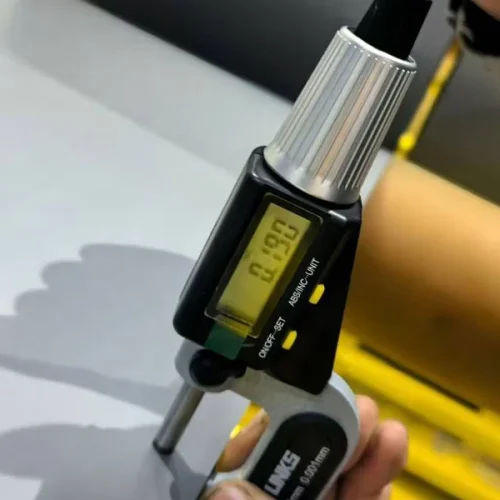
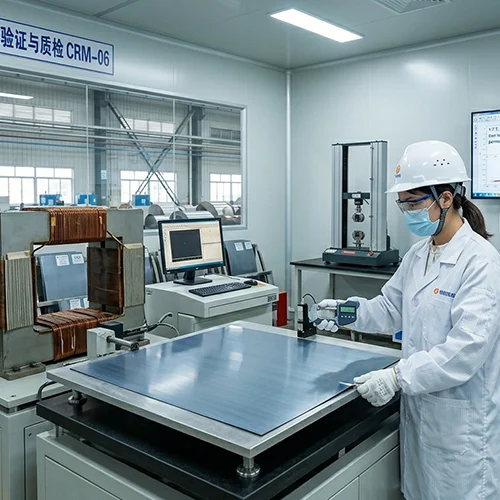
Quality: tight control of purity and inclusions. Each coil tested for core loss (e.g., 0.27 mm grade: P₁.₇/₅₀ ≤ 1.10 W/kg) and J₈₀₀ per IEC/GB. EBSD/XRD checks texture. Thickness, flatness, coating adhesion and resistance are monitored. Lamination factor >0.96. MES system ensures full traceability and consistent performance.
6. Packaging and Transportation
Grain-oriented silicon steel coils rust easily from moisture. Professional packaging is very important for B2B customers. Zhongxin Special Steel uses the following solutions:
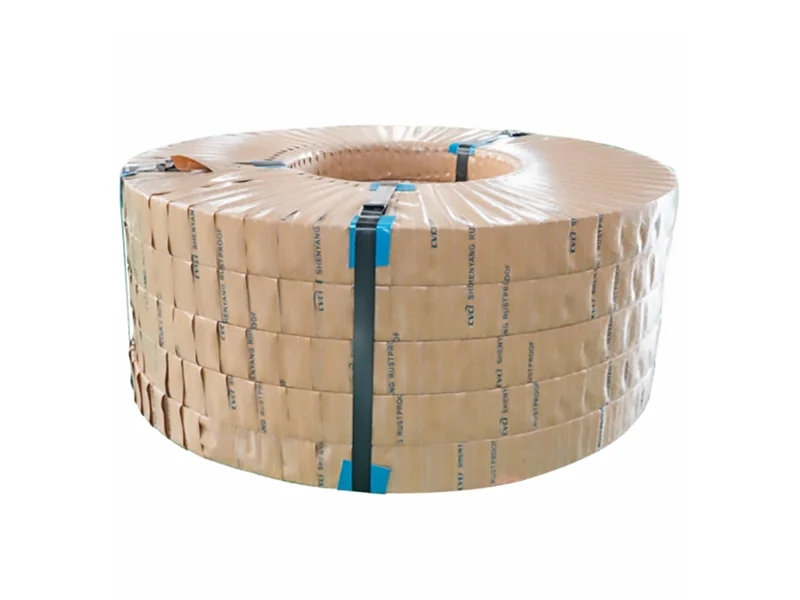
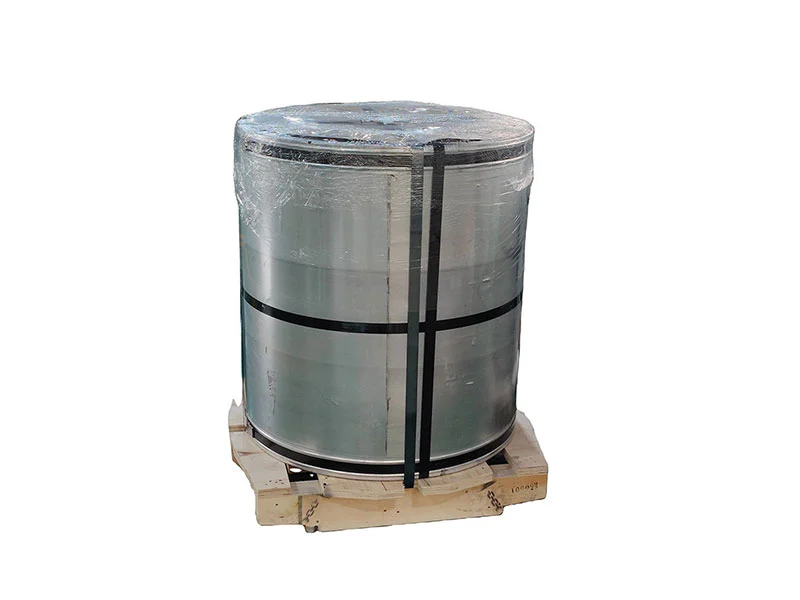
Moisture-Proof Packaging – Vertical packaging is used. Two options are available: Eye-to-Sky and Eye-to-Wall. Eye-to-Sky means the coil axis is vertical. The eye faces upward. The inner layer uses plastic film and VCI rust-proof paper. The outer layer has steel strapping, corner protectors, and steel sheathing. This provides excellent moisture protection and allows stacking. Eye-to-Wall means the coil axis is horizontal. The eye faces sideways. End faces are sealed more tightly. This makes lifting and unpacking easier. Both methods stop moisture during storage and transport.
Wooden / Steel Pallets – Coils are placed on wooden pallets or steel pallets. Wooden pallets meet ISPM 15 standards. They use heat‑treated or fumigated solid wood with IPPC marks. Wooden pallets are for one‑way export and cross‑border shipping. Steel pallets are reusable. They are ideal for closed‑loop supply chains and multiple trips. They offer stable support and need no fumigation.
Container Lashing – After loading, wooden wedges block both sides of the coil base. This prevents rolling. Steel wire ropes or strapping belts go through the coil eye. They are tightened to the container’s side lashing rings. Air bags fill the gaps. This stops the coil from shifting or bumping during sea transport and rough handling. Each shipment includes lashing photos and records for customer inspection.