
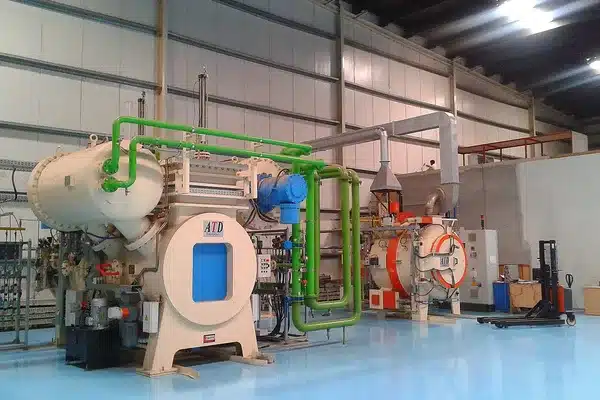
Stress relief annealing (SRA) heats finished laminations or cores to roughly 700–845 °C in a protective gas so that the stress left by punching, shearing or winding relaxes and the steel gets back the magnetic properties it had at the mill. Whether it pays depends on the part size, the gauge and the core design. If you plan to anneal, you also have to buy steel that survives the furnace. This guide covers when SRA is worth doing, the published furnace recipes, which coatings and grades survive the anneal, and what to write in the steel order.
Cutting damage itself, and how laser, EDM and stamping compare before and after annealing, is covered in our guide to prototype motor laminations. This article is about the anneal and the steel you buy for it.
Key Takeaways
- Fully processed steel does not need SRA to meet its grade. The anneal only removes stress added by fabrication, and it matters most on narrow parts. Cleveland-Cliffs singles out laminations under one inch (25 mm) wide.
- Cleveland-Cliffs recommends 1450 °F (788 °C) in nitrogen with 2–10% hydrogen for its fully processed non-oriented grades, with only enough time at temperature to heat the charge evenly.
- C-3 and C-6 organic coatings do not survive SRA. C-5 and C-5-A survive up to about 845 °C in a neutral or slightly reducing atmosphere.
- SRA pays less on thin EV gauges. In a 2025 POSCO study, 0.30 mm steel gained the most, while 0.20 mm steel changed little or got worse. 750 °C beat 850 °C at every thickness.
- Laser-scribed grain-oriented steel loses its domain refinement above about 600 °C. Wound cores that will be annealed need non-scribed or heat-resistant grades.
- Mill certificates for fully processed steel report loss on as-sheared strips, not annealed parts. Agree the test basis before you compare numbers.
Does Your Core Need Stress Relief Annealing?
Only if you need the full magnetic quality of the grade in a part that cutting or winding has strained. It is not a default step for fully processed steel.
Cleveland-Cliffs’ 2026 data bulletin for its DI-MAX non-oriented grades states it plainly: “Stress-relief annealing is not always necessary.” Whether it is needed “depends upon thickness, size and type of lamination or core, and the required magnetic properties.” The same bulletin says that if the full properties of a grade are required, SRA is necessary, “particularly when the lamination width is less than one inch.” Narrow teeth and thin back iron carry a larger share of damaged edge, so they gain the most.
There is a cost beyond furnace time. The bulletin warns that SRA “always incurs the possibility of impairing lamination flatness” unless the parts are loaded and cooled with care.
Semi-processed steel is a different case. It must be annealed by the user to develop its properties at all, and that anneal is longer, hotter and decarburizing. Our guide to non-oriented electrical steel grades explains the difference and why most buyers without a furnace should order fully processed steel. On Reddit the two are often confused. One commenter on a motor-building thread wrote that industrial laminations are “annealed in an inert atmosphere,” as if every lamination were. For fully processed steel, that is an option, not a rule.
| Situation | SRA? | Why |
|---|---|---|
| Fully processed steel, wide laminations, standard efficiency | Usually not | Edge damage is a small share of the part |
| Fully processed steel, narrow teeth or small parts, high efficiency target | Worth testing | Damaged edges are a large share of the flux path |
| Semi-processed steel | Always | The anneal develops the grade’s properties |
| Grain-oriented wound core | Normally yes | Winding bends every turn of the strip |
| Grain-oriented stacked core of cut sheets | Often not | Cut edges are a small share of long sheets |
What Temperature and Atmosphere Does SRA Use?
Published recipes for fully processed steel sit between about 680 °C and 845 °C, in nitrogen or nitrogen with a little hydrogen. The ceiling is set by the coating. Higher is not better.
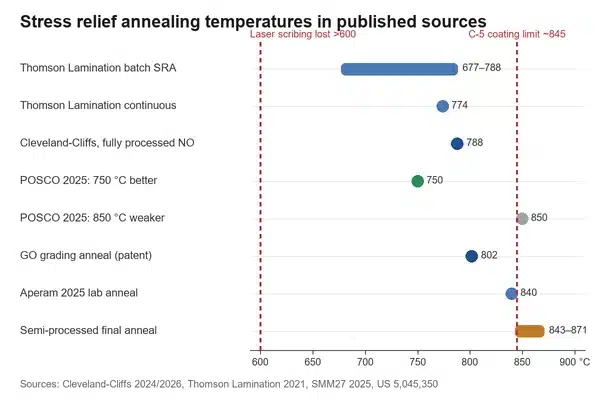
Mill recipe for non-oriented steel. Cleveland-Cliffs advises that its fully processed grades “should be done at 1450 °F (788 °C) in an atmosphere of nitrogen, which may contain 2% – 10% hydrogen.” Time at maximum temperature “need be no longer than that required to heat the charge uniformly.” It also recommends “a minimum amount” of hydrogen when the steel carries a C-5 or C-5-A coating.
Lamination makers’ recipes. Thomson Lamination, a US stamper, lists a continuous SRA at 1425 °F (774 °C) as its standard and batch retort SRA at 1250–1450 °F (677–788 °C) for runs that need other temperatures and soak times.
Lab results. Aperam’s research centre annealed 0.30 mm non-oriented steel at 840 °C for 60 minutes in 90% nitrogen and 10% hydrogen with a dew point of −20 °C. POSCO compared 750 °C and 850 °C for two hours and found the lower temperature gave the better loss reduction on every gauge it tested.
Furnace practice. The same Cleveland-Cliffs bulletin gives several handling rules that a heat-treatment subcontractor should follow:
- Remove punching lubricant before annealing. Carbon from the oil can contaminate the steel.
- Use flat, low-carbon plates and covers.
- Anneal in a covered box where possible, and flush out the air before heating. Oxidation “impairs magnetic properties, particularly at high inductions.”
- Cool slowly under protective gas to 316–427 °C. For charges of a few thousand pounds, the bulletin gives a maximum of 28 °C per hour, and slower for heavier charges.
Continuous furnaces suit high volumes, but the parts must be light enough to reach temperature quickly. Batch furnaces are slower and more flexible. If you stamp in volume, our guide to motor lamination stamping covers the burr and die limits that come before the anneal.
Which Coatings Survive Stress Relief Annealing?
Inorganic C-5 and C-5-A coatings, and the bare C-0 mill oxide. Organic C-3 and C-6 coatings do not. This is the decision that most often goes wrong, because the coating is chosen at the steel order and the anneal is planned months later.
The classes below follow ASTM A976, as described in Cleveland-Cliffs’ bulletin.
| Coating class | Type | Survives SRA? | Notes from the bulletin |
|---|---|---|---|
| C-0 | Natural oxide from mill annealing | Yes, in neutral or slightly reducing gas | Low insulation; small cores. Insulation “usually enhanced by a stress-relief anneal” |
| C-3 | Organic varnish | No | “Will not withstand the heat of stress-relief annealing.” Good for die life |
| C-5 | Inorganic with fillers and a little organic | Yes, up to about 845 °C | Neutral or slightly reducing atmosphere; high insulation |
| C-5-A | Thin inorganic | Yes, below about 845 °C | Moderate insulation; good for punched parts |
| C-6 | Organic with inorganic fillers | No | Withstands motor burn-off at 320–540 °C, not SRA |
Two practical points follow. First, the C-5 rating holds only inside the stated limits: about 845 °C and a neutral or slightly reducing gas. If your furnace runs hotter, wetter or more oxidizing, ask the supplier for the coating’s insulation value after your own cycle. Second, organic coatings are kinder to dies, which is why many stampers prefer them; Cleveland-Cliffs notes C-3 “has a beneficial effect on die life.” If the part will be annealed, tell the stamper the coating will be inorganic so tool wear is planned for.
Our standard CRNGO coating is a semi-organic C-3 type, and C-5 is available on request. Tell us at the quotation stage if the parts will be annealed. Our article on electrical steel coating types compares the classes in more detail.
Does SRA Still Pay on Thin EV Gauges?
Less than on standard gauges, and sometimes not at all. This is the newest part of the picture, because EV traction motors have pushed laminations down to 0.20–0.30 mm with high silicon.
Seil Lee of POSCO and Se-Jong Kim of the Korea Institute of Materials Science presented results at the Soft Magnetic Materials conference in Turin in 2025. They annealed three commercial non-oriented grades with about 3.5% silicon, at 0.20, 0.25 and 0.30 mm.
- The 0.30 mm steel showed the largest loss reduction.
- The 0.25 mm steel improved less.
- The 0.20 mm steel showed “minimal change or even increased losses.”
- At every thickness, 750 °C worked better than 850 °C.
The authors explain that SRA works in low-alloy steels “through both stress removal and grain growth,” but that in high-alloy thin-gauge steel its effect is limited “due to restricted grain growth.” They also note that SRA “is being reconsidered” to raise motor efficiency, so the question is open, not settled.
Other recent work points the same way for standard gauges. Aperam found that SRA at 840 °C cut the difference in loss between rolling and transverse directions in 0.30 mm steel from 11% to 3–4% at 1 T, 400 Hz. A 2026 paper by Volvo and Chalmers researchers reported that the stress from laser cutting and punching “can be reduced strongly, restoring the material to near-original performance.” Earlier, a 2019 KIT study built three 4 kW induction motors and found that annealing recovered the steel’s original properties and raised efficiency.
For a thin-gauge design, do not assume the anneal helps. Anneal a sample stack at your gauge and compare it with an unannealed stack before you add SRA to the process. Our ultra-thin silicon steel page lists the thin grades we supply.
What Changes for Grain-Oriented Wound Cores?
Wound cores are annealed after winding as normal practice, so the grade must keep its low loss through the furnace. That rules out ordinary laser-scribed steel.
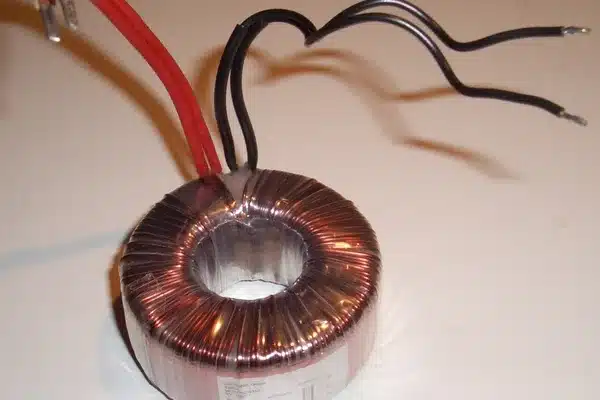
Winding bends every turn of the strip, which strains the whole core, not only its edges. For grain-oriented steel, an anneal of two hours at 1475 °F (802 °C) in 85% nitrogen and 15% hydrogen is described as standard commercial grading practice in a 1991 Allegheny Ludlum patent. The same patent allows a stress relief anneal anywhere from 1300 to 1800 °F (704–982 °C), so the exact cycle is set by the core maker.
The catch is domain refinement. Cleveland-Cliffs’ TRAN-COR H bulletin says its laser-scribed DR grades suit “transformers where a stress relief annealing treatment of the magnetic core is not used,” because SRA “will result in the eradication of the effect provided by the laser treatment and will result in a significant increase in core loss.” The bulletin adds that the refinement is erased by annealing “at temperatures greater than 600 °C.”
So for a wound core that will be annealed, order a conventional or Hi-B grade without laser scribing, or a heat-resistant domain-refined grade made for annealed cores. Our guide to low-noise transformer core steel explains how laser-scribed and heat-resistant grades differ.
Stacked cores built from cut sheets are often used without annealing, and laser-scribed grades give their lowest losses there. See our Hi-B CRGO page for the grades.
Which Core Loss Does the Mill Certificate Show?
The loss of the steel as the mill tested it, which is not the loss of your annealed part. Buyers who compare the two directly can end up disputing a result that both sides measured correctly.
- Fully processed non-oriented steel: Cleveland-Cliffs grades on “as-sheared” Epstein strips cut “with sharp shears to avoid burr and excessive strain.” The figure “represents the magnetic quality of mill annealed material, except for the effect of strains introduced in shearing the strips.”
- Semi-processed non-oriented steel: the test strips get a laboratory “quality anneal” of one hour at 1550 °F (843 °C) in a decarburizing atmosphere, which imitates the anneal the user must do.
- Grain-oriented steel: in the TRAN-COR H bulletin, core loss is graded on as-sheared single-sheet samples, while permeability is graded on stress-relief-annealed Epstein samples.
If your acceptance test is on annealed parts, write the test basis into the order: which sample, cut how, annealed how, and measured by which method. Our explainer on core loss testing with the Epstein frame shows what each test measures.
What Should the Steel Order Say If You Will Anneal?
Everything the furnace depends on, stated before the steel is rolled or cut.
| Order item | What to write | Why |
|---|---|---|
| Processing state | Fully processed or semi-processed | Decides whether the anneal is optional or required |
| Coating | Class rated for SRA, e.g. C-5 or C-5-A | C-3 and C-6 do not survive the anneal |
| Your SRA cycle | Temperature, time, atmosphere, dew point | Lets the supplier confirm the coating and grade suit it |
| Domain refinement (GO) | Non-scribed or heat-resistant for annealed wound cores | Laser scribing is erased above about 600 °C |
| Gauge | Thickness and grade | Thin high-silicon gauges may gain little from SRA |
| Test basis | As-sheared, quality-annealed or SRA samples; test method | Avoids comparing certificate and part values that differ by design |
| Insulation after SRA | Minimum surface insulation resistance, if critical | The coating rating assumes the stated temperature and gas |
| Samples | Sample stack for an annealed vs unannealed loss test | Confirms the anneal helps at your gauge |
We supply non-oriented steel as CRNGO steel coil, slit strip and cut sheet, and grain-oriented steel in conventional, Hi-B and laser-scribed grades. We also stamp laminations to drawing, so the coating, the grade and the stamping can be matched to your anneal in one quotation. Coil orders typically start at about 5 tonnes, and smaller lots can be cut from coil. Sheet orders typically start at about 500 kg; if you need less, tell us and we’ll do our best to meet the request. Samples typically cost USD 200 including freight, refunded when you place a production order.
FAQ
What is stress relief annealing of electrical steel?
It is a heat treatment of finished laminations or cores, usually between about 700 and 845 °C in nitrogen or a nitrogen-hydrogen mix. It relaxes the stress that punching, shearing or winding put into the steel, so loss and permeability move back toward the values the steel had at the mill. It does not change the grade of fully processed steel.
Do fully processed laminations need stress relief annealing?
Not to meet their grade. Fully processed steel has its magnetic properties developed at the mill. SRA only removes fabrication stress, and it pays most on narrow parts. Cleveland-Cliffs singles out laminations under one inch wide. For wide laminations or modest efficiency targets, many makers skip it. Test a sample stack before deciding.
What temperature is used for stress relief annealing?
Cleveland-Cliffs recommends 788 °C in nitrogen with 2–10% hydrogen for its fully processed non-oriented grades. Thomson Lamination runs 774 °C continuous and 677–788 °C batch cycles. A 2025 POSCO study found 750 °C worked better than 850 °C. C-5 coatings tolerate up to about 845 °C in a neutral or slightly reducing atmosphere.
Which electrical steel coatings survive stress relief annealing?
Inorganic C-5 and C-5-A coatings survive up to about 845 °C in a neutral or slightly reducing atmosphere, and the bare C-0 mill oxide survives too. Organic C-3 varnish and C-6 coatings do not withstand SRA, although C-6 survives the lower-temperature burn-off used in motor rebuilding. Specify the coating at the steel order if parts will be annealed.
Can laser-scribed grain-oriented steel be annealed?
Not without losing the benefit. Cleveland-Cliffs states that annealing above about 600 °C erases the laser domain refinement and significantly raises core loss. Laser-scribed grades suit stacked cores that are not annealed. For wound cores that will be annealed, use a conventional or Hi-B grade without scribing, or a heat-resistant domain-refined grade.
Planning to anneal laminations or wound cores? Contact us with your grade, thickness, coating and SRA cycle, and we’ll confirm the steel suits the furnace before you order.
References
- Cleveland-Cliffs, April 2026 — DI-MAX non-oriented electrical steels, M-15 to M-47: product data bulletin
- Cleveland-Cliffs, October 2024 — TRAN-COR H grain-oriented electrical steels: product data bulletin
- Thomson Lamination Co., 11 June 2021 — Annealing process
- S. Lee, S.-J. Kim, 27th Soft Magnetic Materials Conference, Turin, 2025 — Reduction of core losses in thin-gauge non-oriented electrical steels through stress-relief annealing
- E. M. M. Alves et al., 27th Soft Magnetic Materials Conference, Turin, 2025 — Effect of texture, residual stress and stress relief annealing on magnetic properties anisotropy of non-grain oriented electrical steel for e-mobility
- S. Soltanipour, D. Jutsell Nilsson, T. Thiringer, J. Lindström, IPEC-Nagasaki 2026 — Quantification of manufacturing-induced degradation in stator cores and the restorative role of annealing
- P. Breining, A. Kahveci, M. Doppelbauer, IEEE IEMDC 2019 — Effects of annealing on magnetic properties of laminated stator cores and efficiency of induction machines
- J. G. Benford, E. Choby Jr. (Allegheny Ludlum), US Patent 5,045,350, 1991 — Applying tension to light gage grain-oriented silicon electrical steel of less than 7-mil by stress coating to reduce core losses
- ASTM A976-18 — Standard classification of insulating coatings for electrical steels by composition, relative insulating ability and application
- Reddit thread behind this topic: r/electronics, “45Kw DC Brushless motor construction “
Image credits
- Controlled-atmosphere furnace: S zillayali, Wikimedia Commons, CC BY 3.0
- Toroidal transformer: wdwd, Wikimedia Commons, CC BY 2.5


