Products · Electrical Steel
Electrical Steel — Grain-Oriented & Non-Oriented Silicon Steel for Transformer and Motor Cores
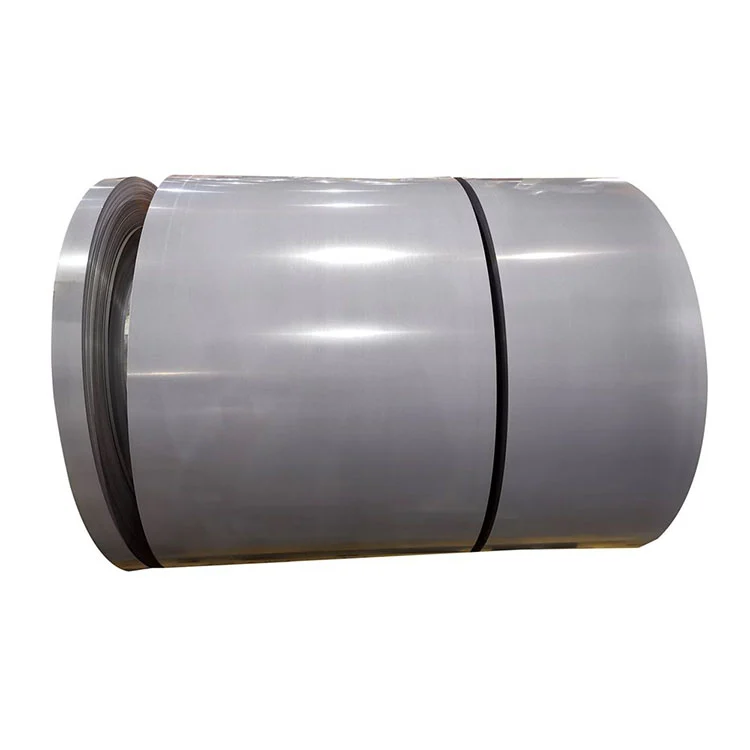
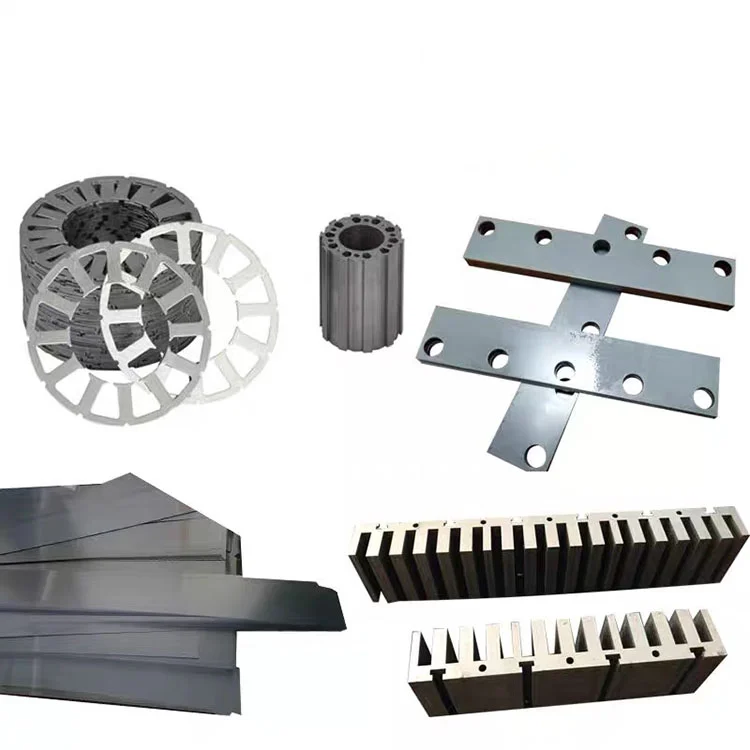
Electrical steel — also called silicon steel or lamination steel — is a soft-magnetic iron–silicon alloy, cold-rolled to strip 0.10–0.65 mm thick and coated with an insulating film, used to build the laminated cores of transformers, motors, generators and reactors. It comes in two main families: grain-oriented (CRGO), optimised for low loss along one rolling direction in transformers, and non-oriented (CRNGO), with near-uniform properties in the sheet plane for rotating machines — plus thin-gauge grades for medium- and high-frequency use. Zhongxin Special Steel manufactures and exports both families across GB, AISI/ASTM, EN and JIS grade systems, with cross-standard matching and certified test data.
The material class
Three families under one name
Everything called “electrical steel” is cold-rolled silicon steel. The families differ in how the grains are aligned and how thin the strip is rolled — and therefore in core loss, induction, workability and price.
Transformer core steel
Grains aligned to the rolling direction for very low loss and high induction along that axis. The standard choice for power and distribution transformers at 50/60 Hz, in conventional (CGO) and high-permeability (Hi-B) grades.
Grain-oriented range →Motor & generator steel
Near-isotropic magnetic properties in the sheet plane, because flux rotates relative to the laminations in a rotating machine. Specified by loss level and thickness, from EV traction grades to economy appliance-motor grades.
Non-oriented range →Medium / high-frequency steel
0.10–0.20 mm grain-oriented and high-frequency non-oriented strip for 400 Hz to several kHz — aerospace, ground-power units, traction auxiliaries and medium-frequency transformers.
Thin-gauge range →What it is & why it matters
The material, and the numbers that drive selection
What the silicon does
Electrical steel is low-carbon steel alloyed with roughly 0.5–3.5% silicon, plus small aluminium and manganese additions. Silicon raises the alloy’s electrical resistivity, which suppresses eddy-current losses in an AC magnetic field, and it reduces magnetostriction and magnetic ageing. The trade-off is that more silicon makes the strip harder and more brittle to roll and stamp, and slightly lowers saturation. The steel is always used as thin, individually insulated laminations rather than a solid block, because dividing the core into thin layers is the other half of controlling eddy-current loss. Every lamination carries a thin surface coating that provides interlaminar insulation and acts as a die lubricant during stamping.
Grain-oriented vs non-oriented — the split that governs selection
Grain-oriented (GO / CRGO) steel is processed so the crystal grains are aligned — the “Goss texture” — to give exceptionally low loss and high permeability in the rolling direction only. That suits transformer cores, where flux follows a fixed path around the limbs and yokes. Within GO there are conventional grades (CGO) and high-permeability grades (Hi-B, the GB “QG” designation), the latter with lower loss, higher B8 and lower audible noise. Non-oriented (NGO / CRNGO) steel has near-isotropic properties in the sheet plane, because in a motor or generator the flux rotates relative to the sheet. NGO is chosen by its loss level and thickness: lower-loss, thinner grades for EV traction and high-efficiency industrial motors, higher-loss economy grades for fractional-horsepower appliance motors.
The indicators on a datasheet
Selection turns on a small set of numbers. Core loss (specific total loss) is the energy dissipated per kilogram, quoted at a stated peak induction and frequency: GO as P1.7/50 (W/kg at 1.7 T, 50 Hz), NGO as P1.5/50; lower is better and directly cuts no-load losses and running temperature. Induction / polarisation is quoted as B8 for GO (induction at 800 A/m — higher means a smaller, cheaper core for the same rating) and B50 for NGO (at 5000 A/m). Relative permeability is very high for Hi-B GO along the rolling direction and much lower for NGO. Stacking (lamination) factor is the fraction of stack height that is actually steel — typically ≥ 0.965 for 0.27–0.30 mm GO and ≥ 0.97 for 0.50 mm NGO, and it falls as the strip gets thinner.
Supplied forms
Coil, sheet, slit strip or laminations
Both families are stocked as master coil and processed in-house to your order — cut to length, slit to width, or stamped to a lamination drawing.
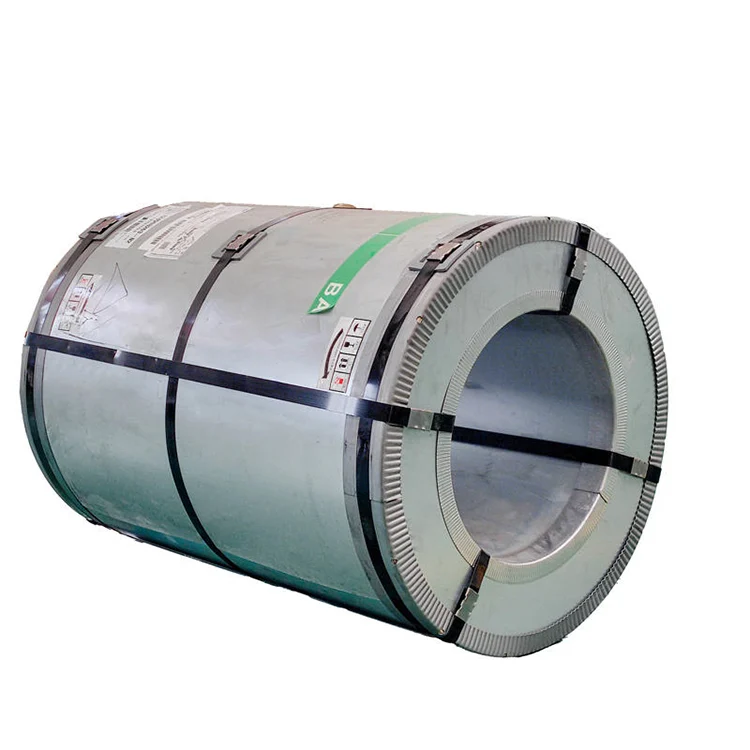
Coil
Master and mill-edge coils wound to your inner diameter and coil weight.
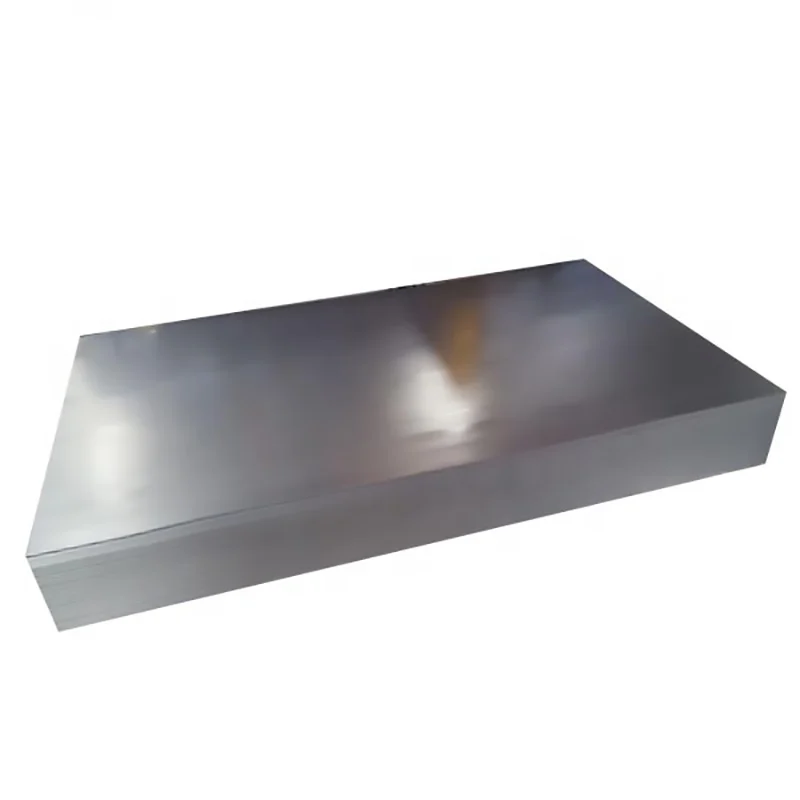
Sheet
Cut-to-length sheet in standard and custom lengths, ready for shearing or stamping.
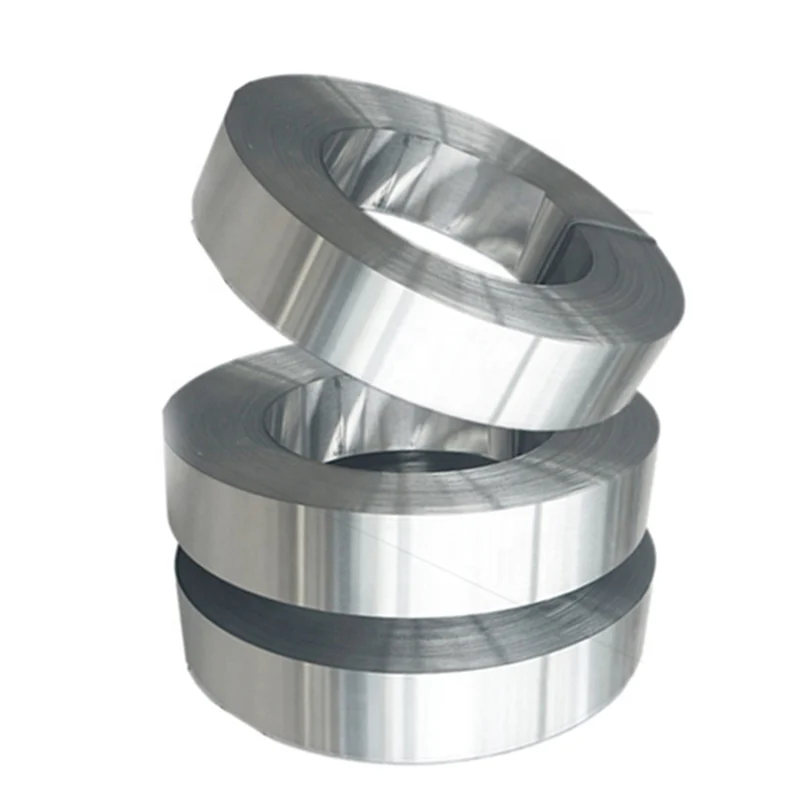
Slit strip
Precision slit to width with tight camber, for stamping and C-core winding.
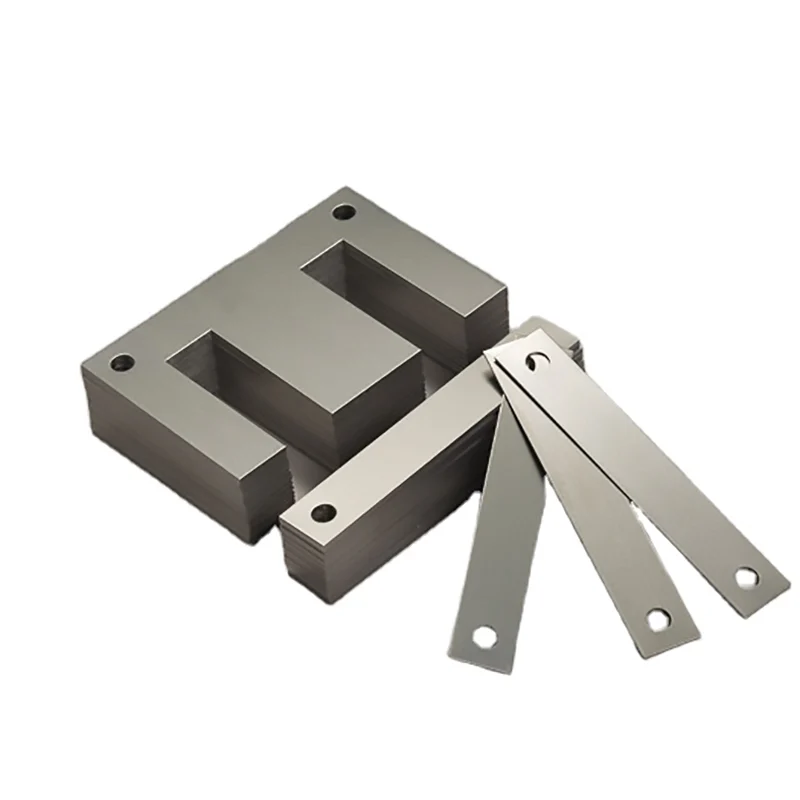
Laminations
Die-cut or laser-cut E-I, mitred and toroidal laminations to drawing.
By family & grade
Representative grades across the class
Family-level reference ranges for orientation, not guaranteed single-grade values. P1.7/50 and P1.5/50 = core loss at 1.7 T and 1.5 T, 50 Hz (W/kg). B8 at 800 A/m, B50 at 5000 A/m (T). Project datasheets are issued against the applicable standard and lot test results.
| Family | GB grade | AISI / ASTM | EN | JIS | Core loss | Induction | Typical use |
|---|---|---|---|---|---|---|---|
| Grain-oriented, conventional (CGO) | 30Q130 | M-5 (≈) | M140-30S | 30G130 | P1.7/50 ≈ 1.20–1.35 | B8 ≈ 1.82–1.88 | Distribution transformers, small power transformers |
| Grain-oriented, conventional (CGO) | 27Q120 | M-4 (≈) | M120-27S | 27G120 | P1.7/50 ≈ 1.10–1.25 | B8 ≈ 1.82–1.88 | Distribution transformers, reactors, instrument transformers |
| Grain-oriented, high-permeability (Hi-B) | 27QG100 | — | M100-27P | 27ZH100 | P1.7/50 ≈ 0.95–1.05 | B8 ≈ 1.88–1.92 | Medium and large power transformers |
| Grain-oriented, high-permeability (Hi-B) | 23QG090 | — | M090-23P | 23ZH90 | P1.7/50 ≈ 0.85–0.95 | B8 ≈ 1.89–1.93 | Large power transformers, low-noise designs |
| Grain-oriented, thin-gauge | 15Q / 10Q | — | — | — | P1.0/400 ≈ 8–14 | B8 ≈ 1.80–1.90 | 400 Hz–2 kHz transformers, aerospace, traction auxiliaries |
| Non-oriented, fully processed | 50W470 | M-19 (≈) | M470-50A | 50A470 | P1.5/50 ≈ 4.4–4.9 | B50 ≈ 1.60–1.64 | General-purpose motors, generators, pumps, compressors |
| Non-oriented, fully processed | 35W300 | — | M330-35A | 35A300 | P1.5/50 ≈ 2.8–3.2 | B50 ≈ 1.58–1.63 | EV traction motors, high-speed and IE4/IE5 motors |
| Non-oriented, economy | 50W800 | — | M800-50A | 50A800 | P1.5/50 ≈ 7.5–8.5 | B50 ≈ 1.64–1.68 | Fractional-hp appliance motors, intermittent duty |
| Non-oriented, semi-processed | semi-processed 0.50–0.65 mm | A683 class | — | — | P1.5/50 ≈ 5–7 after anneal | B50 ≈ 1.62–1.66 | High-volume motor cores finished with an in-house anneal |
Send us any one grade — GB, AISI, EN or JIS — and we return the cross-standard match plus the closest grade we manufacture, with a datasheet, before quoting.
Grade numbering
Four standards, four names for the same steel
The grade number encodes thickness and loss differently in each system, so one physical material carries four designations. How to read each one:
27Q120 · 50W470
GO: 27 = 0.27 mm, Q = grain-oriented, 120 = 100 × P1.7/50 (1.20 W/kg). High-permeability grades use QG (e.g. 23QG090). NGO: 50 = 0.50 mm, W = non-oriented, 470 = 100 × P1.5/50 (4.70 W/kg).
M-4 · M-19
GO “M-numbers” track thickness: M6 ≈ 0.35, M5 ≈ 0.30, M4 ≈ 0.27, M3 ≈ 0.23 mm. NGO fully-processed grades run M-15, M-19, M-27, M-36, M-43, M-45, M-47 — lower number, lower loss. Standards: A876 (GO), A677 (NGO), A683 (NGO semi-processed).
M120-27S · M470-50A
Format M{loss}-{thickness}{letter}. M120-27S = ≤ 1.20 W/kg at 1.7 T/50 Hz, 0.27 mm, S conventional GO (P = high-permeability). M470-50A = ≤ 4.70 W/kg at 1.5 T/50 Hz, 0.50 mm, A non-oriented fully processed.
27G120 · 50A470
GO: 27G120 = 0.27 mm, G grain-oriented, loss code 120; high-B grades appear as 23ZH90 style. NGO: 50A470 = 0.50 mm, A non-oriented, loss code 470.
- 23QG090 (GB, Hi-B) ≈ M090-23P (EN) ≈ 23ZH90 (JIS) · 0.23 mm GO
- 27QG100 (GB, Hi-B) ≈ M100-27P (EN) ≈ 27ZH100 (JIS) · 0.27 mm GO
- 27Q120 (GB) ≈ M-4 (AISI) ≈ M120-27S (EN) ≈ 27G120 (JIS) · 0.27 mm GO
- 30Q130 (GB) ≈ M-5 (AISI) ≈ M140-30S (EN) ≈ 30G130 (JIS) · 0.30 mm GO
- 35W300 (GB) ≈ M330-35A (EN) ≈ 35A300 (JIS) · 0.35 mm NGO
- 50W470 (GB) ≈ M-19 (AISI) ≈ M470-50A (EN) ≈ 50A470 (JIS) · 0.50 mm NGO
- 50W800 (GB) ≈ M800-50A (EN) ≈ 50A800 (JIS) · 0.50 mm NGO
Equivalence is a working guide, not full interchangeability — confirm against actual test data before design release.
Technical & physical properties
Common to the electrical-steel range
By application
Where electrical steel goes
Power Transformers
Hi-B and domain-refined 0.23/0.27 mm grain-oriented grades where no-load loss drives lifetime cost.
Distribution Transformers
Conventional CGO and Hi-B 0.27/0.30 mm balancing loss against material economics for volume builds.
EV & Industrial Motors
Thin, low-loss 0.35 mm non-oriented grades for traction motors and IE4/IE5 industrial drives.
Generators & Reactors
0.50 mm non-oriented for generators and alternators; conventional CRGO for shunt reactor and instrument-transformer cores.
How it’s measured
Magnetic properties are tested, not calculated
Specific total loss and induction are measured on the finished strip with an Epstein frame (IEC 60404-2 / GB/T 3655 / ASTM A343) or a single-sheet tester (IEC 60404-3 / GB/T 13789), quoted at the standard reference points — 1.7 T/50 Hz for grain-oriented, 1.5 T/50 Hz for non-oriented. Stacking factor follows IEC 60404-13. Interlaminar surface insulation resistance of the coating is checked by the Franklin test (ASTM A717 / A937). Thickness and shape — crown, edge camber, waviness — are verified against the applicable strip standard. Zhongxin issues a mill test certificate per coil or lot; independent third-party testing (SGS or equivalent) can be arranged on request.
Choosing a grade
Which line fits your design
Start from what you are building; each route below links to the product line with full thickness, grade and property data.
Transformer cores, 50/60 Hz
Grain-oriented steel. Distribution and small power → conventional CGO 0.27–0.30 mm. Medium/large power, low-noise or high-efficiency → Hi-B and thinner gauges.
Standard CRGO →Hi-B / high-permeability CRGO →
Motors, generators, alternators
Non-oriented steel, chosen by duty. EV traction and IE4/IE5 → thin 0.35 mm. General-purpose → 0.50 mm mid grades. Cost-driven appliance motors → economy or semi-processed.
Non-oriented range →400 Hz to several kHz
Standard transformer strip loses too much energy here. Use ultra-thin 0.10/0.15 mm grain-oriented, or high-frequency non-oriented grades for rotating machines.
Ultra-thin silicon steel →You only have a foreign grade
Send the AISI, EN or JIS grade with your thickness, width and form (coil / sheet / slit strip). We confirm the equivalent and point you to the matching line.
Grade equivalents chart →How we work
From enquiry to delivered coil
Send your spec
Family, thickness, grade, width and coating, or upload a drawing.
Quote in 24h
Matched grade, guaranteed loss and induction, availability in one business day.
Free samples
Test core loss and stampability, usually within a week.
Production & QC
Rolled, slit and tested coil by coil, with a mill certificate.
Export delivery
Moisture-proof packing and ocean freight to your port.
Packaging & export
Seaworthy packing to any port
Coil packaging
Moisture-proof kraft paper and VCI wrap, banded with edge and coil-eye protection.
Sheet & strip packaging
Strapped on wooden pallets or steel racks, corner-protected for forklift handling.
Container loading
Coils secured with dunnage and lashing, by container or in bulk for break-bulk.
FAQ
Sourcing electrical steel from us
What is the practical difference between grain-oriented and non-oriented electrical steel?
Grain-oriented (CRGO) is engineered for very low loss and high permeability in one direction — the rolling direction — which suits transformer cores where the flux path is fixed. Non-oriented (CRNGO) gives similar properties in every in-plane direction, which is what a motor or generator needs because the flux rotates relative to the laminations. They are not interchangeable.
My drawing calls out an AISI M-number, EN M-grade or JIS grade. Can you supply against it?
Yes. Give us the grade plus thickness, width and form. We return the GB equivalent and the nearest grade we manufacture, with a datasheet showing guaranteed loss and induction against the standard you need. Most AISI, EN and JIS transformer and motor grades have a direct GB counterpart.
What thicknesses do you supply, and is thinner always better?
Grain-oriented: 0.18, 0.20, 0.23, 0.27, 0.30, 0.35 mm plus thin-gauge 0.10 and 0.15 mm. Non-oriented: 0.35, 0.50 and 0.65 mm plus high-frequency NGO down to 0.20–0.27 mm. Thinner strip lowers eddy-current loss but costs more per kg, is harder to handle and has a lower stacking factor. Choose the thinnest grade the loss budget and frequency actually require.
What do “P1.7/50” and “B8” mean on a datasheet?
P1.7/50 is the specific total core loss in watts per kilogram at 1.7 T peak induction and 50 Hz — lower means lower transformer no-load loss. B8 is the magnetic polarisation in tesla reached at a field of 800 A/m; a higher B8 lets you run the core at higher flux density and make it smaller for the same rating. For non-oriented steel the equivalents are P1.5/50 and B50 (at 5000 A/m).
Which surface coating should I specify — C5, C6 or C3?
C5 is an inorganic phosphate-based coating with good interlaminar resistance and heat resistance, standard for stress-relief-annealed cores. C6 adds an organic top layer for higher insulation resistance and better punchability. C3 is a thin organic enamel for cores that will not be annealed. Tell us whether you stress-relief anneal and the operating temperature, and we recommend the class.
Do you provide certified test reports?
Every coil or lot ships with a mill test certificate stating chemical composition, thickness, core loss and induction (Epstein or single-sheet method per IEC 60404) and stacking factor. Third-party inspection (SGS or equivalent) can be arranged before shipment on request.
What are minimum order quantities, lead times and samples?
MOQ depends on grade and form — slit strip and cut sheet run smaller than full coils. Free samples of stock grades are available for evaluation. Typical production lead time is a few weeks after spec confirmation; standard grades held in stock ship faster.
What standards and certifications apply?
ISO 9001 and IATF 16949 production; material to GB/T 2521, EN 10107 / 10106, JIS C 2552 / 2553 or AISI/ASTM; RoHS and REACH compliance; mill test certificate with every shipment.
Why buyers choose Zhongxin
Mill-grade electrical steel, export-ready service
Not sure which grade or family fits your core?
Send your application — transformer or motor, rating, frequency, target losses, and any foreign grade on your drawing — and our engineers will recommend a grade, match it across GB/AISI/EN/JIS, and send samples and a quote within 24 hours.
Request a quote → Talk to an engineer