
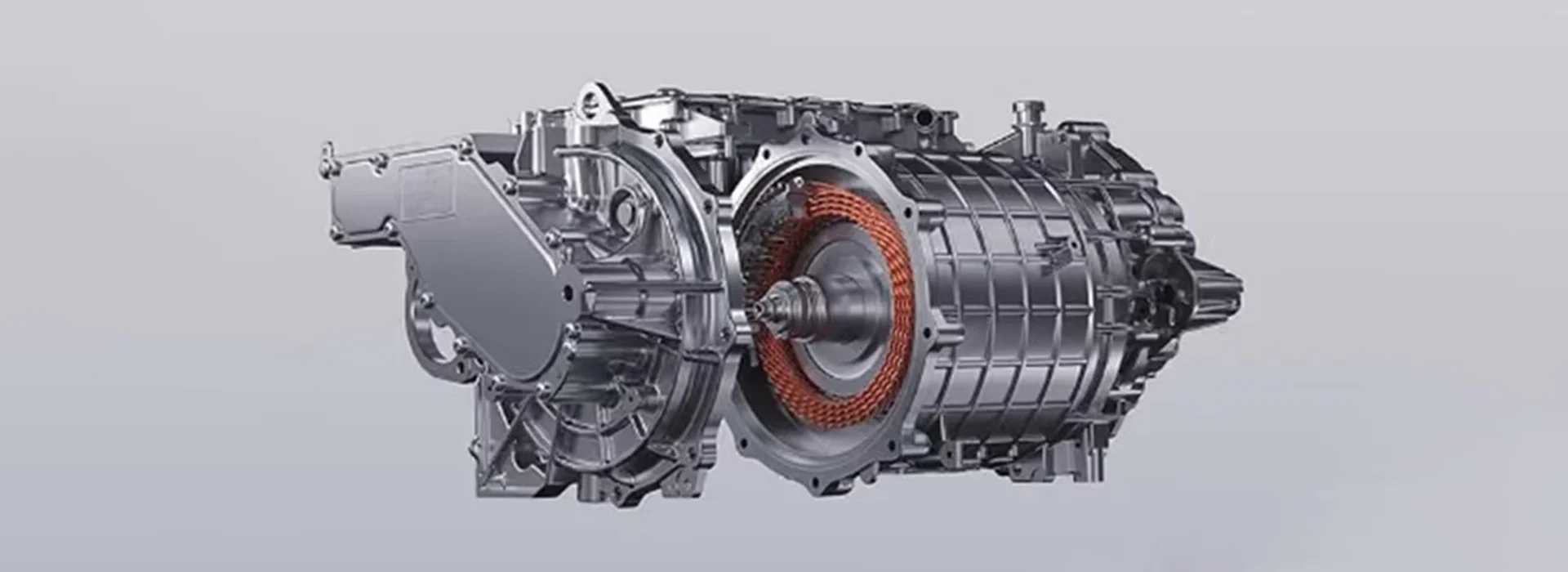
Non-oriented silicon steel / EV traction motors
Application · EV & hybrid traction motors
Non-Oriented Steel for EV Traction Motors
EV traction motors spin faster, switch at higher frequency and are judged on efficiency far more strictly than a typical industrial motor — vehicle range depends on it. We supply high-strength non-oriented steel at 0.20–0.35mm and ultra-thin gauges to 0.05mm, built to survive rotor stress and keep iron loss down as frequency climbs.
Why EV motors need different steel
Faster, hotter, judged by range
An EV traction motor doesn’t behave like a typical industrial motor. Rotor speeds run several times higher, which puts far more mechanical stress on the rotor lamination stack during operation — steel that would deform or fatigue in a high-speed EV rotor holds up fine in a slow industrial motor. Inverter-driven switching pushes the effective electrical frequency well above the 50/60Hz a standard motor sees, and iron loss rises sharply with frequency, so thinner laminations matter more here than almost anywhere else in electrical steel.
And unlike most industrial motors, efficiency isn’t just a cost line — it’s directly tied to vehicle range on a fixed battery pack, so OEMs push core loss down harder than IEC 60034-30 efficiency classes (IE3/IE4) typically demand for stationary industrial motors.
What we recommend
In the field
Non-oriented steel in the EV traction motor
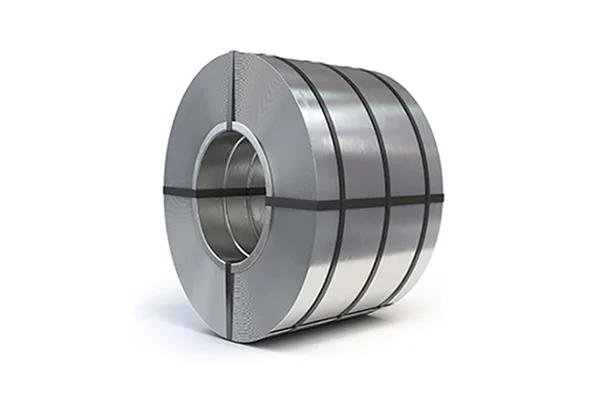
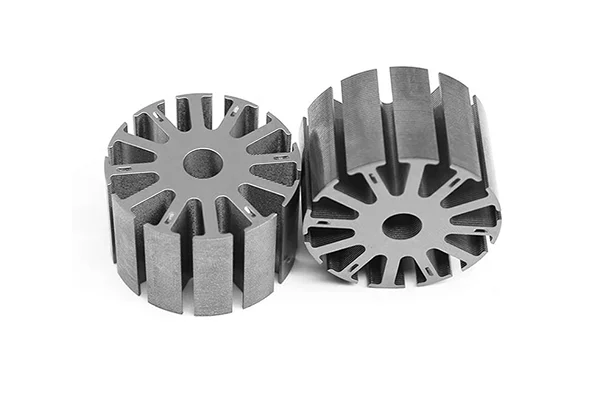
What our high-strength CRNGO looks like from coil to finished rotor and stator laminations.
Recommended grades
Non-oriented lines for EV traction motors
Grade choice splits by what the motor prioritises — mechanical strength for high rotor speed, or minimum core loss for maximum range at a given battery size.
High-Strength CRNGO
Higher yield strength to survive high-speed rotor stress, with core loss kept low for efficiency.
- Thickness0.20–0.35 mm
- Yield strength≥ 600 MPa
- Core loss P1.0/400≤ 13 W/kg
Ultra-Thin CRNGO
Gauges down to 0.05mm to cut eddy-current loss at high rotational speed and switching frequency.
- Thickness0.05–0.20 mm
- Core loss P1.0/400≤ 11 W/kg
- Induction B50≥ 1.60 T
Non-Oriented Hub
Compare all three CRNGO lines side by side before you commit to a grade.
- Thickness range0.05–0.65 mm
- StandardsGB · EN · JIS · AISI
- Grade equivalentsCross-referenced
Technical requirements
What EV traction motor specs typically call for
| Yield strength | ≥ 600 MPa on high-speed rotor grades — survives centrifugal stress at high RPM |
|---|---|
| Core loss (high frequency) | ≤ 11–13 W/kg at 1.0T/400Hz, lower is better as switching frequency rises |
| Thickness | 0.20–0.35mm for high-strength grades; 0.05–0.20mm ultra-thin for the highest-frequency designs |
| Surface insulation | High-temperature, high-adhesion coating — motors run hotter and closer tolerances than typical industrial units |
| Efficiency reference | IEC 60034-30 IE-class framework, though EV OEM efficiency targets typically exceed IE4 |
| Mill certification | Mill test certificate with every order, ISO 9001 / IATF 16949 |
Building a stationary industrial motor instead of a traction motor? See Standard CRNGO for the more cost-balanced spec — view standard CRNGO →
How we work
From enquiry to your dock
A simple path from spec to delivery, built for overseas buyers.
Send your spec
Rotor RPM, switching frequency, target loss, or a drawing.
Quote in 24h
Grade recommendation, pricing and availability within one business day.
Free samples
Test core loss and stampability, usually within a week.
Production & QC
Rolled, slit and tested to grade, with a mill certificate.
Export delivery
Moisture-proof packing and ocean freight to your port.
FAQ
Non-oriented steel for EV traction motors
Why does an EV traction motor need higher yield strength steel than an industrial motor?
EV rotors often spin several times faster than a typical industrial motor. At high RPM, centrifugal force puts significant mechanical stress on the rotor lamination stack, so the steel needs enough yield strength (≥600 MPa on our high-strength grades) to avoid deformation or fatigue over the motor’s service life.
How do I choose between High-Strength CRNGO and Ultra-Thin CRNGO?
High-Strength CRNGO (0.20–0.35mm) is the default for most EV traction rotors, balancing strength and loss. Ultra-Thin CRNGO (0.05–0.20mm) goes further on high-frequency or very high-speed designs, like some drone and servo motors, where eddy-current loss at frequency dominates over the strength requirement.
Why does switching frequency matter for core loss?
Inverter-driven EV motors operate at electrical frequencies well above the 50/60Hz a grid-connected industrial motor sees. Iron loss rises sharply with frequency, so thinner laminations — which reduce eddy-current loss — matter more here than in most other electrical steel applications.
Can you supply against our own datasheet or a competitor’s grade?
Yes — send us your datasheet or the grade code you’re currently using and we’ll confirm the closest match, or produce to your exact spec where feasible.
What’s the lead time and MOQ for EV-grade CRNGO?
Quotes come within 24 hours. High-strength and ultra-thin gauges are typically made-to-order — tell us your volume and timeline and we’ll confirm lead time and pricing tiers.
Why buyers choose Zhongxin
Mill-grade material, export-ready service
Wuxi Zhongxin Special Steel Co., Ltd. is a Chinese manufacturer and exporter of non-oriented silicon steel, serving EV and motor makers across Europe, the Americas, Asia and beyond.
Send your rotor spec — get a grade recommendation
RPM, switching frequency, target loss, or a drawing — we’ll recommend a grade and quote in 24 hours.