
For a small order of electrical steel, send samples and the first few dozen kilograms by express courier, a few hundred kilograms on one pallet by air or express freight, and one to a few tonnes by LCL sea freight; full coils go by container. Steel is dense, so weight rather than volume sets what each carrier will take and what it counts. This guide shows where each route stops working, how to cut and pack sheet so it arrives flat and dry, and which HS code and papers go with it.
If you still need to find a seller at this quantity, start with where to buy electrical steel. This guide starts one step later: you have a supplier and a quantity, and you need to decide how the steel travels.
Quick reference: which route fits which quantity
| Quantity | Usual route | What limits it |
|---|---|---|
| Up to about 25 kg (samples) | Express courier parcel | DHL Express Worldwide: 70 kg and 120 × 80 × 80 cm per piece, so sheet must be cut to fit |
| About 25–100 kg | A few courier parcels | Couriers are generally used up to about 100 kg in total, sometimes 300 kg |
| About 100–1,000 kg | One pallet by express pallet service or air freight | DHL Express Worldwide pallets: up to 1,000 kg and 300 × 200 × 160 cm |
| About 1–5 tonnes | LCL sea freight; air freight if urgent | Billed on weight or volume, whichever is larger; consolidation adds days |
| About 5 tonnes and up (roughly one coil) | Full container | See the container-loading guide below |
The quantity bands are our planning rule of thumb. The per-piece limits are the carriers’ published figures; carriers revise them and services differ by route, so confirm with the one you will use.
Why does weight, not volume, decide how electrical steel ships?
Because electrical steel is dense and thin, a heavy lot takes up very little room. At a representative 7.65 g/cm³, a 0.35 mm sheet measuring 1,000 × 2,000 mm weighs 5.355 kg, and 186 of them, just under a tonne, make a stack only about 65 mm high. Our guide to electrical steel density and weight gives the formula and the grade-by-grade spread in density.
Each mode of transport charges on the larger of actual weight and volume, and each has its own rule:
- Express courier: actual weight or volume ÷ 5,000 (cm³ per kg), whichever is higher. DHL Express’s 2026 sheet gives the same factor as 200 kg/m³.
- Air freight: the higher of gross weight and volumetric weight. Maersk gives volume ÷ 6,000 and notes that some carriers use 5,000.
- LCL sea freight: cost follows weight in tonnes or volume in cubic metres, whichever is larger (W/M). Forwarders set their own conversions; one large forwarder treats cargo above 800 kg per cubic metre as heavy and bills it by weight.
Two worked cases show which side wins. Both use 0.35 mm sheet at 7.65 g/cm³, and the packed sizes are our assumptions.
| Lot | Net steel | Assumed packed size | Volumetric weight | What the carrier counts |
|---|---|---|---|---|
| 15 sheets, 600 × 1,000 mm | 24.1 kg | 105 × 65 × 10 cm parcel | 13.65 kg (÷ 5,000) | Actual (gross) weight |
| 186 sheets, 1,000 × 2,000 mm, on a pallet | 996 kg | 100 × 200 × 30 cm | 100 kg (÷ 6,000) | Actual (gross) weight |
In both cases the volumetric figure is a fraction of the real weight. The German insurers’ transport service TIS-GDV lists stowage factors for steel sheet of 0.22 to 0.47 m³ per tonne, so in a W/M quote the tonnes figure is the larger number. A freight quote for a small electrical steel lot therefore follows the gross weight on the scale. You save money by trimming packing weight, consolidating parcels and ordering what you need, not by squeezing the box smaller.
What fits in a courier parcel?
The limits come from the carrier, not the steel. DHL Express Worldwide takes up to 70 kg per piece at 120 × 80 × 80 cm; its 9:00 service is limited to 25 kg and 100 × 80 × 80 cm. FedEx International Priority and Economy take up to 150 lb (about 68 kg), 108 in (274 cm) in length and 130 in (330 cm) in length plus girth, according to an EasyPost summary of FedEx’s limits.
A packed 1,000 × 2,000 mm sheet measures about 2.1 × 1.1 × 0.1 m. That is longer than DHL’s 120 cm, and at 450 cm of length plus girth it is over FedEx’s 330 cm. Sample sheet therefore has to be cut smaller:
- Cut to about 1,000 × 600 mm or less, so the packed parcel stays inside a 120 × 80 cm footprint.
- Count sheets by weight, not by thickness. A 600 × 1,000 mm sheet at 0.35 mm weighs 1.61 kg. Fifteen sheets are about 24 kg and a stack barely 5 mm thick, so the parcel is heavy for its size.
- Pack between two rigid boards. A thin stack in a long box flexes, and bending strains the steel and raises core loss.
- Cut to your own process size if you can. If your laser bed or press takes 500 × 1,000 mm, ask for that size; every extra cut at your end is scrap.
- Consider narrow strip. A few hundred kilograms of slit strip ships as one or two small coils, the most compact form. Our slitting service page lists the widths and forms available.
For non-oriented samples, our CRNGO steel sheet page lists the cut-to-length forms we supply. If you only need a few sheets to prove a laser-cut or stamped lamination, send the dimensions of your blank and we will do our best to meet them.
When do an express pallet or air freight make sense?
Use them between about 100 kg and one tonne, when a parcel is too small a unit and sea freight is too slow. DHL Express Worldwide accepts pallets up to 1,000 kg and 300 × 200 × 160 cm, so a full 1,000 × 2,000 mm sheet fits on one. DHL’s sheet adds that any piece over 70 kg must be in a fork-movable crate or on a stackable pallet.
Air freight uses the same logic with a different factor. A pallet of 1,000 × 2,000 mm sheet packed 0.3 m high takes 0.6 m³, which is 100 kg of volumetric weight at ÷ 6,000 against roughly a tonne of actual weight, so weight decides again. Two checks before you book:
- Door or airport? Ask whether the quote ends at the destination airport or at your dock. Airport-only quotes leave local delivery and clearance to you.
- Forklift at the receiving end? A pallet near a tonne needs a forklift or pallet truck. If your address has none, ask for smaller packages or a tail-lift delivery.
Express and air routes pay off when schedule matters more than freight per kilogram, for example a pilot build waiting on material. If time is not critical, get a sea quote for the same pallet and compare.
Is LCL or a full container the better choice?
LCL, less than container load, puts your pallets into a container shared with other shippers, and it suits lots from about one tonne up to a few tonnes. Your cargo passes through a consolidation warehouse at the port of loading and is unstuffed at the destination, so it is handled more often than in a full container and needs sturdier packing.
Sea transit comes on top of production. Our standard export wording is FOB Shanghai or Ningbo with 25–45 days of ocean freight, and LCL adds time for consolidation before sailing and unstuffing after arrival. Ask your forwarder for the cargo cut-off date and the free storage days at the destination.
Once a lot approaches one coil, about 5 tonnes, ask for a full-container quote as well. Our guide to container loading and packaging for steel coil export shows how coils are blocked and secured.
How should small lots be packed?
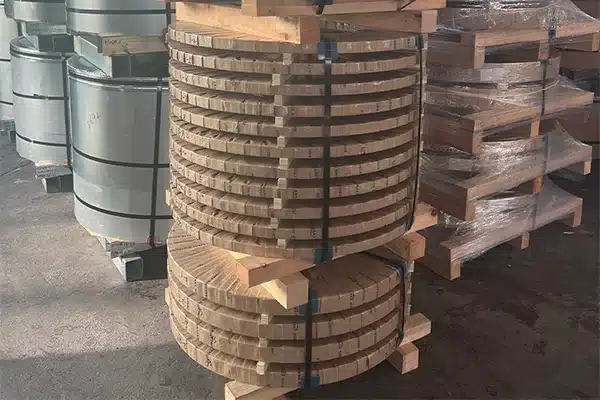
Pack sheet and slit strip like a full coil shipment, only in smaller units. TIS-GDV says electrical steel needs multilayer packaging: kraft paper or VCI (volatile corrosion inhibitor) paper, PE film of at least 150 µm (or two 100 µm layers), edge protectors and a wooden skid. Packages on a skid should have at least two longitudinal straps and, depending on length, at least three transverse ones, and the skid should be sized so the package edges do not overhang.
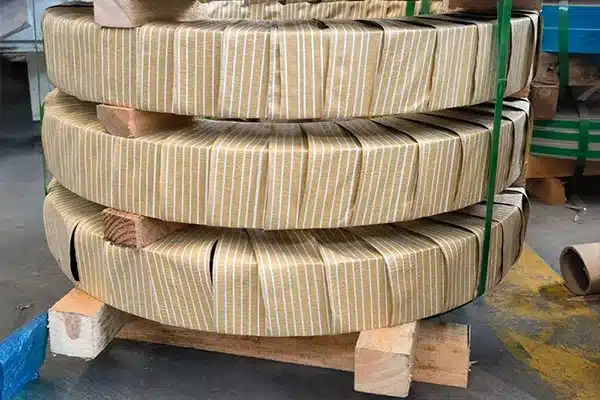
Moisture is the main risk on a long route. TIS-GDV notes that corrosion starts at about 40% relative humidity and speeds up above 60%, and that cold steel under warm, humid air collects condensation. Two habits follow from that:
- Mark the package “KEEP DRY” and “DO NOT UNWRAP UNTIL STEEL REACHES ROOM TEMPERATURE.” After a winter crossing, a cold coil or stack opened in a warm hall will sweat.
- Protect sharp edges. Sheared and slit edges can cut through film and strapping. Edge protectors under the straps also stop the strap from denting the stack.
Wooden pallets, skids and crates for export must meet ISPM 15: heat-treated (or fumigated) wood carrying the IPPC mark. Ask the supplier to confirm the mark on the pallet before it ships. For what happens once the steel is in your store, see our guide on whether electrical steel rusts.
Which HS code and documents go with the shipment?
Flat-rolled silicon-electrical steel falls under HS 7225 or 7226, and the split is width. Material 600 mm wide or more goes under 7225; narrower material goes under 7226. Within each heading, subheading .11 is grain-oriented and .19 is the other silicon-electrical steel, which covers non-oriented grades.
| What you ship | Genişlik | Six-digit HS code |
|---|---|---|
| Cut sheet, non-oriented, 1,000 mm wide | 600 mm or more | 7225.19 |
| Cut sheet, grain-oriented, 1,000 mm wide | 600 mm or more | 7225.11 |
| Slit strip, non-oriented, 300 mm wide | Under 600 mm | 7226.19 |
| Slit strip, grain-oriented, 300 mm wide | Under 600 mm | 7226.11 |
Slitting a wide coil into narrow strip can therefore move it from 7225 to 7226, so the code on the invoice must match the form that actually ships. Importing countries add digits after the sixth, and stamped laminations are finished parts that are usually classified separately from flat-rolled steel. Have your customs broker confirm the full national code before you order; our electrical steel import customs guide covers Europe, North America and the Middle East.
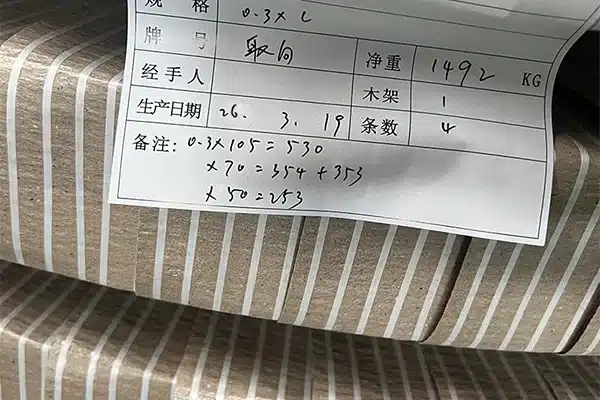
The usual documents are a commercial invoice, a packing list, a mill test certificate and, where required, a certificate of origin. Put net and gross weight per package on the packing list, and declare samples at their real commercial value even when they are priced with freight. Trade measures follow the HS code and the country of origin, so check them before you commit; our article on the Section 232 tariff and transformer steel laminations shows one example.
Which Incoterm suits a small order?
For parcels and pallets, ask for a delivered term. Under DAP the seller delivers to your named address, and the buyer carries out and pays for import clearance; under DDP the seller takes that on as well, unless local rules require the importer to clear the goods, in which case DAP applies, according to the ICC. Under FOB the seller puts the goods on board at the port of loading and you book the main carriage, which suits LCL if you already work with a forwarder.
Our standard terms are FOB Shanghai or Ningbo, with CFR and CIF on request, and our sample price includes freight. Which term fits depends on who in your company can handle import clearance. Our guide to FOB, CIF and DDP for electrical steel imports compares them.
What should you add to the inquiry?
Add the shipping details to the grade, size and quantity you already send. They decide the packaging and the quote.
| Include | Example | Why it matters |
|---|---|---|
| Delivery address and unloading | Factory with dock and forklift | A one-tonne pallet needs lifting equipment |
| Largest package you can handle | No piece over 25 kg | Sets how the lot is split |
| Delivery term and who clears customs | DAP, buyer clears | Decides who needs a broker |
| Importer number, where required | Tax or EORI number | Needed for entry in some countries |
| Date you need the steel | On site by 20 January | Chooses courier, air or sea |
| Weight basis | Net and gross per package | Lets you reconcile the delivery |
These items sit on top of the core fields in our electrical steel RFQ checklist.
What do we supply, and in what quantities?
These are our usual terms as of November 2026. They are typical figures, and we confirm quantity and date with each quotation.
| You need | What we do | Typical minimum | Typical time |
|---|---|---|---|
| Material to test | Sample of a stocked grade, freight included | USD 200, refunded against a bulk order | About one week |
| Cut sheet | Sheared to your size | 500 kg | About 15 days |
| Less than a full coil | Cut from a coil, as coil or slit strip | For example 3 tonnes | About 15 days if in stock |
| Full coil | Coil as produced, or slit to width | About 5 tonnes | About 15 days |
Grain-oriented cut sheet is on our CRGO steel sheet page. If your lot is smaller than these minimums, send us the grade, size, quantity and destination and we will do our best to meet it. We reply to a complete inquiry with price, lead time and the packing we propose.
Bottom line
Match the route to the weight, then pack for moisture.
- Samples up to about 25 kg: express courier, with sheet cut to 1,000 × 600 mm or smaller.
- About 25–100 kg: a few courier parcels.
- About 100–1,000 kg: one pallet by express pallet service or air freight.
- About 1–5 tonnes: LCL sea freight; ask for an air quote if the date is tight.
- About 5 tonnes and up: full container.
- Whatever the route: multilayer packing, edge protectors, ISPM 15 wood, the right HS code on the invoice, and net and gross weight on the packing list.
FAQ
Can electrical steel samples go by DHL or FedEx?
Yes, if they are cut to fit. DHL Express Worldwide takes 70 kg and 120 × 80 × 80 cm per piece, and FedEx International Priority takes 150 lb. A packed 1,000 × 2,000 mm sheet exceeds both, so ask for pieces of about 1,000 × 600 mm or smaller, packed flat between rigid boards in paper and film.
Is air freight or LCL better for 500 kg of electrical steel?
It depends on the date. Both bill on weight for steel, because the volumetric figure is far lower than the real weight. Sea freight usually costs less per kilogram and takes longer; air or an express pallet reverses that. Ask for both quotes with the same gross weight and delivery term.
Can electrical steel corrode during shipping?
It can. TIS-GDV reports that corrosion starts at about 40% relative humidity and accelerates above 60%. Use VCI or kraft paper, PE film of at least 150 µm, edge protectors and a skid, and leave the package wrapped until the steel reaches room temperature, so condensation does not form on cold metal.
What HS code applies to electrical steel sheet?
Flat-rolled silicon-electrical steel is under 7225 if it is 600 mm wide or more and 7226 if it is narrower. Subheading .11 is grain-oriented and .19 is other, which includes non-oriented. Importing countries add further digits, so confirm the full code with your customs broker. Stamped laminations are classified separately.
Who pays import duty on a sample?
It depends on the Incoterm. Under DAP the buyer carries out and pays for import clearance; under DDP the seller does, unless local rules require the importer to clear the goods. Ask which term your quote uses, and check whether the sample price includes freight only or duties as well.
Need to move a small lot of electrical steel? Contact our team with the grade, size, quantity, destination and the delivery term you prefer.
References
- DHL Express — Weights and dimensions, 2026. Used for the 70 kg, 25 kg, pallet and volumetric figures.
- EasyPost — FedEx weight limits. Used for the FedEx International weight and size limits; a third-party summary, so confirm with FedEx.
- Maersk — Air cargo chargeable weight. Used for the ÷ 6,000 and ÷ 5,000 divisors.
- DHL Global Forwarding — The cost drivers of LCL rates. Used for the W/M rule.
- Flexport — Cargo measurements: differences. Used for the 800 kg per cubic metre heavy-cargo threshold.
- TIS-GDV — Steel sheet in sheets. Used for packaging layers, strapping, humidity, condensation and stowage factors.
- Global Sources — How to send small quantities and samples in and out of China. Used for typical courier weight ranges.
- Japan Customs (Kanzei) — HS 7226.11. Used for the 7226.11 description.
- FreightAmigo — HS code for silicon electrical steel sheets. Used for the 600 mm split between 7225 and 7226 and the .11 and .19 subheadings.
- ICC Academy — Incoterms 2020: DAP or DDP. Used for the import-clearance responsibilities.
- Australian Department of Agriculture — ISPM 15. Used for the wood packaging treatment and mark.
- Zhongxin Steel — sales terms for samples, cut sheet and coil, as stated by our sales team, November 2026.


