
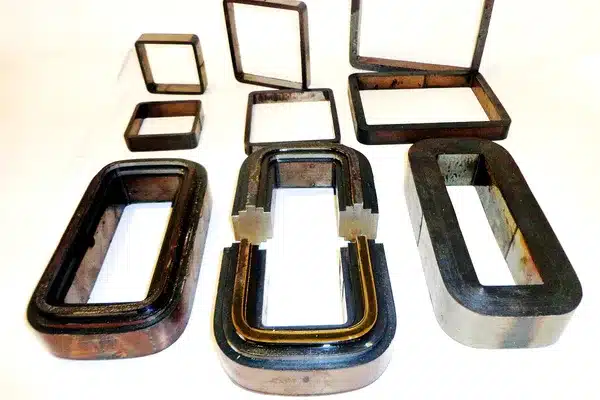
Transformer core types fall into two families: stacked cores assembled from flat sheets cut to length, and wound cores made by winding one continuous strip of grain-oriented electrical steel, such as the toroidal transformer core, the C-core and the wound distribution core. That one difference changes what the core maker buys: strip width, coil size, joints per coil, scribed or non-scribed grade and coating all follow from it. This guide compares the core types, explains where each loses efficiency, and lists what to write on the steel order for each.
If you need the basics first, our explainer on why transformer cores are laminated covers eddy currents and insulation. This article starts where that one stops: the shape of the core and the steel it needs.
Key Takeaways
- In a wound core the flux follows the rolling direction of grain-oriented strip all the way round. In a stacked core it has to turn across the grain at every corner joint.
- Wound cores are bent, so they normally need a stress relief anneal. A Unicore-type core, bent only at its corners, can skip it.
- Whether the core is annealed decides the grade. Laser-scribed steel loses its domain refinement above about 600 °C. Annealed wound cores need non-scribed or heat-resistant (grooved) grades.
- Under the US distribution transformer rule that takes effect in 2029, DOE estimates 89% of liquid-immersed units can still be met with grain-oriented steel cores.
- For wound cores, the order should state coil inner diameter, maximum outer diameter or weight, and the number of breaks or welds allowed per coil, as well as width and gauge.
What Are the Main Transformer Core Types?
The four transformer core types below cover almost every grain-oriented steel core. A wound core is made from strip coiled on a mandrel; a stacked core is built sheet by sheet from cut laminations. A 2021 JFE Steel patent filing on wound cores describes the usual route: the whole wound core “is subjected to bending into a prescribed shape,” then shape correction, then strain relief annealing.
| Core type | How it is made | Typical use | What the core maker buys |
|---|---|---|---|
| Toroidal (uncut ring) | Several hundred turns of strip wound on a round mandrel, annealed, insulated, then wound with copper on a toroid machine | Power transformers for audio and electronic equipment | Narrow slit GO strip, often 0.23–0.30 mm |
| C-core (cut core) | Wound on a rectangular mandrel, bonded, cut into two halves; cut faces ground so they mate | 400 Hz aircraft and military units, chokes with an air gap | Slit GO strip, thinner gauges for higher frequency |
| Wound distribution core (Unicore type) | Strip cut to a length per turn, bent at four corners, closed with a step-lap joint in one leg | Single-phase and three-phase distribution transformers | Slit GO strip at core width; grade depends on whether the core is annealed |
| Stacked core | Sheets cut to length with mitred ends, laid in step-lap joints; several widths form a stepped cross-section | Power transformers, larger distribution and dry-type units | Slit strip in several widths, or sheet, cut to length by the core maker |
A 2002 US patent on toroidal transformers gives a typical wound core as “several hundred turns of a grain-oriented silicon steel strip, about 0.2 to 0.3 mm thick, around a cylindrical jig.” For C-cores, IEC 60329 covers strip-wound cut cores of rectangular section made from cold-reduced grain-oriented silicon-iron strip, and leaves some requirements to agreement between user and maker.
All four transformer core types start from the same CRGO steel coil. What changes is how the coil is slit, cut and wound before it becomes a core.
Stacked cores have their own joint choices, from interleaved E-I to multi-step lap. Our guide to lamination stacking methods compares them; the rest of this article focuses on wound cores.
Why Do Wound Cores Suit Grain-Oriented Steel?
Because the flux never has to leave the rolling direction. Grain-oriented steel has its lowest loss and highest permeability along the direction it was rolled. In a ring of continuous strip, that direction follows the magnetic path the whole way round.
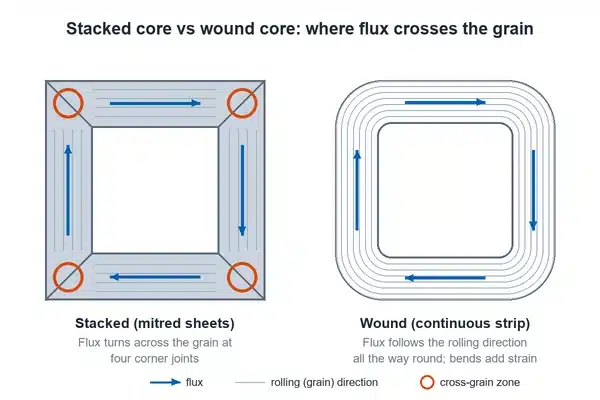
A stacked core cannot do that. Aleksandar Lojpur’s core lesson for Transformers Magazine’s online programme puts it plainly: “At the corner joints the flux is not along the grain orientation.” He adds two rules that buyers of stacked-core steel should know:
- “As electrical steel is better oriented, higher is building factor.” The better the grade, the more of its advantage is lost at the corners.
- “The higher the proportion of corner weight in the total core weight, the higher are the losses.” Small stacked cores suffer most.
The building factor is the ratio of the loss of the finished core to the loss of the same steel tested on Epstein strips. Lojpur lists step-lap with 5–7 steps as standard practice to keep it down.
Wound cores are not free of loss penalties either. They have two of their own:
- Bending strain. Every turn is bent, and strain raises loss until it is annealed out.
- The lap joint. Where a Unicore-type core is closed, JFE’s filing says the flux has to transfer between layers, and this “interlaminar magnetic flux transfer in the lap portion” is a source of large loss.
So neither type is lower-loss by definition. A well-annealed toroid of good strip is hard to beat at small sizes. A step-lap stacked core of Hi-B CRGO is the normal choice for large power transformers.
When Does a Stacked Core Make More Sense?
When the transformer is large, three-phase with a stepped round limb, or needs low inrush current. Comments in the US Department of Energy’s 2024 distribution transformer rule show where stacked cores still win.
Schneider, Eaton and NEMA told DOE that “the inherent air gaps, high saturation flux density, and lower remnant flux density of stacked core construction” help limit inrush current. That matters in data-centre transformers. HVOLT added that many transformers require stacked cores, and that “three-phase construction with wound cores generally increases the transformer size.” For low-voltage dry-type units, DOE concluded that its standards “are achievable using many designs with continued usage of stacked core GOES designs.”
For a buyer, the practical split between transformer core types is simple. Toroidal and C-cores are for small and special transformers. Wound cores are common in high-volume distribution transformers. Stacked cores are the default above that, and in units where joint flexibility or inrush matters. Our power transformer core steel guide covers grade choice for the large stacked-core end.
Toroidal Transformer Core vs C-Core: How Do They Differ?
A toroidal transformer core is a closed ring with no joint at all. A C-core is wound the same way but cut in two so a pre-wound coil can slide on.
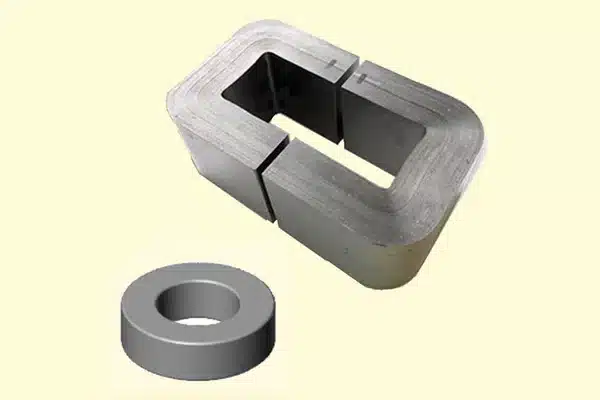
Toroids have no air gap and a low stray field, but the copper has to be threaded through the ring on a special winding machine. The steel is wound, annealed, insulated and then wound with copper. Once annealed, the core should not be unwound or bent again, as that puts strain back in.
C-cores trade a small air gap for easier assembly. The cut faces are ground flat so the two halves mate closely. A 1984 Allied Corp patent on cut cores notes that the gap “can be adjusted by inserting suitable spacers” between the halves, which is useful for chokes.
Frequency drives the gauge. Arnold Magnetics, a US maker of thin silicon steel strip, recommends 4-mil or 6-mil (0.10 or 0.15 mm) grain-oriented strip for 400 Hz in its 2024 tolerance sheet, citing its old C-core data. At 50/60 Hz, 0.23–0.30 mm strip is normal. Our ultra-thin CRGO page lists the thin gauges we supply for 400 Hz and above.
Scribed or Non-Scribed Steel for Wound Cores?
It depends on one question: will the finished core be annealed? If yes, avoid ordinary laser-scribed steel. If no, laser-scribed steel is an option.
Cleveland-Cliffs’ TRAN-COR H bulletin says annealing “at temperatures greater than 600 °C” erases the effect of laser scribing. JFE’s filing describes the industry response. Heat-resistant grades, with “grooves physically formed,” have been used in wound cores that get a strain relief anneal. Laser-, electron-beam- or plasma-scribed grades, which JFE calls “non-heat-resistant,” suit cores that are never annealed.
That is where the Unicore type comes in. Because it is bent only at the corners, it can skip the anneal. JFE built its 30 kVA test cores, about 40 kg each, on “a unicore production apparatus manufactured by AEM.” DOE says the same in a footnote to its 2024 rule: “there may be instances where dr grades can be used in certain wound core transformer designs without annealing, specifically if using a unicore production machinery.”
DOE also notes the cost side. What it calls “pdr” steel “typically requires greater investment,” carries a greater premium than ordinary domain-refined steel, and “would achieve greater loss reduction on account of annealing benefits.” One US maker, Central Moloney, told DOE it buys cores made of pdr steel for 90% of its designs.
| Core route | Annealed after forming? | Grade to order |
|---|---|---|
| Toroid, C-core, conventional wound core | Yes | Conventional or Hi-B without scribing, or heat-resistant (grooved) domain-refined |
| Unicore-type wound core | Usually not | Laser-scribed domain-refined is possible; heat-resistant also works |
| Stacked core of cut sheets | Usually not | Laser-scribed domain-refined gives the lowest loss |
Furnace recipes, coatings that survive the anneal, and certificate test bases are in our guide to stress relief annealing.
Scribing type also affects transformer noise, which our low-noise transformer core steel guide explains.
Why Does Wound Core Supply Matter in 2026?
Because grain-oriented steel stays the main distribution-transformer core material under the next US efficiency rule, and capacity for it is still being added.
- The US rule. DOE’s distribution transformer standards were published in April 2024, with compliance from April 2029. DOE estimates that “the vast majority of liquid-immersed distribution transformers shipments (89 percent of units) could be met with GOES cores.” The draft would have pushed most of them to amorphous cores.
- Core imports. A US Commerce Department review, summarised in the DOE rule, found imports of finished wound and stacked cores rose from $22 million in 2015 to $167 million in 2019, and lamination imports from $15 million to $33 million.
- New capacity. Hammond told DOE that all of its expanded transformer capacity “is for GOES core construction, not amorphous.” In August 2025 Klöckner & Co said it was expanding CRGO processing, slitting and transformer core production in the US. In October 2026 Cleveland-Cliffs announced a $200 million project at Butler Works to raise grain-oriented output by up to 25%, with completion expected in early 2028.
For core makers this means steady demand for slit strip in specific widths, alongside the wider grain-oriented steel shortage.
Our distribution transformer page lists the grades we supply for that market.
What Should the Steel Order Say for Wound Cores?
More than width and grade. A wound core runs from one coil of strip, so coil size and joints matter as much as the magnetic grade.
Arnold Magnetics’ tolerance sheet (rev. April 2024) for its thin coated strip is a useful model of what a strip supplier should state. It lists two coil centre sizes, 6 in and 16 in, with maximum outer diameters of 20 in and 32 in. It caps the number of breaks per coil, sets a minimum length between breaks, and requires a C-5 coating with “a minimum insulation resistance of 10Ω/cm² per lamination” by ASTM A717. Those figures are for 1–7 mil strip; the items to specify are the same at 0.23–0.30 mm.
| Order item | What to write | Why it matters for wound cores |
|---|---|---|
| Grade and domain refinement | Conventional, Hi-B, laser-scribed or heat-resistant | Must match whether the core is annealed |
| Thickness | 0.23, 0.27, 0.30 mm, or thinner for 400 Hz | Sets loss at your frequency |
| Slit width and tolerance | Nominal width and ± tolerance | Sets the core build and stacking factor |
| Camber and burr | Maximum camber over a length; maximum burr height | Camber makes the core build drift; burr can short turns |
| Coil inner diameter | Match your winding or decoiler mandrel | Wrong ID means re-spooling, which adds strain |
| Maximum outer diameter or coil weight | Per your decoiler | A heavier coil means fewer changeovers |
| Breaks or welds per coil | Maximum number, minimum length between them | A break inside a toroid is a defect, not a joint |
| Coating | Class and insulation value, and whether it must survive the anneal | Turn-to-turn insulation in an annealed core |
| Test basis | As-sheared or annealed samples | Wound cores are judged after the anneal |
Width tolerance, camber and burr are explained in our article on slitting tolerances and camber.
We supply grain-oriented CRGO steel coil in conventional, Hi-B and laser-scribed grades, slit to width for core makers. One US transformer core maker buys slit Hi-B strip from us monthly, at 12.70 mm and 139.70 mm cut from a 1,010 mm master coil; the monthly slit-strip order shows the paperwork. Coil orders typically start at about 5 tonnes, and smaller lots can be cut from coil. Sheet orders typically start at about 500 kg; if you need less, tell us and we’ll do our best to meet the request. Samples typically cost USD 200 including freight, refunded when you place a production order.
FAQ
What are the main transformer core types?
There are two families. Stacked cores are built from flat sheets cut to length and joined at the corners, and are standard in power transformers. Wound cores are made from one continuous strip: the toroidal transformer core, the C-core, which is cut in two, and the wound distribution core. Shell-type and core-type are a separate split, by winding layout.
Is a wound core better than a stacked core?
Neither is better in every case. Wound cores keep the flux along the grain and suit high-volume and small transformers. Stacked cores suit large three-phase units, need no anneal, and their joint air gaps help limit inrush current. Each has its own loss penalty: bends and lap joints for wound cores, cross-grain corners for stacked ones.
What steel is used for a toroidal transformer core?
Mostly grain-oriented silicon steel strip about 0.23–0.30 mm thick for 50/60 Hz, slit to the core height. A typical core has several hundred turns. Thinner grain-oriented strip, around 0.10–0.15 mm, is used at 400 Hz. Because toroids are annealed after winding, use non-scribed or heat-resistant grades rather than ordinary laser-scribed steel.
Do wound cores need annealing?
Most do. Winding bends every turn, and the strain raises core loss until a stress relief anneal removes it. Toroids, C-cores and conventional wound cores are annealed after forming. Unicore-type distribution cores, bent only at the corners, are often used without annealing, which is why laser-scribed grades can be used in them.
Can laser-scribed grain-oriented steel be used in a wound core?
Only if the core is not annealed. Annealing above about 600 °C erases the laser domain refinement and raises loss. DOE notes laser-scribed grades can work in some wound cores made on Unicore machines without annealing. For annealed wound cores, order conventional or Hi-B steel without scribing, or a heat-resistant grooved grade.
Making toroidal, C-core or wound distribution cores? Contact us with the grade, gauge, slit width, coil ID and whether the core will be annealed, and we’ll quote strip to suit your winding line.
References
- T. Omura, H. Inoue, K. Senda (JFE Steel), EP 4199015 A1 — Wound core
- Kitamura Kiden, US Patent 6,407,655 B1, 2002 — Wound core for toroidal transformer
- Allied Corp, US Patent 4,476,753, 1984 — Cut core apparatus
- IEC 60329:1984 — Strip-wound cut cores of grain-oriented silicon-iron alloy, used for electronic and telecommunication equipment
- A. Lojpur, Transformers Magazine Digital Online Programme — Lesson 5: Core
- US Department of Energy, 22 April 2024 — Energy conservation program: energy conservation standards for distribution transformers, final rule, 89 FR 29834
- Cleveland-Cliffs, October 2024 — TRAN-COR H grain-oriented electrical steels: product data bulletin
- Arnold Magnetics, SP-RP-0001 rev. 30 April 2024 — Tolerances for coated slit and as-rolled edge silicon steel
- EUROMETAL / Kallanish, 8 August 2025 — Klöckner expands electrical steel capacity in US
- GMK Center, 7 October 2026 — Cleveland-Cliffs is investing $200 million in the expansion of the Butler Works plant in the US
Image credits
- Wound and cut transformer cores: Engindenizoglu, Wikimedia Commons, CC BY-SA 4.0
- C-core and ring core: Elcap, Wikimedia Commons, CC0


