
The density of aluminum is 2.70 g/cm³, which is 2,700 kg/m³, 0.0975 lb/in³, or about 168.5 lb/ft³. That’s for pure aluminum at room temperature. Common alloys stay close to it: most fall between 2.64 and 2.81 g/cm³, depending on how much magnesium, copper, or zinc they carry.
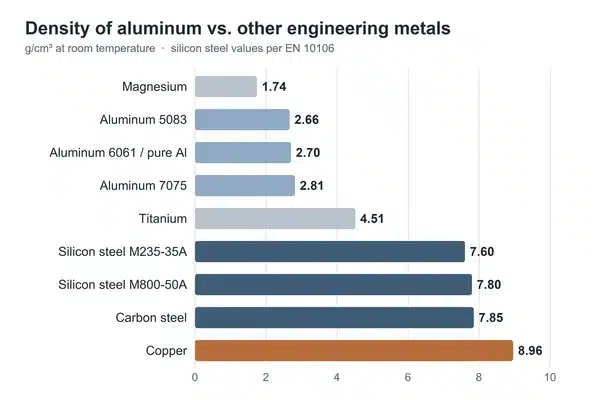
The comparison most people care about: aluminum weighs roughly one-third as much as steel for the same volume. A plate of carbon steel is 7.85 g/cm³; the same plate in aluminum is 2.70. Copper is heavier still at 8.96.
We’re Wuxi Zhongxin Special Steel (ZHX Steel), and our day job is silicon electrical steel. Density comes up in our work more often than you might expect. It sets theoretical coil weights, it’s built into how core loss is measured, and aluminum itself is an alloying element in many of the steel grades we ship. So this guide covers the aluminum numbers first, then the places where aluminum and electrical steel meet.
Key Takeaways
- Pure aluminum: 2.70 g/cm³ = 2,700 kg/m³ = 0.0975 lb/in³ = 168.5 lb/ft³ at about 20°C.
- Alloys range from about 2.64 (5356 filler wire) to 2.81 g/cm³ (7075). Magnesium makes aluminum lighter; copper and zinc make it heavier.
- 6061, the most common structural alloy, is 2.70 g/cm³. It’s safe to use the pure-aluminum figure for 6061 and 6063 weight estimates.
- Weight = volume × density. A 1,000 × 2,000 × 3 mm aluminum sheet weighs about 16.2 kg; the same sheet in carbon steel weighs about 47.1 kg.
- For equal electrical resistance, an aluminum conductor weighs roughly half as much as a copper one, even though it needs about 64% more cross-section.
- Silicon electrical steel is lighter than plain steel, at 7.60 to 7.85 kg/dm³ depending on grade. That’s partly because aluminum is added to it.
2.70 g/cm³ in Every Common Unit
Handbooks list pure aluminum at 2.6989 g/cm³ at 20°C. Everyone rounds it to 2.70. Honestly, nobody weighing a sheet will ever notice the missing 0.0011.
| Unit | Value |
|---|---|
| g/cm³ (= g/mL = t/m³) | 2.70 |
| kg/m³ | 2,700 |
| kg/dm³ | 2.70 |
| g/mm³ | 0.00270 |
| lb/in³ | 0.0975 |
| lb/ft³ | 168.5 |
A quick sanity check if you forget the number: a one-liter block of aluminum (10 × 10 × 10 cm) weighs 2.7 kg. The same block of steel weighs just under 8 kg.
Density of Aluminum Alloys: Chart
Alloy densities barely move from the pure-metal figure. The values below are the nominal densities used in design and weight calculations:
| Alloy | Main alloying element | Density (g/cm³) | Density (lb/in³) | Typical use |
|---|---|---|---|---|
| 1100 | None (99%+ Al) | 2.71 | 0.098 | Foil, heat exchangers, chemical equipment |
| 2024 | Copper | 2.78 | 0.100 | Aircraft skins and structures |
| 3003 | Manganese | 2.73 | 0.099 | Cookware, roofing, tanks |
| 5052 | Magnesium | 2.68 | 0.097 | Marine parts, enclosures, fuel tanks |
| 5083 | Magnesium | 2.66 | 0.096 | Shipbuilding, pressure vessels |
| 6061 | Magnesium + silicon | 2.70 | 0.098 | Structural parts, machined components |
| 6063 | Magnesium + silicon | 2.70 | 0.097 | Architectural extrusions, window frames |
| 7075 | Zinc | 2.81 | 0.101 | High-strength aerospace and tooling |
| 356.0 (cast) | Silicon + magnesium | 2.69 | 0.097 | Die and sand castings, wheels, housings |
The spread from lightest to heaviest in that table is about 6%. For a rough weight estimate on an unknown wrought alloy, 2.70 gets you within a few percent. For a quote or a shipping declaration, use the alloy’s own figure.
Why Alloys Differ (and Why It’s a Small Difference)
An alloy’s density follows its ingredients. Each element either pulls the average down or pushes it up:
- Magnesium (1.74 g/cm³) is lighter than aluminum. The 5xxx series, with up to about 5% Mg, sits below 2.70, which is why 5083 and 5356 are among the lightest common alloys.
- Silicon (2.33 g/cm³) is also light. Casting alloys rich in silicon stay near or slightly below 2.70.
- Copper (8.96 g/cm³) and zinc (7.14 g/cm³) are heavy. The 2xxx and 7xxx series climb to 2.78 to 2.81.
- Lithium (0.53 g/cm³) is the extreme case. Aluminum-lithium aerospace alloys lose roughly 3% of their density for every 1% lithium added, and gain stiffness at the same time. That’s why aircraft makers pay a premium for them.
Alloying additions are small, usually a few percent in total, so even heavy elements only nudge the density. You won’t find a wrought aluminum alloy anywhere near 3 g/cm³.
How to Calculate Aluminum Weight
The formula is the same for any metal:
Weight = Volume × Density
The only trap is units. Keep everything in one system.
Metric example: sheet
A 1,000 mm × 2,000 mm × 3 mm sheet of 5052:
Volume = 1.0 m × 2.0 m × 0.003 m = 0.006 m³
Weight = 0.006 × 2,680 = 16.1 kg
Imperial example: plate
A 4 ft × 8 ft × 1/8 in sheet of 6061:
Volume = 48 in × 96 in × 0.125 in = 576 in³
Weight = 576 × 0.0975 = 56.2 lb
Round bar
A 6061 bar, 50 mm diameter, 1 m long:
Volume = π × 0.025² × 1.0 = 0.001963 m³
Weight = 0.001963 × 2,700 = 5.3 kg
Tube
Use the outer circle’s area minus the inner circle’s area, then multiply by length and density. The same logic works for any extrusion if you know its cross-sectional area. Extrusion catalogs usually list the weight per meter directly.
These are theoretical weights. Real stock varies with thickness tolerance, and a sheet at the heavy end of its tolerance band can weigh a few percent more. That’s why a packing list uses scale weight and a quote uses theoretical weight.
We deal with the same gap on steel coils every week. A quote says one number, the scale says a slightly different one, and the thickness tolerance explains the difference. If you’ve ever been surprised by a scale ticket, that’s usually why.
How It Stacks Up Against Steel and Copper
| Material | Density (g/cm³) | Relative to aluminum |
|---|---|---|
| Aluminum (pure / 6061) | 2.70 | 1.0× |
| Titanium | 4.51 | 1.7× |
| Zinc | 7.14 | 2.6× |
| Silicon electrical steel | 7.60–7.85 | 2.8–2.9× |
| Carbon steel | 7.85 | 2.9× |
| 304 stainless steel | 7.93 | 2.9× |
| Copper | 8.96 | 3.3× |
So aluminum is a third the weight of steel, case closed? Not quite.
Swapping steel for aluminum is a stiffness question, not just a weight question. Aluminum is about one-third the density of steel, but it’s also about one-third as stiff (elastic modulus around 69 GPa against steel’s 200 GPa). An aluminum part designed to flex no more than the steel one it replaces needs more material, so the real-world weight saving is usually closer to 40-50% than 66%. It’s still a big saving, which is why car bodies, trailers, and aircraft use so much aluminum.
Aluminum vs copper is where density really pays off. Aluminum conducts about 61% as well as copper by volume, so for the same resistance an aluminum conductor needs roughly 1.64 times the cross-section. But at less than a third of copper’s density, that larger conductor still weighs only about half as much. This is the math behind aluminum overhead power lines, aluminum busbars, and aluminum windings in many distribution transformers.
Where Aluminum Density Meets Electrical Steel
This part matters most for our customers, and it’s rarely covered in general density guides.
1. Silicon steel is lighter than ordinary steel, and aluminum is part of the reason.
Plain iron is about 7.87 g/cm³. Electrical steel adds silicon, and higher grades also add some aluminum. Both elements are much lighter than iron and both raise electrical resistivity, which cuts eddy current losses. The result is a family of steels whose density drops as the grade improves. The EN 10106 conventional densities in a mill data sheet show the pattern clearly:
| Grade (EN 10106) | Thickness | Max core loss P1.5/50 (W/kg) | Density (kg/dm³) |
|---|---|---|---|
| M235-35A | 0.35 mm | 2.35 | 7.60 |
| M270-35A | 0.35 mm | 2.70 | 7.65 |
| M400-50A | 0.50 mm | 4.00 | 7.70 |
| M600-50A | 0.50 mm | 6.00 | 7.75 |
| M800-50A | 0.50 mm | 8.00 | 7.80 |
| M940-50A | 0.50 mm | 9.40 | 7.85 |
The low-loss grades at the top carry the most silicon and aluminum, so they’re the lightest. Grain-oriented steel uses a conventional density of 7.65 kg/dm³.
2. Density is built into how core loss is measured.
In an Epstein frame test, the lab never measures the strip’s cross-section directly. It calculates the cross-section from the sample’s mass, length, and the grade’s conventional density. Using the wrong density shifts the calculated flux density and the reported W/kg. So when two certificates for “the same grade” disagree slightly, it’s worth checking that both used the same density value.
3. Coil weights follow the same formula.
A slit coil of M270-35A, 1,000 mm wide, 0.35 mm thick and 1,000 m long works out to 1.0 × 0.00035 × 1,000 × 7,650 ≈ 2.68 tonnes. The same volume of aluminum strip would weigh about 0.95 tonnes. If you’re planning container loads or crane capacity for a line that handles both materials, don’t reuse one density figure for the other.
A smaller version of the same mistake: using the generic steel figure of 7.85 for a low-loss grade like M235-35A. That overstates the theoretical weight by about 3%. On a 25-tonne container, that’s roughly 800 kg the scale will never show. We’d rather you ask us for the grade’s density than chase that difference after the goods arrive.
4. Aluminum and steel share the machine.
In an induction motor, die-cast aluminum rotor bars sit in slots punched through silicon steel laminations. In a distribution transformer, aluminum windings wrap around a CRGO core. The aluminum saves weight and cost in the conductor, and the steel does the magnetic work.
Temperature, Melting, and Castings
Heat. Aluminum expands about 23 µm per meter for every °C, roughly twice as much as steel. Its volume grows about three times that rate, so between 20°C and 100°C the density falls by only about half a percent. You can ignore it for weight estimates, but not for tight-tolerance assemblies that mix aluminum and steel parts. A common example is an aluminum motor housing shrink-fitted over a non-oriented silicon steel stator stack, where the fit has to hold across the motor’s whole temperature range.
Melting. Aluminum melts at 660°C. At that point, liquid aluminum is about 2.375 g/cm³, roughly 12% less dense than the solid. That shrinkage on solidification is why castings need feeders and risers, and why casting design has to account for it.
Porosity. A die-cast part can have a real density below its alloy’s nominal figure because of trapped gas porosity. Weighing a casting and comparing it with its CAD volume is a quick check on casting quality. The same check flags a part that’s secretly a heavier material, such as a painted steel part sold as aluminum. A magnet test catches that one even faster.
Bottom Line
If you only remember one number, make it 2.70 g/cm³. It’s right for pure aluminum and for 6061, and within a few percent for nearly every other alloy. For quotes, contracts, and shipping paperwork, look up the actual alloy. 5083 and 7075 differ by more than 5%, and on a truckload that adds up.
The less obvious lesson is on the steel side. Electrical steel isn’t one density either, and part of the reason is the aluminum inside it. If you need density, grade, or coil weight figures for CRGO or CRNGO coils, those come with every quotation we send.
FAQ
What is the density of aluminum in kg/m³?
2,700 kg/m³ for pure aluminum at room temperature (2.70 g/cm³). Common wrought alloys range from about 2,640 to 2,810 kg/m³, and 6061, the most widely used alloy, is 2,700 kg/m³.
How much does aluminum weigh per cubic inch?
0.0975 lb/in³, often rounded to 0.098. In pounds per cubic foot, that’s about 168.5 lb/ft³.
Is 6061 aluminum the same density as pure aluminum?
Practically, yes: 6061 is 2.70 g/cm³ (0.098 lb/in³). Its small magnesium and silicon additions are both lighter than aluminum and only present at about 1% or less, so they barely change the density.
Is aluminum heavier than steel?
No. Aluminum is about one-third the density of steel: 2.70 g/cm³ against roughly 7.85 g/cm³ for carbon steel. But aluminum is also about one-third as stiff, so a part redesigned from steel to aluminum usually needs more material, and the weight saving in practice is often around 40-50% rather than 66%.
Which aluminum alloy is the lightest?
Among common alloys, the high-magnesium 5xxx series is lightest, around 2.64 to 2.66 g/cm³ for 5083 and 5356. Aluminum-lithium alloys used in aerospace go lower still, because each 1% of lithium cuts density by about 3%.
How do I calculate the weight of an aluminum sheet?
Multiply length × width × thickness to get volume, then multiply by density. In metric, a 1 m × 2 m × 3 mm sheet is 0.006 m³ × 2,700 kg/m³ = 16.2 kg. In imperial, a 4 × 8 ft sheet at 1/8 in is 576 in³ × 0.0975 lb/in³ = 56.2 lb.
Why is silicon electrical steel less dense than regular steel?
Because silicon and, in higher grades, aluminum are added to the iron, and both are much lighter than iron. Under EN 10106, non-oriented grades range from 7.60 kg/dm³ for low-loss grades such as M235-35A up to 7.85 for M940-50A. Grain-oriented steel uses 7.65 kg/dm³. Carbon steel is about 7.85. Our non-oriented electrical steel grades guide explains how to read those grade codes.
References
- Wikipedia — Aluminium
- AmesWeb — Aluminum Density (Alloys)
- Wikipedia — 6061 aluminium alloy and 7075 aluminium alloy
- Waelzholz — EN 10106 Electrical Steel Strip Standard Grades (data sheet)
- IEC — IEC 60404-13: Methods of measurement of resistivity, density and stacking factor of electrical steel strip and sheet
- Metallurgical and Materials Transactions A — Thermophysical Properties of Liquid Aluminum
- Total Materia — Aluminum-Lithium Alloys


